








African natives who call Illinois home talk about Black American and Black Immigrant relationship
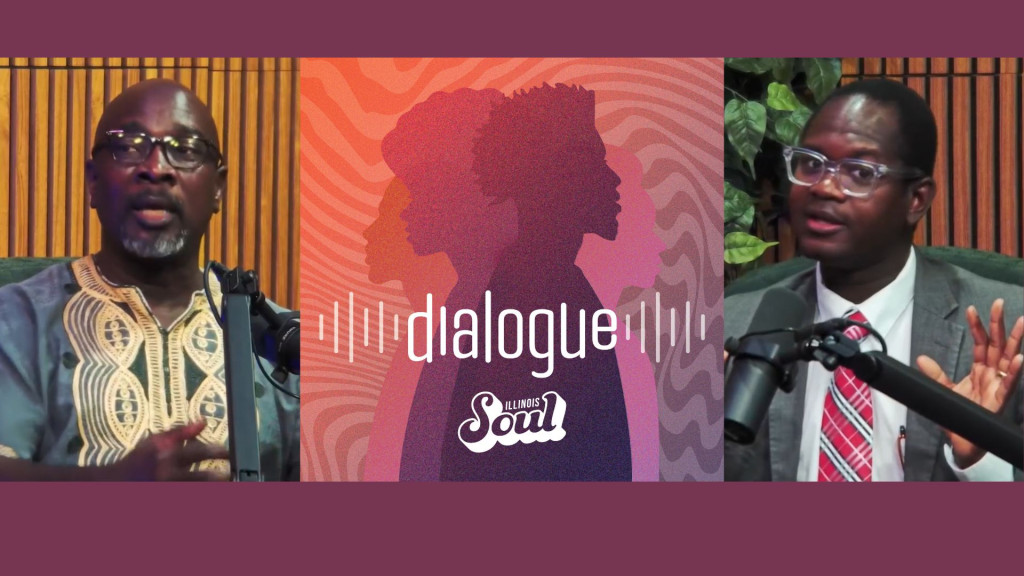
Left: Joe Omo-Osagie and right: Champaign-Urbana Public Health District (CUPHD) is Dr. Mamadou D. Tounkara Illinois Public Media
// This is a machine generated transcript. Please report any transcription errors to will-help@illinois.edu.

[00:00:00]
Reginald Hardwick: From Illinois Soul, this is Dialogue. I'm Reginald Hardwick, news and public affairs director at Illinois Public Media. Dialogue is an exchange about culture straight from the soul.

According to the latest data from ICE, officers made nearly 50,000 arrests in July. Among those targeted are Haitian and other immigrants from the African diaspora. Nearly 9,400 Haitian immigrants call Illinois home, and here in Champaign-Urbana, nearly 6,000 Congolese immigrants live here.
,
The state of Black immigrants and their relationship with Black American communities here in Illinois is what we're talking about today on Dialogue with Dr. Mamadou D. Tounkara, public health administrator and executive director of the Champaign-Urbana Public Health District. Welcome. Thank you. And Joe Omo-Osagie, a longtime counselor in Champaign and longtime resident as well. Thank you.

[00:01:01]
Dr. Mamadou D. Tounkara: Thank you.

[00:01:03]
Reginald Hardwick: Dr. Tounkara, I'll start with you. What was your journey to central Illinois?

[00:01:08]
Dr. Mamadou D. Tounkara: Yeah, great questions. I'll try to give a short one, but, uh, graduated — I graduated from med school in Mali, West Africa, and wanted to do public health since med school, so got the opportunity to come to Salt Lake City, Utah, and attend Brigham Young University to do a master of public health on scholarship. So after that, I got married, and then started working for the state health department.

[00:01:54]
Reginald Hardwick: In Illinois?

[00:01:56]
Dr. Mamadou D. Tounkara: Uh, no, in Salt Lake City,

[00:01:58]
Reginald Hardwick: Utah. Utah.

[00:01:58]
Dr. Mamadou D. Tounkara: Yes. So I was hired there as a lead epidemiologist and then a population health director, promoted later on. So I was in that role for two to three years, and then moved here as a deputy director or deputy administrator. So yeah, we built our home in that place, and this opportunity came up. I'd never heard of Champaign before. I came in and visited, really liked the university town. That was one of the things that I really, really enjoyed. So I was given a tour not only of the town — I remember the administrator at that time, Julie Pryde, took me to all the places that African American people live, and you can see the discrepancy as you move toward nicer areas. And for me it was like, OK, I can come here and make a difference, or I can stay where I am and things will be fine. So, you know, sometimes it's just a nudge that you're like, OK, this is probably where I need to be and contribute. So that's why I'm here, and I'm still figuring that out. So it has been about a year and probably three months since I got here. I started as a deputy administrator last June, and then in February this year, earlier, I was promoted to be the administrator.

[00:03:39]
Reginald Hardwick: Joe, what about your journey? How did you come here?

[00:03:42]
Joe Omo-Osagie: My journey — I would say I always, I mean, I come from a family of academics. My father was an academic. He got his undergrad in Nigeria at [Amadu Bayor] University in Zaria, Nigeria, then he got his master's at the University of Massachusetts Springfield. And I think I was [young] when he got his master's in Springfield, Massachusetts. Then he did not work on his Ph.D. till the early '70s, and his Ph.D. was here at the University of Illinois. And that's how my journey started.

Because I mean, I always knew I wanted to go to college. My goal initially when I came to the United States was to study international relations, and I did get my bachelor's in international relations because I wanted to work for the United Nations. I remember growing up in the '70s, the Vietnam War, and the same thing going on in Israel and Gaza and Palestine was happening, and I was just interested in that whole idea of let's solve these problems. I think it's humanly possible for us to solve these problems.

So I got my bachelor's in international relations from here at the University of Illinois, and as I was telling Reginald earlier, I lived down the street from here where the WILL station is — and now it's part of the engineering campus. And I stayed in international relations, but in my junior year into senior year, I couldn't afford to pay for my senior year, so I ended up working. And when I worked, I ended up working at what is called the women's emergency shelter, which was downtown Champaign at that time. It's now part of Courage Connection. And that's when I first realized that I can talk to people and people can talk to me, and that was the realization that I had an affinity to dialogue with people on a very visceral, deep level. And that's when I started thinking differently about the difference between international relations and just human relations, because international relations — I may never find out if things work. But in human relationships, I run into my students who were in 1st grade when I was working at King's School, who meet me 20, 30 years later, who remember things that I said and talked about. And that was when I really started thinking about going into social work or counseling or things like that.

But I started out in international relations. I came to the United States on the day that John Lennon was killed at the Dakota in New York. And so I always had this thing about what do I want to do. And I come from a family of — let's say, let's get something done. The name Omo-Osaji means [child god sent]. My grandfather was part of an independence movement in Nigeria. And for the ethnic group that I'm from — it's a relatively smaller ethnic group — everybody in Nigeria says, oh, are you Edo, are you Yoruba, Hausa or Igbo? And I say no, I am Edo, and the Edos are relatively small.

[00:07:15]
Reginald Hardwick: What do you see as the relationship between Black Americans and Black immigrants in your experience? And I know you can't talk about everyone.

[00:07:21]
Joe Omo-Osagie: No, I can't speak about everyone. But I think one of the big things is that it's almost — there is this uncertainty that seems to occur between Black Americans and new immigrants who are from Africa or from the diaspora, because there's a sense that the new Black people in America are sometimes accepted by the white folks in this community a whole lot easier. And so there's that uncertainty, or a lack of trust — like, are you going to deceive me the same way that I see myself? So it's almost like I have to build a sense of trust with the Black community here. And over the last 40 years or so, I think I have come to that place where I've been able to build some trust and some capacity to say I can walk into a church or a school and feel very comfortable with the young men and their families.

And even in that experience over time, I mean, there were times where I was in meetings with families and the family said, "Hey, you ain't even Black." And it's because they said you ain't Black, but I'm saying I'm the Blackest man in this room. I mean, as you can see, I am very dark complexion, because that's a complexion of being an African. But I understood what the parents were saying — that I wasn't Black because I did not have the Black American experience. But I said, no, I don't have to have had the experience, but I know that I want to be here to support your child through this experience so that he or she can succeed in whatever they choose to do.

So it's about really trying to create a capacity to understand that I am not here in an adversarial relationship. It's a relationship that we want to support one another. We want to make sure that we get what we deserve from this society, and that's the goal. And it's an ongoing relationship, and it's something that you have to keep working on in every organization or every place that you're in.

[00:09:32]
Reginald Hardwick: Is it powerful — and I know you left Nigeria at a young age, but is it powerful — and maybe this question is for you, Dr. Tonkara — that here in the United States, Black families who have lived here for generations are obviously still dealing with the aftermath of slavery and Jim Crow and continued attacks, and redlining and everything else. As opposed to growing up surrounded by Black leaders and other kinds of — and whereas you were saying you're focused on ethnicity, and race is — you know, everyone's Black, so everyone is business owners and everything. I guess my question is, is that part of the conflict — that you think people are not understanding each other and understanding that?

[00:10:34]
Dr. Mamadou D. Tounkara: I think that's true, that — at least from my perspective — when I came here, the way people were looking at me and the way they were treating me did not lower my self-belief, specifically because I've seen people — or I was surrounded by people who love me, who are my same ethnicity, and I've seen people who were great athletes with my ethnicity. I've seen people who were great leaders. So whatever trends or talk that we're seeing about inferiority or that kind of thinking — I did not accept that. I personally just did not accept it. And I probably will say also that maybe because I came here as a young adult, I was very self-aware, and I think that helps too.

But I also think that there is an inherent — because I've, you know, even from some of my friends here who were born here and raised here —

[00:12:21]
Reginald Hardwick: What were you taught about African Americans, or what did you know about Black Americans?

[00:12:27]
Dr. Mamadou D. Tounkara: That is a question no one ever asked me. Because, you know, I remember my first awareness — I was like probably 10 or 11 — the movie Roots. I remember watching that, and that was like the first — I was like 10 or 11, and I was thinking about that for like a month. You know, I mean, the atrocity in that movie. And I did not accept it. Even now I did not accept it. Because — I don't know if it's the right thing to say, but I try to really summarize things to best fit myself in a way so that I'm not hurt. So when I was looking at that movie, the way it was framed, I just — from the beginning, I just did not like it at all. Like, young — I was like 10 or 11 — I remember I was like, this is not right. And after that I think I watched it only one time, and I'm like, I'm not gonna watch it because it hurt me. But that was my introduction to the notion of the way African Americans are treated.

[00:13:56]
Joe Omo-Osagie: I mean, I grew up in Nigeria, and going back — I read the book Alex Haley's Roots. I did not see Roots till I got to the United States, but I read the book and I saw the history, and I knew the history, and I knew the history of the Edos and the Yoruba and the [Ijekiris] working out ways of dealing with slavery. They say, oh, Africans sold other Africans — it's — I mean, Nigeria speaks over 500 languages. There are almost 500 different ethnic groups. So yes, you're from Mali, which is just right above Nigeria, and we don't speak the same language. So although we don't narrow everything into a complexion — culture is more than complexion.

And I think unfortunately, the United States would like to bring everything into what our complexions are. We are three Black men here. We've had three different experiences of life. And until the nation starts to look at us as being not just colors, but as people — individual people with life experiences and historical experiences that are very different.

I mean, growing up in Nigeria, watching the Cisco Kid — which is, I don't know, I'm probably the oldest person here — the Cisco Kid was a show in the '50s in America. The Cisco Kid was cowboys and Indians, and the Indians — the Native Americans — were the bad folks, and the cowboys always came up with their white hats and won. And we played that game.

And when I came to the United States, Chief Eli Iwek was dancing at football and basketball games, and I thought that was an oddity. But I did not really start reading about the history of Native Americans and of how African Americans and all the other cultures came to be American.

Being a Black man in America is a journey for us because I come to America as an adult man. I am not Black yet. I would say I became Black when I started having children in America who will be seen as Black Americans, African Americans. But till then, I was just an immigrant. And that's a part of a journey that we have.

And I think — I know we — it's there's got to be a part two to this, because you've not asked us more than two questions already. But it's a longer story than we can distill in 30 minutes, because part of this journey of African American and African is a journey that we are still working through, because there's still sometimes some animosity and some discomfort and some lack of understanding that it takes a while.

When I've worked with predominantly African American young men — that's been my experience of working in this country — because they say, "Oh, you're a Black guy, you can work with an African American kid." I have to find a way to break down some of those walls by playing basketball, by showing I can dance, or by showing I can sing — showing I can do those things that value has been ascribed to within the culture. And I say, oh yes, I can do those things also. And that's part of my humanity, and that's part of your humanity, and let's figure out a way to say, hey, maybe it's a good thing to go to class and do some work.

[00:17:48]
Reginald Hardwick: For both of you, what is one thing that you wish Black Americans would know about Black immigrants, or vice versa — Black immigrants would know about Black Americans? I'll start with you because you've been in this community the longest.

[00:18:05]
Joe Omo-Osagie: One of the things is that we really, really do want the same things. I mean, I have two adult sons — a 19-year-old and he just turned 23 — two adult sons. And I think they are wanting the same things that I wanted when I was their age. And that's what I think America gives you. This is still a land of opportunity, but the opportunity is a little bit harder. But there is still an opportunity.

I mean, both my kids have the intellect and the ability to be good students, so both of them are here at the University of Illinois. And my oldest decided — in urban planning, I can get an urban planning degree, but also I can get a construction management degree. So he's doing both. He's going to be a construction manager with an urban planning degree.

And what Black America and we as new Americans can do is really sit down and dialogue. So I'm friends with — these are some of my contemporaries in town here — Sam Smith and Tracy Parsons and Maurice Mosley. These are all contemporaries of mine who are American, who grew up here. And we have dialogue. We get a chance to talk about different things over the years that I've known them. And that's that constant — talk to us. Let's have some dialogue.

[00:19:40]
Dr. Mamadou D. Tounkara: Yeah, so — I mean, he has more experience than me. But for me, you know, I always give grace because I don't know people's experience here of the situation. So I always try to walk in people's shoes before — you were talking about Tracy. I'm like, the first time we met, there was a connection. I don't know what that is, but there's always that support. I need to support him to be successful. So that has been my experience. I don't know what they see in me. Maybe for older people it's different, but me — I always see that support. You know, they sometimes don't even have to say it. I can feel it, or I can see it in their eyes — you are here. They didn't say that, but I can tell: you're here. Our experience is not the same, but I know you also had some experience, and we want to make sure that you're successful. That has been the message that I get.

But again, I always give the grace because I can feel the struggle. I can feel the pain. I can feel sometimes the trauma, just the way people are communicating, or if you're in a meeting, the way they respond or the way they don't respond — because there's always this background thing going on that they want to measure up. They want to — that has been my experience.

And, like you said, I think that we all want the same thing. I mean, no matter the age, we all want our family to be successful. We all want to have a beautiful family. We all want our kids to be college graduates or play in school plays and go and cheer for them. So I think, you know, looking through that lens and trying to be supportive of each other — I think in my mind, at least, when I go into meetings, that's how I see it. That's the joy and energy that I bring with me. I don't know if that makes any difference in how people treat me, but it helps. It helped me build the confidence to speak.

But going back — always to know that my experience is different than theirs, and I can't and will not try to determine or suggest what they went through. I just want to make sure to learn from them their experience and how to treat people better, and how to make sure the organization that I work in is successful and helps others be successful.

[00:23:01]
Reginald Hardwick: We've been speaking with Dr. Mamadou Di Tonkara, public health administrator and executive director of the Champaign-Urbana Public Health District, and Joe Omo-Osagie, longtime counselor in Champaign. Thank you both for joining us for this Dialogue. Thank you. Thank you.

That's all for this edition of Dialogue. If you have any thoughts on our show today, please share them on the Illinois Soul Facebook or Instagram pages. Our producer, editor and intern is Curtis Beasley the 4th. Jill Clements is Illinois Soul's station manager. Dialogue and Illinois Soul are part of Illinois Public Media, a service of the University of Illinois Urbana-Champaign. I'm Reginald Hardwick. Thank you for joining us. We'll talk with you again next week.

---

**Flags for Human Review:**

- **[00:03:42] "Amadu Bayor University"** — Joe Omo-Osaji references his father's undergraduate institution in Zaria, Nigeria. This may refer to Ahmadu Bello University; please verify the correct spelling.
- **[00:03:42] Speaker label** — The original transcript labels this speaker as spk_2, which does not match the prior two-speaker pattern (spk_0 = Reginald Hardwick, spk_1 = Dr. Tonkara). Based on context, this has been attributed to Joe Omo-Osaji. Please verify.
- **[00:03:42] "I think I was [young] when he got his master's"** — Original transcript reads "I think I wasw when he when he got his master's," which appears to be a transcription artifact. Inference made that speaker meant to indicate he was young at the time; please verify.
- **[00:07:15] "child god sent"** — The meaning of the name Omo-Osaji as stated by the speaker. Please verify spelling and translation.
- **[00:13:56] "[Ijekiris]"** — Original transcript reads "thehekiris," which appears to be a transcription artifact. This has been inferred as a reference to the Ijekiri (also spelled Itsekiri) ethnic group of Nigeria; please verify.
- **[00:13:56] "Chief Eli Iwek"** — Reference to a figure associated with University of Illinois athletics. This may refer to Chief Illiniwek; please verify the name as transcribed.
- **[00:23:01] Speaker name spellings** — The closing segment spells the guests' names as "Mamadu Di Tunara" and "Joe Omo Osagi" in the original transcript, differing from the introduction ("Mamadou Di Tonkara" and "Joe Omo Osaji"). The spellings from the introduction have been used throughout. Please verify correct spellings for both guests.
Two African natives discuss their journey to Champaign-Urbana and the conversation between Black Americans and Black Immigrants. Nigerian native Joe Omo-Osagie is a longtime counselor in central Illinois. Champaign-Urbana Public Health District (CUPHD) is Dr. Mamadou D. Tounkara is a native of Mali.