Transcript: Democratic congressional candidate Julie Fortier on economy, gun laws, and Southern Illinois voters
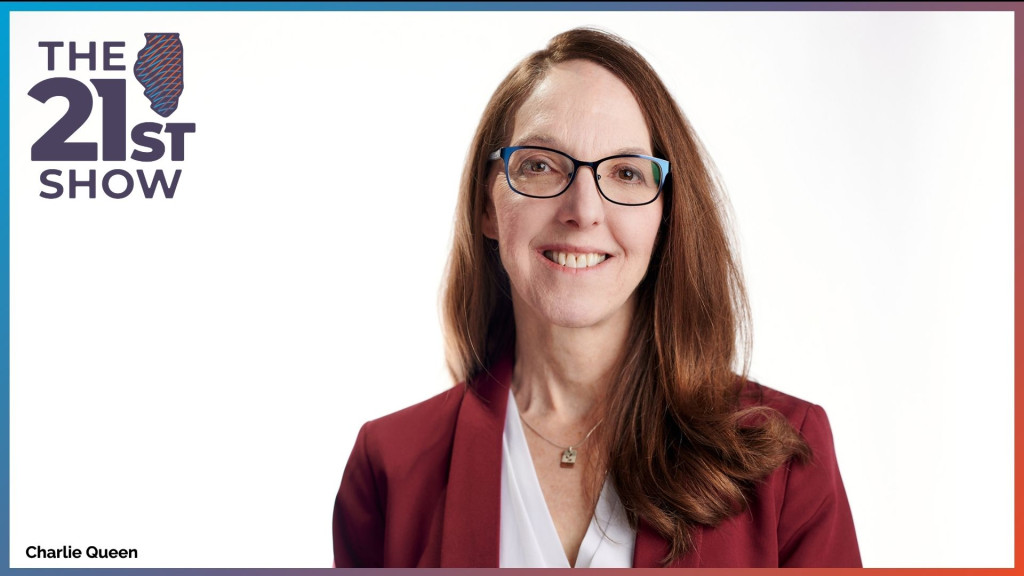
Transcript: Democratic congressional candidate Julie Fortier on economy, gun laws, and Southern Illinois voters
The 21st Show
Democratic congressional candidate Julie Fortier on economy, gun laws, and Southern Illinois voters
Read the full story at https://will.illinois.edu/21stshow/democratic-congressional-candidate-julie-fortier-on-economy-gun-laws-and-southern-illinois-politics.
Transcript
// This is a machine generated transcript. Please report any transcription errors to will-help@illinois.edu.

[00:00:00]
Brian Mackey: Today on the 21st show, Illinois has some of the most heavily gerrymandered congressional districts in the country, with 14 seats drawn to elect Democrats, leaving 3 for Republicans. And yet members of the opposition party are running in every one of those districts. And today we're having the first in a series of planned interviews with the men and women running for Congress in Illinois.

Julie Fortier is a research pathologist, Air Force veteran, and first-time candidate. She's also a Democrat running against incumbent Republican Mike Bost, who's in his 12th year representing the heavily Republican 12th district in southern Illinois. I'm Brian Mackey. We'll talk with [her] live for the hour today on the 21st show, which is a production of Illinois Public Media airing on WILL Urbana, WUAS Springfield, WNIJ Rockford DeKalb, WVIK Quad Cities, and WSIU Carbondale. But first, news.

From Illinois Public Media, this is the 21st show. I'm Brian Mackey. After the last census, when Illinois Democrats set out to redraw our state's congressional districts, they sought to maximize their power and representation. So they drew legislative boundaries that in most cases give Democrats an edge. In the converse of that, that meant packing as many Republicans into the fewest districts as possible. And from the Democratic perspective, that plan has been a success, with the state electing 14 Democrats and just 3 Republicans, a balance of power that is much more lopsided than the general party preference here.

I [meant] all that as background to today's conversation, because although the odds are against the challenger party in every one of those districts, someone has still stepped forward to challenge the incumbent. And from now through the election, we're planning to bring you interviews with several of the men and women running for Congress in Illinois, both incumbents and challengers, especially downstate where our program has its focus.

And that includes the 12th district, which spans almost the bottom third of Illinois. Republican Congressman Mike Bost has been in office there since 2015. He had very competitive elections in the beginning, but under the new maps, he's won both elections [with], I should say, 75% of the vote.

And that's where Julie Fortier comes in, Bost's opponent this year. She is a veteran of the U.S. Air Force, and that's how she came to be in southern Illinois. For a time, she was stationed at Scott Air Force Base in the Metro East. She's now lived in O'Fallon for more than three decades. Her main line of work since then has been science, and in fact, she has a Ph.D. in research pathology. This is her first political campaign, and she joins me now.

Julie Fortier, welcome to the 21st show. Thank you for being here.

[00:03:20]
Julie Fortier: Thank you for having me today.

[00:03:22]
Brian Mackey: I should say we've emailed Representative Bost's campaign to schedule an interview. After an initial inquiry in July, we did hear back this morning. We're closing in on a date in early October. That said, we are live for the hour today. If you have questions for the Democratic candidate in the 12th Congressional District for the Metro East through southern Illinois, you can join us at 800-222-9455. That's 800-222-9455.

All right, Julie Fortier, tell me a little bit about your life before coming to Illinois.

[00:03:31]
Julie Fortier: Before coming to Illinois, I grew up primarily in Colorado, but I graduated high school near Cincinnati, and that's when I joined the Air Force because I needed money for college. I had joined in order to get the GI Bill. I spent four years in the Air Force, most of it overseas in Germany, but I was TDY a lot of that to four different countries — England, Turkey, obviously I was in Germany — and then I went and I was in Qatar for four-and-a-half months during Desert Shield. And primarily during that time, we just set up equipment and communications for the supporting team that we were with. I left three days after the war started and came back to the states for an emergency, and then I was stationed at Scott Air Force Base.

And once I was there, I started taking classes full time again at McKendree University. I completed my degree there. I have two majors, biology and mathematics, and then I went on and I completed a Ph.D. at Saint Louis University in biomedical science, and my Ph.D. is in research pathology.

[00:04:38]
Brian Mackey: What made you want to stay in Illinois after finishing your time in the Air Force?

[00:04:44]
Julie Fortier: I established a life here. I had a few friends here. I had met my husband here. We had met at Scott Air Force Base, and once we had children, we wanted to stay. And O'Fallon is an amazing place to raise kids. It has a great school system. It had a network, and my kids — my daughter just finished high school this year — so it is an amazing place to raise kids. So that's why we stayed.

[00:05:10]
Brian Mackey: I like to borrow sometimes from Richard Scarry, the children's author, and his famous book, "What Do People Do All Day." What does a research pathologist do all day?

[00:05:20]
Julie Fortier: So, although my degree is in research pathology, basically I can do any kind of biomedical science. And so what I do all day — because my title right now is scientific writer, but I do spend some time in the lab — basically, what I do all day is I work with multiple myeloma, and I help ensure researchers who are working with multiple myeloma have the samples they need in order to move their research forward. I am also working on some research samples myself and analyzing basically proteins within those samples.

[00:05:57]
Brian Mackey: So why do you want to give that up and become a member of the United States House of Representatives?

[00:06:03]
Julie Fortier: To be honest, I think we need a stronger voice in southern Illinois. I think we need somebody who actually can assess data quickly and then come up with reasonable solutions. I think we've lost our voice in our district right now. Our constituents — I am one of the constituents, I live in District 12 — and right now we have in District 12 no access to our representative. He refuses to meet with constituents. He only holds phone town halls. I know he screens calls, and he even limits the people who are allowed to be on the calls. And so this to me is not true representation, and we need to ensure that people in southern Illinois have a voice. This is why I'm running.

[00:06:48]
Brian Mackey: You know, politics is an interesting profession in that there's not necessarily the gatekeeping that would happen in, you know, say a research laboratory or flying a jet in the Air Force or doing anything else. You're aiming pretty high as a first-time candidate. You know, some people might say, why not start with your park district or school board, and then state legislature, and work your way up as your opponent did for decades before becoming a member of Congress?

[00:07:16]
Julie Fortier: Yeah, let me first step back. I was not an officer in the Air Force. I was enlisted. I did not fly a plane, and —

[00:07:22]
Brian Mackey: I didn't mean to imply you did, just as a general — thank you for — thank you for clar[ifying]. I get it. No stolen valor. Good point.

[00:07:28]
Julie Fortier: Exactly, exactly. I think he needed an opponent, and I'm up to the task. I learn quickly. I can assess data quickly. It was interesting — we were both interviewed by a gentleman in southern Illinois, Brian Sackett, and the comment that Bost kept making is, "I have experience, I have experience," but if that experience he has is not moving our democracy forward and is not protecting our Constitution, then his experience doesn't matter. So to me, anybody who is willing to represent with integrity and with morality right now and is willing to protect our Constitution needs to step up, and that's what I'm doing.

[00:08:23]
Brian Mackey: All right, let me reintroduce our conversation if you're just joining us. This is the 21st show. My guest today is Julie Fortier, the Democratic candidate in the 12th Congressional District in southern Illinois. She's running against six-term incumbent Republican Congressman Mike Bost. And you can join us throughout the hour, 800-222-9455. That's 800-222-9455.

All right, let's get into some policy talk, and we can start with the economy. What can the federal government do to improve the economy, especially for Americans with the least income and no wealth to speak of?

[00:09:06]
Julie Fortier: There are a few things we can do. First of all, although Illinois's minimum wage currently is $15, we definitely need to boost the entire United States minimum wage. What has been proven time and time again is that when you have a strong working class and a strong middle class — meaning they can afford to live, they can afford houses, they can spend a little extra — this actually builds an extremely strong economy and puts money back into the economy. And so that's the first step we need to take.

We need to make sure that there are taxes that are being gathered not only from the ultra-rich but from corporations as well. Right now there are so many loopholes that people use not to pay taxes, and unfortunately it shouldn't just be on the shoulders of the working and the middle class. It shouldn't be. Everybody, if you're in this country, should be paying taxes.

And what is interesting is a lot of people think that trickle-down economics works, and it has been proven for years that it does not. One person, for instance — if you don't tax the ultra-rich and you have one person who is not getting taxed, that person is still only going to buy five pairs of jeans in a year and is only going to buy maybe one car a year or, you know, a television or two. But when you make life affordable for the working class and the middle class, and you do that by multiplying the number of people who are in those classes in their affordability — to buy five pairs of jeans a person and buy one or two televisions a family and buy maybe a car every five or eight years — that boosts our economy. That puts money back into the system, and a lot of people don't seem to consider that. And so this to me will help definitely boost our economy, and putting money back in will actually allow us to have more money to spend on infrastructure and more money to go back into our communities, and that money then creates jobs and it becomes a cycle, and we seem to have forgotten that.

[00:11:29]
Brian Mackey: What form does getting that money out — I mean, are we talking minimum wage increase, just straight government redistribution?

[00:11:36]
Julie Fortier: Yeah, it starts with a minimum wage increase, and then little by little, giving that will actually increase the purchasing power of people, and then it literally will start a roll. So then, more money — the more people earn, the more taxes that are actually gathered for the government — and then that money can actually go back in and be used toward infrastructure, and then that infrastructure [spending] will actually help create jobs. So yeah, it can start by increasing minimum wage, and that would be a huge benefit.

Also, healthcare needs to be — we need to have a universal healthcare plan. People are spending way too much out of their salary, if at all, and if they aren't spending anything on health insurance right now, then they're gambling. And if unfortunately something happens, right now a person could literally go into debt the rest of their life paying off a medical bill. So this also is part of our affordability and economics — although it is a whole separate issue, healthcare — but it does weigh into affordability for Americans right now.

[00:12:51]
Brian Mackey: So when you talk about universal healthcare, are you saying single-payer, you know, as Bernie Sanders would have it — Medicare for all?

[00:12:59]
Julie Fortier: I am not sure if Medicare for all is exactly what we need right now. To be honest, it's gonna have to be a step-up program. A lot of people, if you just do Medicare for all right now, it will flip everything on its head. So it's not gonna be a one- or two- or probably even a four-year plan. So it could definitely lean its way toward single-payer, but I think right now if we can reinstate the ACA, reinstate the subsidies for the ACA, and also put the tax penalties on for people who aren't carrying insurance, that will give us a stopgap and at least people will be covered. And then we can start working toward most likely an individual-paying system. I need to sit down and actually go through the money and the finances and to see economically how that will work, and then it has to be a progression. So a lot of people think that this can turn over in a year, and it won't. This has to be a step-by-step, stepwise progression to achieve where we can have a universal healthcare [system]. And so I think Bernie Sanders' [approach] might work, but I'm not sure Americans will want to do the tax increase that will probably occur if that happens.

[00:14:18]
Brian Mackey: All right, let's go to the phones at 800-222-9455. We have Gene calling from Carbondale in southern Illinois. Gene, thank you for calling in.

[00:14:28]
Gene: Oh, thank you. I have a question, and there's sort of a premise to it. I feel like people in southern Illinois see northern Illinois as, you know, the opposite of what they want and what their values are. And I'm just wondering how — and I think the Democratic Party helps people, especially those who are disenfranchised — and I think that now with the Democratic governor we've had for a long time and the Democratic legislature we've had forever, that people in southern Illinois feel disenfranchised, not represented perhaps by Democrats, and I think that's unfortunate. I'm glad that you're running. I have thought about this myself. I thought, man, he needs somebody to run against him, and that's my comment and question.

[00:15:27]
Brian Mackey: All right, Gene, thank you. Julie, do you want to respond to that? And I should say we need to take a break in a couple of minutes, but go ahead.

[00:15:34]
Julie Fortier: I understand how southern Illinois feels disenfranchised. I absolutely get that. I also understand that a lot of people in southern Illinois think that northern Illinois is actually taking their tax dollars, and what is interesting is the money actually goes south. If it wasn't for northern Illinois, southern Illinois — we use some of that money for schools, we definitely use it for infrastructure.

I think we need to have a representative who's willing to listen for southern Illinois, and I think that will help maybe make them feel as if they're included, because if somebody is willing to listen — people in southern Illinois have different needs than people around Chicago. We are a rural community. We have many farmlands, many farmers. So this is where I come in, because I'm willing to listen to everybody. And right now I've been going town to town. I've held 23 town halls so far, and I've been listening to people all over the district.

[00:16:38]
Brian Mackey: Julie Fortier is the Democratic candidate in Illinois's 12th Congressional District. She is running against incumbent Republican Congressman Mike Bost. We're talking with her for the hour today, part of a series of conversations we're having with the men and women running for Congress across Illinois, across downstate Illinois. If you want to join us, if you have a question, 800-222-9455 is the number. You can be in the 12th district, or maybe you're outside of it and you just care about Illinois politics. Let us know — 800-222-9455. We'll have more with Julie Fortier after a break. This is the 21st show. Stay with us.

It's the 21st show. I'm Brian Mackey, and my guest for the hour today is Julie Fortier, the Democratic candidate in the 12th Congressional District, which covers much of southern Illinois, including the Metro East, Carbondale, and points in between and outside. She is running against incumbent Republican Congressman Mike Bost, who will have been in office for 12 years at the end of this term. I should say we have been in communication with Representative Bost's campaign to schedule an interview for at least a month now. We did hear back this morning. We're closing in on a date in early October for an interview. You can join us throughout the program today at 800-222-9455. That's 800-222-9455.

I do want to share a comment we got from a caller — didn't stay on the line, but Ted in Springfield said healthcare should be a right, not a luxury in this country. Why is it that every country in Europe provides health insurance? Again, let us know what you think, or if you have questions, 800-222-9455. That's 800-222-9455.

All right, before the break you were talking about some of the ways that southern Illinois is different from Chicagoland certainly, and other parts of Illinois as well. One of those you often hear about is gun culture. So I'm going to ask you, do you own a personal firearm? Are you a gun person?

[00:19:02]
Julie Fortier: I actually currently do not own one, but I actually enjoy shooting. I am a proponent of the Second Amendment. I agree that it is part of the Second Amendment and people have a right to own guns. I have no problem with that. I also believe that there has to be some regulation. It's no different than owning or driving a car.

People know if they're going to go hunting. My father was an avid hunter, actually a very good hunter. I think we had Canadian goose most of the time when I was a kid for Thanksgiving, and he always knew when he was going to go hunting. And so, you know, saying that they should be able to walk into a gun store and buy a gun and ammo the same day without any kind of background check or anything — I think we've gotten to the point where we know, in this society, in our country, that safety-wise, that's just not [wise] anymore.

I don't know if anybody on this call or anybody listening has ever had their child's school go on lockdown. It's heart-wrenching. I've had it, I think, twice since my daughter was in high school this last time as a senior. Fortunately nothing had come of it. But if we could stop — if we could stop any of those horrible situations from ever occurring again, not just at high schools but in public, I don't see why anybody would be opposed to that.

[00:20:41]
Brian Mackey: You know, in 2[02]6 [🚩 review: year reference may be incorrect], there are a lot of things there's growing dissension among Republicans on, but gun laws does not seem to be one of those areas. And, you know, you hear from a lot of people who think that Democrats in general — and, you know, the Pritzker administration here in Illinois — are out to get them. How do you relate to voters who think Democrats are going to take away their weapons?

[00:21:06]
Julie Fortier: I think they actually need to look at the facts, because we're not. Nobody has asked to go take away their weapons. Nobody has. It's just wanting to have smart legislation for them. I don't think that is asking too much at all.

You know, and to me, even protecting — I don't know how law enforcement would view this, but do they want everybody on their streets who might not be mentally sound enough to have a weapon to go out and be able to buy a weapon? I don't know. I would think they wouldn't.

[00:21:51]
Brian Mackey: Another issue, a key social issue that has been top of mind for several years now since the U.S. Supreme Court overturned what had been a constitutional right to abortion in Roe v. Wade, is the issue of abortion. And we've seen the Trump administration moving to suspend — or trying, I think not succeeding so far, but trying to suspend — the medication abortions that have been shipping around the country, especially to states unlike Illinois where abortion is now largely illegal. So let's talk about this. What laws, if any, do you think there should be imposing restrictions on abortions?

[00:22:31]
Julie Fortier: So I am not pro-abortion. I am pro-women's healthcare. And what that means is that is between a doctor and a woman, and every politician needs to step outside of the clinic. That is none of our business. Any medical care that a woman needs is literally between the doctor and his patient. And all of these people that think that we as politicians have a right to step inside and know better than somebody who has gone to school — medical school for four years, residency for three, fellowship for three to five — who are we to say what kind of treatment a patient needs? I believe in medical care. I believe in people having a right to medical care. This should not be limited because it's a woman.

[00:23:26]
Brian Mackey: The people who are most passionate about this issue on the anti-abortion side often say it's a question of life. So I guess I would ask you, when do you think life begins?

[00:23:40]
Julie Fortier: When does life begin? That's a philosophical question. So I guess it shouldn't necessarily be a question of when life begins, but who has a right to control their own body. It doesn't — people can always say, I mean, if you think about it, every individual cell you have, even if it's not a gamete, so even if it can't turn into a child, each cell is alive, but yet you wash your back and you scrape off cells, both dead and living. And I know that's kind of — I'm not trying to be hyperbolic — but the thing is, it's not necessarily when life begins, but who has a right to control somebody's life, and that's what is actually happening.

And what is interesting is the term abortion is used in even procedures where a fetus is not removed. So, for instance, if you need to have a D&C — where it's a dilation and [curettage] — sometimes that occurs, and that's considered an abortive procedure. And sometimes that occurs even after a viable birth, even after a mother has given birth to a viable child, and a D&C needs to be done in order for a woman at times — not every time a woman gives birth, but sometimes it needs to be done so a woman doesn't bleed out. And now we have politicians, because the term abortion is used in there — because oftentimes some placenta tissue or some other tissue will be removed during this procedure, it's considered an abortive procedure — and so removing this ability, putting politicians going into a doctor's office — and what I mean by that philosophically, any rule that a politician is making is literally going into these doctor's offices — and it shouldn't be. That should be between a doctor and their patient.

[00:25:46]
Brian Mackey: Let's go back to the phones, 800-222-9455. We have John calling from Bloomington, Illinois. John, thank you for calling in.

[00:25:55]
John: I really appreciate the opportunity to speak to Julie and to convey my respect and encouragement — to just nail it, just give them everything you can, full barrels. Shut Mike Bost down. He's one of the 126 congressmen who voted to suspend the election, what I consider a betrayal to his oath. So I'll stop that right there. But I wanted to talk about the primary results, which kind of — I think they should give you a reason for encouragement. There were 100,000 people who voted for Mike [Bost] in the Republican primary. Excuse me. There were 29,000 who voted for Julie. So I think relying on the [results] — what that means was explained to me a couple of days ago by a guy who said, so what that means is that if you take half of Mike's and half of yours, that's the split, the independents who went either way. So if the independents and the disenchanted Republicans go Democratic no matter what, because they're tired of this, then you've got a chance to flip Mike Bost.

And I know that your funding — you got $1 for every $50 that Mike Bost has — but you've got spirit on your side. And I'd like to talk about that specifically, because I want to mention Ken Gray, Paul Simon, and Glenn [Poshard] [🚩 review: caller says "Pchard"; may be referring to Glenn Poshard] and think about their legacy and what they brought to southern Illinois. They brought more prosperity, right? They flipped southern Illinois from, you know, [struggling] to [a] metroplex where you could — they brought prosperity there. So think about what's happened since then. And, you know, awaken [that spirit] and you've got a shot, and I appreciate the few moments that you gave me.

[00:28:22]
Brian Mackey: John, thank you so much for calling in to share your perspective. Julie, let me ask you about that — about southern Illinois used to be solidly Democratic. You have been there, what, three decades now. You've seen this process by which it has become a, you know, one-party [dominant] part of the state. What has that been like? What do you understand to have happened over the past 30 years that made a place where Democrats used to be dominant into a place where they're, by some definitions, an endangered species?

[00:28:52]
Julie Fortier: Yeah, it's interesting. It is actually sad. I think people don't necessarily consider the fact that the Democratic Party will actually help them out. They're looking at other aspects of what the other party is, and they're believing what they're hearing without necessarily taking the time to investigate or look up their own sources.

I will tell you this — people in southern Illinois, people in this country are exhausted. They're tired of keeping up with the newsreels, constantly. I am listening to newsreels, and I usually listen to them on two-speed because just to get twice as much in all the time. And to take — if you're working one or two jobs and you have two children at home, and then to come home, put the kids to bed, clean up the kitchen, start your laundry — a lot of people don't have the energy to sit there and go through the facts. And so sometimes they'll follow the one that sounds the best, and that's not necessarily the truth, but they're hoping. They're hoping that no new wars were going to be started. They're hoping that all of this money from tariffs, they'll get a tariff check. They're hoping that after DOGE occurred that they'll get a check in the mail from DOGE.

And I'm trying to bring back to southern Illinois, and to this country — and so many of us are trying to do this — reality. I'm trying to make sure that we can have a commonsense government come back. And it is exhausting to have to sit there and do fact checks, and I understand that. And I think our district is just tired, and I think if they will take two seconds and maybe do one fact check and say, "You know what, this isn't working the way anybody had said," I can't blame people for necessarily voting for what somebody had said. But what was promised were lies.

What I can blame, however, is the fact that Bost has not stood up for southern Illinois. He has not stood up for this country. Between the — you know, any kind of money that is being spent, our tax dollars that are being spent without congressional governance, anything that has gone on — for instance, $1.2 billion was given to a German company a week and a half ago. That wasn't approved by Congress, and that was our tax money, and it was given to this company so that they weren't going to build wind turbines where they were actually contracted to build, and this is our tax money — it's gone.

We need to make sure that we have people in Congress who are willing to do their job, who are willing to speak out, even if it's not popular, but speak out for the truth and speak out for morality and speak out for integrity. And this is why I'm running, and I will support southern Illinois with that — with morality, with integrity — and to make sure that we are doing the job that we're supposed to do, and that will actually benefit this district.

[00:32:26]
Brian Mackey: We need to take a break in another couple of minutes here. Maybe I'll only ask one more policy-related question before we do. You work in the field of science. The Trump administration has had a lot of cuts to scientific research funding. Have you seen the effects of that in your work or the people around you?

[00:32:44]
Julie Fortier: Absolutely, absolutely. And it is disheartening. And if we want to be, as a country, in the forefront of science and technology, then the last thing we want to do is defund science. We have lost over 15,000 scientists in this country recently, and that's devastating. People in America have to decide where we want our country to go. If we want it to move forward, if we want to be competitive, we're going to have to fund science, and the only thing that refutes science is future science. It's not somebody in a suit who doesn't understand science saying something isn't true.

[00:33:32]
Brian Mackey: What about — all right, let me — we'll take a break and then we'll come back and talk more. My guest on the program today is Julie Fortier, who is the Democratic candidate in the 12th Congressional District in southern Illinois. She's running against incumbent Republican Mike Bost, whom I should say we have invited on the program as well. We've been communicating with his campaign since July. We are closing in on a date in early October for that conversation. If you want to join us in today's conversation though, you can do so. We're going to be together for the next 20 minutes or so. 800-222-9455 is the number. Once again, that's 800-222-9455. We will have more with Julie Fortier here on the 21st show after a short break. Stay with us.

It's the 21st show. I'm Brian Mackey. We're talking for the hour today with Julie Fortier, who is running against incumbent Republican Mike Bost. She's a Democrat in southern Illinois, 12th Congressional District, which includes Carbondale, the Metro East, and points in between and beyond. You can join us today at 800-222-9455. This is the first in a series of conversations we are planning with people running for Congress in downstate across Illinois, spanning both parties. And in fact, Congressman Bost — we're closing in on a date in October hoping to have him on the program as well. You can join us again, 800-222-9455.

Now, before the break you were talking about the disconnect — we were talking about the disconnect among voters in southern Illinois with Democrats over time. And you mentioned policy and fact-checking and being aware of issues. We had a text message from Terry, who's in the Quad Cities, who says what the candidate is saying about people not having the ability to be on top of the facts is so true. He says, "I've watched the discussion on Facebook having to do with the closing of the packing plant in the Quad Cities" — that's a meat-packing plant that's closing there, 2,500 jobs being lost. He says people are upset but they are woefully uninformed on the facts that supported the decision to close the plant.

I get what you're saying. I get what Terry is saying. So much of modern politics though is also vibes, right? Do I think this candidate would go to a NASCAR race with me, or would they rather watch, you know, English Premier League soccer on Saturday? Do they have a, you know, real tree camo coat like I do, or a basketball jersey or something? Do they like country music or pop music? Do you see Democrats — are you working to sort of bridge those vibes — in the term that people use nowadays — those cultural divides that seem to have grown as people now make their politics so much a part of their personal identity?

[00:37:07]
Julie Fortier: Yeah, I think what's interesting is so many people nowadays — well, they flipped, right? So this district flipped. It used to be blue a long time ago, and then Glenn [Poshard] [🚩 review: speaker says "Bouchard"; may be referring to Glenn Poshard] was the last representative who was actually a Democrat and he finished his term in '99. And what is interesting is I think —

[00:37:31]
Brian Mackey: I do have to shout out — Bill Enyart was a Democrat there, and I think he's the one that Bost defeated [in] 2014. Might have been a different shape. Oh, I —

[00:37:37]
Julie Fortier: I apologize. Yes, you are correct. I apologize. Yes, so you are correct, and I apologize.

So what I'm trying to figure out is, if people are willing to actually look to see who will actually work the hardest for them, or the people who can actually relate to them — I might be working in a science lab now, but I've worked labor jobs. I've spent 10- to 14-hour days on my feet being a line cook or being a waitress. So I know what it's like to make ends meet by scraping by, and I don't want people to scrape by. I want people to be able to afford a living, and I want people to be able to save for a future. I don't think that's far-fetched, and I don't think our current Congress and our current representative in southern Illinois will reach out to the constituents the same way. He doesn't — he won't even have town halls. I'm one of his constituents. I would love to have a conversation with him. We have invited him. My campaign has invited him to every town hall we have had, and he has not shown. And we have also invited him through WSIU to have a debate, and he has not responded.

[00:39:01]
Brian Mackey: I was going to ask — we had an email asking if there were any debates scheduled, so no debates scheduled with him?

[00:39:05]
Julie Fortier: No, we've tried. We have definitely tried, and to me, the constituents have a right to have a debate. They have a right to hear a debate. And I don't understand — I could guess, but I don't know why Bost, if he wants to represent his constituents, would not come out and have a debate with us.

[00:39:28]
Brian Mackey: I want to ask more about what Democrats might do should they regain power in Congress, what you might do should you win this election. There's a debate going on about whether to investigate and impeach President Trump, you know, tear down the East Wing ballroom or let all that go and focus on the price of ground beef and things like that. Where do you come down on that?

[00:39:52]
Julie Fortier: Why does it have to be one or the other? I guess so my thing is everybody should be accountable for their actions. And if their actions were illegal, then they need to be held accountable for those. And at the same time we can start working on affordability for people. We can start working on a universal healthcare plan. We don't have to just focus on one thing, but everybody definitely should be held accountable for their actions.

[00:40:22]
Brian Mackey: Would you support prosecuting members of the Trump administration for some of the excesses of — be it street-level Border Patrol agents, or the people who directed these programs that have resulted in Americans being shot on the streets of cities like Chicago and Minneapolis and elsewhere?

[00:40:40]
Julie Fortier: If anybody in this administration [was] involved with anything that was an illegal act, they should absolutely be held accountable. Here's the thing — if we don't hold people accountable for doing this, then why would any constituent, any American not think that they, too, should not be held accountable for anything they might do that would be not law-abiding? So if we don't hold the people in public office to at least our minimum standard — and to me they should be held to a higher standard — but if we don't hold them to the minimum standard, then what are we saying to the American people?

[00:41:28]
Brian Mackey: I want to mention another comment — we got a text message from Pete in Carbondale who says your vibe comment is spot on. "It's just that the rebel spirit used to be with the Dems in southern Illinois, but now it's shifted to the Republican side. It's the same vibe but different end result. Still us versus them, but the focus and end result is changing."

We also have another caller on the line. Joseph from Marion is calling. Joseph, thank you for calling in. I understand you want to talk about Congressman Bost and his case on voting — mail-in voting. Yes?

[00:42:00]
Joseph: My comment is regarding Representative Bost's Supreme Court case. This case is about mail-in ballots and the counting of these ballots that are postmarked before election day to be counted up to 15 days after election day. According to Google, Bost's comment is that it's costing him money having his staff monitoring the counting of the ballots. The irony here is that the attorney presenting Bost's case to the Supreme Court commands a salary of about $2,650 an hour. It just seems that this whole effort is to restrict voter participation and [has] nothing [to do] about money. I appreciate your comments. Thank you.

[00:42:47]
Brian Mackey: Thank you, Joseph.

[00:42:50]
Julie Fortier: So interestingly, this — I was stationed overseas for two years, and most of that I was actually TDY, and —

[00:43:00]
Brian Mackey: Temporary duty, for people who are not steeped [in military terminology], which means you're assigned elsewhere to other assignments. Yeah, go ahead.

[00:43:05]
Julie Fortier: Yes, so I was never where my mail was supposed to be. And what people need to consider is, if we are going to limit the time frame of mail-in ballots being mailed in, the people it is affecting the most are our military personnel. These people who are wearing the uniform, these people who have sworn an oath to our country — we will be limiting them. So to me, as long as a postmark exists, the ballot should be counted. I don't know why you would want to limit any votes, because if you're a strong candidate, those votes would be for you, presumably, so it should just add to your count. But it literally will disenfranchise [the] voting [rights] of military personnel.

[00:43:54]
Brian Mackey: You know, the U.S. Supreme Court ruled 7 to 2 that Bost can continue — there was a preliminary ruling, not on the merits of the case, but just that he can continue pursuing this, regardless of whether he can prove the law harmed him. You know, one of the questions that Democrats are also going to face in the coming years is what to do about the U.S. Supreme Court, because it has frustrated attempts at — Democratic Party attempts at reform in the past. Would you expand or support a law aimed at expanding the number of justices on the court or limiting the court's jurisdiction?

[00:44:28]
Julie Fortier: I would expand the court to represent — we have 13 judicial districts, I would expand it to at least one [justice] in every district. I would also put term limits on the Supreme Court. This [appointment for life] — also, they should be accountable for any kind of gifts and any kind of bribery that any of them have taken. That should also occur. They should be the highest court in the land, and they should be the most moral, and what we're seeing now is — there's so much. I mean, the word "unprecedented" unfortunately can be used over and over again right now with this administration. And I don't think anybody — why would you want a court that doesn't stand behind the Constitution?

[00:45:24]
Brian Mackey: Another issue that comes up is gerrymandering. This is something where in Illinois, most Democrats benefit from the gerrymandering that happens here, right? We have 14 Democratic members of Congress, three Republicans. If you just looked at how the statewide vote preference goes, which is usually 55 to 45, give or take a few points, Democratic — we would only have 10 Democratic members of Congress, seven Republicans. So most Democrats in Illinois sort of benefit from the gerrymandering. You are in a district where that is not the case. And I wonder how you think about this issue — do you think Democrats went too far in heavily gerrymandering as much as they have?

[00:46:08]
Julie Fortier: I don't think gerrymandering is good regardless, and if we allow it on one side, we allow it on the other, and that just doesn't sit well with me. I don't know the best way to draw districts. It obviously has to be based on population. I don't know the best way to draw districts in order to ensure that there is an adequate amount of representation for a demographic. So, do you focus on race? Do you focus on rural population? There's always an issue on how you draw the lines. But to me, gerrymandering should not be allowed on either side.

And we have definitely seen it in other states. I mean, Illinois is no different, but it's leaning toward the Democratic side. It would just be nice if people could do what is best for the states or for the districts. And unfortunately right now there is so much division in this country, and we have forgotten that we're all Americans, and that everything that occurs in this country, anything that goes through Congress, affects all of us. We need to remember that all of us are Americans and see if we can come back together again.

[00:47:30]
Brian Mackey: On that note — and we are coming to the end of our time together, just a couple of minutes left — coming back together. We are in an era where trust in institutions, the cohesion of our society, it's eroding, right? Whether it's science, journalism, the law, government. What steps do you think we should be taking to rebuild that trust and unity in American society?

[00:47:57]
Julie Fortier: Yeah, interesting. As far as journalism, I think if somebody literally or intentionally puts out falsehoods or misinformation, I think they should have a monetary fine.

Interestingly with science, if your science goes through a peer-reviewed journal, the only thing that can refute science is new science, and that happens all the time, and usually it just increases our understanding and enhances our next steps. And as far as helping with science, it literally is putting money into science, and that's how we definitely allow science to grow.

And people — I don't expect people to have blind trust in science. I mean, I go in and I question physicians all the time. And I have the background, so unfortunately it drives physicians nuts, I'm sure. But I think people shouldn't be going in blind and saying yes, absolutely, to everything. Ask the questions. And if you don't happen to understand the journal articles that go with science, I understand that. Then ask your physician to explain it if you happen to pull one up.

But I think holding people accountable for making sure that they don't present falsehoods — this is what we need to bring back. We have allowed people to lie. We have made it acceptable, and to me that's not OK. And then basically somebody saying, "Well, as long as it still can be called a news network" — but it has to be, it's an entertainment network, but we can still put the word "news" after it — that doesn't sit well with me either. So we have to have some sort of regulation out there again that makes sure that what is being presented is truthful.

[00:50:00]
Brian Mackey: Julie Fortier is a biomedical researcher. She's an Air Force veteran, and she is the Democrat running against Republican Mike Bost in the 12th district in southern Illinois. Thank you so much for joining us today.

[00:50:13]
Julie Fortier: Thank you so much for having me. I greatly appreciate the time.

[00:50:16]
Brian Mackey: That is it for us today. The 21st show is a production of Illinois Public Media. I'm Brian Mackey. Thank you for listening. We'll talk with you again tomorrow.
Transcript Assistance
Illinois Public Media may use AI assistance for transcript generation and/or formatting. Transcripts that have not yet been reviewed for accuracy will be labeled.
To report a transcription error, or to request transcription of archival material, please contact will-help@illinois.edu.