







Transcript: From the State Fair: Illinois Ag director on storms, tariffs, and Iran war
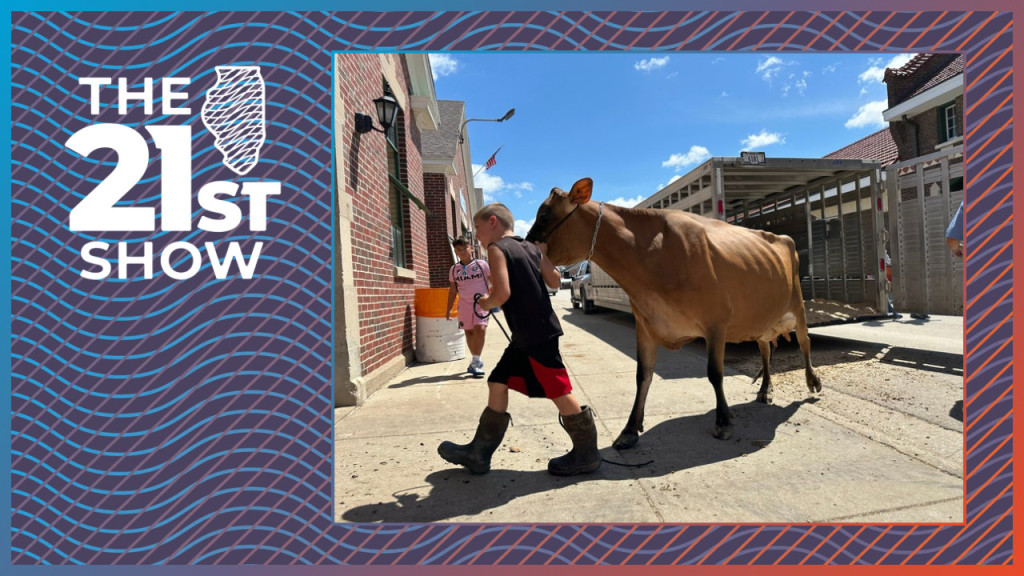
Transcript: From the State Fair: Illinois Ag director on storms, tariffs, and Iran war
The 21st Show
From the State Fair: Illinois Ag director on storms, tariffs, and Iran war
Read the full story at https://will.illinois.edu/21stshow/illinois-agriculture-director-weighs-in-on-impact-of-iran-war-and-tornadoes-on-farmers-farm-bill.
Transcript
// This is a machine generated transcript. Please report any transcription errors to will-help@illinois.edu.

[00:00:00]
Brian Mackey: From Illinois Public Media, this is The 21st Show. I'm Brian Mackey. And today we're bringing you the program from Springfield at the 2026 Illinois State Fair. Later in the hour, the sounds and voices of some of the many people who are part of making the fair what it is. But first, Jerry Costello the Second has been director of the Illinois Department of Agriculture since March 2020. The name Jerry Costello may be familiar to several generations of Illinoisans. His father was a member of Congress for many years. Costello the 2nd grew up in Belleville and also spent time on his great grandfather's dairy farm in [Cesser]. He served in the Illinois House of Representatives for eight years, including some as chairman of the Agriculture and Conservation Committee. He was also director of law enforcement at the state Department of Natural Resources, overseeing Illinois's conservation police. I spoke with Costello this morning on the state fairgrounds. Because of that, no calls today, but you can always let us know what you thought. Our email address is talk@21stshow.org. Jerry Costello, welcome back to The 21st Show.

[00:01:12]
Jerry Costello: Hey, it's great to be here and really appreciate you all being at the Illinois State Fair.

[00:01:18]
Brian Mackey: Where are we at in this growing season this year?

[00:01:20]
Jerry Costello: So yeah, if — I mean, numbers wise, we're doing fairly well. I think, you know, we're at about 60% across the board if you look at crop conditions.

[00:01:33]
Brian Mackey: What does that mean for people who are not farmers? 60% good to —

[00:01:35]
Jerry Costello: Excellent. So, and those are the numbers that we track very strictly. So corn right now, good to excellent, we're at 60%. In single digits, poor to very poor, I think it's somewhere around 11%. Beans, the real number is 59% good to excellent right now. I round it up to 60 because it's 60 across the board. Then pasture condition, about 60% good to excellent. So in general — and again these are statewide numbers, so it's averaging the entire state. Obviously we have pockets that have received a ton of rain, pockets that have been a little bit dry, but overall condition for crops in the state of Illinois honestly is pretty good.

It's been a — but we got off to the season really, really well in most places in the state. I mean, we were ahead of planting, things were going extremely well, and then a number of places got really wet when we were about somewhere in the area of 70% planted in the state. So I mean, a lot of people got a big jump on it, planting early, got crops in early, and then we had some wet spots. And what most people in the state will be extremely familiar with is all of a sudden the state of Illinois became the tornado capital of the United States. So as we sit here right now, I believe we've had in the area of 200 touchdowns — tornado touchdowns — in the state of Illinois. So, you know, normally we're talking about Oklahoma, that's, you know, had the most tornadoes, but no, that's the state of Illinois this year. So we've had some extreme weather and extreme weather disruptions. But suffice it to say, back to where the overall condition is right now, really we're doing pretty well.

[00:03:34]
Brian Mackey: Yeah, so it may be pretty well overall, but if you're one of those farmers who had an F2 tornado tear through their fields, what does that mean for a farmer in a given year?

[00:03:43]
Jerry Costello: Yeah, so — not only tornadoes, straight-line damage can do major, major damage to corn, especially because essentially it's hitting a wall. And so that wind, you know, when the corn goes down, it's really going down.

[00:04:01]
Brian Mackey: It looks like one of those corn maze kind of thing, right?

[00:04:04]
Jerry Costello: It does. And then there are two types of scenarios that can occur. If it's not as bad and the roots are actually still in the ground, a lot of times that corn can pop up in four or five days. Now, if it's taken up by the roots, obviously you know those crops are ruined.

[00:04:25]
Brian Mackey: Do you think farmers are adapting to the idea that this could become our new normal? We've talked on the show about, you know, is tornado alley shifting east. Climate change is obviously a persistent topic for us. How do you see Illinois agriculture as a — you know, as an industry, as a field — pardon the pun — adapting or not to this?

[00:04:44]
Jerry Costello: So the one thing that I can tell you about agriculture is it's very resilient and farmers are so used to being weather dependent, and have been for generations. It's something where we have to adapt. So the answer to your question is yes, I see farmers adapting. The other side of it is what I hate to say about that is that type of weather pattern and having to react to it — because in general, the Midwest has been a very, very stable place for crops. I would tell you — and I know we're going to probably talk about the farm bill later — if you look at crop insurance data and aspects, the number of storms that we receive in the state of Illinois and the Midwest, we actually are a very, very minute portion of the crop insurance aspect because we're a very, very stable growing area historically speaking. And having the type of weather that we've had recently worries me from that perspective.

[00:05:55]
Brian Mackey: What about — so what does this mean ultimately for crop yields for Illinois farmers, you know, and especially considering where prices have been in recent years?

[00:06:04]
Jerry Costello: Yeah, so — and here's the technology and the way our farmers in the state of Illinois and the Midwest have adapted. We're doing more with less. The precision agriculture aspect of things from a fertilizer aspect, you know, just chemicals in general, we're using less, we're getting more return. So those are great things, but the weather-dependent aspect is something we just have no control over. You know, when people have to replant and then replant again, that's an issue. And eventually you run out of the period of when you can be covered by crop insurance as well. So all of those things make farming right now a very volatile industry — not to mention the other volatilities that are going on in the world, and I assume we'll get into that here in a few minutes as well.

[00:07:00]
Brian Mackey: Yeah, before we do though, talk to me about livestock producers, right? We've also seen in recent years, you know, mass chicken slaughters have to happen in Illinois, other things along those lines. How are they faring with all this crazy weather and everything else we've been dealing with?

[00:07:16]
Jerry Costello: Yeah, so H5N1 — most people know it as bird flu. It's something that — and a lot of people don't realize this — we've been dealing with it in this country for years and years. It ebbs and flows, spikes at times. Most of the time when it's spiking in the Midwest, it's around a migration. So it's carried by wild birds most of the time. And so when you get a change in weather pattern, you get animals — ducks, geese — that are normally flying south. Then the pattern changes and you get snow in Florida or down south, they migrate back. So when you get those changes in weather pattern, it's a larger point of exposure for us as well. Now I will tell you I'm not a scientist, I'm not a veterinarian, but just generally tracking numbers and situations, that's kind of what we've seen in the Midwest.

The state of Illinois is not a huge poultry producing state. At the time when we saw some crossover into dairy cattle, there was a lot of concern. We have a small dairy industry too, a great dairy industry, but not as big as some of the surrounding states like Wisconsin. But the concern really got to: well, if that would affect beef cattle. So we haven't seen those situations for bird flu, H5N1.

Other diseases — obviously we're still very concerned about the whole scenario with screwworm and what's going on in Mexico. Texas, there was a case in New Mexico as well. Those things we're watching very, very closely as far as how they can or would possibly affect our livestock. Nothing detected other than Texas and New Mexico right now, but our state veterinarian, our veterinarian team, they're constantly — when it spikes, there's daily conversations with the USDA. Right now we're having probably biweekly conversations a couple of times a week, just tracking things and making sure that we're OK.

Interesting, the rules that we adopted in the state of Illinois — we're largely across the USDA playbook except for companion animals. And what we did is we actually had a period of time to where you had to have a veterinary certificate. You had to get it within a week before bringing a companion animal from either the whole state of Texas or the entire state of New Mexico, instead of just the zone that was infected, which is the normal process. The reason we did that is because Texas has received an enormous amount of flooding. And what was occurring — obviously we have O'Hare, an extremely busy airport — a lot of the animals from shelters in the Texas area during flooding were being moved up into other states, and we were trying to make sure that we're protecting our livestock and companion animals here in the state of Illinois.

[00:10:41]
Brian Mackey: So let me remind listeners, if you're just tuning in, this is The 21st Show. We're speaking with Jerry Costello, director of the Illinois Department of Agriculture. I also want to ask you about conservation efforts, environmental efforts. Talk to me about where do you find farmers buying into that? Where have you run into skepticism?

[00:10:58]
Jerry Costello: So our cover crop program here in the state of Illinois has grown immensely under Gov. Pritzker, the Pritzker administration. It's something that was started, I believe, in 2019, and we started with 50,000 acres and now we're at 200,000 acres.

[00:11:18]
Brian Mackey: And for listeners, this is, you know, fields that are fallow — they get these cover plants put there to keep the blowing dust and erosion — and so —

[00:11:25]
Jerry Costello: They're for a couple of things. And what I love about the cover crop program is it's an area to where agriculture and the environmental community agree and come together. So we're building bridges. But so you're talking about carbon capture, you're also talking about a root structure which helps the soil in many ways. There are a number of things that cover crops do to where they're helping us, our soil conservation aspects — a nutrient loss reduction strategy, so we're not receiving runoff on our fields. Fallow fields, to your point, you get these hard rains that we've experienced and you're losing topsoil. We've got some of the best, if not the best, topsoil in the United States — but honestly in the world. And having that runoff into rivers and streams is very counterproductive. So cover crops are important.

I would tell you in the last year and a half, it's been a fabulous program. The participation — we've still maxed out — but it's been a little slower in the last year, and it's because of cost. Farmers are in a position to where they're really drastically cutting costs because of the ag economy. We're all very familiar with what general input costs are. So, you know, a cover crop is an added situation many times, and incurring some of that cost has slowed people to the game, even though we're still maxing out at our 200,000 acres. It's just the last year has taken a little longer to get there.

[00:13:09]
Brian Mackey: And I do want to come back to that issue of costs. I know that's a big one, but while we're still on this idea of the environment, we did ask members of our texting group if they had questions. Lloyd in Danville said he's not a farmer, but his farming friend has major issues with solar farms. What's being done to discourage the sale of farmland? I know that some members of our congressional delegation have had legislation on this. Talk to me about this issue.

[00:13:35]
Jerry Costello: So I would tell you there's probably the major scenario when we get into this discussion is personal property rights. And the other aspect is if you're an aging farmer and maybe it's a little more difficult for you to turn a profit — you know, you're not in the situation where you're wanting to buy that new equipment, whatever the case may be — it's pretty hard for us as a government, in my opinion, to tell somebody, "No, you can't lease your ground to this solar company at $3,000 an acre," when you're underwater and losing money on your operation as a farmer. So the personal property rights aspect — and this is a personal opinion, I'm not speaking for Gov. Pritzker or the administration — that's where it really gets into a difficult situation.

Now, if you're taking extremely, extremely productive farmland and turning it into solar, obviously that's a scenario to where I think it can become questionable from a food production aspect. So again, you know, we've got somewhere in the area of the top 10 to 11 soybean counties in the United States in the state of Illinois, and the top five, I believe, corn producing counties in the United States are in the state of Illinois. They're in that McLean County, you know, Bloomington, central Illinois area. I mean, those are highly, highly productive farm ground areas. And those areas are a little different than maybe some of the ground that's in deep southern Illinois that doesn't have that type of production.

[00:15:35]
Brian Mackey: All right, we're going to take a break on the program. When we return, we'll have more with Jerry Costello, who is the director of the Illinois Department of Agriculture. This is The 21st Show. Stay with us.

It's The 21st Show. I'm Brian Mackey. We are beginning today's program from the Illinois State Fair. We're actually in an air-conditioned room in a media filing center. I've been covering the fair on and off 21 years. I've actually never been to this — if only I had known. But we are talking earlier this morning in order to accommodate his schedule. So we're not taking calls for this part of the show, but you can always let us know what you think by emailing talk@21stshow.org.

All right, you mentioned input costs. We can talk about tariffs, we can talk about overseas markets, we can talk about the war in Iran, we can talk about other aspects of what is driving that. Maybe let's start with the war in Iran. What have we seen? How have we seen Illinois farmers being affected by that and adapting to it?

[00:17:23]
Jerry Costello: Sure. The whipsaw effect that occurred because of the war in Iran — so essentially from Feb. 28 on — has been honestly immediate, and probably the biggest area that farmers have seen the effect has been fuel costs, because fuel costs are baked into everything. They're baked into the clothes we wear. I mean, anything that is transported, fuel costs are going to hit. There's a surcharge, a fuel surcharge, which is passed on to the consumers by bigger oil companies, which by the way have made record profits in the quarter of the war in Iran. And when I say record profits, I mean like triple and quadruple what their records were before. So that's a whole different discussion.

But fuel costs — diesel fuel in general, so that would be both retail and ag — has gone up since the war in Iran anywhere from 33 to 51 or 52% at different times, according to what the announcement of the week is. If it's going to end, it's not going to end. The Strait of Hormuz is open, no, it's closed. The instability aspect for farmers — because farmers are businessmen and women, they need to plan their business just like any other business plans — the instability of all of these price structures. Urea is another good example. The Middle East in general — I think, you know, I've seen a couple of different numbers, but the highest number I've seen, the Middle East in general is about 52% of the world's urea production. Twenty percent of the urea comes from two countries, Iran and Egypt. So, primary nitrogen source — extremely important growing corn — it's just rocketed. And so all of those prices are scenarios that are having to be eaten by farmers now.

Knock on wood, luckily some of that — you know, a lot of those monies were spent earlier than the war, but farmers plan six months out for the next year as well. And we also know this because everybody who drives a car understands this: when oil prices go up, boy, the price at the pump or ag diesel goes up immediately.

[00:19:52]
Brian Mackey: When diesel's been a lot higher than just regular that you and I are putting in our vehicles.

[00:19:57]
Jerry Costello: One hundred percent. Diesel's disproportionately gone up compared to regular gasoline. But my point is, when oil goes up, you'll see fuel prices jump the next day, if not that day. But when it comes down, boy, it takes them [347] days for fuel prices to come down. That's the area that really bothers me as far as what I would tell you is war profiteering and where oil companies are gouging the consumer. So that's a whole other discussion.

But just all of this to say, input costs in general have really skyrocketed. The Strait of Hormuz, anywhere from 20 to 25% of all of the oil traded in the world. And here's another thing that people don't get — and we ran into this with the potash situation when you talk about the tariffs, what occurred with Canada. I think it's somewhere in the area of 85, 86% of the U.S. potash comes from Canada, but for the state of Illinois, it's somewhere in the area of 95, 96%. So those scenarios, they affect different states and different farm regions differently according to what you're deriving from that country.

[00:21:25]
Brian Mackey: Well, let's talk then about international trade and tariffs and everything else. China was a huge market for Illinois soy in particular — that closed for the most part. Where are things today with farmers trying to export what they're growing here in the 21st state?

[00:21:41]
Jerry Costello: So I would tell you — and we could do a whole show on this, by the way, because it's a fascinating area to me — but just to put things in perspective, this isn't a Republican or Democrat statement. But just to run the numbers off the top of my head: if you look at tariffs under Trump 1, so the first Trump administration — the last year of the Obama administration, this is the state of Illinois — I believe we exported about $1.6 billion worth of soybeans to China. Then, this is Trump 1 again, 2017, tariffs are introduced. Over the next three years after that, the state of Illinois only exported — it's somewhere in the area of $200 million — all three of those years combined.

And here's my point for the Illinois farmer: these tariffs didn't work the first time. I have no idea why we're going about this again, because it was a failed structure, a failed policy the first time for agriculture. The tariff policy that agriculture finds themselves under right now is disastrous for agriculture.

The stability of our markets is why countries do business with us. There are a lot of times that at the end of the day, our prices may be a little higher than other markets. But doing business with the United States has always been about two things: stability and quality. The quality of our crops is normally higher than other countries. The stability of doing trade with the United States is probably the most important aspect, and that's been thrown out the window under this administration.

[00:23:34]
Brian Mackey: I recently saw where Gov. Pritzker was at a ceremony signing some documents with some delegates from Indonesia, I believe. What — I mean, talk about efforts to — can't — how close are we to sort of making up what we lost with the Chinese relationship?

[00:23:50]
Jerry Costello: OK, so the Indonesian market — we're right at $370 million worth of soybeans that trade annually with Indonesia. The MOU that you're referring to that Gov. Pritzker signed — and this was, I believe, two weeks ago, I was at the signing ceremony, maybe a week —

[00:24:12]
Brian Mackey: Time is a flat circle. I get it.

[00:24:13]
Jerry Costello: Especially during the fair. But my point being is, you know, we're in a comparison of 1.5, 1.6 billion that we've done in the past with China. Actually, the last year of the Biden administration we were at $1.4 billion in what was traded — so we were almost back to the $1.6 billion of the last year of the Obama administration, not quite. But to put those in perspective, $370 million going to Indonesia, right at $1.4 billion in 2024 going to China.

So the Chinese market — the problem is, I won't say it's impossible to make up, but it takes multiple layers of situations and countries to make that up. The Indonesian population is somewhere in the area of 250 million. The China-Asia market — that's a third of the population of the entire world. So making up that trade is almost impossible.

And here's what I don't get. So this tariff aspect — if you look at China, Canada, Mexico, they are, agriculturally speaking for the country, 47 to 48% of our overall ag exports, those three countries. The state of Illinois is a microcosm of that, so it's somewhere in the area of 46 to 47% of our agricultural trade goes to those three countries. I'll give you an example. Prior to the Trump administration coming in this last time, $1.7 billion worth of corn was going to Mexico, mostly on rail, and a large part of that coming out of the state of Illinois because Chicago is the rail hub of the United States.

So those type of markets — when anybody who is a business owner out there who is listening to us, do me a favor: go punch your best customer in the face and bring them back the next day and ask if they'll do business with you. Why we're attacking our absolute No. 1 best customers — No. 2, when you talk about Canada and Mexico, there are border countries. Why this blanket policy? I believe in tactical tariffs. If there are major trade imbalances from a tactical aspect, you know, one here, one there, some of those things make sense. But just to do blanket policies for everybody we're doing business with is ludicrous.

[00:26:58]
Brian Mackey: To give the sort of devil's advocate argument, or the president his argument, this is supposed to spark a renaissance in American manufacturing and onshoring of those kinds of jobs. Obviously manufacturing is part of the agriculture industry in Illinois when you think of companies like Deere. Have you seen any evidence of that happening, you know, within your remit in state government?

[00:27:18]
Jerry Costello: So here's the evidence that I've seen. I've seen John Deere closing factories, laying people off. We just saw the [Joslyn] plant — Tyson just closed it.

[00:27:28]
Brian Mackey: A big beef processing plant in the Quad Cities, thousands of jobs.

[00:27:31]
Jerry Costello: 2,500 jobs. They're processing anywhere from 5,000 to 10,000 animals in a week. And so our beef producers — the state of Illinois, Department of Agriculture — we're working with them right now trying to find other processors that they can go to. So the disruption in trade, the disruption in markets — the only person that I see that's profiting, and I really don't want to get political, is the president.

[00:27:58]
Brian Mackey: You mentioned the farm bill earlier. Congress is still working out a draft. The Senate version, if that becomes law, would authorize year-round sales of E-15 fuel, modernize farm loan programs, allow more time for states to rework the administrative side of the food assistance benefits. The House of Representatives draft includes, among other things, international food aid moving from the now-defunct USAID — fed into the woodchipper by Elon Musk — over to the USDA, the Department of Agriculture, changes to foreign investment in U.S. agricultural land, and farm income protection. What is Illinois hoping to see out of the farm bill?

[00:28:40]
Jerry Costello: So let's go back to that single word of stability. We're operating under the 2018 farm bill right now. There are a number of things that — and again, we could do a program on the farm bill.

Here's what worries me: what the current farm bill reflects is a disproportionate rise for a couple of crops. Those crops are cotton, rice, and peanuts. Well, where are those crops grown? They're grown in the southern part of the country, which happens to be more red than blue. And I'm just saying, if you look at what's going on with year-round E15, if you look at what's going on with the farm bill, there's one party that is in control of the House, the Senate, the executive office, and to be blunt, possibly the Supreme Court. So at the end of the day, there is no one to point the finger at. I do not understand, for people that are supposed to be representing farmers and agriculture, why we can't get a farm bill across the line.

The crop insurance aspect is probably one that farmers lean on or understand the best about the farm bill. I think that's about 11% of the farm bill — crop insurance — very, very important, and farmers rely on it.

Getting back to the base acre scenario, here's a problem that we have — I don't believe this is fixed in the farm bill, matter of fact I know it's not in the current iteration of it. Back to the [exaggeration] aspect of it: the fact that you can be paid for base acres — so the government determines that you have base acres of peanuts or rice, and you don't actually have to plant that crop. It's just your base acre on the map. So you may be planting soybeans, receiving the profits on those soybeans, and getting paid for planting peanuts or rice because that's the determination of your base acres. That's where I've got a major issue with how this current farm bill is constructed when it comes to the Midwest. So that would be in Iowa, which is a red state — that would be in Illinois, blue state. It's a bipartisan concern if you're in the Midwest as far as the structure of the farm bill, the structure of how it's paid out on both reference prices and base acres.

[00:31:27]
Brian Mackey: So last thing — that sort of merges into this political territory we've been in, or at least — how should I put that a little more delicately — things that are happening to Illinois farmers that come out of Washington, D.C. Labor is an issue. Obviously a lot of Illinois crops come out of the ground through mechanization, but there are still pockets of Illinois where people are very important, and again on the processing side as you've mentioned. Have we seen labor shortages in Illinois perhaps relating to immigration enforcement?

[00:31:57]
Jerry Costello: So this is an interesting dynamic too. If you look at — I'm a numbers and statistics guy and I read a lot — so I'm going to go back to something that I read, boy, it's probably been nine months ago, talking about the H-2A visa situation, ag labor in general across the United States. About 44% of ag labor is what's categorized as unauthorized. So these are people — when you say unauthorized, technically I'm assuming that means without documentation — about 12% are authorized labor. So you're at 56% either unauthorized or authorized immigrants, probably the H-2A visa situation. So that's the type of leverage the labor component has on agriculture, especially when you're talking about specialty crops, when you're talking about dairy, when you're talking about the pork industry, to your point, which are very, very labor intensive. It's a major, major situation for agriculture in the United States.

I would tell you it's not as large of an issue — it still is a big issue in the state of Illinois — but it's not as large as a lot of other states, where they have some of the more labor-intensive types of agriculture going on.

[00:33:35]
Brian Mackey: We'll have to leave it there. Jerry Costello, director of the Illinois Department of Agriculture, thank you for your time.

[00:33:40]
Jerry Costello: Thank you very much. Always good to be with you.

[00:33:42]
Brian Mackey: More from the Illinois State Fair after a short break. This is The 21st Show. Stay with us.
Transcript Assistance
Illinois Public Media may use AI assistance for transcript generation and/or formatting. Transcripts that have not yet been reviewed for accuracy will be labeled.
To report a transcription error, or to request transcription of archival material, please contact will-help@illinois.edu.