








Transcript: Illinois book examines quinceañeras in pop culture
Transcript: Illinois book examines quinceañeras in pop culture
The 21st Show
Illinois book examines quinceañeras in pop culture
Read the full story at https://will.illinois.edu/21stshow/illinois-book-examines-quinceaneras-in-pop-culture.
Transcript
// This is a machine generated transcript. Please report any transcription errors to will-help@illinois.edu.

[00:00:00]
Brian Mackey: It's the 21st show. I'm Brian Mackey. In Latina culture, a girl's 15th birthday is a special occasion. There are, of course, many ways we celebrate coming of age from sweet 16 to bar and bat mitzvahs, but as America becomes a more diverse country, the quinceañera has grown in both popularity and visibility. Some examples include TV shows like Friday Night Lights and Wizards of Waverly Place. Shows and movies use quinceañeras to bring Latina representation to the screen, and they're an opportunity for Latina girls and women and their communities to assert their presence in American life. And yet, the quinceañera is far from a universal experience. All of this is the subject of a new essay collection called [Quinceañeras, Latina Dares and Girlhood in Popular Culture]. Joining me now for the rest of the program to talk about it are the editors of that collection. [Anadad] Valdivia is professor emerita of Latino Latina Studies and the Institute of Communications Research at the University of Illinois Urbana-Champaign. Professor Valdivia, welcome back to the 21st show.

[00:01:20]
Professor Valdivia: Thank you. It's great to be back.

[00:01:22]
Brian Mackey: Jillian M. Baez is associate professor of Africana, [Puerto Rico and] Puerto Rican and Latino studies at Hunter College in New York City. She earned her doctoral degree in communications from the University of Illinois. Professor Baez, welcome to you as well.

[00:01:38]
Professor Baez: Thank you so much for having me.

[00:01:40]
Brian Mackey: And Diana, Diana Leon [Boyce] is an assistant professor of media and cultural studies at the University of Wisconsin-Madison. She earned her PhD in communications and media studies from the U of I as well. Professor Leon [Boys], thank you for joining us.

[00:01:57]
Professor Leon [Boys]: Thank you so much for having me here.

[00:01:59]
Brian Mackey: And listeners, if you wanna join in, 800-222-9455 is the number. 800-222-9455. All right, Professor Valdivia, I'll start with you. Say a little more than I did in the introduction about the quinceañera and the significance it can take for those who choose to celebrate.

[00:02:22]
Professor Valdivia: Yes, I would love to. I would like to talk about the quinceañera and why it has become a recurring trope in English language media. I would identify five items. One of them is that Latinx in the United States are an increasing portion of the population and the English language media needs some kind of shorthand to represent us, to talk about us. Another item, another reason is that in terms of ethnicity, families — large and extended — are the way that the mainstream media represents ethnic families. So if you have large families, parties, foods, dance, music, that's a way of representing ethnic people. And so therefore the quinceañera fits perfectly within that paradigm. As you mentioned, Brian, this is a coming of age trope. It's not just limited to Latinos. Lots of cultures historically and contemporarily have coming of age tropes. This is something that's recognizable to a lot of the people in the culture, regardless of ethnicity. And then there's the fact that this is about youth and youth is beautiful and there's always a desire to represent youth, and this is not just youth but girls, and girls are so visual and they're much less threatening, and contemporary ways of talking about Latinos — we see Latino males as somehow related to criminality, but we see girls, you know, in some ways pure but in some other ways hypersexualized — so there is a desire to represent girls. And so all of that, you know, the kind of end result of that is that we have an incredibly visual and seductive celebration that just media cannot seem to stop themselves from representing.

[00:04:12]
Brian Mackey: So, Professor Jillian Baez, I'm gonna bring you into the conversation now. So, one of the observations you make in the introduction — the three of you make in the introduction to this collection — is that, you know, for all we think about the quinceañera as this, you know, traditional cultural practice, it's become quite commercial as well. I don't know, maybe that's the true hallmark of Americanization, but talk about the cottage industry that's sort of taken shape around this, you know, idea of the quinceañera.

[00:04:40]
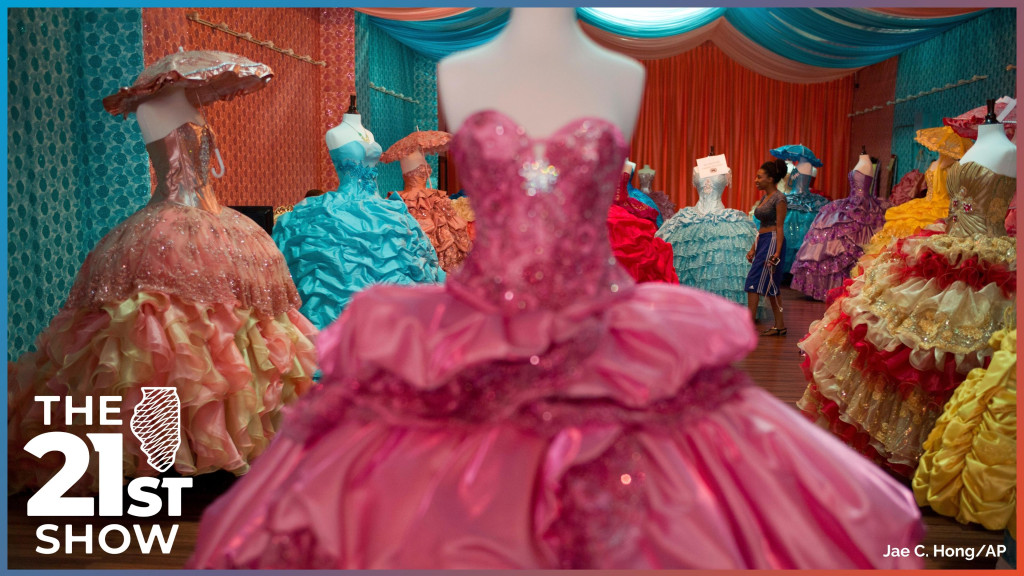
Professor Baez: Sure, I think that, you know, when we think about the quinceañera, it has this long-standing history and tradition of being practiced as a community event, as a coming of age ritual. You know, historically, quinceañeras were tied — and sometimes are still tied — to the church. So for example, at many celebrations prior to it there was a mass specifically for the quinceañera, and they still exist. However, it has become more commercial, it's become more secular, and, you know, we have a section in the book where there are a few chapters that specifically look at how the quinceañera has become commercialized. And I really wanna emphasize that, you know, in the United States this has become big business. So for example there are yearly quinceañera expos where there are dress companies displaying new dresses, there are fashion shows that are part of that, there are all sorts of vendors there selling cakes and all sorts of materials that people might use at a quinceañera. There are interesting services that have popped up, so for example, you know, traditionally in a quinceañera a girl — the quinceañera — has a court of young men and young women who accompany her, similar to a wedding. And because there aren't as many boys interested in becoming parts of these courts — and usually it requires dancing — there are services like rent a [chambelan] where you would rent a young man or teenage boy to be part of a quinceañera. You can hire choreographers. You know, we recently learned as a team that there are cruises that are specifically designed to celebrate quinceañeras. So it is a huge business, and it's one of the tensions that we sit with in the book. On the one hand we recognize this as a ritual that of course changes over time, right, and we can talk about this a little bit later, but you know there are really interesting ways that it has changed in ways that are less gender conforming, for example, and there are other ways in which it's become extremely commercialized, right. And so we tease that out and the kind of contradictions that come up — as you might imagine — within families, and within sort of what the girls want and what they desire and how others, how outsiders are viewing the quinceañera.

[00:07:17]
Brian Mackey: Yeah, and well, let's not wait, let's talk about it now. So Diana Leon [Boys], I'm gonna come to you. And you know, I think certainly those of us who follow politics closely, the idea of, you know, Latinos, Latino voters — it's this idea of a monolithic culture, right? It's all pretty much the same. But obviously there are many, many differences, and talk a little bit about how the traditions of quinceañeras are maybe becoming more inclusive in 21st century America. Right? We have [quinceañeros] and [cincuenteneras] and other, other sort of evolving traditions here.

[00:07:52]
Professor Leon [Boys]: Yeah, and that's actually — I feel like we've organically sort of worked our way through the different sections of our edited collection. And that last section, which I think is just so powerful, it's called transgressive quinceañeras, and I think that speaks directly to your question of how are these events becoming more inclusive, and also, how are they changing? How are they evolving from these long-standing traditions, which, as Jillian noted, are often tied to the church? What are we seeing? You know, we have, like you said, the quinceañera celebration — we're having a lot more boys, maybe gender nonconforming folks using these sort of markers or symbolism, a symbolism of coming of age, but not just necessarily tied to girlhood. At the same time, we have the [cincuentañera], which technically means of 50, you know, instead of quince — 15 — cincuenta — 50 — the celebration of 50-year-old people. We have [noventañeras] — 90 or 80 — you know, we're seeing a lot of these virtually through TikTok, also on a lot of different platforms, how Latinas, Latinos, [Latins] are, you know, taking this celebration that has for so long been so strictly about girls and girlhood and adapting it to other needs.

And I want to go back very quickly to one of the comments you made when you sort of opened it up to me about the fact that it's not a monolithic culture, right. And you briefly mentioned politics. Although this is not directly addressed as a central point in any one of the chapters, it's something that a few of us do bring up peripherally — how the quinceañera, the actual visual symbol, right, the dress and the tiara and all the accessories that come with it, it has actually been used for, you know, different types of political movements. For example, quinceañeras in Texas in 2018 — and not necessarily quinceañeras, young women in quinceañera dresses — set out at the Riverwalk in San Antonio to get people registered to vote for the midterm elections. Then we had the Senate bill protests in Austin, Texas, where we had over 16 girls, young women dressed in their quinceañera dresses or quinceañera dresses that were lent to them, protesting atrocities and injustices against the Latinx community. So we're seeing all of these ways in which the symbol and even, you know, the attire has adapted and adjusted to various needs — political, cultural, societal.

[00:10:44]
Brian Mackey: Yeah, and maybe that's where we can sort of bring this to a close. And Professor [Anadad] Valdivia, I'll come back to you because, you know, some of the examples we're reflecting on — as a team as we were talking about this conversation this morning and preparing for it — some of these examples are 10, 15, even 20 years old in popular culture. And we're now in a moment where, you know, it's an era of mass deportations and people at the very top of our government are trying to make America less multicultural. How are you thinking about that in the place of the quinceañera and other sort of celebrations like that as we move forward?

[00:11:21]
Professor Valdivia: Oh, thank you, that's a great question. Well, the quinceañera is with us today, and one of the ways that scholars of popular culture have theorized it is as an assertion of presence and visibility. And as you mentioned, in a time when there's extreme oppression and deportation and criminalization, to have a quinceañera is to affirm visibility, presence, and ethnic pride, and to say we're here, we're not going anywhere, we're part of this culture, we're part of this country and we're proud of our culture and we will celebrate. We will let you all know that we're here and we still have created spaces for joy. So some of the examples are a little bit old, but we still have a lot of quinceañeras appearing in popular culture. In fact, one of the things that we mentioned in our book is that if you have a television show or a movie with a Latina girl who's around 15, there will be a way for the makers of that show or movie to include a quinceañera, so it's still an often used trope. And we also have elected officials such as [Pulido] who draw on the symbology of the quinceañera to again assert a presence, to gather votes, and to speak out for social justice. So the quinceañera is also part of a visible political assertion of presence, citizenship, and visibility.

[00:12:53]
Brian Mackey: So just a couple of minutes left in our time together. And maybe Professor Jillian Baez, I'll ask you to stand in for your colleagues. All of you write about having — you know, it's not a universal experience for Latino women — and, you know, none of you actually celebrated a quinceañera, at least in the traditional sense. Can you talk about your relationship personally with this cultural phenomenon?

[00:13:17]
Professor Baez: Sure. Yes, none of us have had a quinceañera, for various reasons. So in the case of [Angie] Valdivia, you know, some of that is she was coming from Chile, and in Chile the quinceañera is not as commonly celebrated. Diana chose to take a trip instead of doing a quinceañera, which we found actually is a common choice for some girls who are offered the option. In my case it was more of a financial issue. I was one of several children and I was the oldest, and I think for me it also was kind of a marker of assimilation in the case of my family. And so we came to this project in a bit of a roundabout way because we were looking at just representations of Latina girls in general and trying to sort of chart what is happening in mainstream media and popular culture, how do we see girls being represented, and the quinceañera just kept coming up and really was the main signifier for Latina girls when we looked at media over the last, you know, 10 to 15 years. And so we thought that, you know, we have to look at this even though it is not necessarily our personal experience — something is happening here within the larger U.S. culture where this is becoming a major symbol, and so we have to really investigate this. And so, you know, that was how we approached the project.

[00:14:48]
Brian Mackey: And we're gonna have to leave it there. The book is called [Quinceañeras, Latina Dares and Girlhood in Popular Culture]. It's out now from the University of Illinois Press. I wanna thank the co-authors [Anadad] Valdivia of the University of Illinois, Jillian M. Baez of Hunter College, and Diana Leon [Boys] of the University of Wisconsin-Madison. Thank you for sharing your work with us today here on the 21st show, which is a production of Illinois Public Media. Thanks to everyone who listened and called in today. We will talk with you again tomorrow.
Transcript Assistance
Illinois Public Media may use AI assistance for transcript generation and/or formatting. Transcripts that have not yet been reviewed for accuracy will be labeled.
To report a transcription error, or to request transcription of archival material, please contact will-help@illinois.edu.