








Transcript: Illinois House Democrats grow their supermajority and look for a new speaker
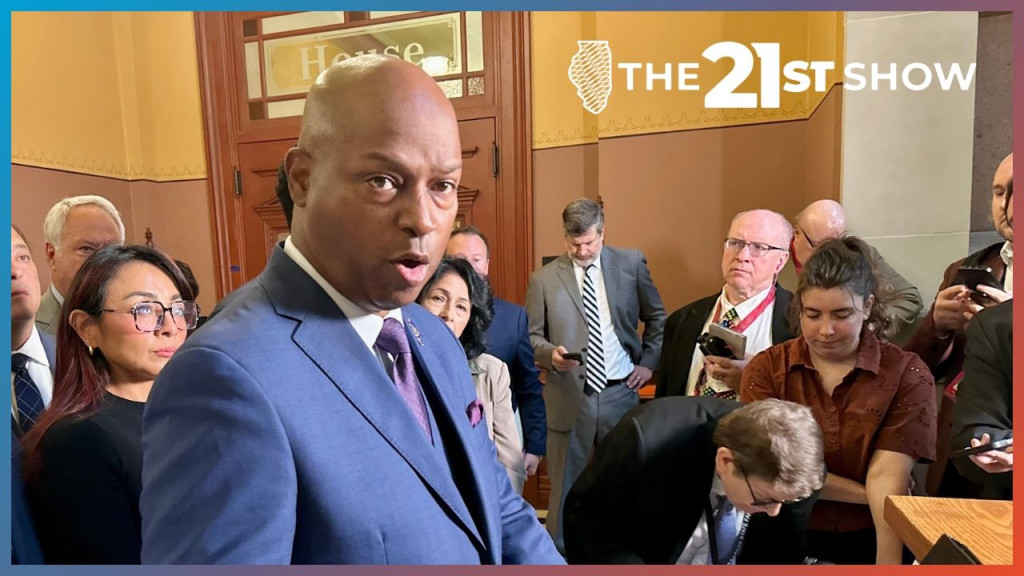
Transcript: Illinois House Democrats grow their supermajority and look for a new speaker
The 21st Show
Illinois House Democrats grow their supermajority and look for a new speaker
Read the full story at https://will.illinois.edu/21stshow/illinois-house-democrats-grow-their-supermajority-and-look-for-a-new-speaker.
Transcript
// This is a machine generated transcript. Please report any transcription errors to will-help@illinois.edu.

[00:00:00]
Brian Mackey: From Illinois Public Media, this is the 21st show. I'm Brian Mackey. For years, Democrats in the Illinois General Assembly have had supermajorities in the House and Senate. That means there were enough Democrats to do things the framers of the Illinois Constitution set a higher bar for passing, like overriding a governor's veto or approving a constitutional amendment. In last week's midterm election, they added to their supermajorities, picking up several seats in both the House and the Senate.

But as the dust was settling on those victories, 26 House Democrats, some of them just elected for the first time, put out a letter calling for a new speaker. Chris Welch, the current Democrat in charge, has faced growing questions over his handling of sexual harassment allegations against a former member of his own caucus. There have been other concerns too. We'll get to that. Late Thursday, Speaker Welch released a statement announcing he would not seek another term as the leader of the House Democrats.

All this comes as lawmakers are headed back to Springfield next week for the start of the General Assembly's fall veto session. And I should say it's officially called veto session, but Governor Pritzker has only issued one veto this year. It was to fix a technical mistake, a typo in the latest state budget. But there are other things they'll be discussing. And joining us now to talk about that and more is Ben Szalinski, statehouse reporter with Capitol News Illinois. Ben, welcome back to the 21st show.

[00:01:35]
Ben Szalinski: Hey, Brian, good to talk to you.

[00:01:37]
Brian Mackey: And uh, listeners, if you have questions about any of this, we're on this for just the first 15 minutes of the show today, so don't wait. 800-222-9455 is the number. 800-222-9455. All right, let's back up a little bit here. For those who may have missed some of this story or forgotten the details, what happened to raise concerns about Speaker Welch and those uh, allegations I mentioned against another lawmaker?

[00:02:03]
Ben Szalinski: Yeah, really this all started with how Welch handled the Harry Benton issue. Representative Benton -- former Representative Benton resigned from the House in July after an inspector general investigation found he was inappropriately talking to women, touching women. Um, but the issue really is, is that Speaker Welch initially knew about these allegations a few years ago, and nothing was ever forwarded up for further investigation or dealt with, and then about a year after those — uh, he first learned about these allegations, he still backed Benton in his 2024 re-election campaign. And we've also learned since then that really around the same time, Speaker Welch himself was actually talking to this victim, this person who was sexually harassed by Representative Benton. Welch was messaging her on Instagram, responding with heart-eye emojis to pictures that she posted. Um, and then the staffer said that the speaker made her feel uncomfortable.

So all of that really frustrated a lot of House Democrats, especially women, and it seemed like there were other things that kind of lined up too, you know. Since this letter came out, we've heard that members have been frustrated with how Welch manages his caucus, how committees and caucus meetings are run, um, how campaigns are run, so this really just kind of seemed like a lot of frustration coming to a head here with the Benton scandal and an opportunity for enough House Democrats to say it's time for a change.

[00:03:34]
Brian Mackey: Talk more about that idea of caucus management. What are some of the concerns raised there?

[00:03:39]
Ben Szalinski: Yeah, so Speaker Welch, one of his most notable rules is there's a 60-vote rule, which means there have to be 60 Democratic votes from House lawmakers before he is willing to move a bill to the floor. The problem, according to some members, is that is not applied evenly. Some votes get exempt from that requirement. Other votes meet that requirement, yet the bill still doesn't get called. Um, so there's been a lot of frustration, a lot of internal fights within caucus meetings lately because of some of these kinds of rules, um, and you know, there's just been a lot of general frustration, I think, about how the speaker manages these meetings and his willingness to listen to members or let members pursue their own priorities.

[00:04:23]
Brian Mackey: It's interesting. I'm old enough to remember when this was in federal politics — this was known as the Hastert rule, and it was the idea of you want a majority of the majority to want some legislation, so you don't — it basically forecloses the possibility of, you know, maverick groups of bipartisan lawmakers working across the aisle. Maybe you'd get 30, you know, or 40 Democrats and 20 Republicans to go along with something. Uh, but you kind of foreclose that if you — if you say no, only things that have majority Democratic support can advance.

[00:04:54]
Ben Szalinski: Yeah, that's — I think one of the things that we've seen hold up the Bears bill, for example. We knew there was going to be Republican support from about 10 or so members, but back in April this past year, it was really hard to get House Democrats behind this bill, but we knew it would have been able to pass if the speaker would have allowed bipartisan support, but he's got this rule — he doesn't want Republicans to be able to take credit for legislation. He wants Democrats to be able to own anything that passes. Um, and so here we are, the Bears bill got held up for a bit and it's just one example of something that's kind of been a victim to this process.

[00:05:28]
Brian Mackey: Yeah, interesting. All right, quick note for listeners, uh, one of the Illinois legislators who has been critical of Welch, Kelly Cassidy, did sign on to this statement many House Democrats put out last week. I talked with her back in August to get her perspective — I should say, after Benton resigned. And you can find a link to that conversation on our website twentyfirstshow.org. She did say at the time that she has no interest in being speaker.

But, uh, so let's talk though: what happens next? Welch says he'll continue to be a member of the Democratic caucus. Um, what happens now that he has, you know, or is at least relinquishing the speakership in January — not immediately, but in January.

[00:06:06]
Ben Szalinski: Yeah, they got to come up with some sort of process here, you know. Traditionally, these leadership votes have been held privately in November when lawmakers come back for the veto session, which begins next week. We're not expecting the House is going to take any sort of votes on that in their private caucus meetings, but uh, it's probably gonna be kind of a chaotic behind-the-scenes process where there's different folks who want to be speaker — they're gonna be trying to line up these votes and to get enough support from 60 Democrats in order to actually, uh, earn their speakership officially when the new House convenes in January.

Um, so we don't really know exactly who is actually going to be a front-runner. There's been a lot of speculation. We know Representative Cassidy is not going to be involved in that, um, but we've heard that Marcus Evans from the south side of Chicago has been making phone calls. There's speculation about Kam Buckner, who's been very influential on a lot of bills, Mary Beth Canty — she's the chair of the Women's Caucus and has been a very vocal opponent of Chris Welch over this summer. But there could be maybe a dark horse candidate somewhere in the state who might emerge as the next speaker, so I think it's gonna be a tough closed-door process with a lot of horse trading and haggling between Democrats, and they're gonna hope to come out with smiling faces at the end of this, I think.

[00:07:23]
Brian Mackey: You know, it's interesting, one of the things I've thought about Illinois politics as the state has grown increasingly blue is that, you know, it's almost a disservice to readers and listeners to say, oh, what are the Democrats and the Republicans doing? You almost need to cover the factions within the Democrats, because their caucuses are now so large. And I think you're definitely going to see that playing out here with moderates versus progressives and Blacks and Latinos and women and all the other different groups that make up the Democratic coalition here in Illinois.

Um, so you mentioned a few of the names there. I guess we'll see what happens. Um, let's — uh, let me remind listeners, this is the 21st show. Uh, we're talking with Ben Szalinski, statehouse reporter with Capitol News Illinois, about, uh, Speaker Welch's decision to not remain speaker after January. He lost the support of his caucus, uh, so there'll be an election for new leadership, I should say. And let's come back now to who will be casting those votes, because there are going to be more Democrats than ever in the Illinois General Assembly. Um, what happened to make that possible? Where they actually picked up seats in a map that, you know, a lot of people thought maybe had been sort of drawn to maximize — and it reached the limits of what it could do for the Democratic Party in Illinois.

[00:08:37]
Ben Szalinski: Yeah, it's hard to believe that in the House we're going to have 84 Democrat members out of 118. The Senate's even worse. I mean, there's going to be only, I think, 14 Republicans left out of the 59 seats by the time uh, the new General Assembly is sworn in.

[00:08:53]
Brian Mackey: Just a little quick math on that for listeners: that's 71% of the legislature will be Democrats in the House, compared to like even Pritzker, who exceeded all his past vote totals — he only got 60% of the vote. So that shows you how much more representation Democrats have managed through clever mapmaking in these legislative elections.

[00:09:15]
Ben Szalinski: Yeah, and it's far more than that 66% supermajority threshold that is needed to pass bills at certain times of the year. So, uh, it was really just the best-case-scenario election, I think, for Illinois Democrats. You know, this exceeded everyone's wildest dreams, I think, going in. Uh, folks expected that Democrats in the House were going to pick up, you know, two or three or four seats here, um, and it turned out to be way bigger than that. We've seen, you know, some moderate folks like [Daniel Gassy] who wasn't really on anyone's radar — he's out in the [Kane] County area in a typically safe Republican district. He lost this election big, and there were no opportunities really anywhere on the board for Republicans to pick up seats the way this ultimately turned out.

Um, you know, all this national stuff that we've talked about, the frustration with the Trump administration, it really just seemed to trickle down all the way across the ballot, even in Illinois, where these moderate Republicans who aren't fans of Donald Trump, don't identify with the [MAGA] wing of the party — they got punished and they are not coming back to Springfield, because Democratic voters were just so motivated this year.

[00:10:23]
Brian Mackey: Fascinating. All right, well, we mentioned the uh, fall veto session, legislative session. Let's talk about some of the things that can come up there, starting with data centers. Of course, this has been a big political issue in this election cycle, both here in Illinois as well as around the country. There was talk in the spring about some legislation to regulate them that didn't make it anywhere before adjournment. Can you remind us what is on the table in terms of regulating data centers here?

[00:10:50]
Ben Szalinski: Yeah, one of the main things that the governor really wants to see is that data centers are going to have to pay for their own utilities. He wants them to be paying a separate bill for their electricity, for their water, um, because these facilities just use so much of this energy and the utilities and the water. Um, so that's I think really the big sticking point here — is they don't want consumers to be saddled with the bills for data centers eating up a greater supply of electricity.

So, you know, one of the central questions is how are these data centers going to be able to bring their own electricity without straining the grid that the rest of us are trying to use on a daily basis. You know, there's a lot of talk about nuclear regulation and allowing these data centers to be able to bring in nuclear, small nuclear reactors, to power facilities on an individual basis. Um, there's other concerns though about land use and local regulations. We've seen a lot of local governments throughout Illinois that have tried to, you know, approve a data center in the area, and the community has had just massive bipartisan backlash to these facilities coming to their area. So lawmakers are also trying to find a way that, um, you know, would allow for more local control and more local regulation of these facilities, allowing maybe neighboring communities to weigh in and potentially block a data center from moving in next door, for example.

So there is a lot on the table, but we know this has been a big issue for voters, so we do expect that lawmakers are going to try and get something done here in the next couple of weeks on it.

[00:12:31]
Brian Mackey: One of the other issues — and you mentioned this briefly earlier — is uh, Chicago Bears. There was no, uh, legislation aimed at allowing the Bears — or I should say encouraging the Bears to build a new stadium in Arlington Heights in the spring. Uh, there's been a lot of talk about them moving to Indiana. The president and CEO of the Bears, Kevin Warren, uh, even called the Hammond development the team's sole focus back in August. And yet they may still end up calling Illinois home, if not Chicago. What's going on there?

[00:13:03]
Ben Szalinski: Yeah, it sounds like there is a lot of positive progress here in Illinois for lawmakers to get a bill done. It sounds like they are trying to wrap up the details of this thing this week. Um, the governor has said we could see a hearing on the bill as soon as next week, um, with a vote following right after Thanksgiving. So, uh, you know, what it looks like is going to happen is the NFL has gotten increasingly involved in this and trying to steer the Bears in a direction. Um, we heard from Senator Bill Cunningham recently, who said that the Bears have become increasingly comfortable with this idea that the public is going to own this stadium, so this would create a new stadium, um, ownership oversight board here in the state of Illinois that would own the Bears stadium. But the Bears would ultimately be paying for it, kind of alleviating those concerns that the state is, you know, going to be bankrolling a multi-billion-dollar sports franchise.

Um, the Bears apparently are becoming interested in that model where, you know, they're OK paying for it and they get that property tax certainty that they've long sought here in Arlington Heights at the end of the day. Um, so it seems that's the direction we're going. There's still a lot of questions we don't really know the answers to, but, uh, you know, from all the lawmakers we hear from about the veto session, it sounds like this is really a priority across the board. I think a lot of folks do kind of view this as potentially one of the last chances for Illinois to compete with Indiana and make sure the Bears aren't leaving the state.

[00:14:33]
Brian Mackey: All right, I want to come back to this data center legislation, the Power Act you referenced. We got a call from Paul in Urbana. For the sake of time, I'm just gonna ask it to you myself. What else is in there — in about a minute and a half — what else is in that legislation besides, um, you know, data center regulations?

[00:14:50]
Ben Szalinski: That's a good question. It's pretty tight-lipped right now, so that's all we kind of, I think, really know — is that there's going to be some sort of data center regulation bill. I kind of outlined those high-level thoughts, which we know are the priorities of the folks involved in this conversation, but, uh, you know, it's gonna be a really big bill. I think there's going to be a number of things in there that maybe we're not watching right now. It's gonna be very specific and very technical too.

[00:15:18]
Brian Mackey: Christmas tree legislation? I mean, is there an opportunity for some of the other — uh, yeah, we'll have to wait and see, I guess, as these things go.

[00:15:27]
Ben Szalinski: Yeah, it's a good question.

[00:15:27]
Brian Mackey: Yeah, all right, uh, thank you for the call, and Ben, thank you for sharing your reporting with us here on the 21st show. Ben Szalinski, statehouse reporter with Capitol News Illinois. Appreciate your work.

[00:15:41]
Ben Szalinski: Thank you, Brian.

[00:15:43]
Brian Mackey: Coming up after the break, we're gonna be turning to another piece of legislation that the backers hope to get through during the Illinois General Assembly's fall veto session this year. It has to do with people coming out of prison in Illinois. Uh, prison is a difficult enough experience, but then you get out. What happens next? Where do you even find a place to live? That is a big challenge. This legislation aims to address some of those challenges. We'll talk about it with people who are behind it after a short break. This is the 21st show. Stay with us.
Transcript Assistance
Illinois Public Media may use AI assistance for transcript generation and/or formatting. Transcripts that have not yet been reviewed for accuracy will be labeled.
To report a transcription error, or to request transcription of archival material, please contact will-help@illinois.edu.