








Transcript: Quad Cities film festival celebrates Latino culture and history
Transcript: Quad Cities film festival celebrates Latino culture and history
The 21st Show
Quad Cities film festival celebrates Latino culture and history
Read the full story at https://will.illinois.edu/21stshow/latino-film-series.
Transcript
// This is a machine generated transcript. Please report any transcription errors to will-help@illinois.edu.

[00:00:00]
Brian Mackey: It's The 21st Show. I'm Brian Mackey. In the six counties of the area around the Quad Cities in Illinois and Iowa, Latino residents make up about 10% of the population, according to the U.S. Census Bureau. In Moline, they're around 20%. There are many ways people in those communities come together to both reflect on and celebrate their history and culture.

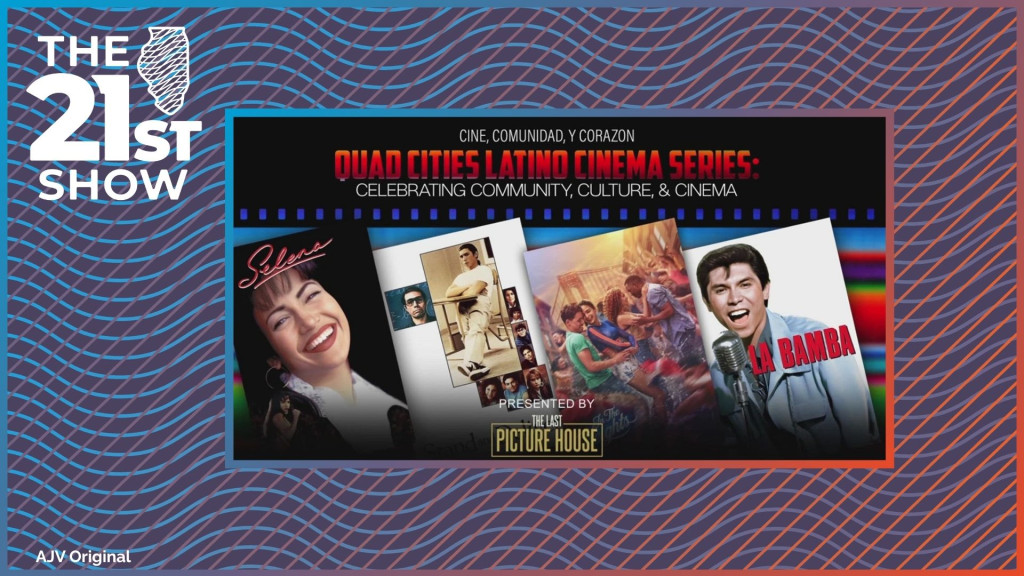
Over the next few months, the Davenport movie theater The Last Picture House is adding to that, with monthly screenings of films that highlight Latino culture. It's being called the Quad Cities Latino Cinema Series. It started a couple of weeks ago with "Selena." Later this month, they'll be showing "Stand and Deliver," in September "In the Heights," and October is "La Bamba."

The organizer of the festival is Antonio Varela, who makes his living as a photographer and videographer in the Quad Cities. He's with us for the last part of the program today. Antonio, welcome to The 21st Show.

[00:01:05]
Antonio Varela: Thank you for inviting me. I'm, I'm, I'm pretty excited. It's my first time on, on radio.

[00:01:09]
Brian Mackey: Well, we're just two people talking. Don't, don't worry about anyone else. But if anyone else is listening, you can join us at 800-222-9455. That's 800-222-9455. All right, Antonio, we'll, we'll talk more about the film series in a little bit, but I just wanna start by talking about you, your own experience. You're born and raised in the Quad Cities. What was it like for you finding community with people there as you were coming up?

[00:01:36]
Antonio Varela: So I was lucky enough to be raised in the Floreciente neighborhood in Moline, primarily Mexican-American immigrants. It was awesome. I, I was also blessed, being able to go to Mexico every summer, winter, spring break, whenever my dad or my mom wanted to go visit their parents or their family. So I was able to, to live in Mexico, experience Mexico, the warmth, the getting up early and walking and everybody saying good morning to you and acknowledging you. And I got that in the Floreciente in, in Moline, which you don't get a lot, you know, in every other neighborhood. So it, it, it was awesome to get a little bit of, a little bit of Mexico in that neighborhood, because now living outside of that neighborhood, you, you can just tell the difference, you know, life passes by fast. People are on the phones, you know, walking past you, not saying hi. So, yeah, it, it, it was awesome. And again, I was lucky enough to be raised in a, a Mexican neighborhood like that.

[00:02:48]
Brian Mackey: Talk about the, the Latino, you know, the broader Latino community in the Quad Cities. How, how has it grown, changed over the past decade or so?

[00:02:56]
Antonio Varela: It's grown immensely. When you said the statistical 20%, I was like, oh man, like, in, in my, again, everybody has their own little world, but in my world, it, it, you know, tripled since I was in high school, and, you know, quadrupled since I was in elementary. It, it's, it's amazing. We have, you know, different walks of life, whether it's from Honduras to, you know, Guatemala to Colombia, you know, all these different colors and different flags and representations of, you know, Latinidad or those that are Latinos. And even though we're from different countries, and even though we speak Spanish, you know, it's still different, it's still unique, and, and it's amazing to to see that. It's amazing to see it's more accepted, more, a lot of people are more open-minded to, you know, celebrating with us and being wanting to be educated on where we come from, what we celebrate, and how we celebrate it.

[00:03:56]
Brian Mackey: So this is your, your first time organizing a film festival. What, what gave you this idea?

[00:04:02]
Antonio Varela: So really, I saw a Facebook post from this theater, The Last Picture House. They wanted some input on what they can do differently or, you know, what, what, what kind of events we want to see. And I messaged them saying I have an idea and I would love to sit down with you. This is who I am. This is what I've done. And they said, let's do it. Let's meet. So we ended up meeting and my number one goal was to at least have one movie that I can take my kids to, that they would, you know, feel represented, because I take the kids to the movies all the time. They love it. They love seeing all different types of movies, but unfortunately, movies that are based off of Latin culture or inspired by Latin culture is very rare. So that was my number one goal, and I said, you know, we can make a film festival if you want to, and the Last Picture House was amazing enough to say, let's do more. Let's do this. It's like they, the, it was just a blank canvas, and I said, let's, let's make it happen.

And at the end of the conversation — 'cause there were so many different iterations of this event — but at the end of what stood out to me the most was, if you want, we can incorporate nonprofits, and the nonprofits can benefit from all the ticket sales. And that's what shocked me. I was like, what do you mean all the ticket sales go to the nonprofits? What's the catch? And they said there's no catch. Like they want to be more inclusive, and they want to be more part of the community, and they want these nonprofits to benefit. So I went ahead and I chose the nonprofits that have benefited me, my family, my community, to be a part of this, you know, first event or first series, and they all hopped on it, and it was, it was amazing. It was amazing to see, you know, all these nonprofits together in one event, and it's awesome.

[00:06:03]
Brian Mackey: So talk about programming the festival, right? It's, it's one thing to organize a photoshoot as a still photographer. Putting together a film festival is another. And I understand picking movies like that for this, that was like a collaborative process with some of the organizations. How did that work?

[00:06:19]
Antonio Varela: Yes, so I'm not only a full-time photographer, but I also am the director of, um, operations of markets, or the, the manager of operations and marketing for Mercado on 5th. It's, um,

[00:06:37]
Brian Mackey: Oh yeah, we visited there for, uh, Día de los [Muertos] on the show a couple of years ago. Did a full show from there.

[00:06:43]
Antonio Varela: Awesome, yeah, so I run the market, uh, promotions and operations, and so I have, I'm, I, I know how to kind of program things, and you know how to contact who to contact. And when it, when it came to this, I know I could, I could have programmed every night myself. But I didn't want it to be about me. I didn't want it to be solely run by me. I wanted it to be a whole team effort, you know, bringing in the community. So for each night, I had recommendations for each of them on what to program, how to program. It was up to them if they wanted to move with my recommendations or do something different, which is totally fine because what the Last Picture House and I did was we provided the space, the opportunity for them to be empowered to, you know, pick a movie or give us a list of movies, and then program each night to their mission or to what they want to represent. And again, some of these did pick my recommendations and some went all out and do something different, which I'm excited to see. So yeah, programming was, it was collaborative, but also it was on them, on, on their specific night.

[00:08:04]
Brian Mackey: What was the top movie on your list that, that is gonna be available for, for people to go to and maybe you can just talk about what it means to you and why you, why you chose it.

[00:08:13]
Antonio Varela: So the first one, I mean, the most popular one was, of course, "Selena." Everybody wanted that one, but the one I really wanted to, to bring out was not available, which was "Blood In Blood Out," but also the next best one was "Stand and Deliver," sorry. With Edward James Olmos and Lou Diamond Phillips, it's a great movie, great message, and I really —

[00:08:41]
Brian Mackey: 1988, for people who aren't — I feel like it's old enough now that maybe we should tell people if they haven't seen it, it's like a — [comedy drama], I guess. That's, I'm looking at the Wikipedia page here. I did remember seeing this in the '80s, but it's like a, a, a high school teacher who takes a group of kids into advanced placement calculus math class, right? Kids that maybe the school hadn't, you know, thought were capable of that.

[00:09:06]
Antonio Varela: Correct. And it's based off a true story, which is also amazing. And it, it, it's a great message of, you know, just resi — resiliency and, you know, to, to try your best no matter what circumstances you're in. And we were able to get that movie and the programming for that — excuse me, for that night — is amazing. The Greater Hispanic Chamber of Commerce is hosting that night and will be benefiting from all ticket sales that night. They are programming a car show outside the theater, and they, they will also be honoring a Latino teacher from the Quad Cities that has helped or has done something in the same way as the teacher does in the movie, and they're gonna be honoring a teacher that night. They haven't announced it yet, but they will be, they will be doing it.

[00:10:01]
Brian Mackey: You know, I have to ask — you, you talked about the, the Latina, Latino population there, Guatemala, Colombia, Mexico. There are people in this country who hear that and think that's not where they want America to go. And some of those people are in the White House right now. And we've certainly seen the effects of what they're trying to do about that in communities across the country, including here in Illinois. I wonder if that has put a damper on this or, or some of the other, you know, community activities, just community life that, that you've experienced in the past year and a half.

[00:10:36]
Antonio Varela: So it has, I'm not gonna lie to you, it, it, it has, across the board, whether it's with small events to big city events like in Chicago, I mean, we see it, it, it does affect everybody. But my mission is to always — me myself, my mission is to always, no matter how hard the predicament is, to always be proud of who we are and to celebrate who we are, for those that can't or are too afraid to do so at this moment. So that's, uh, just another, I think what drives me and what I do in my photography and also, excuse me, with this event. And, uh, yeah, it has dampened some events, you know, throughout the, the, the country. But there's still people that are able to come out and, and feel the same way that I do, is that we should not be, you know, hiding. We should be celebrating and educating, so that those that are feeling some sort of way, as you mentioned, about, you know, the growth of the Latino population, hopefully they get educated enough to see that we're not on opposite teams. We're one country, one team. And yeah, that's, that's the way I feel and the way I think.

[00:12:05]
Brian Mackey: Why does it matter to have these stories — coming back to the movies, right — to have these particular stories told and shared time and again.

[00:12:14]
Antonio Varela: Well, that's a very good question. It, it, it's very important because first off, again, my number one goal is representation for my kids. So if my kids feel inspired or represented, you know, hopefully it sparks something in them to create something better for their future, to put more effort into what they wanna do. And with that being said, for those kids that are going, for those families that do go, you know, the purpose of this is to inspire, to educate, to, to get that spark going for the next generation. And especially to know, you know, some of our history — you know, "Stand and Deliver" is based on a true story. "Selena," "La Bamba," these stories are part of the, the history, whether it's American or Latino history. Like it's our history. And if we don't know where we come from or what we did, I mean, we're just doomed to repeat the same thing over again. So we have to learn from our mistakes and learn from our accomplishments.

[00:13:22]
Brian Mackey: Antonio Varela is the organizer of the Quad Cities Latino Cinema Series. It's being presented at the Last Picture House in Davenport, Iowa. The next film — film in the festival, I should say — is "Stand and Deliver." That's August 19th. We'll have more information about it on our website, 21stShow.org. Antonio, thanks so much for being with us today on The 21st Show.

[00:13:44]
Antonio Varela: Thank you so much for the invite. This is amazing, great experience. I thought I was gonna mess up. I didn't, so I appreciate it.

[00:13:50]
Brian Mackey: You did great. Thanks for being here.

[00:13:52]
Antonio Varela: Thank you.

[00:14:07]
Brian Mackey: That is it for us today. Coming up tomorrow on the program, we're gonna be talking about the Speaker of the Illinois House, Chris Welch, with two reporters who have been covering an ongoing controversy involving his leadership of the House Democratic Caucus. There's a state representative who is accused of misconduct, sexual harassment by one of his staffers. This came up years ago. It's finally coming to light now because of both an ethics complaint that has been released now, although there was some question about that, as well as a series of stories in the Chicago Tribune, looking at the response to these complaints long before it became public. We're going to be talking with two of the reporters behind that story, plus another reporter who took a reporting trip to Lithuania to talk about the connection between Illinois and Lithuania.

That's all coming up tomorrow here on The 21st Show, which is produced by Christine Hatfield and Jose [Zaeda]. Our digital producer, [Kum] Khan. Technical direction and engineering by Jason Croft and Steve Mork, and Reginald Hardwick is our news director. Let us know what you think. [talk@21stshow.org] is the address. Subscribe to our podcast — Apple, Spotify, YouTube, wherever you listen. The 21st Show is a production of Illinois Public Media. I'm Brian Mackey. Thanks for listening.
Transcript Assistance
Illinois Public Media may use AI assistance for transcript generation and/or formatting. Transcripts that have not yet been reviewed for accuracy will be labeled.
To report a transcription error, or to request transcription of archival material, please contact will-help@illinois.edu.