








Transcript: Sights and sounds from 2026 Illinois State Fair
Transcript: Sights and sounds from 2026 Illinois State Fair
The 21st Show
Sights and sounds from 2026 Illinois State Fair
Read the full story at https://will.illinois.edu/21stshow/sights-and-sounds-from-2026-illinois-state-fair.
Transcript
// This is a machine generated transcript. Please report any transcription errors to will-help@illinois.edu.

[00:00:00]
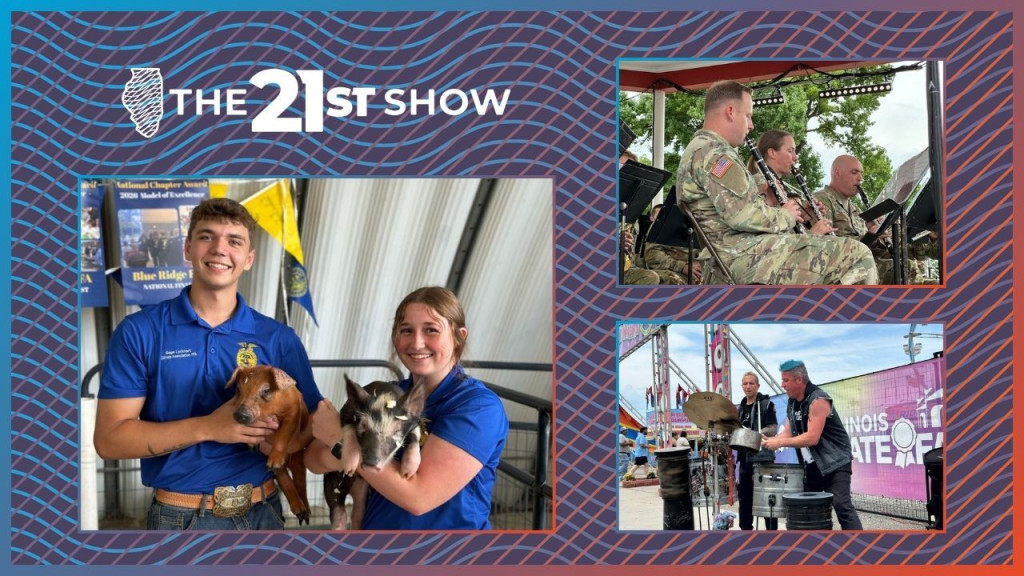
Brian Mackey: It's the 21st show. I'm Brian Mackey. This is the 144th Army Band, part of the Illinois National Guard performing last Friday at the Illinois State Fairgrounds. The team and I spent several hours roaming the fair that afternoon. We had lunch at the Village of Cultures. We took in the sights and sounds from musicians to carnival games to the Future Farmers of America. And from that we offer you this sonic postcard of some of the thousands of people who are part of making the State Fair here in the 21st state.

[00:00:58]
Keith Shasine: My name is Chief Warrant Officer 3 Keith Shasine. I live in Pinckneyville, Illinois, and I'm the commander of the 144th Army Band. We're stationed in Peoria at the 182nd Air Wing there. Lovely facility, and in my full-time job and teaching job, I teach at Sparta High School in Sparta, Illinois down south.

[00:01:16]
Speaker 2: What subject?

[00:01:16]
Keith Shasine: Sure, I teach high school band, chorus, music appreciation, all things music there at the high school, and in addition to that, I'm also a driver's education teacher.

[00:01:25]
Speaker 2: Wow, you got a lot of hats. How often do you all get together to perform?

[00:01:31]
Keith Shasine: Sure, of course we do have our monthly drills. So once a month we come together and rehearse and take care of everything that we need to with our rehearsals, and on occasions we perform during those drills. But then we have 14 days spread out throughout the year that we can perform all over the state. So on average we usually have two to three performances a month somewhere in the state of Illinois.

[00:01:52]
Speaker 2: Obviously musicians have been a part of the army since the days of George Washington and the Continental Army. What is the mission of military musicians in 2026?

[00:02:01]
Keith Shasine: Sure, I think military musicians in 2026 — we do a couple things. So our two biggest things are we perform for military ceremonies and military event requests — balls, our jazz combo in particular plays military balls a lot. And then so we take care of all of the military requests, changes of command and changes of responsibility. But in addition to that, we have an educational outreach program as well, and so we have a number of ensembles that go to our schools not only to recruit for us and the Illinois Army National Guard but to recruit for the force altogether. And in addition to that, we accept performances from communities all over the state of Illinois. So if you have a local parade that you'd love to see the 144th Army Band at, or if you have a performance opportunity or a nice venue, town-type setting, feel free to reach out.

[00:02:55]
Speaker 2: I look around, I see specialists all the way up to — I think I saw a master sergeant maybe — on the various tabs people are wearing. Is there a typical background of the people who are in this unit? You know, they're mostly professional musicians, they do other things?

[00:03:09]
Keith Shasine: Absolutely. There are anything from recently graduated high school, and they have gone to school — they're in college now earning their degree in music or other degrees. We have one that's in engineering, and several of them are going to be music educators. But in addition to that, we just have musicians that gig around the city of Chicago and wanted a steady job with the Illinois Army National Guard in [the] 144th. We have factory workers, we have teachers of all kinds.

[00:03:40]
Speaker 2: And what's next? Are you leading this unit as well, the jazz band here?

[00:03:46]
Keith Shasine: So on the jazz band, it'll be under the command — he's the NCOIC, as we call it, the NCO in charge — of Sergeant Wesley Anderson, and he's also a music educator in the state, and he's going to take over the jazz band for here about an hour. We're excited for the performance.

[00:04:04]
Speaker 2: Sounds very avant-garde right now. They're warming up.

[00:04:28]
Brian Mackey: From the Village of Cultures, we make our way north through the dairy building, where the life-size butter cow is endlessly rotating on a platter in a refrigerated glass case. The dairy building runs along Illinois Avenue, where there's a hot pink tent advertising face painting, tattoos and balloon animals.

[00:04:49]
Oren Traman: Oren Traman. I'm from West Chicago, Illinois, and I am a balloon artist.

[00:04:55]
Speaker 2: How does one get into the field of balloon artistry?

[00:04:59]
Oren Traman: Well, my wife was already a face painter and I've had friends that did balloons, and one thing led to another. I'm a photographer also, so —

[00:05:09]
Speaker 2: This is a family affair, this tent here. So what do people not understand about doing balloon sculpture? What is the trick to it? Because, you know, my kids got one of those sets once where they tried to do it themselves — doesn't work out.

[00:05:21]
Oren Traman: You always have to lock it in. You can't just twist it and then let go — it won't, it'll just untwist. You have to lock it with another balloon, with that balloon, so you have to wind it and then you have to lock it.

[00:05:33]
Speaker 2: An intersection of the balloon element.

[00:05:35]
Oren Traman: Intersection of the balloon — yes, you have to make sure you twist it enough. You always have to twist in the same direction. If you twist in the opposite direction, it will untwist. Those are important things, and then you have to have good twisting balloons, so —

[00:05:47]
Speaker 2: Special balloons?

[00:05:48]
Oren Traman: Balloons, you know, like at Dollar Tree, a lot of times they're likely to pop.

[00:05:54]
Speaker 2: What is the most requested balloon animal you get?

[00:06:00]
Oren Traman: Super water blaster, maybe.

[00:06:02]
Speaker 2: Oh, it's like a super — OK, like a Super Soaker, I guess, would be the brand — yeah, very popular. And so what does your season look like? Do you go from county fairs, state fairs — what kind of events?

[00:06:12]
Oren Traman: Birthday parties, corporate events, block parties, business events — all year round. Tattoo conventions, we do tattoo conventions.

[00:06:21]
Speaker 2: Tattoo conventions — what's that like?

[00:06:23]
Oren Traman: We're the only ones — but we're the only ones doing artificial tattoos, not real ones, so we're the one — there might be 1,000 booths and we're the only one doing, you know, balloons and face painting.

[00:06:35]
Speaker 2: If somebody's not ready to commit to that skull or —

[00:06:37]
Oren Traman: Whatever — a way to learn, you know, to try it out before you get the real thing.

[00:06:42]
Speaker 2: Excellent idea. Thanks so much for your time.

[00:06:44]
Oren Traman: You're welcome. Thanks for coming by.

[00:06:54]
Speaker 2: I'm Brian with Illinois Public Media, just going around talking to different people. Can I ask who you are, what you do?

[00:06:59]
Scott: We are the Street Drum Corps. We're based out of L.A. and we're here for the Illinois State Fair, going to be performing every day all week.

[00:07:06]
Speaker 2: L.A., like Los Angeles?

[00:07:09]
Scott: L.A. in California. Yes, sir.

[00:07:11]
Speaker 2: What are your names?

[00:07:12]
Scott: I'm Scott. This is Jeff. We're a group of drummers. We're kind of a [group] of drummers. We do high-energy street performances usually made out of buckets and trash cans, pots and pans, leftover things that a lot of people would consider trash or throwaway items. Yeah, yeah, yeah. We got a lot of just high energy, and we love getting the crowd involved too. So anything can be a drum, and we're happy to show people that you don't need a lot of money to do it.

[00:07:53]
Brandon Ransom: I'm Brandon Ransom. I work with Beat the Bar here over at the Illinois State Fair. I get people to try to win $150 by being suspended in the air with either an overhand grip or an underhand grip.

[00:08:05]
Speaker 2: This is like a pull-up, but — you know, what do they call it — the dead arm hang, or something? Hang challenge. Yes, OK. What — so it's a bright yellow tent. There's two bars, different for boys, girls, men and women.

[00:08:17]
Brandon Ransom: So for the men, the hang time is 2 minutes, but for the ladies and children it is 90 seconds.

[00:08:24]
Speaker 2: How often does somebody actually make it through?

[00:08:26]
Brandon Ransom: It varies by person. It's a very difficult challenge. I myself am only able to go about 57 seconds.

[00:08:33]
Speaker 2: What makes it so hard?

[00:08:35]
Brandon Ransom: So the bar sits on ball bearings, so it's a swivel bar, so it makes it a little bit more challenging than most people think. But it is completable. We've had over 750 winners throughout half the United States so far.

[00:08:46]
Speaker 2: What about in the fair? Have you seen any winners yet out here today?

[00:08:49]
Brandon Ransom: Not yet. I'm very [much] hoping that there are going to be some winners. The past couple of days it's been a little bit slow with the weather and all that, but I'm hoping with today being a really good day — being Friday — I hope that we get a lot of winners today.

[00:09:01]
Speaker 2: The rain's let up a little bit. Do you ever get people sort of angry when they don't make it?

[00:09:08]
Brandon Ransom: So with most people's reactions, they either end up being a little bit disappointed or they do end up being a little bit angrier that they aren't able to complete it themselves. But they do come back for redemption, and most winners do come back on their second attempt.

[00:09:21]
Brian Mackey: We continue up Illinois Avenue until it curves into Grandstand Avenue. Continue walking north by northwest and you'll eventually come to the FFA barnyard. This is a small Quonset hut filled with baby farm animals and staffed by the young men and women of the Future Farmers of America.

[00:09:39]
Gage Lockhart: My name is Gage Lockhart, and I'm from Section 20. I'm with the Illinois [FFA].

[00:09:45]
Speaker 2: So where's Section 20?

[00:09:46]
Gage Lockhart: Section 20 is way down south and it's right on the Indiana border.

[00:09:51]
Anne McCollum: I'm Anne McCollum. I'm from Section 18 and I live in Catlin, Illinois, which is about 20 minutes south of Danville.

[00:09:57]
Gage Lockhart: We have with us today Jack and Jackie — the male is Jack and the female is Jackie.

[00:10:04]
Speaker 2: So keep in mind our listeners cannot visualize. Tell them what they would see if they were looking in here.

[00:10:09]
Gage Lockhart: OK, so Jack is a small baby, 6-week-old Duroc pig, and he is bright red. And then his partner in crime is Jackie, and she is a crossbred and she is black and white.

[00:10:20]
Anne McCollum: And we're here just to let FFA make its impact in the state fair and to show little kids and everyone from across the state about agriculture and all the different sides of it. But it's not just the farm life — there's also more opportunities than just being a typical farmer or livestock kid.

[00:10:37]
Speaker 2: So now, you know I'm the type of guy — I think bacon tastes good, pork chops taste good — but I get a little sad when I watch "Charlotte's Web." So how do you all think about that?

[00:10:46]
Gage Lockhart: Well, with us right now we have show pigs, so they're actually not going to be bred to be butchered.

[00:10:52]
Speaker 2: Tell me more. I didn't know that was a thing.

[00:10:54]
Gage Lockhart: So basically, we raise [show pigs]. I don't personally, but there's people who raise show pigs and they take them around the country — sometimes just around the state — and show them and see how good of a body they can get on them and see how well they'll do.

[00:11:08]
Speaker 2: And then what happens when they need to retire from being show pigs?

[00:11:12]
Anne McCollum: A lot of times they'll end up getting [bred], so like if you have a really good show pig, they'll just keep on making them. Or a lot of people get really good bonds with their pigs, so they just keep them around, kind of like they would a dog.

[00:11:24]
Speaker 2: [Keep them] like a dog. Do pigs live inside houses?

[00:11:27]
Anne McCollum: Usually not. Some people might do that if they're into that kind of stuff.

[00:11:35]
Speaker 2: I think we can leave it there. [Can I get] a picture — I definitely want — can I get a picture of you all with the pigs? You want to hold the pigs? Can you do that safely? Oh my goodness, they're so cute.

[00:11:48]
Brian Mackey: I got the picture, which you can see on our website, [twentyfirstshow.org]. From there we head west. It starts to rain, so we duck into the sheep barn, where a man is quite thoroughly blow-drying one of the residents.

[00:12:10]
Ty Holdle: My name is Ty Holdle, and I'm from Peoria, Illinois, and I'm just here with my sheep getting them ready for the breeding show that we have on Monday.

[00:12:19]
Speaker 2: So the sheep is making his voice heard here. What's his name?

[00:12:24]
Ty Holdle: I don't really have a name for her, but my cousins sometimes call her Lily, but —

[00:12:29]
Speaker 2: Lily — sorry — her name. My bad. So, is that a blower? I mean, you've been sitting here — it looked almost like vacuuming, but there's air coming out. So what are you doing?

[00:12:38]
Ty Holdle: So this is, yeah, it's a blower — exactly right. So I went and washed her to get ready to shear her, and you have to blow off all the water off of her wool to make sure they're nice and dry and clean, to get them ready to be sheared and shorn and get them ready to be shown.

[00:12:52]
Speaker 2: So what are the key things that you keep in mind as you're preparing for a show?

[00:12:56]
Ty Holdle: Big thing is their diet — making sure they get the right amount of food and protein so they're in shape and they're ready to get shown. Working with them ahead of time, so tying them up, working with them outside to make sure that they stand well in the show ring. And just caring for them, making sure they have a good living space.

[00:13:12]
Speaker 2: All right, what do you think your chances are this year?

[00:13:16]
Ty Holdle: I got some pretty good ones, so I'm hoping I do well.

[00:13:19]
Speaker 2: Blue ribbon?

[00:13:20]
Ty Holdle: I'm hoping so — maybe even a purple.

[00:13:22]
Speaker 2: Oh, purple's better than blue. Tell me about that.

[00:13:25]
Ty Holdle: Purple is the champion. So if you get a purple ribbon, that means you won champion overall.

[00:13:29]
Speaker 2: Thanks, man. I appreciate your time.

[00:13:31]
Ty Holdle: Of course. Thank you.

[00:13:31]
Speaker 2: Good luck.

[00:13:31]
Ty Holdle: Thank you.

[00:13:34]
Brian Mackey: The last word in our program today will go to Ty's sheep, who may or may not answer to the name Lily. That is it for us today.

Before we go, I want to invite you to take in and take part in our extensive political coverage leading into this fall's elections. We Illinoisans will be choosing a governor, other statewide officials, members of Congress, the General Assembly and certain local officers. Last week on the show, we aired our conversation with incumbent Democratic Governor JB Pritzker, and one with his Republican challenger, Darren Bailey. You can find both of those conversations at twentyfirstshow.org, or you can watch them on YouTube — just search for "The 21st Show."

Tomorrow on the program, we'll talk with someone who's waging an uphill battle for a seat in Congress. Julie Fortier is a Democrat running against incumbent Republican Mike Bost. He is in his 12th year representing southern Illinois's 12th District. If you have questions for Fortier, please email us at talk@twentyfirstshow.org. Once again, that's talk@21stshow.org.

We leave you today with karaoke at the Illinois State Fair. I certainly didn't go looking for it, but for some reason I was compelled to stop and listen to this tune.

[00:15:13]
Brian Mackey: The 21st Show is a production of Illinois Public Media. I'm Brian Mackey. Thanks for listening.

[00:15:25]
Oren Traman: [Sit-down] karaoke.

---

**Flagged for human review:**

- **[00:00:58]** "Keith Shasine" — spelling of last name unverified; please confirm.
- **[00:09:39]** "Illinois [FFA]" — original transcript reads "Illinois Ffafe," which appears to be a transcription error for "FFA" (Future Farmers of America); bracketed inference applied.
- **[00:11:12]** "getting [bred]" — original reads "getting bread," which appears to be a transcription error for "bred"; bracketed inference applied.
- **[00:12:10]** "Ty Holdle" — spelling of last name unverified; please confirm.
- **[00:13:34]** Host refers to "Ti Sheep" in original; inferred as "Ty's sheep," referring to Ty Holdle's sheep; please verify.
- **[00:15:13]** The closing attribution "Really" appears at the start of Speaker 2's final segment in the original transcript; this appears to be a transcription artifact from the karaoke audio bleeding into the recording. It has been omitted. Please verify.
- **[00:15:25]** Final line attributed to spk_3 (Oren Traman) reads "sit karaoke" in original; inferred as "[Sit-down] karaoke," likely a description of the karaoke style observed. Speaker attribution is uncertain, as this may be ambient audio rather than Oren Traman speaking. Please verify.
- **[00:11:48]** Host references website as "our website2firstshow.org" in original, which appears to conflate narration with the URL. Inferred as "our website, [twentyfirstshow.org]." The closing segment also references both "twentyfirstshow.org" and "21stshow.org" for the email address — please verify the correct domain(s) in use.
Transcript Assistance
Illinois Public Media may use AI assistance for transcript generation and/or formatting. Transcripts that have not yet been reviewed for accuracy will be labeled.
To report a transcription error, or to request transcription of archival material, please contact will-help@illinois.edu.