








Transcript: Book sheds light on unique history of bicycling in Illinois
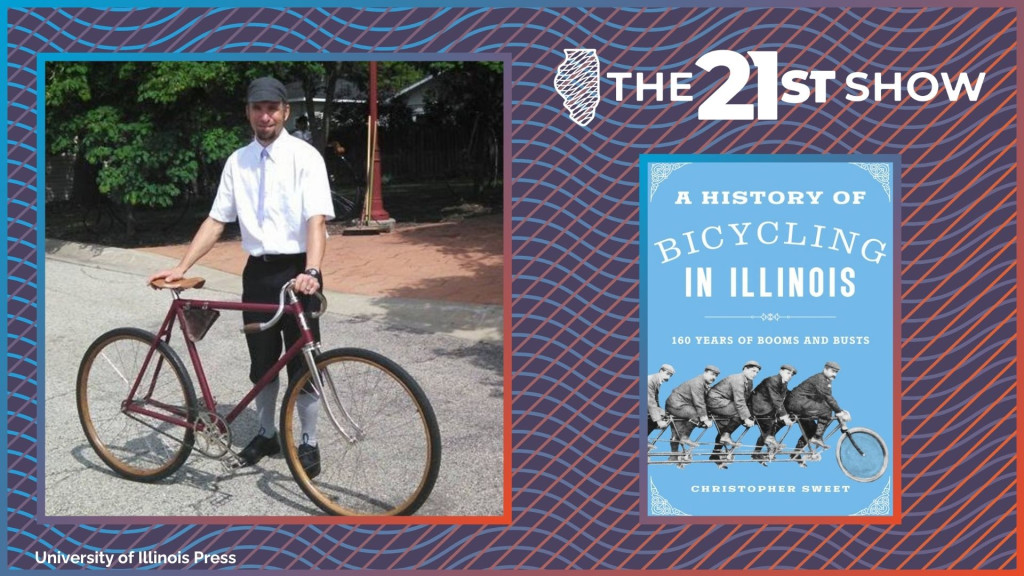
Transcript: Book sheds light on unique history of bicycling in Illinois
The 21st Show
Book sheds light on unique history of bicycling in Illinois
Read the full story at https://will.illinois.edu/am/book-sheds-light-on-the-rise-and-fall-of-bicycling-in-illinois.
Transcript
// This is a machine generated transcript. Please report any transcription errors to will-help@illinois.edu.

[00:00:00]
Brian Mackey: Today on The 21st Show, at the turn of the 19th century, bicycling was a significant force in American life, and the center of American cycling was arguably in Illinois. From Chicago to Peoria, hundreds of thousands of people turned out for races. Meanwhile, American bicycles were sought after around the world, and no state made more of them than the 21st. We'll talk about all that and more with Christopher Sweet, who's written a book called "A History of Bicycling in Illinois, 160 Years of Booms and Busts." I'm Brian Mackey. That's all coming up today on The 21st Show, which is a production of Illinois Public Media, airing on WILL in Urbana, WUIS in Springfield, WNIJ in Rockford DeKalb, WVIK in the Quad Cities, and WSIU in Carbondale. But first, news.

From Illinois Public Media, this is The 21st Show. I'm Brian Mackey. Before Schwinn was a household name, before Chicago had a single protected bike lane, before cars became one of the dominant forces in American life, the 21st state was arguably the center of American bicycling. One trade directory from the 1890s put the Chicago region's share of U.S. bicycle production at roughly 2/3, and by the end of the boom, Illinois led the country in factory employment and output. That boom reshaped everything from courtship to city streets, to women's fashions, before it went bust, and then boomed again, and busted again, more than once over the century that followed. My guest today spent nearly a decade digging through archives, scrapbooks, and old cycling magazines to tell that story. Christopher Sweet is the author of "A History of Bicycling in Illinois, 160 Years of Booms and Busts." Sweet's also a professor and librarian at Illinois Wesleyan University, the private liberal arts school in Bloomington. Chris Sweet, welcome to The 21st Show. Thanks for being here.

[00:02:15]
Christopher Sweet: Uh, great. Thank you. Thanks for having me. The, um, uh, a good, a good overview of the, the book there in the introduction.

[00:02:22]
Brian Mackey: Well, uh, that's our show for today. Uh, thanks for, no, I'm kidding. All right, listeners, our, our phones are open throughout the hour. Uh, you, you can join us at 800-222-9455. You know, I wonder, do you still have an old bicycle in the family, maybe a Schwinn you salvaged from grandpa's garage? Uh, maybe you ride a bike in Illinois today. Can you imagine a time when cyclists were the queens and kings of the road here? 800-222-9455 is the number. 800-222-9455. All right, Chris, take us back to where this book starts in the 1890s. In terms of bicycles, what would an average Illinois main street — you know, Michigan Avenue in Chicago, one of the smaller streets downstate — what would it have looked like on an average weekday afternoon?

[00:03:09]
Christopher Sweet: Yeah, the book, if we go back even a little bit further, we kind of traced to the first time that I could document that someone rode a bicycle in Illinois, and that would've been about 1868. And that was well before the biggest of the booms. The period that you were talking about was the 1890s. So there was a, there was a little minor boom as those early bicycles hit the streets of Chicago and some of the smaller cities around the state in the, you know, 1868, [1869], 1970, and then they kind of faded out again and came back again, kind of a theme there.

[00:03:51]
Brian Mackey: I'm trying to get a visual sense of it. Is it like one bike every 5 minutes or 50 bikes a minute and the pedestrians better, you know, watch where they're going because these people are just zipping by on these things?

[00:04:03]
Christopher Sweet: Yeah, so if again, if we focus on the, the boom period, which the book also does spend most of the time focusing on, which is roughly 1890 to 1900, that decade. Um, there were at times they did pedestrian or — pedestrian or bicyclist counts going into downtown Chicago. Cyclist advocates do the same thing today, you know, if you want to get accurate counts of people going, using your bike trails or bike lanes. So if I remember my book right, I believe it was upwards of 200 people per minute at the busiest thoroughfare at the busiest time, like when they're commuting into work in the morning, later 1890s. So there's there's nothing to compare it to today. The country was bicycle mad and that was international to some degree as well.

[00:04:57]
Brian Mackey: 200 per minute. I mean, that'd be like watching a race. Right, like one of these bicycle centuries or something at the start where you have just all these cyclist after cyclist crowding, crowding paths.

[00:05:06]
Christopher Sweet: Yeah, you would need a, you would need quite a bit of space just for the bicyclists. They would be taking up most of the road or there were dedicated some kind of side paths or bike lanes. Even in this, this early era, there was a, in some places. More bicycle infrastructure, so you know, bike lanes, bike parking than, uh, some urban areas have today.

[00:05:29]
Brian Mackey: Oh, no doubt about that. All right, so what, what made you — you, you are, uh, uh, by, by trade an information literacy and scholarly communications librarian at Illinois Wesleyan. What made you want to spend years of your life on the history of the bicycle in Illinois specifically?

[00:05:46]
Christopher Sweet: Yeah, so, um, my, my undergraduate background is in, is in history, and I was looking for a good long-term project that could sort of merge my research skills as a librarian and then my writing and research skills as a historian, and I was looking for something that made a significant contribution to American history. I think there's a lot of projects that I'm interested in, but not many of them would I spend a decade on and pour all this time and effort into if I didn't think it was important and significant. So that's, that's, I think that's the, you know, a part of the answer is that I do think beyond the bicycles themselves, the ways that people interacted with them and the social changes that the bicycle pushed, that's, that's what made me commit to [writing] it and spend all that time working on this particular topic.

[00:06:49]
Brian Mackey: You also have a personal connection and experience with cycling professionally, right? At least or triathlons, that's, which is a third cycling, right?

[00:06:59]
Christopher Sweet: Yeah, so yeah, my own, my own background has certainly helped if you're going to, if you're going to write intelligibly about bicycles and bicycle racing and contributions. I grew up in rural central Illinois riding quite a bit. I got into triathlon racing early in the 1990s and continued that for about two decades. At some point, yeah, I did. There were a couple of years in there. I had a professional card for triathlon racing. I raced internationally once, but so so that understanding of the nomenclature, right, the terminology for bicycle, the way that they're built and racing, that all, that all kind of figures into, you know, how, how and why I wrote the book.

[00:07:48]
Brian Mackey: So let's go back to that, uh, the earliest evidence you found of a bicycle being ridden in Illinois. And, and I should say, the book traces briefly the sort of, uh, you know, the story that's been told elsewhere of, of like the sort of international history of the bicycle and how it evolved, uh, from, you know, uh, a sort of a glider bike [invented] by a German fellow to, uh, to the, uh, the, the what we call the penny-farthing today. People will remember the one with the giant front wheel, the tiny little back wheel. You can see people still riding those on YouTube. Pretty entertaining. Um, to what we now call the safety bicycle. So like, how, how did that make its way from Europe to here in the middle of America, in the mid-1800s?

[00:08:28]
Christopher Sweet: Yeah, it was a part of the research that surprised me was how quickly things moved in that era. So if we're, let's see, if we're, if we're talking 1860s, something like Chicago, only, only a couple [hundred] thousand people, probably under 200,000 at that, that time point. So not really the urban mecca that we think of today. But the bicycles and the velocipedes — that the big, the big change in the 1860s was the addition of pedals to, to bicycles, and that definitely occurred in a Parisian workshop early mid-1860s, so let's just, let's just call it about 1863, [1864], something like that. But they came to the United States by 1866 and in Chicago 1868, so a pretty quick move from the East Coast to, to Chicago, and I think there's a, there's a technology story there in and of itself about how fast things moved across oceans in this time period, you know, well before flight or anything like that.

[00:09:46]
Brian Mackey: It's so interesting, those early bicycles and, and I think velocipede, is that, is that the phrase you use, and those had like metal wheels. You would definitely fall off. You couldn't just put your foot down. They looked high enough that you were like practically needed a stepladder or you needed to be a good athlete, which I suppose most people were a little more fit back then, um, to, to get on one of those. To then you get to where the bicycle, you know, we, what, what is called the safety bicycle at the time, what now just seems like a standard bicycle to us. It, it seems, you know, largely unchanged. You can look at a bicycle from the 1890s, and I think someone from today could probably get on that thing and make it work. Whereas the [velocipede], the penny-farthing, that would be a, a daring feat for a modern person to, to attempt.

[00:10:27]
Christopher Sweet: Yeah? Yeah, the, the, the design evolution of the bicycles, it is, it's kind of wild that by the, by 1890-ish, the frame design does look like most common bicycles today. We call it, we call it a double diamond. There's two, there's two diamond or triangle shapes in the, in the frame. And they came up with that when they added the chain drive to, to the bicycle, and it worked so well that, you know, people flocked to them. It was safer to ride than those, you know, that high wheel style that you were, you were mentioning. The safeties were considerably easier and for the people that cared about racing, they were also much faster because they could take advantage of, you know, a chain drive system to go faster than they could on a high wheel.

[00:11:18]
Brian Mackey: So let's talk about, and let me reintroduce our conversation actually. If you're, if you're just joining us, this is The 21st Show. I'm Brian Mackey, and we're talking today with Christopher Sweet, uh, who's the author of "A History of Bicycling in Illinois, 160 Years of Booms and Busts." Uh, it's published by Three Fields Press, which is an imprint of the University of Illinois Press. Sweet is also a professor and librarian at Illinois Wesleyan University in Bloomington. Uh, if you want to join us today, 800-222-9455. What is, what is your experience with bicycling? Uh, have you participated in some of the booms, uh, we're gonna be talking about later? Be it the, uh, the sort of health craze in the '70s, maybe even the most recent bicycling boom, which was around the pandemic. Maybe you remember empty bike shops back in 2020. 800-222-9455 is the number. 800-222-9455.

So, one of the big central booms in your book, as we mentioned, is the 1890s. What happened? What changed at that time that turned bicycling from a novelty into this full-blown national craze, international craze?

[00:12:29]
Christopher Sweet: Yeah, I think a couple of things came together. First of all, if you look at [the] 1800s and even beyond, then there, there's always, there's been a number of sporting crazes this, you know, this sort of this Victorian era. They were looking for entertainment, things to do. So before the bicycle there was a huge roller skating craze, you know, roller skating races, endurance roller skating, recreational roller skating. They called it pedestrianism also before that, which was competitive walking, and they would walk for days at a time, you know, and just see who stopped first and this sort of thing. So bicycling in that regard was the next, the next big social craze, the thing, the thing to do. So, so, so there's that part — that, that social idea of, you know, everybody is doing this that can afford to do it at the time period. Bicycles were quite expensive at the beginning of that, of that, of that boom period.

But so there's a social issue, and then there's some of the design issues that we talked about. Once the bicycle became something that looks like our modern bikes, they were easy to ride. Women could ride. Kids could ride. That also set up a boom. And then the manufacturers got in on the game, right? They saw a chance to make a buck or a lot more than a buck. Uh, and so they began to promote it, uh, you know, as, as, as, as something healthy to do, as an exciting thing to go out and watch. So we had the social issues and the design issues all kind of coming together, and that set the stage for that, for that boom.

[00:14:17]
Brian Mackey: There was a sentence that's really stuck with me. I, I think it's pretty early in the book, maybe even the introduction. Um, I'm gonna read it here. "In the 1890s, Chicago had more than 50 cycling clubs, the largest of which fielded their own football, baseball, and bowling teams. Cycling clubhouses of the day were lavish affairs with amenities like billiard tables, bowling alleys, cafes, libraries, theaters, parlors, lodging rooms, and weight rooms." Talk about — I mean, uh, it's hard to imagine any club, you know, in our "bowling alone" society of the 2020s, uh, you know, having this sort of amenities and, and, you know, the adherence to it. Talk about how cycling really became central to a lot of people's lives.

[00:15:01]
Christopher Sweet: Yeah, when I came across some of these references, and I kept, I wasn't sure I was getting it right, you were talking about the, the bicycle clubs fielding their own, a baseball and bowling teams and I was like, am I, am I, am I reading this, this, this right? And I found more and more mentions of it and the cycling was so central to social identity right for a while that they came together in, in these clubs. Some of the clubs were based on ethnicity. Some were based on the brand of the bicycle that you rode. Some of them were more racing oriented. Others were more about taking, you know, casual weekend jaunts out, out into the, into the country. But there were people [who] really identified as cyclists as a big important part of who they were and then which club that they chose was another part of that, of that, of that identity. And yeah, you, you'd be hard pressed to find anything similar — maybe, maybe in, you know, sort of the Hamptons equestrian clubs or something — might kind of look like these bicycle clubs, although these were a little bit more for everyone, even though they had all these amenities in the clubhouses as you mentioned.

[00:16:25]
Brian Mackey: Yeah, I've gotten occasionally — as a, as a journalist you get asked to like moderate a panel or something — so I've been in some of those fancy downtown Chicago clubs that I think do have gyms and maybe even like lodging for people, nowhere near being at the level of becoming a member of one of those things. But yeah, it seems like having something like that for the everyman, that, that's fascinating. All right, let, we need to take a break. We're gonna continue our conversation with uh Chris, Christopher Sweet. He's the author of "A History of Bicycling in Illinois, 160 Years of Booms and Busts." If you want to join us, 800-222-9455 is the number. We'll get to some calls after the break. 800-222-9455. This is The 21st Show.

It's The 21st Show. I'm Brian Mackey, and my guest today is Christopher Sweet, author of "A History of Bicycling in Illinois, 160 Years of Booms and Busts." He's also a librarian on the faculty at Illinois Wesleyan University. Has bicycling ever changed the way you get around your own town or neighborhood? You can join the conversation today at 800-222-9455. That's 800-222-9455. And, and let's go now to the phones. We have Carrie calling from Woodstock, Illinois on line one. Carrie, thanks for calling in.

[00:18:10]
Carrie: Hi. Um, I just wanted to call in and maybe comment a little bit on the change in attitudes around bicycles in Illinois. Um, I'm coming from McHenry County and I spent my whole life here and I was fortunate enough to be a free-range child in the '80s and '90s and um happily spent a lot of my time, especially during my summers, riding my bike around town and kind of intentionally trying to get lost sometimes to see if I could find my way home, um, but I always felt very safe and, and secure in my town, um, and, and felt seen by motorists, um, and so I grew up kind of with, you know, a, a lack of fear of being out on a bike, and, um, but I also, you know, took some biking classes and like knew the rules of the road and how to signal and all that. So I, I just always felt like I had a good handle on it and then. Um, fast forward to my late 20s, early 30s, my husband and I did a fair amount of road biking, um, together and, and competed in triathlons and, um, felt very good about that even, uh, I would say into the early 2010s, um, we would go out on. Cross McHenry County excursions, um, sometimes 30, 40 miles at a time, not that we're great cyclists, but, uh, we enjoyed that and always felt really good about it. And somewhere around the mid-2010s, I feel like our, our perception of that just really changed, and I'm curious to see if other callers or other cyclists have, have felt this as well. Um,

[00:19:50]
Brian Mackey: That's interesting. So when you say your perception changed, you feel less safe on the roads now?

[00:19:56]
Carrie: Definitely, yeah, um, we had a few incidents here in McHenry County, several rather, um, where we felt like people were kind of edging us off the road. There were, uh, there was an incident where I actually reached out and slapped the back of a minivan just to bring attention to them like they had kind of intentionally pushed me off towards the shoulder and, um, they saw us at an intersection and and acknowledged that we were there and then went ahead and pushed me off. Um, but it was just like a handful of these incidents where, where there was aggression towards us, revved motors as they fly by, you know, stuff like that where we just got to the point where we said, you know, it's kind of not, it's not worth getting killed. And um we really only do road biking on dedicated trails now. We're lucky enough to have running, you know, all the way through McHenry County, um, the Prairie Trail that goes down to Aurora, so we take advantage of that as much as we can, but uh I feel like it's just kind of a sad state where, you know, something that we grew up enjoying and, and, and loved doing is something that we just don't feel like we can be visible enough or, or protect ourselves enough out on the open roads. And I'm wondering if any other cyclists have experienced this over the last 15 to 20 years, maybe.

[00:21:19]
Brian Mackey: All right, Carrie, thanks so much for calling in. And, and yeah, if, if anyone else out there, if you feel that way, let us know at 800-222-9455. Um, Chris, let me, let me come to you about that. I don't know if you still cycle. Have you, have you felt a change in the way vehicles, uh, interact with, with cyclists on the road?

[00:21:39]
Christopher Sweet: Yeah, I'm thinking of a whole bunch of different threads that, that, that, that go into Carrie's comments here, and I do feel somewhat the same way. I said earlier in the program that I grew up in rural central Illinois and riding sort of out of necessity right before I had a car. If you're going to go visit friends or go to your job, it was on a, it was on a, on a bicycle. And so there's certainly a sort of nostalgia for that time period and also, you know, there's, there's, there's demographic change that figures into it. That same area of rural central Illinois where I grew up, there, there just are more people and more cars than the '80s and '90s, right, when I was riding. So I think that that's part of the story. We're just getting — the population is getting denser. Therefore, there are more cars on, on the, on the roads. I think that's part of what we're, what we're experiencing.

Another thing that I thought about when I, when I was listening to the comments is that there's also another element that the more you get into cycling, the more likely it is that you're going to have some poor encounters. So if, if I, if I'm, if I'm an in-town bicycle commuter and I ride 1 mile a day back and forth to work, the opportunities to have poor interactions are few. If I do a weekend ride and it's 20 miles, you're just out there for longer. If you really get into it and you're riding 50, 100 miles or something, the chances of having a poor interaction with the vehicles over the course of 100 miles, it's just statistically that there's more. So I think that's another, another of the threads, but yeah, there's definitely some animosity towards cyclists. People want to get to where they want to go in their cars as fast as possible with no impediments. That's, that's part of what's going on. It also points to the need for infrastructure, right? You know, these kind of trails that, that people are riding on now, it feels much safer. We could use more of those. They could be larger. So, yeah, those, those are some of the things that I was thinking of.

[00:23:56]
Brian Mackey: Yeah, 100%. And infrastructure, even in cities, right, there's a difference between a piece of or a line of paint, some plastic cones, and a true, you know, concrete barrier protecting bike lanes. Yeah, yeah. All right, another caller, Steve, calling from Carbondale. Steve, thanks for calling in.

[00:24:14]
Steve: Hey, what's going on?

[00:24:16]
Brian Mackey: Uh, we're talking about cycling. I understand you, uh, you have some long-distance rides in your past.

[00:24:21]
Steve: I do. When I was in college at SIU my sophomore and junior year, I rode my bike from Carbondale up to the Chicagoland area. My parents lived in Park Forest and, uh, I did that ride the first year by myself, took 4 days, and then I did it the next year with a buddy of mine and we spread it out a little bit and did 6 days on the road. Uh, you know. It's interesting, uh, yeah. You leave Carbondale and it's all pretty much farmland all the way to Chicagoland. We took [Route] 37 and Route 45, and the people we met were very friendly and interested in why we're out there bicycling the road and, uh, you know, uh, it was, it was definitely an experience. It was a lot about learning about Illinois and all of central and northern and southern Illinois. I mean, you get a chance to see it all.

[00:25:27]
Brian Mackey: You sure do, up close and personal. Well, great to hear from someone from the, uh, representing the South suburbs as well, Steve. Thanks for calling in. I went to school in Chicago Heights right next door to Park Forest. So, um, Chris, I don't know if you want to respond to any of that. You know, listening to, to both of these callers and especially something that, that Carrie said a moment ago is, you know, as a kid of the '80s and '90s. I was biking all the time, biked into adulthood and just kept, kept biking. And I think that is true for people who are maybe Generation X and younger. Sometimes I get the sense from people of earlier generations that they didn't have that connection and bicycling seemed like, you know, something for kids to do. Can you talk about how it is, uh, you know, it evolved — the, the place of cycling in American life, which is also part of the, the story of your book.

[00:26:12]
Christopher Sweet: Yeah, again, I'm thinking of a couple of different tangents or threads here, and the one that I'm interested to see if there is going to be some social change that comes out of it is like the sort of "Stranger Things" phenomenon, right? That, that series got so popular and it featured bikes a lot and bikes the way that many of us remember them — riding with your friends around the neighborhood and taking your BMX off road. It kind of glamorized that maybe, or it, you know, [brought] kids and teens' attention to the, oh, there are other modes of transportation other than, you know, driving and and public transportation. So I wonder if there won't be another small bump in ridership just because of the impact of that, of that particular [series].

But if we, if we go, if we go back further, so there was certainly a bust period after that, the boom period we talked about from 1890 to 1900, and very, and a lot fewer people rode during that early era. We're talking like World War I era, but then the first kind of bringing bicycles back towards the mainstream, they did reach out to that kids and teens market. So now you're going back and you're thinking about especially those Schwinns like the balloon tire bikes. They had a lot of chrome. They were heavy. They were designed to kind of look like the motorcycles and the cars of the day, so they were cruisers, a lot, a lot of bling to them. And so that, that was a that was a new market that, that, that drove bicycling and really kept Schwinn and other bicycle companies alive, kids and teens market. 1930s, 1940s, 1950s, that would have been the major demographic of riders during that time.

[00:28:11]
Brian Mackey: So, let me remind listeners, we're talking with Christopher Sweet, author of "A History of Bicycling in Illinois, 160 Years of Booms and Busts." At one time, Chicago and, and Illinois more broadly were the centers, arguably, of American cycling life, both in terms of participation and racing, as well as manufacturing. You can join us today at 800-222-9455, 800-222-9455. All right, so you mentioned Schwinn. He, he shows up early in this story. Let's go back in time a little bit again. Um, well before his name became synonymous with American bicycles, what was his path to Chicago? And, uh, you know, how did his company end up standing out and surviving from the hundreds of other Illinois bicycle makers?

[00:29:00]
Christopher Sweet: Yeah, the founder of Schwinn, his first name was Ignatz, which you might be able to ascertain [was] German, so he immigrated from Germany and brought a bunch of German know-how and craftsmanship and technological manufacturing abilities with him. He actually got his start working for a couple of different Chicago bicycle companies before he went out and founded his own company. And when we talk about Illinois and bicycles, Schwinn is what most people are going to know and really for good reason. Uh, Schwinn did go on to dominate manufacturing and racing, really the whole scene in the country for, for most of the 20th century, right? Um, and, and that, that had been covered in another, another book. There's a, it's called "No Hands: The History of the Schwinn Company," uh, something, something like that. Uh, so my book tries to tell the other parts of the, of the Illinois story. Schwinn's so it's, it's so important. We still absolutely cover a lot of that. But they were a minor player, Schwinn, through the early 1900s. There were much bigger Illinois companies. They just had the most staying power.

[00:30:28]
Brian Mackey: Well, let's talk about some of them. So Western Wheel Works is one of the ones I think you're talking about. What, what sets that company apart?

[00:30:35]
Christopher Sweet: Western Wheel Works is interesting because they did go on to become the biggest manufacturer as far as I can tell in the world at that time, certainly, certainly in the United States. I don't think there was anybody else that — the numbers I've seen elsewhere in the world — producing more bikes than Western Wheel Works. So you could do a couple of different things to try to sell bikes. One is to make them really fancy, sort of high-art bikes, and that speaks to a certain demographic. Western Wheel Works wanted to produce as many bikes as they could and drive prices down. So the big innovation for that factory — and this is, this is like when bikes have an impact beyond bicycling — they refined industrial stamping. This is, this is very common even in today's modern manufacturing. The use of great big hydraulic — in that time, it would have been steam — presses to stamp metal rather than to like drop-forge it. That would have been an earlier technique. It's much slower and you have to remove a lot of material when you're forging something, you know, pouring more metal like in, into a form. So Western Wheel Works developed these big presses, and that allowed them to really speed up manufacturing and drive, drive costs down, and they were really a pioneer of that technology anywhere in the country and it was and then that would have later been adopted by motorcycle and automobile manufacturers.

[00:32:08]
Brian Mackey: Another big name, uh, who, you know, starts in bicycles and goes to, to automobile manufacturing is, uh, Charles Dye. I'm not sure if I'm pronouncing that correctly. Please correct me, but —

[00:32:26]
Christopher Sweet: — I love Duryea. Thank you. I, I love, he actually builds himself a working bicycle, uh, on his family farm. Talk about him.

[⚠️ Timestamp note: The conversation appears to overlap or shift between speakers here. The attribution and timestamp for the following segment may require human review.]

[00:32:26]
Christopher Sweet: Yeah, this is, this is one of the reasons that I wanted to write the book about Illinois as a whole. There's so many books that are just Chicago-focused, and much of the bicycling history is up there, but certainly not all of it, and some of the, maybe some of the more important parts were, were downstate focused, so. Uh, the Duryea brothers, there were two, Charles and Frank, that were interested in bicycles. I think, I think there were others in the family, but those were the two that had a history with bicycles and then automobiles. So they grew up rural central Illinois initially by Washburn, Illinois, and as you mentioned, as a rural farming family, they could not afford the bicycle prices, but Charles, like, you know, many, many rural farmers of the day, had a lot of just kind of manufacturing know-how growing up on a farm. He cobbled together his own sort of velocipede style of bicycle. Then after he graduated from college, he started to just tinker with bicycles and really got in on the patent game. So Charles got a number of bicycle patents. He was, you know, how can we change it? How can we improve bicycles, and this transitioned from the high-wheel style to the safety style and of course then the Duryea brothers — their claim to fame, after they both were — they manufactured bikes for a number of years, they are known for creating the first mass-produced automobile in the country.

[00:34:05]
Brian Mackey: All right, we're gonna take a break. We will continue with uh Christopher Sweet, who is the author of "A History of Bicycling in Illinois, 160 Years of Booms and Busts." He's also a librarian at Illinois Wesleyan University in Bloomington. If you want to join us today, 800-222-9455 is the number. 800-222-9455. We'll have more in a minute and a half. This is The 21st Show. Stay with us.

It's The 21st Show. I'm Brian Mackey. We are talking today with Christopher Sweet. He's on the faculty at Illinois Wesleyan University, professor and librarian there, and the author of a book called "A History of Bicycling in Illinois, 160 Years of Booms and Busts," as we've been discussing. There have been multiple bicycling booms. One of the most notable was back in the 1890s, and that is when Illinois really became arguably one of the national, if not international centers of bicycle manufacturing. It was a huge, huge business here, and a huge pastime as well. If you want to join us, 800-222-9455.

We had a couple of callers, uh, earlier about, uh, you know, whether cyclists are getting the same sort of respect on the road that they once might have. Uh, we got a text message from John in Springfield who says, uh, the, the caller from McHenry County is right. I've biked all my life from Southern Illinois childhood to my current life in Springfield, and I have absolutely noticed the change in attitude auto drivers have toward bicyclists. I get the feeling autos believe the roads belong to them and no one else. On the other hand, we have David on the line, uh, calling from the Quad Cities, who I think might have a, a little bit of a different perspective on this. David, thank you for calling in.

[00:36:22]
David: Yes, I, I bicycled a lot when I was a teenager in the '60s. I graduated from high school in '66, so a different era than most of these callers. But I noticed a lot of bicyclists don't follow the rules of the road. They don't ride on the same side of the road as the cars like they're supposed to. They don't stop at stop signs. They don't follow the rules of the road. So maybe that's one of the reasons they're not getting respect is they're not giving respect to the, to the rest of the people on the road, uh, and I just yesterday saw two e-bikes run stop signs in my neighborhood, so. I think there's two sides to this story.

[00:37:15]
Brian Mackey: Fair enough, David. I appreciate the call. And yeah, I know that's a big concern, especially like in New York City, for example, the e-bikes, which are really, some of those are basically motorcycles, they're hardly pedaling, um, you know, and, and pedestrian safety for sure. Uh, Chris, I, I, I don't want you, you know, to ask you to be a bicycle ethicist or anything like that, if that's outside your wheelhouse, so to speak. Uh, but, uh, what, what do you make of that?

[00:37:41]
Christopher Sweet: No, I think it's a, I think it's a common complaint you hear about cyclists, and of course his observations are true, and you can see them in any area where there's a, there's, there's a lot of cyclists. So the first thing that comes to mind is I still live in a different small rural town in central Illinois, and I routinely see cars blow through stop signs because it's a rural area. They think, oh, there's nobody, nobody here is going to catch me, there, you know, so I can just, I can just roll through these stop signs. I can exceed the speed limit. So this occurs in all modes of transportation, right? I guess that's the first point that I, that I want to make. Drivers of vehicles routinely flaunt the laws as well. Um, from the bicycling side, the cyclists that are running stop signs, uh, riding against traffic, they're certainly not doing the bulk of cyclists, uh, any favors. Um, perhaps it's a lack of education, you know, they're not being taught at a younger age, uh, the proper [rules of the road], or they just don't see the, you know, the larger implications, but you know, that's the thing, we're, we're not going to ever get all drivers to obey every rule of the road. And the same thing with cyclists is what I've seen.

[00:39:15]
Brian Mackey: All right. In the time we have remaining, about, about 10 minutes left in the show, I do want to also talk about another aspect you, you write a lot, write about a lot in your book, which is this idea of the democracy of the wheel, right? And this goes back again to that 1890s boom. And you know, on the one hand, you have this utopian idea that cycling is a, a democratizing force — the, the shopkeeper and, and the, you know, the attorney, the elite are, are sort of at the same level, literally and, and figuratively when they're on a, on a bicycle. Um, and, you know, as you say, arguably, bicycles accelerated the push for women's rights, suffrage, independence, and a lot of other Progressive Era reforms. On the other hand, child labor was involved in this. Uh, Black cyclists were excluded from, you know, Chicago races at the time. Um, you know, there were medical authorities who argued that women bicycling would lead to, you know, deviant behavior and, and infertility even. Um, talk about that thread and, you know, some of the, some of the evidence that you found both ways on that.

[00:40:19]
Christopher Sweet: Yeah, so, so this was, this is my first, first book that I've, that I've written, and one of the things that surprised me after spending so much time with this material over the course of so many years is that I sort of needed all that time to start to identify threads such as the one that we're talking about now. And that's because I was able to look at the way that bicycle advocates and proponents talked about cycling in the 1890s, you know, what they saw as, you know, contributing to a democratic society and everybody making everybody more equal when it wasn't really the case. They really were mostly talking to other middle, middle and upper-class white males because of the, the costs of the bicycle and because of social norms, but then being able to take that idea and bring it all the way forward to modern times and see how bicycles are being used to address social justice issues in the 21st century, I found that really interesting and it was a really kind of an important thread to follow through on.

[00:41:30]
Brian Mackey: You have a, you have a chapter on women in cycling. It's called "The Great Emancipator." Um, did, did this bicycle actually change women's lives in, in that era that we've been focusing a lot on?

[00:41:41]
Christopher Sweet: Yeah, this is, I think, some of the, the, the, the, the, the broader implications and social history implications of the book and why bicycles are important and should be really kind of reconsidered in historians that look at the Progressive Era. Um, so bicycling was at its zenith as the Progressive Era was expanding. So if, as a reminder, the progressives, what kind of things did they, did they, did they want — most famously, they, uh, their work led to Prohibition for a number of years of alcohol sales to, uh, you know, reduce inebriation and domestic violence and that sort of thing, but they, they cared about, they cared about workplace safety. They cared about women's independence, women's rights and women's suffrage. They cared a lot about manufacturing safety. This is the era of like Upton Sinclair in "The Jungle" and the muckrakers, that, that sort of thing.

So the, so this — the bicycling came along at the right time to kind of champion that movement. So the two things proceeded in tandem and bicyclists were sort of like the figureheads of this movement. There were these images of women known as Gibson Girls, as for the Gibson [magazine], and this was the idea of the new woman. She dressed not like a traditional Victorian woman. She pursued her own education. She sometimes lived alone. She was independent. She was able to work, and this was, they were often depicted as cyclists and beyond depictions they often were cyclists just because that was a thing that progressive women did at the time. So, so yeah, I think that bicycling in this instance did make real impacts in social change.

[00:43:40]
Brian Mackey: Can we spend just a minute or two on your methods here? Uh, 'cause you talk about, you know, these magazines and newspapers, and I think, you know, a lot of this stuff is on the internet now. Newspapers.com is a lot of people who maybe have done genealogical research are familiar with that website and others, but you actually had to travel a lot and get your hands on dusty materials to do this work as well, yeah?

[00:44:02]
Christopher Sweet: Yeah, from a historian's standpoint, you know, a whole bunch of things are not digitized. They, and I don't know if they ever will be just because of the amount of material that's out there. More is added every year for sure. But part of the appeal for me of doing this kind of research — most of the other writing that I've done in the field of information literacy and scholar[ly] communication, it mostly just involves me sitting at my desk and my computer and researching and writing. So part of the appeal for this kind of project was getting out into archives and museums and libraries and special collections, and because I was focused on Illinois, a lot of those materials have stayed in the Midwest. So Chicago History Museum was my, was the best source for bicycling material, but while I was up there in Chicago, I made a couple of stops at the Newberry Library. The Chicago Public Library had good collections up there. Henry Ford, the manufacturer himself, was a cyclist, and he collected a lot of bicycles for his collection and bicycle materials. So I went to the Henry Ford Museum. I went to a place called the Bicycle Museum of America. It's in New Bremen, Ohio, and they had some, some great collections that they let me access. So yeah, a lot of just spending some time in archives and finding things that nobody's seen in 100 years.

[00:45:29]
Brian Mackey: So we're almost out of time here. Um, you, you end the book, uh, with an epilogue, "A Bicycling Dream Deferred." Pull on that thread for us. What, what did you mean by that?

[00:45:42]
Christopher Sweet: Sure. So if, if the dream, the original dream of [the] bicycle was the great emancipator and democratizer, the social, the social leveler, the book lays out that that really was not the case in the early period of [the] bicycle. So the epilogue then looks like what's happening now. 21st century in Illinois with bicycles. There's, there's, there's much less manufacturing going on. There's bicycles themselves. There's only a couple [of] small companies, but the ways that bicycles are being used to address social justice and other issues is what those early advocates had dreamed of, right? So what kinds of things am I talking about? If you look around the state, you'll find a number of bicycle co-ops. There's some famous ones up in the Chicago area, but also a lot of rural areas and smaller cities will have a bicycle co-op where they will take bikes, keep them from being thrown out with the trash, and they will repair them and like teach repair skills. You can often get a bike for little or no cost if you contribute time and you learn how to do the, the bicycle repairs. Bicycles are being used to reduce congestion in urban areas, right? You think about the bike share systems like Divvy up in Chicago that is, it's reducing traffic on the street, which reduces pollution. It can help with overall health and obesity. So just this, you know, the one thing, a bicycle as a tool. Uh, at this point in time, if you, you, you look and see, yeah, OK, it, it actually, it is doing some pretty cool things.

[00:47:33]
Brian Mackey: Although even there, not without some of the old, uh, prejudices, as you point out, Divvy bikes were not available in some of the city's South Side, the, the predominantly Black neighborhoods in, in Chicago.

[00:47:43]
Christopher Sweet: Well, at least when they've been doing a good job of, of remedying that in the last 5 years, but correct.

[00:47:48]
Brian Mackey: Yeah. Well, the book is called "A History of Bicycling in Illinois, 160 Years of Booms and Busts." The author is Christopher Sweet. He's also on the faculty, uh, and information literacy and scholarly communications librarian at Illinois Wesleyan University. Chris, thanks so much for being with us to share your work with us today on The 21st Show.

[00:48:14]
Christopher Sweet: Absolutely.

[00:49:06]
Brian Mackey: That is it for us today. We are scheduled this afternoon. So if you're listening to our live broadcast Wednesday morning, we are scheduled to tape on Wednesday afternoon an interview with Don Tracy, who is the Republican nominee for U.S. Senate in this fall's Illinois elections. If you have questions for him, you can email us, but don't wait, only about an hour and a half till we have that conversation. Our address is talk@21stshow.org. You can also leave a voicemail of your question. We [might] share it during our interview. Uh, and you can leave that at [217-300-2121]. But again, don't wait. If you're listening to our morning broadcast, uh, call now [217-300-2121] and then tune in tomorrow when you can hear that interview here on The 21st Show.

We do appreciate hearing from you about everything we talk about, your suggestions for future guests or stories as well. Again, our email address is talk@21stshow.org. You can find that and all the other ways to communicate with us at our website, twentyfirstshow.org. You can also find links to subscribe to our podcasts or just look us up on Apple, Spotify, YouTube, or wherever you listen. The 21st Show is a production of Illinois Public Media. I'm Brian Mackey. Thank you for listening. We'll talk with you again tomorrow.

---

**Flags for Human Review:**

1. **[00:03:09] — "1868, [1869], 1970"**: The original transcript reads "1868, 1969, 1970." The sequence of years appears to reference an early boom period and has been inferred as a likely misstatement. "1969" has been corrected to "[1869]" as this is consistent with the historical context of the 1860s–1870s early bicycle boom discussed. "1970" may be a further error (possibly "1870") but has been left as spoken pending human review.

2. **[00:08:28] — "1863, [1864]"**: The original transcript reads "1863, 1964." The year "1964" appears to be a transcription error for "1864" based on context. Marked as inferred correction.

3. **[00:32:08]–[00:32:26] — Speaker attribution overlap**: The transcript shows Brian Mackey beginning to ask about Charles Duryea, with Christopher Sweet appearing to complete or redirect Mackey's sentence mid-segment. The segment "I love Duryea. Thank you. I, I love, he actually builds himself a working bicycle, uh, on his family farm. Talk about him." is attributed to spk_1 (Christopher Sweet) in the original but reads as though it may be partially Mackey's words or a transcript error. This segment should be reviewed for correct speaker attribution.

4. **[00:49:06] — Phone number discrepancy**: The original transcript includes two different phone numbers in close proximity: "217-32121" and "217-300-2121." Both instances have been rendered as [217-300-2121] based on the more complete number appearing later in the same segment. Human review is recommended to confirm the correct number.

5. **[00:49:06] — "talk@2firstshow.org"**: The original transcript includes "talk@2firstshow.org" as a second reference to the email address, which appears to be a transcription error for "talk@21stshow.org." The corrected form has been used consistently throughout, but human review is recommended.
Transcript Assistance
Illinois Public Media may use AI assistance for transcript generation and/or formatting. Transcripts that have not yet been reviewed for accuracy will be labeled.
To report a transcription error, or to request transcription of archival material, please contact will-help@illinois.edu.