Transcript: How is the 1872 voyage of a ship relevant to the state of today’s oceans?
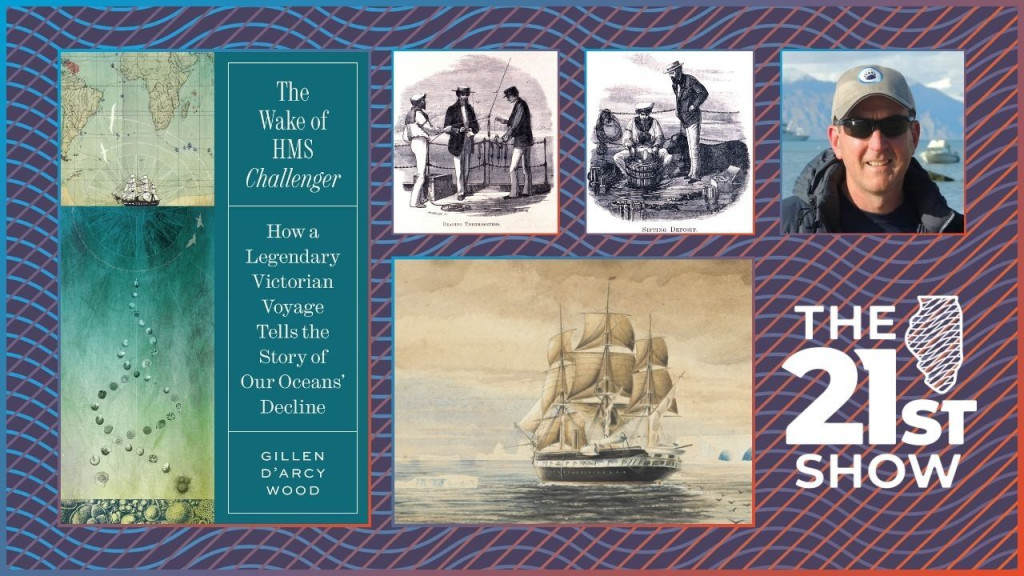
Transcript: How is the 1872 voyage of a ship relevant to the state of today’s oceans?
The 21st Show
How is the 1872 voyage of a ship relevant to the state of today’s oceans?
Read the full story at https://will.illinois.edu/am/book-takes-look-at-nineteenth-century-ships-voyage-in-connection-with-oceans-today.
Transcript
// This is a machine generated transcript. Please report any transcription errors to will-help@illinois.edu.

[00:00:00]
Brian Mackey: Today on the 21st Show — in 1872, a group of men set out to take a census of Earth's oceans. Their trip spanned several years and covered 70,000 miles. It took decades to sort through their findings, but much of the life they discovered no longer exists. Their work is the subject of a new book by Illinois professor [Gillan] Darcy Wood. It's called "The Wake of HMS Challenger: How a Legendary Victorian Voyage Tells the Story of Our Ocean's Decline." I'm Brian Mackey, and that's coming up today on the 21st Show, which is a production of Illinois Public Media, airing on WILL in Urbana, WUIS in Springfield, WNIJ in Rockford DeKalb, WVIK in the Quad Cities, and WSIU in Carbondale. But first, news.

From Illinois Public Media, this is the 21st Show. I'm Brian Mackey.

In 1872, a small British warship was converted for use in research and set out on a voyage of discovery. Her Majesty's Ship Challenger would spend nearly four years traveling 70,000 miles, aiming to make the most complete census yet of our oceans. At hundreds of points around the globe, the scientists would dredge the seafloor, measuring depth, currents, and temperature, and collecting samples of the quasi-alien life that inhabits the deepest, darkest places. Industrialization and the pollution it brought means the world of the Challenger is gone. But more than 150 years later, the data collected by its crew has been a useful benchmark for scientists seeking to understand what has become of our oceans.

All this is the subject of a recent book by [Gillan] Darcy Wood. It's called "The Wake of HMS Challenger: How a Legendary Victorian Voyage Tells the Story of Our Ocean's Decline." Wood writes: "The Challenger expedition on its 150th anniversary represents a unique 19th century encounter with the sea at a planetary scale, a scale we take for granted in our era of global observation systems, deep sea submersibles, and data-rich ocean models. Without Challenger, we would have little notion of how much of the Victorian marine world we have since lost to overfishing, pollution, and climate change, and how much we are still in danger of losing."

[Gillan] Darcy Wood is the Robert W. Schaeffer Professor of Liberal Arts and Sciences at the University of Illinois Urbana-Champaign. He teaches courses on environmental writing, the history of geology, and modern poetry. His previous books include "Tambora: The Eruption That Changed the World" and "Land of Wondrous Cold: The Race to Discover Antarctica and Unlock the Secrets of Its Ice." [Gillan] Darcy Wood joins me now in studio. Welcome to the 21st Show.

[00:03:02]
Gillan Darcy Wood: Thanks so much, Brian. It's a pleasure to be here.

[00:03:05]
Brian Mackey: I should say we are live today. You can join our conversation anytime at 800-222-9455. That's 800-222-9455.

Alright, tell me about the scientific milieu in which the Challenger mission was launched.

[00:03:22]
Gillan Darcy Wood: Hm. So if we think back to the early 1870s, I think the most important context for the book is the fashion around marine life. For the British, there was a kind of fad surrounding the collecting of shells and beachside recreation, and it was one of these things that had entered into the popular culture and popular domain. So there was a kind of zeitgeist for interest in the sea. And also because — Britain ruled the waves — the British Admiralty and the government had at their disposal the Royal Navy, and were capable of outfitting a retired corvette into a sort of floating marine academy, which they did.

So I trace, in my book, the history of the study of marine life all the way back to Aristotle, and the Victorians thought that, well, there had been so little serious advances in the study of the oceans since that time. It felt like a historic opportunity for them to make some new effort, a grand effort toward the study of the ocean, and in particular the deep ocean, which was a complete blank up until that time.

[00:04:56]
Brian Mackey: A complete blank, but not one that had escaped hypotheses about what was happening there. Who is Edward Forbes?

[00:05:04]
Gillan Darcy Wood: So Edward Forbes is the forerunner — I guess he's the sort of patriarch of marine science — who, in Aristotle's footsteps in the Aegean, made tentative studies of the deep sea in the Mediterranean context. But he was the promulgator of what was soon to become clear a false theory, which he called the [a]zoic theory, which, according to Forbes, held that the deeper one went in the ocean, the less biodiversity one found, until ultimately at depths of high pressure and low temperature, there could be no life whatsoever.

[00:05:51]
Brian Mackey: An inverse — exactly.

[00:05:54]
Gillan Darcy Wood: Yeah, exactly. And it was the destiny of the Challenger to overthrow that false notion. We now know, of course — and the Challenger is a landmark in these deep sea discoveries — that the deep sea is teeming with life, even at depths of great pressure and cold.

[00:06:13]
Brian Mackey: You say that in this era, even though it's Victorian — the Industrial Revolution had begun a century earlier in England — but in terms of this human relationship with the sea, steamships are just becoming a thing. This ship has sort of a hybrid, you might say. And humans were already, as you write, affecting the world's oceans at an industrial scale. How so?

[00:06:35]
Gillan Darcy Wood: Yeah, this is one of my discoveries in researching the book. I suppose I began with a too crude, too simple paradigm — that, well, the 1870s Challenger voyage would give us this sort of data-rich snapshot of a pristine, fully pre-industrial ocean to which we could now compare our 21st century ocean. But of course that was not nearly as clean-cut as that. We already had, you know — think of the legacy of "Moby-Dick" and 19th century whaling. We already had an industrial-level impact on the oceans with the whaling and sealing industries, but also the Europeans and we in North America had made impacts on the transatlantic fishery. We think particularly of cod, which were already being harvested at an extraordinary scale. So there are fisheries that are significant, and there are already changes.

But what has happened to the oceans since, in terms of the depletion of marine life — let alone changes in temperature and acidity — are orders of magnitude greater than what we see in the 1870s. So I think the phrase I ended up employing in the book was a "near pristine state," or a state of early industrialization of the oceans in the Victorian times. And of course now we sit 150 years later in retrospect and think: well, what are — this is the purpose of the book — to try to sort of tug at some threads to give us some sort of sense of what the significant changes have been over these last 150 years, and in what respects the ocean over which Challenger sailed is not our ocean.

[00:08:22]
Brian Mackey: Yeah, I mean, our [hominid] ancestors have been around for what, 2.5 million years now, give or take. We often think of them — you write about this — as hunting, you know, saber-toothed tigers, woolly mammoths. I think megafauna is the scientific term, both to extinction. What was our — what was Pleistocene man's relationship with oceanic life?

[00:08:43]
Gillan Darcy Wood: Well, this is news to many people — that there has been a human relationship to marine life and a reliance on the protein from the sea for tens of thousands of years. There was Korean [coastal] whaling, like, 50,000 years ago. There is evidence for that. And also that we are quite addicted to this sort of early American story of the megafauna, the hunting of megafauna, when in fact new researchers showed that the first Americans, coming out of Siberia along the Californian coast, relied much more on — they call it the seafood highway. They were hunting for mollusks, shellfish, some invertebrate fish. So we've been fishermen longer than we've been hunters.

[00:09:48]
Brian Mackey: Let me reintroduce our conversation. If you're just joining us, we're speaking with [Gillan] Darcy Wood. He's a professor at the University of Illinois. His most recent book is called "The Wake of HMS Challenger: How a Legendary Victorian Voyage Tells the Story of Our Ocean's Decline." It's about this British mission — four years, 70,000 miles around the world — attempting to make at that time the most complete census yet of oceanic life, especially at the depths that had not been studied before.

Let's talk about how they did this work — the work of a typical day of dredging. How does it actually work in this Victorian era of steam and sail?

[00:10:27]
Gillan Darcy Wood: So you have to imagine a ship in which there are literally tens of miles of sounding rope made of hemp. This was just before the revolution in dredging technology which brought in wire. So they were dealing with miles and miles of rope, to which they would attach sounding instruments and temperature gauges. This would begin early in the day — the lowering of the rope — which would take first the sounding, then the temperature gauges, and only then would they lower the dredging nets to sample the marine life from the bottom.

It was quite crude — just nets, a kind of trawl attached to the end of the sounding rope and dragged along the seafloor to pick up whatever life it could find. And all of this took the entire day. We know from accounts from below decks that the sailors on board the HMS Challenger quickly became bored, you know, of the tediousness of bringing the ship to a halt and performing this rather backbreaking work of lowering and raising the dredge — what they called dredging. And then the scientists, of course, spent their day leaning over the side of the ship waiting for the nets to be deposited on deck, and hurrying very quickly to make sketches and studies of the marine life that was brought up by the nets before the fading of the twilight. They [carried] them off to the laboratory on board the ship, made some [studies and] sketches, put them into jars. And so this was the daily work of the Challenger for 3.5 years.

So it was exhausting work. An argument can be made that the scientific director of the expedition, [Wyville] Thompson, died from the overwork within a couple of years. He was dead in his 40s, and he said in his diary of the expedition that it had all taken a great toll on them.

[00:12:51]
Brian Mackey: I'm going to read a little bit from your description here of one of — maybe the first time — where they lowered and pulled up one of these dredging nets. "In the long months and years ahead, the Challenger's crew would tire of the spectacle of the suited scientific gentlemen gathered around the large tub on their knees, sleeves rolled, clawing through the cold gray mud brought from the ocean bottom like children in a birthday treasure hunt. But for now they savored its ridiculousness. The sight of the captain's nine-year-old son splashing about, unrebuked, among the philosophers — the scientists — made it a scene worthy of Punch," a satirical magazine. So I love that image, but it became, as you said, drudgery and tedium over the years.

[00:13:37]
Gillan Darcy Wood: That's right. I mean, one measure of that is that of the 240 sailors who embarked from Portsmouth in the Christmas of 1872, 100 of them deserted during the course of the voyage. And in fact, the Challenger was due to visit New York Harbor, but the captain was so afraid of mass desertions that he bypassed New York for Halifax — a more dour destination.

So I think one thing that I so emphasize in the book is that the Challenger is an iconic voyage. We look back on it — it's legendary in the history of oceanography and marine science, the kind of genesis of those sciences, the first great data deposit that launched these sciences. But it was held together by string and tape, and it was just an achievement on the part of the scientists, the officers, and the men just to keep the expedition going across 70,000 miles of ocean and across 3.5 years. And I wanted to pay tribute in the book to that extraordinary effort. Eight men died during the course of the voyage, in addition to the 100 desertions. So it was by no means a fait accompli that this would be a triumph. It's only in retrospect that we can look to the extraordinary achievement of the voyage itself and the 50 volumes of results — each the size of the Gutenberg Bible — that is their legacy.

[00:15:32]
Brian Mackey: You said men — some boys on the ship as well. They even employed a schoolteacher.

[00:15:38]
Gillan Darcy Wood: They were unlucky with schoolteachers — several of whom died. And yes, we think back to the traditions of the Royal Navy, where it was routine to have boys, you know, middle school-aged boys, running around the decks. So it was a little civilization unto itself.

I can only imagine — I wish we had more written testimony from the boys — but [among] them is worth pointing out a boy named Fred Piercey, who was, you know, with no background of any kind of social status that would have allowed him a career path in science. But he became, through his own diligence and ambition, a kind of research assistant to one of the scientists on board. He was hired after the expedition to help with the sorting of the specimens and the cataloging of the specimens, and it became a decades-long career for this boy who started out as just another midshipman aboard the HMS Challenger at the age of 14. So that's an encouraging story.

[00:16:58]
Brian Mackey: Yes, it is. Alright, we're going to continue after a break. My guest is [Gillan] Darcy Wood, University of Illinois professor. His most recent book is "The Wake of HMS Challenger: How a Legendary Victorian Voyage Tells the Story of Our Ocean's Decline." You can join us at 800-222-9455. We'll be right back.

This is the 21st Show. I'm Brian Mackey. We're speaking with University of Illinois faculty member [Gillan] Darcy Wood today. He is the Schaeffer Professor of Liberal Arts and Sciences there, teaches classes in environmental writing and elsewhere in the English department. His most recent book is "The Wake of HMS Challenger: How a Legendary Victorian Voyage [Tells] the Story of Our Ocean's Decline." If you want to join us, 800-222-9455. That's 800-222-9455.

So, you acknowledge near the beginning of this book that other people have told the story of Challenger before. And what you wanted to try and do that was different is take more of the perspective of the sea life itself, right? Some of which is no longer with us, or is certainly in a more deteriorated state than it was. Talk about how you came to that approach.

[00:18:33]
Gillan Darcy Wood: Yeah, so what I wanted to avoid was a kind of rehearsal of heroic accounts of pioneering 19th century science. So what I — as you said — the focus I wanted was a more biocentric version of the story, where the scientists were just vectors, or a lens through which to focus on the marine life itself.

[00:18:59]
Brian Mackey: I'm going to pause it because you say — just so people heard you correctly — biocentric, as in biology-centric?

[00:19:04]
Gillan Darcy Wood: Biocentric rather than, say, anthropocentric — the focus on the human story — really looking at the animals. So after two years of meditating on the intimidating amount of research material produced by the Challenger — the iconic 50 volumes — and thinking how could I tell this narrative in a way that would not span multiple volumes, I decided to organize the book around a dozen chapters that would focus more or less on a specific animal or feature of the oceans studied by the Challenger. In a way, this is not a comprehensive account of everything that they did, but it takes some interesting, singular, engaging examples of the kind of research that they did in their 3.5 years.

So I teased out various stories from the voyage — like their study of the corals in the Caribbean, their study of zooplankton in the Atlantic, their study of glass sponges in the Philippines, their study of the Chilean hake in Patagonia — taking each of these stories to give a kind of emblematic account of the different kinds of work that they were doing. All of which was, as we said at the beginning of the show, completely new — a new style, a new approach, new research. In the end, they brought back 4,500 new species that were new to science and effectively launched marine biology as we know it today.

[00:20:45]
Brian Mackey: So let's start with one of those chapters, and that is the one on the fire reefs. They're approaching Saint Thomas in the Virgin Islands when Challenger arrives. They're surprised by what they do not find in their initial dredges, which is bits of trees or roots. What was happening there?

[00:21:02]
Gillan Darcy Wood: Right, so one of the stories that emerged from working on this Challenger book was, thinking of the relationship between the coastal terrain that the Challenger encountered, and looking at the relationship between land and sea, I came to realize that what we were seeing in the human imprint on the oceans was a kind of time lag for what was already happening on land. So the deforestation of human-inhabited coasts was, for instance, a parallel to the decimation of coral reef systems, of seaweed systems in the near-coast environment. And one way of better understanding our relationship with the ocean is to look at it as a kind of mirror of the environmental changes that are happening on land.

And so in the case of the Virgin Islands, we have an entirely deforested island that had been given over to plantation monocultures. In approaching the island, the near-shore environment would be expected to be full of the detritus of inland forests, but of course, coming to the Caribbean island in the 1870s, those forests no longer existed, and there was no evidence of that.

And in the aftermath of the Challenger — I think this is one of the most stark chapters of the book in terms of the before-and-after picture of the ocean — the Challenger scientists encountered a rich coral reef system in the Virgin Islands dominated by the so-called elkhorn coral, the [Acropora] coral. Visiting there today, those corals — that is no longer a keystone coral — 90% of it has since disappeared. So in that chapter I focus on both the reef system as the Challenger encountered it and what we see today, after 150 years.

[00:23:21]
Brian Mackey: It's so striking to me because I've visited Saint Croix in the Virgin Islands, which I gather the landscape is similar. It does not feel like a tropical sort of paradise, right? It's scrubby. There's a lot of shrubs. And I learned here that it's a lot of invasive species. And, you know, sugar plantations, as you said, and then they were abandoned because of emancipation. There's so much history wrapped up in this discovery that you can see in this scoop of muck from the sea floor.

[00:23:50]
Gillan Darcy Wood: Right. So it's impossible to disentangle a research voyage — a scientific expedition devoted to the deep sea in the late 19th century — from the histories of colonialism, and what is already occurring with the extensive human footprint on many of the island and coastal locations that they visited.

It's interesting that you should talk about your visit to Saint Croix and how altered that landscape is. I've just returned myself from Ascension Island in the middle of the tropical Atlantic, which was the last of the major stops that the Challenger made before returning to the U.K. And you see there a sort of volcanic island that has been radically altered by human intervention, and particularly invasive plant species. Even when — you know, Ascension and Saint Helena sit alone in 15 million square kilometers of ocean — it's impossible to be on land in a more remote location than Ascension, and yet the idea that you'll somehow be beyond the reach of a human imprint is a tantalizing illusion.

[00:25:11]
Brian Mackey: So you mentioned these coral reefs. What happened to them in the century and a half since Challenger, such that we cannot see what they saw today?

[00:25:20]
Gillan Darcy Wood: Right. So I think the major impact on coral reefs — and there's a great deal of reporting on this in the press that we see, unlike many of the other issues affecting the ocean, which I feel are criminally underreported — we do get regular updates on the state of coral reefs and their vulnerability, in particular to increasing acidity of the oceans.

[00:25:51]
Brian Mackey: I would say depending on what news sources one consumes, you get regular updates. I don't know that —

[00:25:57]
Gillan Darcy Wood: Exactly — depending on the news algorithm that you're embedded within. So the increasing ocean temperatures and increasing acidity — reefs and corals are a particularly vulnerable kind of sentinel. These are sentinel species for oceanic change. And also their susceptibility — as I talk about in the book — to viruses, which can afflict them. The increasing warmth and acidity of the ocean creates a greater vulnerability for these corals, who then become susceptible to diseases. And so what we see is a kind of wholesale, systemic change to the system itself, whereby you can have a keystone coral like the [Acropora], over the course of 150 years, be literally decimated — reduced to a kind of relic or remnant volume of its historic levels that date back many thousands of years since the last ice age.

[00:27:07]
Brian Mackey: We're talking with [Gillan] Darcy Wood, a University of Illinois professor. His most recent book is called "The Wake of HMS Challenger: How a Legendary Victorian Voyage Tells the Story of Our Ocean's Decline." If you have a question or a comment about oceanography, or this voyage, or the state of our oceans today, we'd love to hear from you. 800-222-9455. That's 800-222-9455.

I was so happy to see that the Challenger crew made some discoveries about bioluminescence as well. I find this a fascinating topic. What did we know before? What did they discover?

[00:27:49]
Gillan Darcy Wood: Yeah, so the mariners from time immemorial had been astounded by the phenomenon of bioluminescence, which seemed to be a singular or signature characteristic of the ocean globally — that once the sun set, the ocean surface would be, as it were, lit up with a kind of phosphorescent glow. But they were ignorant of what would be the cause. Clearly there were creatures that were emitting this light — why, and why were they doing so? It was all sort of mysterious and of course encrusted with various kinds of myths and legends. And it was the Challenger [scientists] who first really subjected this phenomenon to study.

What they found was that bioluminescence was characteristic of not only microscopic ocean creatures but also larger animals as well. It was, as we now understand, an evolutionary pathway chosen by many thousands of creatures at all trophic levels of the ocean, having to do with predator-prey relationships and the ability to both escape one's predators and to identify one's prey. So the ability to create light in the darkness of the ocean served both those functions.

In the immediate aftermath of Darwin's "Origin of Species," they were already beginning to think about these competitive relationships and how a physical characteristic like bioluminescence might serve a creature. They also became fascinated by the daily cycle of bioluminescence — that it seemed to involve an extraordinary migration from the middle depths of the sea to the surface and back over a 24-hour period, and that there was some connection between this and bioluminescence.

We now know today that this extraordinary migration — which is the greatest, in terms of biomass, daily migration occurring on planet Earth — involves these creatures moving from the surface to the depths of the sea and then back, attempting to escape being eaten, essentially, in the giant fish bowl that is the global ocean. Because if you think about it, there's nowhere to hide, right? Not like on land. They can't scale trees and they can't run. So what do they do in the three-dimensional, featureless depths of the ocean? They can trick their potential predators with a play of light.

[00:31:31]
Brian Mackey: You also have a chapter on octopuses. And I love this turn of phrase you use — there's one they pulled up that was "a creature of true alien rarity, the size of a man rebuilt as a pink umbrella." Tell me about Challenger and octopuses. I'm striving not to say "octopi" — I realized I did that for so long and I've been corrected that it's a Greek word, not Latin.

[00:31:58]
Gillan Darcy Wood: So exactly. They certainly pulled up a great range — I mean, they were stunned by the variety, the biodiversity of the deep ocean. And also in the most unlikely places. Our conversation began with Edward Forbes and his [a]zoic theory in the 1850s — that increasing depth was inimical to biodiversity and in fact to the existence of marine life. The most plentiful day of dredging that they had was in fact in the subantarctic, around [Kerguelen] Island. What we now know, of course, is that the cold depths of the ocean are nutrient-rich, and that the deeper one goes, there's a system of cold and warm currents that are assisting in this extraordinary biodiversity of our oceans.

And one of the prospects that we face in the 21st century is an ocean that is warmer and more [stagnant], with less temperature contrast at depth, and therefore more impoverished in terms of nutrients for animals. So what we're looking at is an ocean of less diversity. There'll be winners and losers from this new 21st- and 22nd-century ocean. The losers will definitely be [vertebrate] fish — the fish stocks that we are familiar with and rely on. They face greater challenges in our ocean. Any creature with a calcite shell, or crustaceans in an acidifying ocean, will be struggling more. But the winners will be the invertebrates — the squids, the jellies, and even the octopuses — who will benefit from an ocean depleted of vertebrate fish and marine mammal predators.

So the chapter on the octopus — the extraordinary octopus that they find — is an opportunity in the book for me to think about what are the prospects for a future ocean that will perhaps look more like an older, Precambrian ocean: more [uniformly characterized], warmer, and less biodiverse than our historic ocean.

[00:34:46]
Brian Mackey: The cephalopods are remarkably resilient, as you say. Alright, we're going to continue with University of Illinois professor [Gillan] Darcy Wood. The book is "The Wake of HMS Challenger." 800-222-9455. This is the 21st Show.

It's the 21st Show. I'm Brian Mackey. Today we are talking with [Gillan] Darcy Wood. He is the Robert W. Schaeffer Professor of Liberal Arts and Sciences at the University of Illinois Urbana-Champaign. He teaches courses there on environmental writing, as well as other subjects. He's written books including "Tambora: The Eruption That Changed the World" — that one's actually out in a new edition this year, originally 2014 — "Land of Wondrous Cold: The Race to Discover Antarctica and Unlock the Secrets of Its Ice," and most recently, "The Wake of HMS Challenger: How a Legendary Victorian Voyage Tells the Story of Our Ocean's Decline." If you want to join us, 800-222-9455. That's 800-222-9455.

So one of the most interesting things about Challenger is that it provides a benchmark of data that we otherwise would not have, because these kinds of measurements are not really happening again on a widespread basis until the mid-1900s. Talk to me about that, and maybe we can start with Project [Oceans] 1876.

[00:36:18]
Gillan Darcy Wood: Yeah, so it's a kind of spin-off from the book. With support from the Carnegie Foundation, we decided to create — in collaboration with folks at the NCSA here at the University of Illinois — a [database] center to scan the 50 volumes of data and create an interactive website that would make available the extraordinary Challenger data set: more than 500 separate stations on the global oceans, their temperature readings from the 1870s at the surface and at depth, to which we can compare subsequent and current temperature readings. And also the species that they found at each of these stations — again, a critical baseline data set from which we can understand the changes in species distribution and populations over time.

So those are extraordinary legacies of the Challenger. Also their studies — from the point of view of oceanography — include the first saline map of the global ocean, the first significant study of undersea geology. The mid-Atlantic ridge comes into great focus. And a current news item today has to do with the potential mining of polymetallic nodules on the ocean floor, and the first significant study of polymetallic nodules comes from HMS Challenger.

So I could go on and on, but without this almost happenstance coming together of a group of interested and well-connected scientists and the naval infrastructure of the British Empire at the time, and the decision to launch this multi-year voyage, we would be, as it were, flying blind in terms of the environmental change of the oceans over the past 150 years. And I wanted to use the opportunity of the 150th anniversary to shine a spotlight on how we are able to create a kind of before-and-after picture of the oceans through this data legacy of the Challenger.

[00:38:45]
Brian Mackey: Alright, you can join us at 800-222-9455. And let's go now to the phones. We have Paul calling from Urbana. Paul, thanks for calling in.

[00:38:54]
Paul: OK, I wanted you to elaborate about the acidification, because it doesn't get enough — maybe it gets it in passing when people talk about bleaching coral. I wonder whether the effects on the bottom of the food chain — plankton — [are] implicated in — you know, it isn't just overfishing that has depleted fish stocks around the world. As a personal note, I participated in Ralston Purina's overfishing of the Peruvian anchovy by handling the fishmeal bags at my father's business. Anyway, but —

[00:39:29]
Gillan Darcy Wood: Yeah, let's pick up on that point you make about plankton — let's start there. Acidification affects any shell-producing creature in the ocean. And yes, there is press about corals and coral bleaching. But I do have a chapter early on in the book that focuses on the deep sea and the accumulation of calcite shells from zooplankton at the bottom of the ocean — you talk about the bottom of the food chain, there it is.

And there have been ways in which the Challenger data from the 1870s is now spawning new research, having to do with the comparative approach that Challenger enables, whereby we can look at the data from 150 years ago and compare it to today. I've had the privilege of visiting the back rooms of the Natural History Museum, where many of the Challenger samples still sit. These include samples of plankton taken from hundreds of sites across the global ocean.

And there's been a recent study that revisited a particularly remote place in the Pacific Ocean and looked at comparing the deposits of plankton on the bottom of the ocean — from the Challenger samples and from today. The alarming result of the study was that the plankton deposited on the seafloor now have shells 75% thinner than the shells of the Challenger samples from 150 years ago — which is rather a spectacular result, and gives us a very stark data point with regard to the effect of increasing acidity on the ocean. So, 75% thinner shells — it means that so many shell-producing creatures in the ocean, all the way up and down the food chain, are really being pushed to the brink of viability.

[00:41:52]
Brian Mackey: In the time we have remaining, I want to ask you about your working life. How does an English professor at a land-grant university come to spend time studying volcanoes, and Antarctica ice, and this Victorian voyage of discovery?

[00:42:13]
Gillan Darcy Wood: Yeah, that's an interesting question. I see working at a landlocked research university as being no impediment to having a global horizon. And I think my coming to Illinois was so crucial, actually, in broadening my horizons. Before then — you can probably tell from my accent that I'm from Australia — I had lived in Melbourne and then subsequently did my graduate study in New York. And the focus of my research had been, to invoke a term from earlier in our conversation, anthropocentric: really the study of people, culture, and metropolitan culture in particular.

And it was in coming to Illinois that I began to look more at the greater biophysical, material world by which we're surrounded. You know, it helps to listen to early morning WILL and hear the corn futures and soil temperatures and start thinking about the world we're surrounded by. So I found myself thinking more about climate and climate change, thinking more about food chains, the global food system, and these larger interfaces between our human world and the biophysical world we depend on. And that sort of naturally led, by degrees, to being interested in these kinds of topics for books, and thinking about ways in which the human-nature interaction is playing out over decadal and centennial time scales, as well as on the scales of deep time. And thinking about our place — and the place of this particular historical moment we find ourselves in — in the larger rhythms of evolution and environmental change on our planet.

[00:44:17]
Brian Mackey: I've mentioned that you teach courses on environmental writing. What do you try to impart to your students? What are some of the key ideas that distinguish environmental writing from other forms of factual writing?

[00:44:30]
Gillan Darcy Wood: Yeah, well, the books [that I've written] are — [they've been written] as trade books, so not as academic monographs, but as narratives designed for a general, interested readership. [You can] find it on Amazon, Barnes & Noble — it's a, you know, an attractive price point. And it's this kind of writing for a general audience that I try to teach my students. A lot of my students in my environmental writing classes have already come to thinking about the human-environment relationship and the importance of these issues, and are eager, looking for ways to communicate and to reach an audience with their writing. And it's those kinds of skills that I hope to teach them.

The motto for the work that we do is "turning data into narrative" — creating stories out of, you know, what we don't lack is data. Daily, we face a kind of tsunami of data. What we don't have is the kind of — different levels of analysis, and also, you know, an army of science communicators who are capable of translating that data into digestible stories and narrative lines that can then be communicated to a broader audience, so that we're all — the public at large — better informed and better able to come to our own conclusions about where we sit, in the third decade of the 21st century, in our relationship to the environment: where we should go from here, what our responsibilities are, what the prospects are for the future.

And I have found, over my two decades of teaching here at the University of Illinois, that students are more and more motivated toward the goal of environmental advocacy, and thinking about ways in which they can help and contribute to a paradigm shift in our understanding.

[00:46:50]
Brian Mackey: So, last question — what will you do next? This book, I've seen it described as the completion of a trilogy for Princeton University Press. You've reissued the Tambora book with a new foreword. What's next for you?

[00:47:04]
Gillan Darcy Wood: Well, I mentioned earlier that I've just returned from Ascension Island. It's the final chapter in the book on Challenger — their last visit — and I focus on the amazing story of the green turtles, who somehow miraculously find Ascension Island from their habitat on the coast of Brazil and return there to breed. So I was first interested in Ascension because of the turtles, but I've been drawn back to that island because it's a key hub in the tropical Atlantic for seabirds.

So the subject of my new research is seabirds, which are — and I've used this term in our interview today as well — sentinel species. There's been a 70% decline in global seabird populations since 1950, and this is on top of the depression of seabird numbers dating back to the 19th century. Seabirds are extraordinary, charismatic creatures. They're the only animals that interface with the air, the earth, and the sea. And I find myself drawn in to this story about how — in a way it's adjacent to the Challenger story, the ocean story — because these are ocean birds dependent on the state of the oceans. But they're also intimately linked to our own future prospects as humans on the earth. You know, they're long-lived creatures, they mostly mate for life, they're migratory — in a way, their horizons are the same as our own.

And the plan of the new book is to travel to key seabird islands around the globe, including the subantarctic in New Zealand, the Hebrides off the coast of the U.K., the Channel Islands in California, and — I've mentioned — Ascension, to study the state of these seabird colonies as they are today, to look at their history, and to look at the rather extreme conservation measures that are now being enacted to try to save these populations. In particular, these new technologies and new approaches to mammal eradication — getting rid of feral cats, rats, feral pigs on these islands, which have decimated seabird populations. Which in a way offers a glimmer of hope: that with the right kinds of human intervention, there can be prospects of recovery for these seabirds.

[00:49:51]
Brian Mackey: We'll have to leave it there. [Gillan] Darcy Wood is the Robert W. Schaeffer Professor of Liberal Arts and Sciences at the University of Illinois Urbana-Champaign. His most recent book is "The Wake of HMS Challenger: How a Legendary Victorian Voyage Tells the Story of Our Ocean's Decline." Thank you so much for being with us today.

[00:50:10]
Gillan Darcy Wood: Thank you so much, Brian.

[00:50:12]
Brian Mackey: That is it for us today. The 21st Show is a production of Illinois Public Media. I'm Brian Mackey. Thank you for listening. We will talk with you again tomorrow.

---

**FLAGS FOR HUMAN REVIEW**

The following items could not be confidently resolved and are flagged for human review:

1. **Speaker's name spelling** — The host introduces the guest as "Gillan Darcy Wood" but also refers to him as "Gille Darcy Wood" and "Gil and Darcy Wood" in different parts of the original transcript, suggesting transcription inconsistencies. The name "Gillan" has been used throughout based on the most consistent rendering in the original, but the correct spelling should be verified.

2. **"Robert W. Schaeffer" vs. "Shaffer"** — The professor's endowed chair is spelled "Schaeffer" in the body of the transcript but "Shaffer" in the sign-off. The correct spelling should be verified against official University of Illinois records.

3. **"zoic theory" / "azoic theory"** — The original transcript renders this as "zoic theory." The correct term is likely "azoic theory" (meaning absence of life), which has been inferred and marked accordingly with brackets.

4. **"Wyville Thompson"** — The original transcript renders the scientific director's name as "Wvill Thompson," which appears to be a transcription error. "Wyville Thompson" (Sir Charles Wyville Thomson) has been inferred and bracketed, but should be verified.

5. **"Kerguelen Island"** — The original transcript renders this as "Kergole Island," which appears to be a transcription error for Kerguelen Island in the subantarctic. This has been inferred and bracketed.

6. **"Acropora coral"** — The original transcript renders the coral genus as "cropora," which appears to be a partial transcription of "Acropora." This has been inferred and bracketed.

7. **"Korean whaling"** — The guest states "there was Korean whaling like 50,000 years ago." This likely refers to coastal or indigenous whaling practices in the region, but the use of "Korean" in this context is geographically and historically ambiguous and should be verified.

8. **"Project Oceans 1876"** — The host refers to "Project uh Oceans 1876," which may be a project name or title associated with the Challenger anniversary initiative. The exact name should be verified.

9. **"hried" / "sties"** — The original transcript contains apparent transcription errors ("hried them off" and "made some sties") within the dredging description. These have been rendered as "carried" and "studies and sketches," respectively, based on context, and are flagged for verification.

10. **"Tes the Story"** — The original transcript contains an apparent truncation ("How a legendary Victorian Voyage Tes the Story") in the second-half introduction. This has been rendered as "Tells" based on context.

11. **"Land of Wondrous Cold" subtitle** — The original transcript renders the subtitle as ending in "its ce," which appears to be a truncation of "its Ice." This has been inferred and corrected accordingly.

12. **Caller identification** — The caller from Urbana is identified only as "Paul." No last name is provided. If a last name is known, it should be added per station standards.
Transcript Assistance
Illinois Public Media may use AI assistance for transcript generation and/or formatting. Transcripts that have not yet been reviewed for accuracy will be labeled.
To report a transcription error, or to request transcription of archival material, please contact will-help@illinois.edu.