







Transcript: Democratic congressional hopeful Paul Nolley on Iran war, ‘chaotic’ tariffs, and workers’ rights
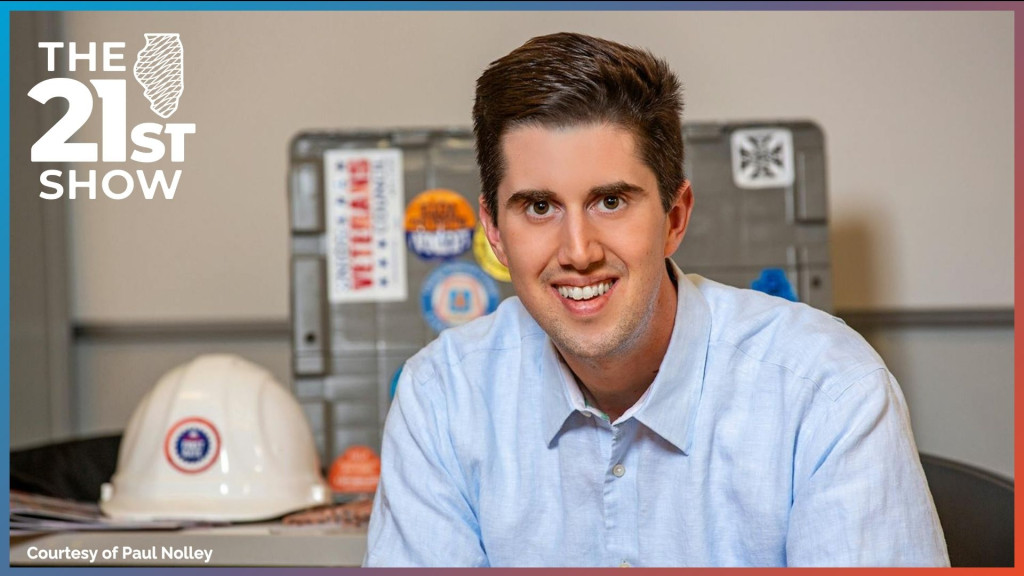
Transcript: Democratic congressional hopeful Paul Nolley on Iran war, ‘chaotic’ tariffs, and workers’ rights
The 21st Show
Democratic congressional hopeful Paul Nolley on Iran war, ‘chaotic’ tariffs, and workers’ rights
Read the full story at https://will.illinois.edu/am/democrat-paul-nolley.
Transcript
Brian Mackey: Today on The 21st Show, two years ago, no Democrats filed to challenge Republican Congressman Darren LaHood of Peoria. This year, a Democrat stepped forward. Paul Nolley was born in Rockford, went to Illinois State University, and now leads a nonprofit, a partnership between union contractors and tradesmen and women. We'll talk with him about policy, politics, and running in a district heavily gerrymandered to favor Republicans. I'm Brian Mackey. That's coming up today on The 21st Show, which is a production of Illinois Public Media, airing on WILL in Urbana, WUIS in Springfield, WNIJ in Rockford DeKalb, WVIK in the Quad Cities, and WSIU in Carbondale. But first, news.

From Illinois Public Media, this is The 21st Show. I'm Brian Mackey. And we start today with another Democratic candidate running for U.S. House in a downstate district that's long been held by Republicans. The 16th District starts in Galena in northwestern Illinois. It then snakes its way east and south, wrapping around Rockford, Peoria, and Bloomington, but avoiding the urban cores of those communities. Democrats drew the map this way to maximize the number of Republicans in the district. And in fact, Darren LaHood is the incumbent. Under current borders, he was unopposed in 2024 and won with two-thirds of the vote in 2022.

My guest today is hoping for a different outcome this year. Paul Nolley was born and raised in Rockford, and today he leads Project First Rate, a nonprofit partnership between union contractors and tradesmen and women. This is his first time running for office. He joins me live. Paul Nolley, welcome to The 21st Show. Thanks for being with us.

[00:02:51]
Paul Nolley: Thank you. Great to be here.

[00:02:51]
Brian Mackey: And I'll note we have emailed Representative LaHood's campaign several times to request an interview. No response yet — we will keep trying. That said, listeners, if you have a question for Paul Nolley, especially if you're in the 16th District, you can join the conversation by giving us a call at 800-222-9455. What do you think of your current representation in Congress, and what are your priorities coming out of this year's elections? 800-222-9455 is the number. That's 800-222-9455.

All right, Paul, I'd like to start these interviews with a little talk about your background, who you are. What was it like growing up in Rockford for you?

[00:02:51]
Paul Nolley: Sure. So I had a pretty, you know, typical working-class kid type of upbringing — parents who didn't have college educations while I was growing up. My mom would eventually go and earn her bachelor's degree. But, uh, yeah, just, you know, kind of the working-class values of working hard and trying to get by, do right by your family. And, you know, I've kind of put that into practice through a long career of working with community organizations. But, you know, I grew up with good people who taught me good values, raised in a Catholic family, and just people who understand that we gotta take care of each other, that we're all in this together. And I think that's what a lot of working-class people experienced growing up, because you don't have everything and you need to stick together to, you know, make life work for you. And so, yeah, that was, you know, a big part of growing up in this area.

And my wife and I met in high school, so she's been a huge part of my life, even since I was, you know, an older teenager. And, you know, just hanging with friends, music — you know, pretty typical upbringing.

[00:03:53]
Brian Mackey: Did you say [mac] or music?

[00:03:57]
Paul Nolley: Music, no, yeah — leave the music, but, you know, it's good for the elevators and such.

[00:04:03]
Brian Mackey: What do you — tell me about how did you get into work with nonprofits, and maybe you can say a little more than I did in the introduction about what exactly you do all day.

[00:04:12]
Paul Nolley: Yeah, I got into nonprofits about 2 — well, actually, I interned when I was in college. I should back up. So I interned for the McLean County Habitat for Humanity. I went to college down at Illinois State University, and my wife did as well. And so I interned there. I interned with another organization called Illinois People's Action. And so I really got, you know, a taste of it through an internship of what that is like, and I enjoyed it.

And then when I got back to my hometown, I was, you know, doing odd jobs, cleaning apartments, this and that, and I actually got hired on to be a field organizer for a local state Senate campaign. And that was, you know, short-lived, as campaigns are. And after that, then I got an opportunity to jump back into the nonprofit sector, working with the YMCA in town. And I just really enjoyed the general industry and the type of work, and, you know, that it was all in service of the common good. And you got — there's all sorts of different things you could do. I got to learn about fundraising and running programs and issue advocacy. And it's very local, so, you know, unless you're working for a national organization, you are helping people directly in your community. And so, in Rockford and the surrounding area, there's a lot of work to be done, and so I just always have found it very meaningful. I've always really enjoyed working with good-hearted people and getting things accomplished.

[00:05:31]
Brian Mackey: Why do you want to be a member of Congress? Because getting things accomplished is not always top of the list of what's coming out of Washington these days.

[00:05:39]
Paul Nolley: That's true. No, you're right. And I want to be someone that can get stuff done. And, you know, one of the biggest things — the reasons why I am doing this is because I have two little kids now, and I never wanted to run as a candidate myself. I've always been interested in politics and policy and issue advocacy. But I've always found electoral politics a little yucky, I guess you could say, and never really wanted to be a candidate. However, I just think we're at a point in time right now when regular people who maybe are reluctant — aren't just so driven to be the guy or woman, you know, in this seat — need to step up. And people who are willing to have independence, people who are willing to be uncompromising in some of the fundamentals of how you run a campaign and some of the issues — that's exactly what this campaign is about. So this was not part of my plan, this is not on my bucket list, this is not a lifelong career goal. But I looked at what was going on in the first couple of months of Trump 2.0, and then I looked at my kids in their eyes and I said, we have to do something.

I can't be 10, 20 years out telling the kids, well, we were financially stable and we were doing all right, so why did we worry about all the rest of the things that were going on in the country and the world? I wanted to be able to say, hey, we got involved, we got in the fight, we fought for your future and the future of other kids, and we did something big. And that's what we're trying to do.

[00:07:02]
Brian Mackey: So you are the only Democrat who even ran in the primary, as far as I can tell from the state records. Why do you think that is? And what is it about you that makes you willing to take on what is, you know, a very uphill battle given how the districts have been drawn in Illinois?

[00:07:19]
Paul Nolley: There were actually four of us at one point, and I would like to think it's because of the power and strength of our campaign that the other candidates, you know, saw the writing on the wall and got involved. So, yeah, we had other candidates that were involved, and it kind of went up to the signature process — one that was in the middle of the signature process and dropped out before filing. And it, you know, it was quite a process to get all the signatures and make sure they're all legit and all that. So, yeah, so we were uncontested on the ballot. You are correct about that.

And I, you know, I think that as far as why I made it past that line and why other folks didn't be more aggressive about it, it's just because I truly believe in the mission — the mission of getting this country turned around and having working-class voices represented. And I'm really upset with my representation of my incumbent, and I just think it's really pitiful, it's shameful. And I'm so fired up to do this. I'm giving it my all. My family is giving everything they have. Our core group of volunteers and hundreds of other people now that have become part of this movement are giving it their all, and I think that we have the passion, and we're on the right side of history, and we are committed to getting this done.

[00:08:29]
Brian Mackey: Let me remind listeners, this is The 21st Show. We're speaking with Paul Nolley, who's a Democrat running in the 16th Congressional District, challenging the incumbent congressman Darren LaHood, a Republican. 800-222-9455 if you want to join us today. 800-222-9455.

So you mentioned you are dissatisfied with your current representation. What's at the top of your list?

[00:08:54]
Paul Nolley: He has no independence. He has a 100% voting record with Donald Trump. All of the things that Donald Trump wanted to get through Congress or wanted to oppose, he has been on that same side. I don't care who the president is, what party — whatever they are — that's absolutely ridiculous. On top of that, the policies he does support are just terrible for working people. It's just a nightmare. And he hasn't had a town hall in almost a decade, which just shows me he's been handed everything, he doesn't take it seriously. Obviously he doesn't feel obligated to meet with his people outside of, you know, quote-unquote safe spaces and scripted scenarios. So I just think that's disqualifying all around to be a U.S. representative, and I know that the people deserve better, the people want better, and I know I could do a heck of a lot better than he [has].

[00:09:41]
Brian Mackey: If you were to win, would you commit right now to holding town halls in the next election cycle?

[00:09:46]
Paul Nolley: Yes. And I have — I have committed to regular town halls across the district in person for the last 16 months of this campaign, and I will never stop making that commitment.

[00:09:55]
Brian Mackey: Let's talk policy. We can start with the economy. That is what voters often say is the most important issue to them. What can the federal government do to improve the economy, especially when you're thinking of the Americans with, you know, least income and least wealth to speak of?

[00:10:12]
Paul Nolley: Well, step one, we could end this insane war that we have in the Middle East. This [is] another quagmire, this [is] another endless war that's going on in Iran. It's absolutely insane. That's step one — to end this war. We have to stop it. All of our inputs, all of our prices are going up because of this, and not just gasoline and diesel. So that's step one.

Number two is to end this chaotic tariff regime. I think just an hour ago, roughly, the president had mentioned some new tariffs going on in Canada. You saw the fallout from the failed negotiations that happened between us and Canada over the last few days. And then, of course, the quote-unquote liberation day and the things going back with the Supreme Court and then him, you know, implementing a new slate of tariffs — that is destructive. It creates uncertainty and instability for businesses making investments. These are just man-made harms to our economy, to the working people, and they're driven by ego — I believe that.

So those are some things that we have to do on day one. In addition to restoring the Affordable Care Act tax credits — I have talked with people seeing their premiums skyrocketing because of those cuts — making sure that those Medicaid cuts get reversed, [because] people are gonna start feeling that. So those are some kind of reactive things that we needed to do from this administration and Darren LaHood's decisions.

And then on top of that, we need to make this economy work for regular people more so than it has. We have an economy that has worked great over the last 50 years for the ultra rich, the big corporations. And the average person's take-home pay has declined as it relates to the cost of living. It's almost impossible to have a one-income household. If you want to get a college education, get ready for mountains of student loan debt. If you want health insurance, get ready to pay, you know, a ton of money to just carry your insurance, much less actually go ahead and use it. So the overall economy is stacked against the average person, and we have to change it. And that starts by electing leaders who are going to take on the forces that have driven it that way and weakened our unions, so on and so forth.

[00:12:12]
Brian Mackey: Yeah, OK — it's a lot to choose from there. So let's actually — you ended with unions. Let's continue that line of thought. I mentioned your current line of work is a partnership between union contractors and tradespeople. Across the workforce, as you probably well know, union membership is down over many decades now. How do you deal with that, and what are the consequences of that?

[00:12:36]
Paul Nolley: Well, the consequences of that are that working people have lower wages, fewer benefits, and worse working conditions. We have higher income inequality because of that. The rich are able to get phenomenally more rich. The wealth that is being created by workers is going to the top — it's not going to us. So that's the consequence of it, and you can see all sorts of data that backs that up.

What we do about it is we strengthen workers' rights. We make it easier to form unions. We strengthen the ability of workers to collectively bargain, so that people are not being held up by this army of lawyers that can hold up negotiations even when you do form a bargaining unit. And making sure that people actually have the ability to have a little control over what goes on in the workplace. They are producing the wealth, they are actually getting stuff made, getting the work done, and they should be the ones that are able to, you know, reap the benefits of it in a substantial way beyond what we're seeing today.

[00:13:38]
Brian Mackey: You know, Republican voters — union voters, right? There's still a majority — I think it was 57% in 2024 went for Harris — but that means that, you know, roughly 40% went for Trump. What is the disconnect between Democrats, at least as a national brand, and so many union members — again, not a majority, but a significant number of union members — who don't see that party necessarily serving what they want to see out of their representatives?

[00:14:18]
Paul Nolley: I think that it gets to one of the foundational ideas that Donald Trump put out from day one: that the system is rigged, the economy is not working for the everyday person, and the political class that has been ruling us for the last, let's say, 50 years is responsible. That is an analysis and assessment I agree with. Now, it's a matter of what we do about it. However, he made that assessment and that analysis, and that was very powerful rhetoric and idea to put out there in the campaign, and a lot of the people like you're suggesting bought into that — and I think rightfully so, because again, I think that's accurate.

It's a matter of how do we go forward. And what this administration and people like Darren LaHood have done is they've actually made it worse for working people in almost every single way. So it's our job as people who are part of the Democratic Party to offer a new vision for a party that makes that assessment — which is true — and then offers proposals that are gonna move us in a direction that actually makes it better in a material way for the everyday person. And I think if you look at the Democratic Party over the years, it has started to build a base of support in the tech companies and, you know, college-educated people, which is fine to a certain degree — but it's only fine if we're not devaluing the priorities of the working class. And I think that's what has happened. Our campaign is an effort to turn that around.

[00:15:44]
Brian Mackey: One other question — you mentioned healthcare. As long as we're talking about economic matters, do you support guaranteed universal healthcare?

[00:15:52]
Paul Nolley: I do. Yes. I believe a universal health insurance program is a much better way to get better outcomes and spend less money at the federal level, to, you know, get us into the modern age.

[00:16:05]
Brian Mackey: Is that single payer? What does that look like?

[00:16:08]
Paul Nolley: I think that the best proposal right now — and I'm open-minded, and I think this is gonna have to go through a process where we bring in critics and we bring in advocates and we have the best product that we could possibly get at the legislative process — but the general model that I think is best right now is Medicare for All. It's not [without its challenges]. There are some changes, some variations, but yeah, having a national health insurance program that is accessible to all, that is not connected to your employment, is the right direction.

[00:16:36]
Brian Mackey: All right, 800-222-9455 if you want to join Paul Nolley and me on The 21st Show today. He is the candidate, the Democratic nominee for the 16th Congressional District, which includes Galena and the rural areas outside of Rockford, Peoria, and Bloomington-Normal. Much of north-central Illinois is in the 16th District. The incumbent is Darren LaHood, a Republican. We have invited him on the show — no response yet. We'll continue doing so. Again, if you want to join us, 800-222-9455. We'll have more with Paul Nolley after a short break. This is The 21st Show. Stay with us.

It's The 21st Show. I'm Brian Mackey. We are live today with Paul Nolley, who's a Democrat running for Illinois's 16th Congressional District. His opponent is incumbent Republican Representative Darren LaHood. We've reached out to Mr. LaHood's campaign several times to request an interview. We have not gotten a response, but we will keep trying. 800-222-9455 is the number if you want to join us today. 800-222-9455.

All right. This district, as I've mentioned, was drawn to elect Republicans. So I want to go through some issues that Republican voters have signaled in the past are very important to them. And let's start with the topic of firearms. Do you own a personal firearm? Are you a gun person?

[00:18:20]
Paul Nolley: Yes, I [own] multiple.

[00:18:23]
Brian Mackey: Is that something you grew up with? How did you come to that?

[00:18:26]
Paul Nolley: I did, yeah. My grandfather, who I'm very, very close to and have been for my whole life — he is a Vietnam veteran. He was drafted into Vietnam. My mom was born while he was serving over there, and he taught me how to shoot on a .22 as a young boy.

[00:18:43]
Brian Mackey: How do you relate to voters who are, you know, fellow gun owners who think Democrats are out to sort of take their guns away?

[00:18:53]
Paul Nolley: Well, I differ in some ways with some of the elected officials. I don't support an assault weapon ban, for example, and some of my supporters and Democratic friends don't agree with me on that. But here's what I would say: I'm focused on my campaign and what I stand for. I support the Second Amendment. I support respect for firearms. I think that's one thing that is lost — having respect for what they are, how to use them — and I think it's important to have that. And, you know, I'm someone that does believe in making sure we have background checks and that they don't get into the wrong hands. But overall, I'm a gun owner, have been since I was a kid, and really respect that. And, you know, that's just who I am. I can't speak for everyone on every issue in the party, but I'm trying to move the Democratic Party in the direction that I see as being right and being able to have generational governance, and that's what we're working towards.

[00:19:50]
Brian Mackey: Another issue that often comes up in surveys is that of abortion. What do you think about the current state of — since the Dobbs decision invalidated the sort of constitutional right to an abortion that the Supreme Court had found in the 1970s — there's been a patchwork. Governor Pritzker has often talked about Illinois being a haven for people seeking this kind of medical procedure. Where are you on this?

[00:20:17]
Paul Nolley: I think the decision is ultimately between a woman, her religious advisors or religious leader, and the physician. That's where it starts and ends for me. It's not a decision for me. It's not a decision for the government. It's a decision for a woman to make on her own, and that's where it starts and ends.

[00:20:39]
Brian Mackey: When does life begin on this topic, right? This is a fraught question for some people, but there are people who think it's murder to have an abortion, and that passing laws to prevent murders is where their sort of motivation comes from.

[00:20:56]
Paul Nolley: Well, I can say this: I grew up — I think I said it earlier — in a very Catholic family, and I was baptized and confirmed into the Catholic faith and, you know, have a lot of family who are very, very religious and very pious in that regard. And so I understand that religious tradition. However, when life begins is a question for philosophers, scientists, religious leaders. And I think when it starts getting into where the government comes in and makes that decision and makes policy based on that — that restricts people's personal freedoms — I think that's where legislators need to take their hands off again. I think it is between a woman, her physician, and her religious leaders and faith that should be making the decision, not government.

[00:21:43]
Brian Mackey: Should there be any laws imposing limits or restrictions on abortion timing during, you know, the course of a pregnancy, for example?

[00:21:53]
Paul Nolley: I, you know — I just am in favor of letting women make the decision for themselves. And, you know, it is very, very rare to have a woman choose to have an abortion at a late term. It's a very, very rare thing, and it's typically due to some sort of health or emergency type of issue. So I am in favor of that decision being made between a woman, her faith community, and her physician.

[00:22:21]
Brian Mackey: Somewhat of a self-interested question here, I guess — it's kind of become a social issue. Public broadcasting, as you know, was defunded by the Republican administration, and the Corporation for Public Broadcasting no longer exists. What do you think about the future of public broadcasting? This, of course — you're speaking to an NPR station. Is this something that you see potentially being restored in the future, or is that era in the past?

[00:22:50]
Paul Nolley: I sure hope so, and I would fight to restore it. And, you know, I think my opponent Darren LaHood has voted to allow that to happen. And, you know, as you just indicated at the start of this, he hasn't even responded to you. I mean, I kind of think it's not funny because I think that's disrespectful to you all, but it is indicative of his general demeanor. I hear it everywhere — whether it's the host of this program I'm on today or voters and constituents of his across the district. We call, we write, we try to get town halls, and he doesn't answer, he doesn't respond, he doesn't show up.

So, you know, that's where he stands. As for me, I stand for public broadcasting. I think it is so essential. I mean, I've been listening to public broadcasting since a young age — especially if you don't have resources to pay into some of the programming that's paywalled, especially in rural communities where it's really locally focused and you're getting information, you know, [emergency] — all that kind of stuff. And my children, for example — some of the best children's programming is coming out of PBS, and for all of that, you know, I just think of how enriching some of the programming is. So, yeah, it's just another attack on the public good, the common spaces, the common things that we all share together. That's the direction they want us to go. They don't want everything to be privatized — they want everything to be individualized. And it's all, "I got this, and don't worry about other people." And I think the cuts to public broadcasting and that general philosophy is just an extension of that, something I absolutely oppose.

[00:24:16]
Brian Mackey: Earlier in the conversation, you mentioned the Iran war — I think you called it disastrous. What can the House actually do? You're sworn in — it would be next January 2027. What can the House actually do to try and put an end to that, or at least stop further escalation?

[00:24:36]
Paul Nolley: Well, they need to be aggressive. Congress has the war-making powers, and I know that's evolved into the executive over the years. But, you know, a step that they could do now is have the war powers resolutions be matching in both chambers of the House and get a veto-proof majority across the finish line, so that that actually goes into effect. It seems like right now they're playing games where the House has one version and the Senate has one version, and it might pass, but it's not reconciled, so it actually doesn't go into effect. They need to actually get their stuff together and make that happen.

But I mean, Congress should be fighting tooth and nail against this. This is not just a disaster — it's illegal. It was never authorized by Congress. It's continued on past the window of time where the executive has the ability to, you know, put some troops and do some actions that Congress has provided. So they need to be aggressively opposing this and pointing out the cost to the American people, which I see they're starting to do in a more concerted effort.

[00:25:35]
Brian Mackey: Related foreign policy issue: Do you think the United States has an interest in a free Ukraine?

[00:25:43]
Paul Nolley: I do. I think that we have an interest in people being free across the globe, and I think we should stand in solidarity with people who are fighting for their freedom. And I think that, you know, when we see authoritarianism on the rise, that's troublesome. We see it here at home, we see it abroad, and we see the rise of countries like China. And it's just a matter of, you know, what's our role in that, how much resources can we put into each of these conflicts — that's really where it gets complicated, I think.

[00:26:13]
Brian Mackey: You know, one of the areas where we've seen this — some people call it a horseshoe effect, right, where the far left and the far right kind of come together on certain issues — is the U.S.'s role overseas. Ukraine and Russia is one area where both people on the far left and the far right are opposed to what, you know, people like President Biden were doing. What do you think about NATO and this idea that President Trump is trying to pull us back from NATO and really the entire sort of post-war security system, where the United States was a global leader? Frankly, do you think President Trump is on the right path with that?

[00:26:52]
Paul Nolley: You know, I understand some skepticism of NATO. And my suggestion, the path forward, is not to eliminate NATO. People often think of it in the terms of the Cold War and its creation, and there's a lot to be said about that. However, where my criticism stems — and I think it's in part with what you're saying, people on that horseshoe — is: What is it designed to do? Is it designed to keep people down? Is it designed to extract wealth from communities and give them to the ultra rich, right? So I want — whether it's NATO or any other international organization, the U.N. or others — I want it to be serving the interests of the average person. The average person in America and the average person in the other member states. And I think that's where it needs to head.

So it's not so much about removing NATO or getting us out of NATO. It's making sure that the priorities of the regular person are reflected in any sort of institution, whether that be international or domestic. And I think that's where people have concern: Is this an institution for the elite, by the elite, to keep the elite in power? And I think there's truth to that in a lot of assessments of institutions that have been created over the years. I just want to make sure that that gets reversed and it's in the interest of the average person.

[00:28:09]
Brian Mackey: A growing number of Americans have been reevaluating our past support for Israel and whether and how that should look in the future. I wonder where you are on that issue.

[00:28:21]
Paul Nolley: Yeah, I think our — where we spend money abroad needs to be overhauled, and I think that applies whether you look at Egypt or whether you look at Israel. And I think there are reasonable, serious questions of: Why are we spending billions and billions of dollars to send abroad to countries that have a larger, more robust social safety net, for example, than we do? We don't have guaranteed healthcare, yet we're using our precious taxpayer dollars — while we're $40 trillion in debt — to subsidize another government, a government that has not really respected our nation. And if you look at Egypt, for example, a very authoritarian country, and we're spending tons of money over there as well. So I think it has to be looked at holistically, and I think people are getting sick of our money going abroad — regardless of what country it goes to — when we can't afford the basics and we are now at record levels of debt in the United States.

[00:29:26]
Brian Mackey: All right, let's go to the phones. We're speaking with Paul Nolley. He's running as a Democrat in the 16th Congressional District against incumbent Republican Darren LaHood. 800-222-9455. And we have Roy calling from Princeton, Illinois. Roy, thank you for calling in.

[00:29:45]
Speaker 2: Welcome.

[00:29:48]
Brian Mackey: No, if you can turn your radio down there and then go ahead, Roy, with your question.

[00:29:55]
Speaker 2: Um, what is the candidate's policy regarding agriculture?

[00:30:04]
Brian Mackey: OK. Is there some specific area of agriculture policy you're most concerned with, Roy?

[00:30:09]
Speaker 2: Uh, no, I just — there's a lot of ag production within this district, and I haven't heard anything yet about any policy toward agriculture on the radio.

[00:30:22]
Brian Mackey: All right, Roy, thank you for the question. I appreciate it. And, Paul, I'll just tee that up in a general way. If you have a sort of broad-based position on agriculture, and then we can drill down a little bit.

[00:30:35]
Paul Nolley: Sure. Well, hey, Roy, thanks for the question, and good to hear from someone in Princeton. We've been traveling there pretty frequently across this campaign.

So as far as agriculture, my policy priorities are to strengthen the small and medium-sized farmer. I think that so much of our policy — whether it's ag or otherwise — has been aimed at the very powerful, the people that have it all, the people that have the lobbyists. And so forth. And I want to be a voice for folks who don't have that power, who don't have that privilege to, you know, have lobbyists in D.C. telling people how to write the bills and all that.

So, specifically, a couple of things that I would focus on would be industry consolidation — whether that's inputs or the buyers. I think that has made it much harder for farmers to make a profit and not rely on subsidies from the government. I also want to make sure that we have restrictions on how much these corporations and foreign governments can buy in our prime farmland. I think that's outrageous that that's happening. Obviously, that drives up the prices for people who are just trying to do honest work and start or expand their family farm.

And then one issue that's really core to me, that I know is core to so many people in farming communities, is the right to repair. My opponent is funded by John Deere and Caterpillar and folks that don't want us to be able to work on our own farm equipment — and similarly in the automotive sector. I'm a son of a mechanic. I do all my general maintenance on my own vehicle, and I think that everyone should be able to [fix] their own stuff. And they are fighting that tooth and nail. I think that farmers care about that more than the average person, because they may be out in the middle of a field doing something and they break down, and they want to be able to get out there and fix it on themselves. And if we don't have right to repair, that is gonna be going away quicker and quicker — and it already is for some pieces of equipment. So those are some priorities for me for agricultural communities.

[00:32:23]
Brian Mackey: What do you think about this idea that some have had of splitting apart food assistance from the farm bill? This was brought together some years ago as a way to get sort of urban Congress members and rural ones to work together on this big issue. There have been attempts to split it up. What do you think of that?

[00:32:43]
Paul Nolley: You know, I guess I'm agnostic, as long as the policy is good and it gets done. I do think — you know, I got a question the other day. I was at the [Jo Daviess] County Farm Bureau, and they had a question for me about: If and when you get elected, you would be one of the few Democrats elected [from a district with] a lot of agricultural outputs — one of the top 25 of all congressional districts — and how would you work with other people across the aisle and get Democrats to prioritize these issues? And I think that's a really important question.

I think that's what we're trying to do — have the Democratic Party make sure it's bringing the voices and concerns of rural America and working-class America to the table. And, you know, I think like you said, that is a product of there not being a lot of Democrats elected from these communities. So I think me being a voice in there will help with that. And I think just broadly, the Democratic Party needs to be focusing on our communities.

So whether that means we can splice those up — that's fine. But whatever gets it over the finish line, and making sure it's good policy, that it actually supports our local small and medium-sized farmers, that's the priority for me. And I'm agnostic as to how it gets done.

[00:33:50]
Brian Mackey: We need to take a break in less than a minute here, but briefly: What about the idea of, you know, ethanol production, corn being grown as a sugar sweetener and not just for consumption by animals — there are those who say this is sort of environmentally terrible for us, it's bad for our health, there are too many subsidies for commodity crops like corn. What do you think of that?

[00:34:14]
Paul Nolley: Well, I think we need to make sure that the foundations of these rural economies, you know, aren't pulled out — the rug isn't pulled out, right? So that's one thing that, regardless of the policy, if you have farms closing down and consolidating at an even greater rate than they already are — and that's already happening, unfortunately — that is detrimental to those communities, that's detrimental to our state, that's detrimental to our country. So we need to be thoughtful. We need to make sure that we are [envi]sioning sustainability practices. OK, and we're —

[00:34:44]
Brian Mackey: We're gonna have to — we need to take a break. I'm sorry to interrupt you. We will continue with Paul Nolley, candidate in the 16th Congressional District. 800-222-9455. We'll be back after a short break. This is The 21st Show. Stay with us.

It's The 21st Show. I'm Brian Mackey. We are live today with Paul Nolley, running as a Democrat in Illinois's 16th Congressional District against incumbent Republican Representative Darren LaHood. We've reached out to Representative LaHood's campaign to request an interview. We've not yet heard a response, but we will keep trying. 800-222-9455. If you want to join us today, that's 800-222-9455.

Paul, if Democrats regain control of the House, would you support Hakeem Jeffries to continue as speaker — or leader of the Democrats if in the minority?

[00:35:45]
Paul Nolley: I'd like to see what my options are. I have some concerns, some skepticism of his leadership right now. I think he has some positive things going — he's kept the caucus relatively unified. But, you know, just for example: He was a supporter of a national health insurance program and then became not. And so there's some issues. So I'd like to see what the alternatives are. You can't vote for no one if you have no options. But yeah, I'm skeptical broadly of Democratic leadership right now.

[00:36:16]
Brian Mackey: There's a debate going on among Democrats about what to do should you regain power, right? Investigate and impeach President Trump — you know, tear down the East Wing ballroom — or, you know, let all that go and focus on the price of ground beef. Where are you in that debate?

[00:36:36]
Paul Nolley: You gotta do both. You absolutely have to do both. Now, you're gonna have to face the reality of having divided government. Hopefully Democrats have the Senate as well, but the Supreme Court and the White House are in the hands of Republicans. And you just have to be real about that. So the one thing that we'll be able to do successfully is oversight — bringing people in, rooting out this corruption, and shining a light on it.

And there's also some issues that we can work with the Republicans on. I use the Faster Labor Contracts Act as one example, where you have some pretty right-wing members of Congress supporting [legislation] with pretty progressive members to make sure that unions are actually able to negotiate a speedy contract without it being held up by the likes of Amazon and Starbucks. So I think there's some work around the edges that can get done. And then on top of that, my priority will be starting to write and tee up legislation that we want to enact when we win the presidency in the next cycle — starting to go through that and getting feedback from stakeholders and having policy ready to move on in the next session.

[00:37:44]
Brian Mackey: You know, you are running in a district that — as I made this point earlier — it's really drawn to elect Republicans. Illinois has been gerrymandered to within an inch of its life. You know, if we took a decade of votes for statewide ballots for governor and senator and president, the state is basically 55% Democrat, 45% Republican. But the congressional delegation is 82% Democratic, 17% Republican, which, you know, if you're a statewide Democrat, that's a net positive — but obviously it makes it a lot harder for you to run in the district you're in. How do you think about that state of play?

[00:38:22]
Paul Nolley: Well, first of all, I'd say I support national redistricting reform — ending gerrymandering across the board. My opponent does not support that and has been against that. So that would solve this issue. I think we have to get there and have a whole slew of political reforms with that as a top priority, to make sure this doesn't happen again, that we have competitive congressional districts across the board in every state. So I just want to say that at the top.

And secondly, you know, I think it's district by district. Yeah, we're running in a tough district. Last time Cook Political Report assessed it — which was over a year ago — I believe it's R+11. But this is a district that can swing. We've been putting in the work, and I think I'm the type of candidate that can win over the type of Republicans we need to win in a district like this. People who are just fed up with the status quo, people who have believed both parties have abandoned them and that the political class is corrupt and isn't working in their interest. I come from working class, I come from nothing — you know, I'm just a regular guy out here trying to do something, and I think we can relate to that. So yeah, they drew the lines, right? It's this race to the bottom. And Illinois is part of that in redistricting and gerrymandering, 100%. And we have to address that at a national level, otherwise the race to the bottom will continue and get worse. And that's how I feel about it.

[00:39:33]
Brian Mackey: Although, ironically, if the districts were more competitive, the Democrats would be less likely to be able to take back control in Illinois specifically, right? If Illinois had, say, seven Republican seats and only 10 Democratic seats, as one might expect from the sort of statewide partisan preferences — how do you reconcile that?

[00:39:54]
Paul Nolley: But national redistricting reform would take place across every single state. So, yeah, nothing would be given or granted or assumed, but you would have competitive races in essentially every congressional district across America. And I think that's what the American people want, that's what the American people deserve. And there's gonna be some communities where people are interested in this type of policy over that, or just the quality of the candidate makes a big difference, and what they stand for and how they [campaign].

And I also believe in public financing of elections, and shortening the window of how long elections go on. I think these are common-sense reforms that the American people are totally behind. It would make our system so much better — less corrupt, less just grating and annoying and terrible. So I think that generally we have to reform the political system. It's just so broken, and redistricting is just one example. But I believe in making districts competitive across the board.

[00:40:51]
Brian Mackey: Any sort of major reforms you're talking about — be it redistricting, campaign finance — it all would most likely have to go through the U.S. Supreme Court, which, as you well know, a lot of Democrats see as partisan, bent the other way, in the past decade. Would you support a law aimed at, you know, doing something to change things up on the Supreme Court — whether it's expanding the number of justices? Let's start with that one. Would you support this idea of court packing we've heard?

[00:41:20]
Paul Nolley: I don't believe in court packing, no. But I believe that there have been times in America's history where [the court] expanded the number of seats there, and I think that's something we should be open-minded to. I don't think it should be this hyperpartisan packing, because again, talking about race to the bottom — that just opens that up even further. OK, the Democrats [add] X number of seats, and then the Republicans get in power and they do the same thing, right? That doesn't get us anywhere other than some short-term victories for whatever partisan group is in power.

So I think just being very, very thoughtful about the reforms — I think the ethics reforms, that's common sense, that's step number one: making sure these corrupt Supreme Court justices are not able to take money and bribes and all these things that they're doing now. I mean, it's just criminal. So that's step one. But then, yeah, I think thoughtful reforms on expansion, term limits, etc. — that has to be had.

[00:42:11]
Brian Mackey: Yeah, so you do support term limits as well for the court? What about age limits?

[00:42:15]
Paul Nolley: Age limits —

[00:42:16]
Brian Mackey: What about limiting the court's jurisdiction, as some have said, right? Like, they currently deal with certain maritime disputes, and then they have a lot of leeway. Would you support limits on that?

[00:42:32]
Paul Nolley: I don't think so. At least that's not something I've explored and that I'm really thinking about right now. So that's not something that's at the top of my mind or a priority for me.

[00:42:41]
Brian Mackey: Let's go bigger picture in the time we have remaining here. In the last election in 2024, a lot of young men — including Black and Latino young men — had a shift toward President Trump. What do you think they were not hearing from Democrats that might appeal to them?

[00:43:00]
Paul Nolley: The economy is screwed and this political class is responsible, and they've sold you out time and time again to the highest bidder. And that's this corporate class, that's the billionaire class, that's the political class that keeps itself in power — and you are screwed because of it. It's harder to get a job. You wanna start a family — good luck with childcare. You wanna get a decent house — good luck with that. You wanna get a college education — OK, get mountains and mountains of student loan debt. You wanna get a blue-collar job — those don't exist hardly anymore. That's what they're facing. That's why they were interested in someone that says, OK, I'm gonna take the bomb and blow up the system and build something new.

Now, that's nonsense as far as the actual solutions they're proposing — and look at what's happening right now and you see his popularity decreasing amongst those populations greatly. But they believe that the system is not working for them, and they're right. They believe that the deck is stacked against them, and they're right. It's just a matter of where we go forward on that. And the Democrats have not had a message consistently that is forceful, that shares that analysis, and then provides a path forward to change things — and they did not, and [voters] acted accordingly. So our campaign is pushing aggressively to be that type of campaign, and I think we are the type of campaign that the Democratic Party is looking to, and that we can be successful in winning people over — not just for one election at a time, but for a generation — and really change this country.

[00:44:22]
Brian Mackey: You mentioned blue-collar jobs in that answer. What do you do to bring back blue-collar jobs, right? Do you really think — like, the washing machine plant that left Galesburg — and I should check the map; I don't know if Galesburg's actually in your district or next door — but as a for instance, right? I mean, are manufacturing plants really coming back to America, or what do you do if not?

[00:44:45]
Paul Nolley: Well, the one thing we're not gonna be doing — I think it was Howard Lutnick had said —

[00:44:50]
Brian Mackey: Tiny —

[00:44:50]
Paul Nolley: Hands —

[00:44:50]
Brian Mackey: Tiny screws —

[00:44:52]
Paul Nolley: We're not gonna be doing that. But yes, we need to make stuff in America, and we need our government to buy American-made goods rather than buying Chinese. That was one thing that Trump for whatever reason ascended on — construction and elsewhere. But yes, we have to have manufacturing. I mean, it's critical — not just to having livelihood in these communities, having jobs and careers and economic vitality. It's critical to our national security. Look at what's going on with the chips in Taiwan and all the stuff — whether China takes it over or we get in a conflict with Taiwan, we're screwed either way on the chips production. You look at what's going on right now in our stockpile of munitions due to this disastrous war in Iran — where's our industrial base, right? It's depleted. It's weakened. And that's a big reason why we're not being able to reproduce this stuff as fast as we need it.

You look at all these different things that are going into automobiles — it's shifted over to Mexico and these suppliers, right? So, yeah, we definitely do need to bring it back. We just can't pretend that we're gonna be living in 1950 again. It has to be modern. R&D has to come into it. But we have to be putting people to work, and I believe in the apprenticeship model. I believe in bringing the apprenticeship model and that pathway into high school, so that we can start giving people training. The CTE education is so important. Obviously making sure people are ready for four-year university if that's the right path for them, but making sure that we have good careers and educational pathways that actually lead to good blue-collar jobs with living wages, with benefits. Because what does it help you if you get into a blue-collar job and you're making $15 an hour and have no sick days, have no time off, have no health insurance? That's not a good path either.

[00:46:31]
Brian Mackey: You know, for some people out there, it feels like our society is just kind of falling apart, right? Trust in government, trust in law, universities, the media — frankly — has declined a lot in recent decades. Societal cohesion is lower, right? The famous book on this, "Bowling Alone," right? People aren't in bowling leagues anymore, they go bowling by themselves. What steps do you think we should be taking to rebuild trust and unity across American society?

[00:47:04]
Paul Nolley: It's such a good point, and it's something I hear — as far as people will ask — oh, what are the questions you get at town halls? And a lot of it may not be articulated in the same way, but they're getting to the same point that you're making, which is we are coming unglued. Our country is coming unglued in a lot of ways, and one of those is that social cohesion, that sense that we're all in this together — regardless of where we come from, the color of our skin, who we love, etc. We're all Americans and we all want the best for each other. We all want the best for our communities. And people are really struggling with that.

As far as a pathway forward: The media — the tribal media and the way things are cut up — is a big issue, and that's hard to address. But I think a lot of it has to do with realizing that this partisan stuff that we've got right now, a lot of it's driven from the top. And a lot of people seek the benefit of that, because when we're scared, when we're fearful of our neighbors, they are able to get their priorities accomplished. And what their priorities are is taking as much money out of our pockets and putting it into their fat bank accounts, into their campaign coffers, into the hands of their donors and their executives. That's what they're doing while we're divided.

So we have to come together as the average people, the average working people of this country, and realize — regardless of all the socioeconomic statuses that we may identify with — we are the people who make this country run. We are the people who get stuff done. And we're the ones that our Constitution and Bill of Rights and all the founding documents that we're so proud of are aimed at serving. And we need to put that into practice by having leaders and people step up who are going to fight for that, who are going to put policy in that direction, and are not going to be beholden to this class of people that are ruining our country and making so much money off of it.

[00:48:47]
Brian Mackey: Paul Nolley is a Democrat. He's challenging the incumbent Republican representative in the 16th Congressional District, Darren LaHood. Paul, thanks for being with us today. Appreciate your time.

[00:48:57]
Paul Nolley: It was a pleasure. Thank you.

[00:49:09]
Brian Mackey: That is all the time we have for our program today. Coming up tomorrow on the show: Federal prosecutors have charged four managers of a Southern Illinois coal mine with concealing deadly conditions there. This is in Franklin County. There was an underground fire. They're charged with concealing that, falsifying safety records, and obstructing investigators. We'll talk with a reporter who has been covering the story. Plus, on the subject of coal, filmmaker Barbara Kopple on "Harlan County, USA" — her film about a Kentucky coal miners' strike. It won the Oscar for Best Documentary back in 1977, and it's getting a re-release in a fancy edition from the Criterion Collection. We'll listen back to our interview with her. It's all coming up tomorrow on The 21st Show.

That is it for us today. The 21st Show is produced by Christine Hatfield and Jose [Zaeda]. Our digital producer is [Kub Khan]. Technical direction and engineering comes from Jason Croft and Steve [Mork], and Reginald Hardwick is our news director. The 21st Show is a production of Illinois Public Media. I'm Brian Mackey. Thank you for listening. We'll talk with you again tomorrow.
Transcript Assistance
Illinois Public Media may use AI assistance for transcript generation and/or formatting. Transcripts that have not yet been reviewed for accuracy will be labeled.
To report a transcription error, or to request transcription of archival material, please contact will-help@illinois.edu.