








Transcript: New book explores nuances surrounding pregnancy loss
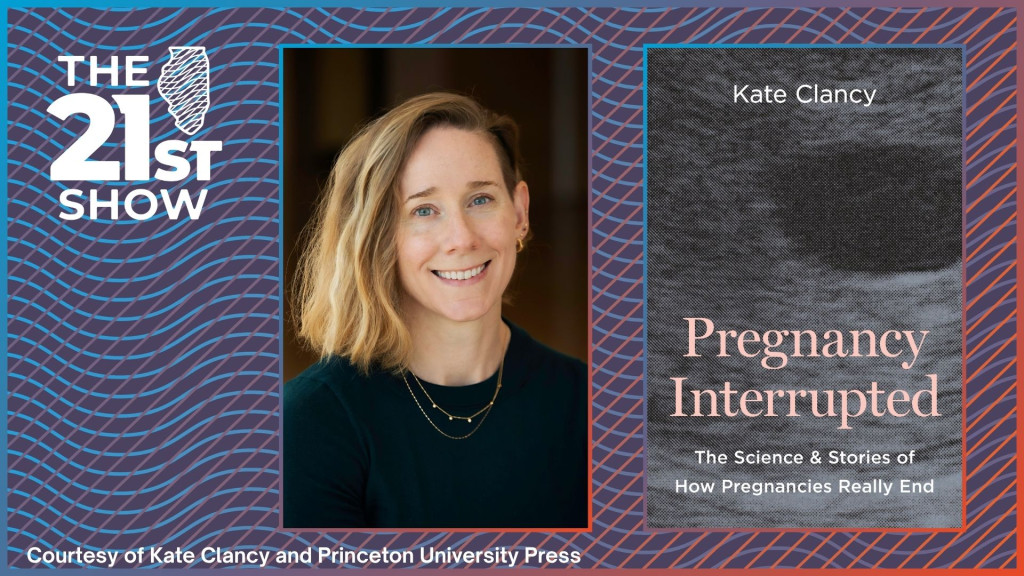
Transcript: New book explores nuances surrounding pregnancy loss
The 21st Show
New book explores nuances surrounding pregnancy loss
Read the full story at https://will.illinois.edu/am/new-book-explores-nuances-surrounding-pregnancy-loss.
Transcript
// This is a machine generated transcript. Please report any transcription errors to will-help@illinois.edu.

[00:00:00]
Brian Mackey: Today on the 21st Show, pregnancy usually brings with it the hope for new life, but many pregnancies do not end with birth. Rather, they end with loss, and that can leave a lasting mark on the women who experience it. That is the subject of a new book by Kate Clancy, an anthropologist at the University of Illinois. It's called "Pregnancy Interrupted: The Science and Stories of How Pregnancies Really End." I'm Brian Mackey with Kate Clancy for the hour today on the 21st Show, which is a production of Illinois Public Media airing on WILL in Urbana, WUIS in Springfield, WNIJ in Rockford DeKalb, WVIK in the Quad Cities, and WSIU in Carbondale. But first, news.

From Illinois Public Media, this is the 21st Show. I'm Brian Mackey. When we talk about pregnancy, our language is often clinical and systematic. There are clear divisions — 1st, 2nd, and 3rd trimester. There are also clear expectations. You should be feeling headaches, nausea, and back pain. Do take this medicine, don't drink that. But human experience is rarely so well ordered, and we often avoid talking about the possibility that a pregnancy might not end with a living, breathing baby, but instead with a miscarriage or stillbirth.

As Randy in rural Peoria County in our texting group put it, we lost one at about 10 weeks. The advice was to just get over it and never bring it up again. I still think about it a lot.

So today we're going to be talking about pregnancy loss. Kate Clancy has been studying this over the past few years. She's a PhD anthropologist and a professor at the University of Illinois Urbana-Champaign. Her new book is called "Pregnancy Interrupted: The Science and Stories of How Pregnancies Really End." It's out now from Princeton University Press. Professor Clancy joins me in studio for the hour today. Kate, welcome back to the 21st Show.

[00:02:23]
Kate Clancy: Thanks so much for having me.

[00:02:25]
Brian Mackey: And listeners, we are live for this program. You can join the conversation at 800-222-9455. How well do you think our medical system takes care of pregnant women? And if you've been pregnant, how much guidance did you have throughout? What did you make of it? And what do you think we can better do as a society about miscarriages and stillbirths? 800-222-9455 is the number. 800-222-9455.

And a brief content note: as you can likely gather from my introduction, our conversation today is going to include some frank talk about bodily functions. So listeners, beware.

So Kate, I want to start with a question I often ask politicians — a sort of philosophical question about a hot-button political issue — is when life begins. But I want to start with you with a scientific question. When does pregnancy begin?

[00:03:23]
Kate Clancy: It's a great question and one that I hesitate to answer with some sort of very straightforward answer. I think there are a lot of ways that we can address that question. One, a historical way would be through the quickening. So the first time that a pregnant person actually feels that little flutter, that there's something there. Other people are going to document it by the number of missed pregnancies they have. And certainly over the last 100 years or so, we've started to mark through a pregnancy test of some form that usually measures what's called human chorionic gonadotropin. And this is a chemical that's released by the embryo when it embeds in the uterus. But none of those are really clear thresholds for when a pregnancy absolutely begins, and they're really colored in a lot of ways by whatever technology we happen to have available at the time. So we kind of have to ask ourselves, is there a more subjective way that we can mark that beginning that's more dependent on what the pregnant person themselves might be thinking about their pregnancy?

[00:04:25]
Brian Mackey: Yeah, and I guess your answer gets at the point that it's complicated and why we want to know — but that's exactly right, you know, so. We have all these expectations and norms and ideas. You write in your book about two fundamental truths of pregnancy. What are those?

[00:04:45]
Kate Clancy: Oh gosh, you're asking me to remember what I wrote.

[00:04:47]
Brian Mackey: I can lead you a little bit, and one is the idea of loss. So I guess talk about that as a fundamental truth of pregnancy.

[00:04:54]
Kate Clancy: I do think that one of the things that we miss when we try to dictate pregnancy as this linear, predictable process that has a beginning, middle and end and always ends in a live birth is that anything that deviates from that is the non-normative experience. But there's an abundance of evidence to show us that actually pregnancy endings well before a full-term birth are actually more the norm. Probably half of pregnancies end before we even get an embryo touching down in the uterus, a significant number more end before we get to full placentation, which is sort of that 9-to-10-week period. And then there's still a risk of a pregnancy ending in stillbirth anytime from 20 to 40 weeks.

[00:05:40]
Brian Mackey: And one of the other sort of truths is this idea that the simple story obscures that the process is marked by significant uncertainty. So talk about that.

[00:05:51]
Kate Clancy: Sure. I think that there are these ways that — I started with the story of the pregnancy test to help answer when does a pregnancy begin. And we now have all of these technologies that allow us to surveil and assess and understand pregnancy. And in a lot of ways, these are great, useful technologies, but in other ways, they kind of impress upon us this idea that pregnancy is full of certainties — that when you see two lines on a pregnancy test, that means that that is a pregnancy, when all it is actually telling you is that there's some HCG in your system above some kind of threshold, which actually can mark a miscarriage, not a pregnancy. And you can see this with ultrasounds as well — what they're actually telling us is something happening in that current moment. But the way we often experience it as a patient is, this is telling us something inevitable or true that helps us then predict out the next 40 weeks.

[00:06:53]
Brian Mackey: Yeah, hm. So this uncertainty is often at odds with this idea that people are supposed to feel joy around pregnancy. Can you explicate that a little bit? I mean, how does that affect the experience of pregnancy?

[00:07:11]
Kate Clancy: I think if a pregnancy is wanted, you get to feel joy regardless of how it turns out. The thing that's really funny about human evolution is that miscarriage is really part of the process, and that embryos experiencing early demise is something that is just kind of part of how human reproduction evolved. And so anytime you get that two lines on a test or that ultrasound that indicates that some part of pregnancy is sticking, it actually means that your system is working as intended. And you might even see it as a positive sign of fertility, even if then that pregnancy doesn't continue.

[00:07:50]
Brian Mackey: Yeah, let's talk about human evolution and how — mammalian evolution, right? And I can't remember if it's in the book or in another piece of yours that I read, but the phrase "hot mess" comes up to describe mammalian evolution. So for those of us who haven't had high school biology in quite a while, can you remind us how we got to this sort of Rube Goldberg system of reproducing the species?

[00:08:16]
Kate Clancy: Sure. The funny thing about the stories we tell ourselves about human evolution is that evolution is not directional or intentional, and yet we then work backwards and tell stories about it almost like it is. But once you understand human reproduction and mammalian reproduction more generally, you can see like we would not have planned it this way. What a mess. And a big part of that is that we have these eggs that, because we want them to be such high quality, we're going to actually produce an overabundance of funky ones. We need a lot of variation. We need to have a lot of things that might be variably responsive to whatever environment that baby is going to be born into. And so you need all of this variable genetic material, and that's going to mean some really funky embryos that are probably not going to survive no matter what. But it also means some very high-quality ones will pass various types of tests over the course of pregnancy, that then will allow it to continue and give it a greater chance of survival later.

[00:09:21]
Brian Mackey: All right, let me take a moment to remind listeners this is the 21st Show. My guest today is Kate Clancy, who is the author of the new book "Pregnancy Interrupted: The Science and Stories of How Pregnancies Really End." If you want to join us today, the number is 800-222-9455.

I should mention, if you happen to be in the Champaign-Urbana area, there's a book launch event tomorrow night, September 9th, 6 p.m. at the University YMCA in Champaign. We'll have more details on that on our website, twentyfirstshow.org. But if you want to join us now, again, the number is 800-222-9455. 800-222-9455.

So pregnancy loss is arguably the most frequent outcome — like half of pregnancies, at least, end in loss. But that phrase, right? I don't know if we call it a euphemism, or just a sort of — it obscures a lot. So talk to me about how so.

[00:10:24]
Kate Clancy: One of the parents that I interviewed — and I'll remove the expletive for this audience — one of the people that I interviewed, who is a stillbirth parent herself and a legal scholar who studies stillbirth, said that she really had a problem with the term because she didn't lose him. This wasn't a misplacing, right? And yet we use this term to kind of encompass a whole range of possibility and ending, because our language is just so inadequate to the variable feelings people might have — from joy to ambivalence to abject grief.

[00:11:05]
Brian Mackey: So, while we're on the subject of terminology, I mentioned trimesters at the start. That's a pretty widely accepted concept, but it's pretty new at the same time. Talk about that history.

[00:11:17]
Kate Clancy: Something that I found interesting as I was researching this book is the fact that there is this trimester framework — and they capture about 13 weeks each of the 40-week pregnancy. But the thing that I always found curious about it was that it didn't seem to correspond to particular physiological moments in the pregnancy, and yet trimesters were used as though they had biological meaning. Things like various types of abortion laws that restrict abortion by trimester, or by a certain number of weeks, despite the fact that people are really variable in how much their pregnancy grows from week to week. And so when I looked at just how often that term was even used, it didn't really appear in relation to pregnancy research until the 1970s, until Roe v. Wade, and then it really ratcheted up. So in a lot of ways, while of course trimesters are real, they are not biologically constructed, but legally constructed — because that was what lawyers decided to hang their arguments on in terms of when abortion was considered OK.

[00:12:26]
Brian Mackey: Yeah, say more. So it's a — it's a legal argument or a legal framework more than a medical framework, I guess.

[00:12:34]
Kate Clancy: Exactly. So at a certain point, they said, well, when are we OK with abortion happening — "we" meaning these male justices who themselves did not have the capacity to get pregnant or had ever had that experience before. And the decision was made around this trimester framework. And then it kind of continued to shift as the science shifted, which Sandra Day O'Connor herself pointed out — like, well, if we're going to keep shifting these norms by technology, then it means that maybe these lines are not as useful as we think, right? Because they're legally constructed and then they're also biologically and technologically constructed as well.

[00:13:12]
Brian Mackey: You know, it's interesting because you mentioned earlier this idea of when pregnancy begins changes over time based on available technology. I was interested in the sort of medieval religious origins — or I guess not origins, but way of thinking — and how some of that is still with us today. Can you talk me through this idea of, you know, whether it's the three births and the canon law, and how the entire apparatus of childbirth for a medieval woman would have been different from what we're used to today?

[00:13:46]
Kate Clancy: Certainly, or at least among Catholics. So there was this one amazing book, "Surgery and Salvation," that I drew upon a lot for one of my chapters and the research of Elizabeth O'Brien in order to write it. And one of the things I was really struck by was the fact that cesarean sections are something that are very affected by medieval Catholic law. And so because ensoulment was such an important component of birth — in some ways considered more important than natural birth itself — there was sort of this push and pull about, well, if the mother's going to die anyway, do we take out this baby so we can baptize it?

[00:14:28]
Brian Mackey: So ensoulment happens before the birth, right? It's in while it's still inside the womb.

[00:14:34]
Kate Clancy: Yeah, I believe that's my understanding as a non-Catholic doing my best to read the literature. And so, you know, what's really interesting about this is that despite the fact that cesarean section — there was no pain medication available at the time — there was this shift from it being seen as an act to save the baby, to something that could be justified on religious grounds. And so we started to see this push and pull around, well, which soul is more important, the fetus or the mother, and starting to make decisions — medical decisions, religious decisions — on those bases, and in a lot of ways starting to sort of dehumanize or disappear that pregnant person in the spirit of saying that these other types of births, these spiritual births, actually were more important than whatever work that pregnant person might be doing during labor.

[00:15:26]
Brian Mackey: And if she has to die, then, to save the soul of this fetus — baby, whatever you want to say — then maybe that's a trade-off people were willing to make increasingly in that era.

[00:15:37]
Kate Clancy: I think there were at least some people willing to make that argument, for sure.

[00:15:40]
Brian Mackey: All right. Let me remind listeners again, my guest today is Kate Clancy, who is the author of "Pregnancy Interrupted: The Science and Stories of How Pregnancies Really End." She's a professor in the department of anthropology at the University of Illinois Urbana-Champaign. Her previous book, which we spoke with her about on the show three years ago, was called "Period: The Real Story of Menstruation." We'll have a link to that conversation on our website. If you want to join us today, we'd love to hear from you at 800-222-9455. How well do you think our medical system deals with pregnancies? And especially if you have been pregnant, how much guidance did you have? If you're willing to share your story about pregnancy loss — I know that can be a fraught subject, and obviously that's the subject of what we're talking about today — if you're willing to call in, 800-222-9455 is the number. 800-222-9455.

We'll have one such story that somebody in our texting group shared. We will talk about that after a short break. You're listening to the 21st Show. Stay with us.

It's the 21st Show. I'm Brian Mackey. We are talking today about pregnancies, why they end, and how we do and do not talk about that. By some measures, as many as half of pregnancies end with loss. And there's a good chance if you know someone who has been pregnant or is of reproductive age, there's a really good chance that they have experienced some sort of pregnancy loss, whether they knew it or not.

My guest today talking about this is Kate Clancy, who is on the faculty at the University of Illinois. She's a PhD anthropologist, and her new book is "Pregnancy Interrupted: The Science and Stories of How Pregnancies Really End." I should mention there's a launch event for the book — September 9th, 6 p.m., that's tomorrow — if you are in Champaign, at the University YMCA. We'll have details about that on our website, twentyfirstshow.org. If you want to join us today, 800-222-9455 is the number. 800-222-9455.

And before the show, we sent out a message to our texting group to ask about people's experiences with this. We heard from Sarah in Bloomington, who says: I've been pregnant twice and have no children, for they both perished before they could be born. I've been married to one man for 21 years. Both children were very much wanted — one gone in a miscarriage, one gone in an abortion because her many birth defects made it unlikely she would live to age 4, and there was a high possibility of a miscarriage that would stop me from ever having a child. She also says: My first pregnancy ended almost as soon as it began. The only way I know for certain that I was pregnant was that I was under the care of an excellent infertility specialist who monitored every aspect of my health and my child.

[Sarah], my condolences. Thank you for sharing your experience. Kate, what do you hear in Sarah's story there?

[00:19:41]
Kate Clancy: I hear what is, sadly, a very common experience. And I'm really grateful that Sarah shared not only her experience of miscarriage, but the experience of abortion she had. Medical termination for fetal anomaly is an incredibly important form of healthcare. It is one of the hardest, most awful decisions a person ever has to make, and it's important that we have access to it so that we can make decisions with our physician and with our families that is best for us and best for our own continuing health. People often have to make these choices about their own health, as well as about the health of the embryo or fetus who is potentially at that time greatly suffering, in addition to the fact that they might not live very long beyond a birth.

[00:20:32]
Brian Mackey: It's — you say it's an important decision, but it's a decision that's increasingly being taken away in certain jurisdictions.

[00:20:39]
Kate Clancy: Yes. So one of the challenges for medical terminations for fetal anomaly is that they often happen pretty late in a pregnancy for a couple of reasons. One is that that person might be documenting and keeping track of something that looks not good, but they don't know until they collect multiple data points. How is it getting worse? Are we looking at more bowel echogenicity? Are we looking at vertical transmission of a pathogen, or just something that's damaging the fetus? Do we see something that is savable through an early induction, or are we looking at something that is greatly suffering right now? The screening tests might be early enough in a pregnancy to have some hint of what's happening, but the diagnostic tests sometimes can't happen until 20 weeks, and then it takes a couple of weeks for those results to come in. By that point, you're 22 weeks, and you are at the point that certain types of abortion technologies might no longer be legally available to you, depending on where you live. And so people are in this race against time to collect information and make the best decision they can, all while carrying often a very wanted pregnancy.

[00:21:54]
Brian Mackey: Yeah. As we've been talking about, when we're talking about pregnancy loss, there is a lot that is out of someone's control. But there's often a moral dimension and a judgment that people either feel on themselves, or maybe other people feel about them, or maybe they're just anticipating. Talk about who is to blame if someone is to blame — and maybe even why that frame may not be the best way to think about this.

[00:22:24]
Kate Clancy: A couple of things. One is that I think something that I try to show in my book is that once a pregnancy loss is starting to happen — once some element of it, from the genetic anomalies to damage to the placenta to something else, has started — this is a fairly inevitable process that is physiological and has nothing to do with that individual. A large number of these are genetic or developmental and have nothing to do with a person's choices, lived experience, actions, or anything.

The other thing I want to say though is that those exact mechanisms that cause genetic or developmental anomalies that lead to miscarriage or stillbirth can be affected by environment — not by an individual's choices, but the way the world in which we live. Exposure to COVID, exposure to flu — these are things that cause miscarriage because of the amount of placental damage that they do. There are certain types of pathogens that don't just damage the placenta, but actually get into the fetus, that cause miscarriage or stillbirth, or might lead to the need for a medical termination. Environmental pollutants and endocrine-disrupting chemicals also exert these same types of genetic and developmental harms that lead to miscarriage and stillbirth. And then you have the fact that things like obstetric violence — particularly obstetric racism — also produce negative health outcomes for pregnant people.

And you look at all those things together, and I don't see an individual making a bad choice. What I see are some biological inevitabilities that then are worsened by certain types of environments in which we live that have to do with whether or not our government is providing the public health protections — the vaccines, the FDA regulations to prevent certain things from getting into our waterways or into our foods. Those are the kinds of things that I see, as opposed to something any one person can particularly protect against.

[00:24:27]
Brian Mackey: And yet we could go to a bookstore right now and find, I don't know, dozens of linear feet of advice about what to do when you're expecting — that kind of thing. Not to single out that book, but I mean, it's an exemplar. What do you make of that whole industrial complex, if you will?

[00:24:47]
Kate Clancy: Certainly. And it's not to say that we don't have some decent evidence around certain types of drugs and treatments — alcohol, you know, there are things that we can say, OK, you should probably avoid these to decrease your risk. Not to eliminate risk, but to decrease it. And there is some decent evidence around certain treatments and drugs and things like that. And around, again, to get back to the vertical transmission of certain types of pathogens — OK, we don't want you to eat — well, and certainly with all of the food recalls happening right now, there are certain foods that you need to avoid during pregnancy to decrease your chance of certain exposures. But again, that's sort of the key word — exposures, right? And risk reduction, as opposed to us really having any control over that process. So, are there things that each individual can do that might mitigate risk? Absolutely. But in the face of the broader environmental harms that we need to pay attention to, I think the bigger question is, how can we be advocating for safer environments for all people?

[00:25:55]
Brian Mackey: One of the other issues you write about in the book is the way pregnancy loss is communicated from medical professionals to the people that are experiencing it. Can you give some examples of the — I guess most egregious, or sort of head-scratching — that you came across in your research?

[00:26:15]
Kate Clancy: Well, you shared someone from your texting group at the beginning named Randy, who — it sounds like they were encouraged to simply forget or to move on from miscarriage. And I would say that's a very common response: just try again. And some real incuriosity about what might have caused it. And you know, for all of the ways in which I say environment is a real major predictor here, there are times — especially with recurrent miscarriage — where we might point to something treatable that could prevent a future miscarriage. And being incurious about what's going on means that person is just going to be suffering again and again and again. And so I do think that, especially with recurrent miscarriage, offering more than simply "you can try again and you'll be happy once you get your rainbow baby" — so that's the term for a baby that someone might have after a miscarriage or a loss — is important. They're still mourning that baby as well. I dedicate my book to several of the stillbirth babies of parents who I spoke to for the book, and every single one of those children was an entire world to those families.

[00:27:23]
Brian Mackey: All right, let me remind listeners, this is the 21st Show. We're speaking today with Kate Clancy, who is the author of "Pregnancy Interrupted: The Science and Stories of How Pregnancies Really End." If you want to join us, 800-222-9455. That's 800-222-9455.

One of the bigger questions here is who and what we as a society prioritize in pregnancy. We have an example of this recently on the program. I spoke with a man named Jeff Wilson. He's this year's Republican nominee for the 13th Congressional District, which is the district here in central Illinois. I want to play an extended clip from that conversation. This lasts about a minute and a half.

Would you support a national law prohibiting abortion?

[00:28:13]
Jeff Wilson: Well, what does the Constitution say right now?

[00:28:17]
Brian Mackey: Since the Dobbs decision, you tell me.

[00:28:21]
Jeff Wilson: Well, it's a states' rights issue. So —

[00:28:26]
Brian Mackey: Would you — you would oppose a national law that no state shall allow abortion past 6 weeks, 8 weeks, whatever it is. Mr. Wilson from Illinois votes aye or nay?

[00:28:39]
Jeff Wilson: Well, let's — what is abortion in the first place?

[00:28:43]
Brian Mackey: I think we have a widely agreed-upon definition, right? I mean, what are you —

[00:28:49]
Jeff Wilson: Well, the reason I'm — I'm pulling your string on this, and which you're not going to answer, but I would say it's the ending of a life.

[00:29:00]
Brian Mackey: A philosophical position — biological —

[00:29:02]
Jeff Wilson: There's nothing philosophical about it, it's biology. So either there's life or there's not. And then how is life created? Is it created philosophically? Is it out of the atmosphere somewhere — we now have life and we don't have life? Or is there a biological function? Is there something going on biologically that's life? And biologically, it's undeniable biologically that there's life there, and now there's the choice. Does the choice of a person want to terminate that life for their own personal desires, or is it to propagate life? I think we should pursue life. I think we should propagate life. I think we should nurture life.

[00:29:54]
Brian Mackey: All right, Kate, Mr. Wilson says his position is biological. What do you make of that?

[00:30:02]
Kate Clancy: I'm confused. I guess I'll just say I don't understand how that's a biological stance. One of the fun things about being a biologist — I talked early on about technologies of certainty. Science itself, the entire practice of science, is all about uncertainty and not having lines. We create and construct various types of lines about life, not life, embryo to fetus, and more in order to make things easier on us. But those lines are often sort of a major assumption. And so to say that it's biological, that we can draw a line about what a life is, ignores a much broader context, and it's clearly placing one existence over another. When what we should really be doing is paying attention to maternal-fetal cooperation and the fact that there are two beings with a lot at stake in this moment who are cooperative — they are certainly rank-ordered in some way, because the pregnant person does have a little bit more control over that process — but we are still ultimately talking about two beings invested in each other, where that pregnant person has to be able to make decisions in order for it to be OK for them to continue to change their body in such fundamental ways, or not.

[00:31:31]
Brian Mackey: Well, it's interesting because you say the pregnant woman has more control over their body, but that's not always the case, right? You document this case from Georgia — this was just last year, if I remember correctly. This completely escaped my notice. I guess that speaks to information bubbles and, I don't know, DOGE and everything else that's been going on in the past year. But can you just briefly share the story of what happened in that instance?

[00:31:56]
Kate Clancy: Absolutely. And you make such a great point, right — that state by state, and for many other reasons, the person that we might hope has more of a choice often does not, either because the time runs out, or in this case because of medical betrayal followed by, I mean, an abhorrent four months.

So there was a woman, Adriana Smith, who went to the emergency room complaining of pretty significant headaches. No tests were run of any kind, but they gave her, if I remember correctly, at most some pain medication. That night, she was struggling to breathe. Her boyfriend was incredibly concerned because she woke in the night gasping and struggling. He takes her to the emergency room. She is very shortly thereafter declared brain dead. This is already a terrible tale, and yet the story doesn't end there, because she just happened to be 7 weeks pregnant. They decided they had to keep her body on life support for months to allow that embryo and then fetus to gestate.

[00:33:06]
Brian Mackey: Hospital authorities —

[00:33:06]
Kate Clancy: Hospital authorities made this call, which there was variable interpretation about whether that was legally necessary, right? But hospitals are overcorrecting big time right now on a lot of things out of fear. And so they forced that body to stay on life support for months, until little baby Chance was presumably old enough that they could induce. And baby Chance is still alive, still needs significant healthcare and support — and there's still an active GoFundMe if people want to find it and support that baby. But it was only after that point that Adriana Smith's body was finally allowed to rest.

[00:33:48]
Brian Mackey: All right. We're talking today with Kate Clancy, who's the author of the new book "Pregnancy Interrupted: The Science and Stories of How Pregnancies Really End." If you want to join us, 800-222-9455 is the number. 800-222-9455. We're going to continue this conversation after a short break. If you want to call in again, the phone lines are open through the rest of the hour — 800-222-9455. More to come here on the 21st Show. Stay with us.

It's the 21st Show. I'm Brian Mackey, and my guest today is Kate Clancy — anthropologist, professor at the University of Illinois Urbana-Champaign, and the author of the new book "Pregnancy Interrupted: The Science and Stories of How Pregnancies Really End." Her previous book is "Period: The Real Story of Menstruation," and we spoke with her about that a few years ago. We'll have a link to that conversation, as well as links to her book and information about an upcoming event happening Wednesday night in Champaign, if you happen to be in the region, for this book. That's all on our website, twentyfirstshow.org. If you want to join us, 800-222-9455. 800-222-9455.

You know, that story you shared before the break from your book about the woman in Georgia who was kept on life support for four months — whether she was alive, maybe that's a metaphysical question people can wrestle with on their own. She was in a persistent vegetative state, or brain dead, as you might say. I guess that's an example of the different ways people think about this, right? Some might see that as a triumph of trying to preserve the life of this unborn child. Others will see a travesty of abuse of this woman — as you say, not letting her rest. How do you think about those contradictions and intentions? Because this is the heart of some of these public policy disputes that we are arguing so much about in recent years.

[00:36:42]
Kate Clancy: I think there are — to the point I was making at the beginning around the way we think about this — there's this term specifically that Jill [Weberlenz] and Greer Donnelly use called subjective fetal personhood, that we should be more subjective in our accounting of what counts and what to do and what should guide our decisions around abortion, miscarriage testing, and more. And in this case, the family was against her being kept on life support. So that honestly should have ended it.

We're talking about an embryo where the placenta wasn't even fully formed yet. You know, if we want to get biological about it, we're talking about something very little more than a bundle of cells that had barely implanted in the endometrium. So we're not talking about something that was a profound being that had already developed in a lot of ways.

The other thing that's important here is that — I was talking before about maternal-fetal cooperation. The embryo and then fetus responds to environment via the placenta and via the person that is pregnant with them. So if that person is brain dead, what are the signals they are receiving that are going to allow them to adapt and survive in the world when they are born? They aren't sending signals to the placenta. In what ways are they responding to the world with joy or fear or anger? This person was brain dead. They couldn't. And so what lessons was that embryo and then fetus learning? They were learning none. And that is such a crucial part of pregnancy that we often overlook — the incredible interplay of engagement with the world and engagement through the placenta with that embryo and fetus. To sort of act as though she was just a short-term rental misses that nuanced biological interplay.

[00:38:49]
Brian Mackey: You mentioned, and maybe you can pull on this thread a little bit, this idea that the medical establishment is making decisions from a place of fear. There were some conflicting interpretations about what Georgia law required in this case. I know you've talked about the attorney general on one hand, and the sponsor of the legislation that the hospital was relying on on the other. Can you pull on that thread a little more?

[00:39:15]
Kate Clancy: I kind of want to step back from that almost — and like, I mean, engage with that question, but in a bigger way. We are in a political climate right now, and have been for many years — it's not just the Trump administration or what's happening right now — where institutions, the medical institution, university institutions, and more are more invested in considering their longevity and short-term reputational harm than the actual good of the people that their institutions were intended to serve. And so one of the things I find really distressing is that the law is conservatively applied to save institutions rather than to save people.

I am seeing this as the parent of a trans child in the state of Illinois, where frankly, the state is full of medical cowards who are not treating young trans people. I am seeing this in the overinterpretation around abortion healthcare for people who are having their miscarriages criminalized. I'm seeing this at universities in terms of the ways that they handle various threats from the Trump administration and the Department of Education.

In general, we should acknowledge that institutions will get sued, because that is just the nature of being an institution. The question is, do you want to get sued for things that you're proud of, or do you want to get sued for things that are inconsistent with your values? And when you decide to be an institution that just avoids lawsuits at any cost, rather than stands for the things that you're supposed to stand for and then risks those lawsuits, I begin to question the purpose of that institution.

[00:40:53]
Brian Mackey: Have you — to the extent you're comfortable talking about it, given the climate of fear we've been talking about — can you talk more about what you've seen? Like, advice on the language you use in grants. I don't know what for-instances you can give of ways you've seen this playing out in your field in particular.

[00:41:08]
Kate Clancy: Sure. What I'll throw in there while we're having this conversation is I'm co-president of the Campus Faculty Association, which is in the middle of a unionization campaign here at the University of Illinois. The tenure-stream faculty are trying to unionize, and our biggest issues are around academic freedom and the safety of international scholars. And it's because every single conversation I have with a colleague, they are telling me some way in which they're changing their teaching, some way in which they've wiped their social media, something they no longer say in faculty meetings, or entire lines of research that have either been defunded or they have themselves had to stop doing. And there has been very little institutional support for people in those situations, and everyone's kind of been on their own to figure it out.

When we could stand for something — again, medical institutions, university institutions, any of these institutions that are thinking about their 150-year legacy as opposed to the actual workers, students, and educators — we're in a situation where, OK, maybe you'll avoid a lawsuit, but then you'll also lose your brightest minds from being able to study climate change, gender, and more.

[00:42:22]
Brian Mackey: I want to talk a little more about the work of being an anthropologist in this day and age. These are, as we've been talking about, pretty harrowing stories for people — sometimes the worst stories of their lives — and there's so much stigma. How do you approach connecting with people to see if they want to share what they've been through?

[00:42:42]
Kate Clancy: I think the most important thing when doing any of this kind of work is figuring out first what you need to do to deserve the trust of others. I think a lot of times — and again, this is sort of my critique of institutions as well as the way I think about my work as an anthropologist — a lot of times institutions ask you to trust them first and then betray that trust through using their processes, their grievance processes and more, and then having it not work out for you, especially if you're being victimized in some way.

Whereas as an anthropologist, I'm trying to do the opposite. I'm first trying to think, this person owes me nothing, has no reason to trust me. What's the work I have to do as a person, as a scholar? What are the additional safety measures I have to take? One of the things that I do with the interviews I did for this book is I made sure that people got to see any use of their work in my book before it was published, and I would show them the entire chapter, not just the couple of quotes from them. And I got their feedback to make sure that I was appropriately telling their story in the way that they wanted it told. So I wasn't just going with a quote and saying, well, it's what they said, so I'm going to stick with it. If they realized they had misspoken, or there was something too vulnerable that they wanted pulled, those are the kinds of things that they were owed if I was going to be trusted with their story.

[00:44:12]
Brian Mackey: Can we talk about the reception you've gotten with this book compared with your last one? And we were talking a little off air — I hope I'm not breaking confidence there — but that was about periods, which is, you know, I think — how do you say — tee-hee, right? People can sort of smile about that. How has it been this time around?

[00:44:32]
Kate Clancy: You know, it's been really interesting because I do have a habit of studying pretty stigmatized topics. Sexual harassment in academia is also a pretty large research interest of mine and something that I've worked on for over a decade — studying periods, as well as studying the impact of COVID vaccines on menstrual changes, and now miscarriage and stillbirth. So I choose really fun topics that everyone loves talking about.

[00:44:58]
Brian Mackey: Not in any way controversial.

[00:45:00]
Kate Clancy: Right, not controversial at all. At the same time, what I find is that when I do have conversations with people, they do have a lot to say and they do have a lot of experiences. And kind of to your earlier point, like anytime you tell people, oh, I'm doing work on miscarriage, they instantly have a miscarriage story for you. And so, you know, these are stigmatized, but they are also things that people are dying to talk about. And in fact, many of the people I interviewed for the book, what they constantly said was, no one around me is asking — you're the only one who's actually asked me. And I think that's pretty sad.

And comparing the reception for "Period" to "Pregnancy Interrupted" — the nonfiction book promotion landscape is actually somewhat male-dominated, and I think dominated by people who want to see coverage of like the "wow" beat — like, oh, this is funny or silly, it's going to make an audience chuckle, it's going to be uplifting or positive. And, you know, I'm not going to pretend that miscarriage and stillbirth are positive topics. But I also think that what I try to do in sharing the feminist science that sort of undergirds my take on miscarriage and stillbirth is offer a different path for how science could be doing better by these women, how they could be doing better by families and by many people with the capacity to get pregnant. And I think that when we only want to share stories that are going to delight and not engage in the elements of stigma that are a little sad or scary, there's almost half of the population out there with a story that they're being told they should just stay quiet about.

[00:46:50]
Brian Mackey: What are some of those things? I mean, your book is one corrective — beyond your book, beyond this one public radio conversation on a regional show here in Illinois. What are some things that we could be doing societally to make this a more — I don't know, how would you want to say it — comfortable conversation, or just a more present conversation?

[00:47:11]
Kate Clancy: I mean, I think the big thing is — again, like so many of my interlocutors said, they just want to be asked. And I've started getting in the habit now of asking more, to friends and colleagues and loved ones — if they start to share, I will ask, is that something you'd like to tell me more about? Because if so, I'd like to hear it. People who've had a stillbirth or lost a baby recently postpartum — I'll ask them, what's something you remember? Something wonderful, something that you'd like to share, a positive memory. Because they really want their babies to be remembered. And so I think the first thing we can do is stop freezing when we learn that someone has been through something like this and just try to move on, or just say, oh, I'm so sorry for you — we can invite them to actually share a little bit about their experience.

[00:48:04]
Brian Mackey: How do you do that? Say more, because I think — you've mentioned freezing, and I can imagine myself having that reaction, right? Like especially in the workplace — this, am I even supposed to talk about this? What do I — yeah, how do you — what advice do you have for overcoming a block someone may feel?

[00:48:23]
Kate Clancy: Very context-dependent, because I agree that like in the hallway, a two-minute conversation — if somehow something this sensitive came up, maybe not the right time to ask. But maybe you can follow up with that person later over lunch and say, you know, you disclosed this thing to me, and I don't want to pretend it wasn't a big deal. Is there anything more you'd like to tell? Because I've heard that people really wish that they could tell their miscarriage stories, and if you'd want, I'd love to hear yours. And maybe they'd say, whoa, I don't want to tell you. That's fine. Or maybe they will.

[00:48:58]
Brian Mackey: Kate Clancy is the author of "Pregnancy Interrupted: The Science and Stories of How Pregnancies Really End." She's also a professor in the department of anthropology at the University of Illinois Urbana-Champaign. There is a launch event for the book — it's happening tomorrow night, September 9th, 6 p.m. at the University YMCA in Champaign. We'll have more details about that, as well as a link to the book, on our website, twentyfirstshow.org. Kate Clancy, thanks so much for coming in and sharing your work with us today on the 21st Show.

[00:49:29]
Kate Clancy: Thanks so much for having me.

[00:49:40]
Brian Mackey: That is all the time we have for today. Coming up on tomorrow's show, Tristan Ahtone is a member of the Kiowa tribe and editor at large at [GRIT]. His award-winning investigation, "Land Grab Universities," revealed how the 1862 [Morrill] Act turned nearly 11 million acres of indigenous land into seed money for land-grant universities, including Illinois. That's coming up tomorrow on the show.

I should also say we are planning a conversation for Thursday marking 25 years since the attacks of 9/11. If you have memories of that time in our history you'd like to share with us, please send us an email — talk@twentyfirstshow.org. The 21st Show is a production of Illinois Public Media. I'm Brian Mackey.

---

**Flagged for Human Review:**

- [00:13:46] — The book title referenced as *Surgery and Salvation* and its author Elizabeth O'Brien should be verified for accuracy.
- [00:36:42] — The name "Jill Weberlenz" could not be confirmed. Spelling and attribution should be verified before publication.
- [00:49:40] — "Tristan Ahtone" — spelling of last name should be verified. In the original transcript, it appears as "Attone," which may be a transcription error. Additionally, "GRIT" — the publication name should be verified, as it may refer to a specific outlet (e.g., *Grist*). The act name "[Morrill]" was inferred from context; "Moral Act" in the original transcript appears to be a transcription error for the Morrill Act of 1862 and should be confirmed.
- [00:19:41] — The original transcript reads "arah" when reintroducing the texter's name, which appears to be a transcription error for "Sarah." Marked as [Sarah] in the refined transcript; should be verified.
- [00:31:31] — "DOGE" reference confirmed as context-appropriate (Department of Government Efficiency); no correction needed, but editors may wish to consider whether a brief clarification is warranted for future readers.
Transcript Assistance
Illinois Public Media may use AI assistance for transcript generation and/or formatting. Transcripts that have not yet been reviewed for accuracy will be labeled.
To report a transcription error, or to request transcription of archival material, please contact will-help@illinois.edu.