








Transcript: When the person you love votes the other way
Transcript: When the person you love votes the other way
The 21st Show
When the person you love votes the other way
Read the full story at https://will.illinois.edu/am/when-the-person-you-love-votes-the-other-way.
Transcript
// This is a machine generated transcript. Please report any transcription errors to will-help@illinois.edu.

[00:00:00]
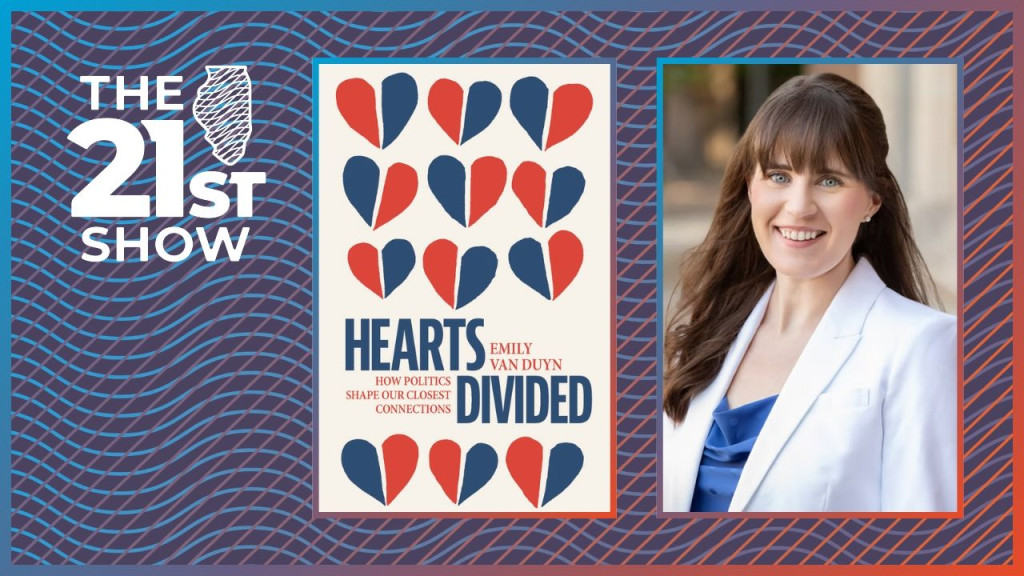
Brian Mackey: Today on the 21st show, millions of Americans are in relationships with people who have different political views. University of Illinois researcher Emily Van [Doon] talked with dozens of the people in those relationships over the past few years. She writes about what she learned from them and what they can tell us about the state of our politics. Her new book is "Hearts Divided: How Politics Shape Our Closest Connections." I'm Brian Mackey with Emily Van [Doon] for the hour.

Today on the 21st show, which is a production of Illinois Public Media, airing on WILL in Urbana, WUIS in Springfield, WNIJ in Rockford DeKalb, WVIK in the Quad Cities, WSIU in Carbondale, and Tri-States Public Radio in Macomb, Galesburg, and [Keokukk]. But first, news.

From Illinois Public Media, this is the 21st show. I'm Brian Mackey. We live in an age of deeply polarized politics in America. The gaps between the parties on issues like immigration, criminal justice, and voting are often seen not just as disagreements on policy, but as signals of different values and morals, and in some cases, existential threats to society and democracy. And yet, millions of Americans are in relationships with people with whom they have different politics. That's not new, but it's become a point of curiosity in our deeply divided country.

Emily Van [Doon] is an associate professor in the department of communication at the University of Illinois Urbana-Champaign. For several years now, she's been researching two big questions. How do our politics shape our relationships and how do our relationships shape our politics? The answers to those questions and more can be found in her new book, "Hearts Divided: How Politics Shape Our Closest Connections." The book is published by Oxford University Press. It's available digitally now and will be out in paper form next week. Van [Doon]'s previous book is "Democracy Lives in Darkness: How and Why People Keep Their Politics a Secret." She joins us for the hour today in our Urbana studios. Emily Van [Doon], welcome back to the 21st show.

[00:02:26]
Emily Van Doon: Thank you for having me.

[00:02:27]
Brian Mackey: If you have questions or thoughts on this, you can give us a call throughout the hour today at 800-222-9455. Especially if you have been in a relationship in which political disagreement was part of that. We'd love to hear how you navigated that. What political conversations with your partner look like. Um, and whether recent trends in politics have affected, you know, who you'd be willing to date if you are or have ever thought of yourself on the dating market. 800-222-9455 is the number. 800-222-9455.

All right, let's go back to 2024, uh, the first assassination attempt on President Trump. You write about how the shooter's parents and their political affiliations got a lot of attention in the media. Why was that?

[00:03:14]
Emily Van Doon: I think, you know, in the United States, but also I mean in cultures around the world, we think about parents as having a huge influence on, you know, how people are raised, of course how they think about the world, their values, but also, you know, we kind of think about children as kind of like inheriting their parents' politics and their orientation to politics. And so a lot of times when we have a big event like this, we kind of turn to look at the family as the unit to help explain why someone engages in this type of behavior. And a lot of the focus on the parents in that case found that the parents did have some different political beliefs, which kind of piqued my interest in thinking about how that kind of trickles down to the child. And of course it's not, you know, a cause of the child engaging in that behavior, but we kind of turn to looking at the family as the explanation for why children engage in certain behaviors over others.

[00:04:05]
Brian Mackey: Is that actually backed up by evidence that the apple falls close to the tree or far from the tree? What do we know about that?

[00:04:13]
Emily Van Doon: Yeah, so there's kind of two models when we think about how children are socialized to politics and how they kind of inherit or don't inherit their parents' beliefs. The first model is what's called kind of like the funnel, which is, yes, we inherit the beliefs of our parents, and this is [largely] true. By and large, we do tend to follow our parents' political orientation. Actually, there's some evidence that this is particularly true for mothers. We tend to follow, are more likely to follow our mother's political orientation than our father's. And then in the research, the very little research that's out there that looks at differences between parents, it does find that we do tend to follow our mothers more than our father's orientation.

Um, and then the second model is what's called the fissure, which is like actually if we raise our children in very politically engaged families where they are really involved in politics, they see their parents watching news, they get taken to vote with their parent, their parents at the voting booth, uh, that can actually encourage them to get ideas of their own, uh, and then kind of go to a different political side. Um, so we see evidence of both of those models in the research, and what was interesting to me and when I started doing my research is that I found evidence of both as well.

[00:05:24]
Brian Mackey: Fascinating. Well, those are sort of familial relationships and, and maybe it's worth pausing here to point out unless you have some better information than I do, we still don't really know much about the shooter's motivations in that case and the target of opportunity. And so maybe trying to read into family politics is, you know, not the wisest thing to help understand the violence that is, you know, a part of American life.

[00:05:47]
Emily Van Doon: Totally. Um, we can't point to one particular cause and we don't have, you're right, we don't have a lot of information still. And so I think we're kind of desperately searching for an explanation there.

[00:05:55]
Brian Mackey: Yeah, some things are just, uh, maybe they defy explanation. All right, so say more than I did in the introduction about romantic relationships, cause that's really your focus here, not the sort of parental or sibling or any other sort of relationships — about how widespread it is to have a romantic relationship across a political divide.

[00:06:15]
Emily Van Doon: Yeah, so when I started this research, most of what everyone was saying, at least in the scholarly community, was like, well, we just, you know, are choosing partners that share our beliefs. We, there's a bunch of research looking at dating apps and people kind of intentionally or even unintentionally selecting a partner who matches their political beliefs. But I —

[00:06:34]
Brian Mackey: And maybe you can say a word — like there are literally filters right on the dating app. I've been married for 19 years now, so I haven't, haven't been on one of these, but talk about that.

[00:06:44]
Emily Van Doon: Yeah, yeah, you can actually filter by political orientation on many of the dating apps, Bumble and, for example, Tinder, and then I think there are other kind of more — in the terms of the younger generation — low-key ways to identify political orientation, right, like signals of the types of things they're wearing or a camo baseball hat, yeah, are they holding a fish, right? Like things like that. I think they kind of take those cues. Um, but most of the research really talks about that, that we're selecting partners that match our beliefs, but there is, as you mentioned at the beginning of the show, there is a fair amount of evidence that we do still have relationships where there is political difference. And even our closest relationships like our marriages or our romantic partnerships, we do have political difference. So there's a study from 2018 that found 30% of registered voters in the United States live in these kind of mismatched partisan affiliation relationships. And so, you know, that isn't small. That's actually a fair amount of the United States that does experience this in their close relationships, and I wanted to know more, right? Like I wanted to know, OK, so if that's actually a fair amount of Americans that do have this experience, what happens, right? What are the challenges? How do they overcome that? And how has that changed over time?

[00:07:57]
Brian Mackey: And this is a topic — you know, this is like a sort of a topic of public fascination, right? In the book you say journalists brandishing the elusive Democrat married to a Republican and the strain this has placed on the relationship. These stories surface, you know, every so often. Millions of people are in these relationships. Why is it such a source of fascination to us?

[00:08:17]
Emily Van Doon: I think for many of the reasons that I kind of uncover — why it's hard to be in a relationship where there's political difference, including like thinking that the other person may have different values or morals than you — I think there are a lot of people out there that just can't fathom this, and it's become this kind of like, um, as we watch, as we're around or surrounded by people who share our political beliefs in many other capacities, right, like our social communities, we are more likely to live in geographic communities that match our political beliefs. We're more likely to go to church with people who share our political beliefs. We're more likely to have friends who share our political beliefs. And so we've almost become like completely shocked or surprised that they could exist, and I think that kind of motivates the fascination because we just aren't exposed to that much political disagreement in many other facets of our life.

[00:09:02]
Brian Mackey: OK, so you do — as you've said, we do tend to — most of us, the royal "we" I'm using here — tend to end up in relationships with people, you know, we connect with people who are more like us. So how is it that people do end up in these crosscutting relationships?

[00:09:17]
Emily Van Doon: That's a really good question and something that I kind of wanted to figure out when I went into this was how does this happen, not in a way of like how could this happen, but really like what is, how is this organically emerging. And you know, a couple of things emerged from my research on this. For one, I think a lot of people don't talk about politics at the beginning of relationships. So I talked to a lot of people who were like, oh, you know, we would go on a date and you know, everything was great. It was really fun. And then, you know, 3 months in we were at a restaurant and the election results were on and he said this and I said this, right? And so it kind of reveals itself over time. And sometimes I think that's intentional, right, because people don't want to, you know, dig into something that could be controversial. Maybe they don't want to know if there are political differences, but I do think that that's one of the reasons.

The other reason, which I think is really kind of surprising to me, and we often forget this, but you know, people change over time, right? So people would be in relationships with someone who does share their politics and then 10, 15 years into the marriage, someone changes. I spoke to people on both sides of the aisle who did this, right? Partners who became more liberal or partners who became more conservative. And so when that happens, you know, you find yourself — what was previously a very politically similar relationship — really experiencing differences you didn't expect. And so that was kind of another way that these kinds of relationships emerge. Yeah.

[00:10:33]
Brian Mackey: What's that, that old cliche about a conservative is somebody who was a liberal and got mugged by reality or something, something along those lines, as some would say. Uh, so, all right, you know, there have been — you mentioned this idea of people not bringing this up. Maybe there's like a code of politeness. My wife's family very rarely discusses politics. There's this sort of omerta about it. Um, for most of the members, there are a few exceptions, but, you know, there have been articles over the past few years where you have these Republican men talking about um the challenge of finding a partner and, and we've seen this increasing now — this last election may be scrambling some of that — but like this, you know, the, the manosphere and all this stuff and the division in voting among younger people, especially, um. And people do actively, you know, not just not talk about it, but they hide their politics from potential partners.

[00:11:28]
Emily Van Doon: Yeah, yeah, and that's something I heard come up on occasion in my research as well, particularly related to my previous book — like I was interested in, you know, how much of this is being held back in relationships, um, and I think —

[00:11:40]
Brian Mackey: The book about how people sort of hide their political beliefs from their communities, right? And for people who may not remember that conversation, which we have linked on our website right now — [2firstshow.org] — was specifically about like Texas women who were really progressive but felt like they could not be open about that in their Texas communities.

[00:11:58]
Emily Van Doon: Yeah, and that's actually kind of what spurred this research was some of the women in that group didn't tell their partners or their husbands where they were going when they went to some of those meetings or that they were a Democrat or progressive. And so that kind of led to this research. And I did hear that mirrored in some of the interviews that I did around this book, um, where people were reticent to share or be expressive with their partner about what they think. Um, and I think that makes it even harder, right? Because then you have this like imagined idea of what someone else believes, right? And all the things that we now associate with politics and political beliefs, like whether you're a moral person or not. Um, and when you base that off of assumption and not truly what you know about the other person's beliefs, then that can be really faulty. It could be correct. You could be totally right that that person doesn't have the same values that you do, but you won't know unless you actually have an explicit conversation about it. And so I think that's where the expressiveness and the openness about your beliefs becomes really important, especially for something as important as a romantic relationship that will very much shape the rest of your life.

[00:13:00]
Brian Mackey: Yeah. And this is like part of the flattening effect we see on social media. If all you have, if all you know about someone is two sentences on a short, you know, form microblogging app, right, like Twitter or X or whatever, you can assume a lot about them, whereas presumably if you're in a relationship, you see that people have depths and contain multitudes.

[00:13:21]
Emily Van Doon: Totally. I think the thing that was really surprising to me is even — you know, I kind of thought, oh, it's a close relationship. Of course you're having these conversations, but a lot of people really aren't having these conversations and maybe intentionally, right, because they don't want to know or they don't want to dig into it, or again, the politeness or not wanting to be controversial. It's better if we just agree to disagree, but that becomes a problem if you start to assume things about the other person from the things you're not talking about, right?

[00:13:46]
Brian Mackey: Yeah, one of my favorite topics in recent years has also been looking at — and this is a bit of a branch off from what we've been talking about, but it does relate — which is how many Americans just are not politically engaged. And that's the real divide. There was actually a book called "The Real Divide" or something along those lines. I'm forgetting the title, but you may be familiar with this about how like, between the people who don't really care about politics and this very relatively small but loud on the internet cohort of people who care a lot about politics. So maybe, maybe it's normal that people are not talking about politics that much.

[00:14:21]
Emily Van Doon: Yeah, I think the work you're talking about — [Jana Krupnikov] and her co-author Ryan — but um, yeah, that research kind of points to this difference in political interest and engagement and, like you said, that that's the bigger divide. I think what's really interesting is like it kind of depends on how we define politics, right? Like people in a survey might say, I'm not very interested in politics because they're thinking of it as an election or I don't know, a debate or something that feels a little more distant to their life. But if you define it as like, you know, things happening in your community, social issues, you know, things that are affecting your day-to-day life, I think a lot more people would say that they're, you know, quote unquote interested in politics, right? So it just kind of depends how you define that. And that was my sense and kind of the interest in this research is like these are experiences that are political. They're very much about politics, but they're also very much about relationships. And so those two things cannot be separated, especially in today's age.

[00:15:18]
Brian Mackey: Yeah. And I do have the title of that book here. It's called "The Other Divide: Polarization and Disengagement in American Politics," [Jana Krupnikov] and John Barry Ryan. So shout out to them and their work, which has occupied a lot of space in my brain in recent years.

Um, I want to share a quick message from a listener. I might have you respond to it on the other side of our break. We'll see how the timing works out. But Lloyd in Danville in our texting group — we asked about this — said, being married for 43 years now, we basically have varied differences based on gender. I found that people in relationships tend to have different opinions based on their upbringing and the level of educational differences. At the end of the day, right is right, except in our current political state. Ask researchers if they've found political ideology to be different when there are economic and deep religious differences between couples.

So how about that? Is, is like, you know, socioeconomic background, educational attainment — how much does that correlate with some of these political divides within relationships? Do we even see relationships that span those other divides?

[00:16:22]
Emily Van Doon: Yeah, I mean, we know, uh, you know, this listener is right. Like those things are related to political ideology, right? We can kind of break down how people vote based on a couple of factors like where they live, their gender, their socioeconomic status, you know, did they go to an institution of higher education or not, right? So all of those factors predict whether you're going to be a Republican or Democrat pretty consistently, not perfectly, but pretty consistently. Um, and because of that, that also transfers to our relationships. So if we have different socioeconomic status or we were brought up differently or one of us went to college and one of us didn't, those things can lead to different political orientations that we then bring into our relationships and bring up those political differences, and that's how they surface.

[00:17:04]
Brian Mackey: Yeah. All right, we're going to continue this conversation. If you want to join us, uh, Emily Van [Doon] is the guest. The book is "Hearts Divided: How Politics Shape Our Closest Connections." 800-222-9455 is the number. We'd love to hear about your experience in a divided relationship at 800-222-9455. We'll be back after a short break.

This is the 21st show. I'm Brian Mackey. We are talking for the hour today about political divides in our relationships, specifically romantic relationships and what they can tell us about politics and democracy in America today. My guest is Emily Van [Doon], professor in the department of communication at the University of Illinois Urbana-Champaign, and her book, which is out now on digital platforms and will be out in paper form next week. It's called "Hearts Divided: How Politics Shape Our Closest Connections."

A few more messages from people in our listener texting group, which by the way, you can join by texting the word "talk" to 217-803-0730. Denise in [Moroa] said, I'm friends with a Trump supporter. We are two senior females who belong to various groups together. We've decided not to talk about politics or make any political statements. Her husband is a Trump tyrant, easy to anger, etc. But she and I can laugh, go places together, give each other things, and be truly caring. She knows I go to protests. When all is said and done, we both care about our families, war, food, and gas prices, etc. just like everyone else.

We also heard from Christopher in [Brimfields], who says relationships are hard. Why would you want to make them harder?

All right, what do you think of that? Let us know at 800-222-9455. Maybe you have a cross-cutting or divided political relationship in your life. We'd love to hear about your experience. Uh, 800-222-9455.

All right, Emily, you spend a lot of the book on uh different ways that people approach conversations about politics when there are these disagreements. We heard Denise in [Moroa] talking about one with her friend. Um, you know, they avoid talking about politics as much as possible. What did your research find about how that works in these, you know, sort of romantic relationships?

[00:19:31]
Emily Van Doon: You know, uh, in the research we call this kind of like, you know, strategic topic avoidance, right, which is just another kind of fancy way to say, yeah, not talking about it or agreeing to disagree, right? And I think there are a lot of people who have found that that works and it can work, right? In fact, a lot of the partners that I talked to were really set — a lot of boundaries about the kinds of topics they do talk about. They would, you know, they would say, hey, you know, an election is coming up. I know we're going to be really tense about this. Let's really try and not emphasize some of these conversation points, particularly, you know, around the dinner table or whatever. And you know, that was helpful, I think.

I think where it's really helpful is when you already kind of know where the other person stands and it's not helping to keep bringing it up again and again and again. And so that actually can really help the relationship continue, particularly if you've already had the conversation, it's already been said, you aren't making assumptions about what the other person believes. You're on the same page and you're not trying to kind of like, you know, group them into some other boogeyman as a bad person.

But I do think there are also problems with topic avoidance, um, particularly what I found in this research is when, you know, you avoid the topic and then you start making all of these big assumptions about, well, they said this and they believe this, so then that means this about them, right? And you start thinking they're a bad person, then you start thinking you don't have the same values, and then you kind of spin out of control in the assumptions you're making about the other person.

The other place where I think topic avoidance can be problematic is for children in these relationships. And so I spend some of the book talking and looking at, you know, what are the implications for these couples where there's political difference for the children that are being raised in them. And what I find is when partners don't talk about politics in front of their children in an effort to kind of keep down the conflict in front of the kids, that actually can be bad for the child's socialization around politics and it can actually potentially lead to kind of generational problems where — if the child — we know that the family is a huge source of political socialization. It's where children learn about news, it's where they learn about and build habits to learn about politics and public issues. And so if they don't get that at home because the parents are avoiding it because they don't want to fight, that could have potential outcomes down the road where the child doesn't engage in politics in their life as an adult.

[00:21:43]
Brian Mackey: It's interesting. Um, so, all right, another aspect of this — and maybe one of these aspects of sort of detente in the household that you talked about in addition to not talking about it — is how you approach news consumption. And you and I talked on the show about this a couple of years ago. Um, you know, there's a couple in the book who only watches local TV news instead of cable news. Um. You know, so talk about how the choice of what to read or watch or listen to on podcasts or radio or whatever, how that, you know, can drive their partners crazy in some cases.

[00:22:20]
Emily Van Doon: Yeah, so I did some of this research around the COVID pandemic, so it was particularly an interesting time where news was on all the time, potentially in households that didn't usually watch that much news. And so it was a huge source of conflict around the pandemic. Where, you know, there were arguments about one, how much news to consume; two, what outlets are we consuming? Are we watching news about the pandemic on Fox News? Are we watching it on CNN? Are we watching, you know, the local news — like arguments about source and outlet — and

[00:22:52]
Brian Mackey: Then to the PBS NewsHour, where I got a lot of my news about the pandemic.

[00:22:57]
Emily Van Doon: Yeah, yeah. And local news was super important during that time, right, because we needed to know about our communities and how the pandemic was spreading there. Um, and I think you know that — you talked about the couple who chose to watch local news as kind of a, you know, happy medium between one another. That actually is a really great strategy because local news tends to be less polarizing. We tend to have a little bit more trust on both sides of the aisle for local news. And so a lot of the evidence around like how to engage across lines of difference is to talk about local issues where some of those national labels are a little bit less present.

[00:23:34]
Brian Mackey: Yeah, Sinclair notwithstanding, but that's a special case maybe uh for people who have those stations in their markets. All right, so, you know, maybe this is a good time to sort of take a step back from some of the research findings and talk about your approach, right? You spoke with, you heard from a wide range of people. Tell me more about people you talked to.

[00:23:54]
Emily Van Doon: Yeah. So I conducted interviews with people in what I call crosscutting romantic relationships, right? So these relationships where there is some level of political disagreement. Um, and I did these interviews from February of 2020 through right before the 2024 presidential election. So I spent about four years collecting these interviews. Um, and I first started interviewing people, a partner who was in a current relationship where there is political disagreement, and that, you know, included people who were dating, engaged, married. I talked to one person who was getting [married] the very next day. Um, so it was a range of people.

And then partway through, I started to realize, oh, I think I kind of have a survivor bias here, right? I'm only talking to people who have made it through and continue in the relationship. And so I actually ended up talking to people who had ended a relationship because of political difference. And so I kind of got different perspectives from them about, you know, how things went wrong, what was at play in the decision to end the relationship.

Um, so the interviews were really like the bulk of what I focused on. But I also did a survey where I surveyed both people in politically similar relationships and people in politically different relationships, so I could get a sense of, OK, across the United States, how are the things that I'm hearing in the interviews kind of transferring? What's the scope of what I'm hearing in the interviews in terms of across the entire population? And so that kind of helped me understand a little bit more of what I heard.

[00:25:22]
Brian Mackey: Yeah, how do you get people to talk to you for these sorts of things just on an individual basis? Because, you know, I've been in the position of wanting to get some, you know, quote unquote everyday people's voices in a radio news story or something. And like, boy, a lot of people do not like to talk about their beefs. Some people love it. But how do you approach, um, you know, having these really intimate conversations, I'm imagining.

[00:25:46]
Emily Van Doon: Yeah, so, um, it was really a joy to be honest, to spend 4 years talking to people across the United States. I talked to, I mean, over 100 people.

[00:25:56]
Brian Mackey: Are these like Zoom calls or how are you doing this?

[00:25:58]
Emily Van Doon: I did them over the phone, usually in my home office, and on the transcripts you can kind of like hear my dogs barking at the mailman, right? Like this was their relationships, but it was also in my home. I felt very personal and connected to these people. I, you know, they were telling me very intimate things about their lives. And so I really took a lot of care and I feel very privileged that I get to hear their stories. Um, and so, yeah, like getting people to talk to you is challenging, but once the conversation starts, it's showing kindness and interest and engagement, uh, and being really grateful of their time because these are average citizens who have jobs, who are trying to get things done. They have kids, they're trying to, you know, juggle a million different things and for them to take time um to talk to me and share their story, I really cherish that, and it changed me too as a researcher in that process.

[00:26:45]
Brian Mackey: You know, one of the things I thought was interesting is you only talk to half — or one person in a relationship — at a, you know, for this research. Why was that important?

[00:26:54]
Emily Van Doon: Yeah, I was a little concerned that if I tried to recruit both partners that I would get a pretty positively biased sample, right? So, I would imagine there are probably a certain type of people who are going to both respond to talking to me. And in fact, there's a bunch of research looking at dyadic sampling in research that finds that like if you sample both partners, you do tend to get a positive bias in the reports that they have about their relationship. And so I didn't want to do that.

The second thing that I was a little worried about was like if I talk to both partners, that one wouldn't be honest with me or that they would be reticent to, or be just trying to calibrate their answers to whatever they think their partner's going to say, to show that they're unified. And so it was a choice to only talk to one. There are inevitable limitations to that, right? I'm not hearing if their perceptions were accurate or not, but in some ways that's — I don't really care, right? Like it's this one partner's perceptions that are influencing their behavior. I don't need to know whether they're accurate to know they're having an effect on how they feel about the relationship.

[00:27:54]
Brian Mackey: So you mentioned you started this work during the COVID pandemic. As you're doing it, we have that. We have the, you know, so-called racial reckoning, uh, police brutality protests — or riots and violence in some cases — in the summer of 2020. We have the violence of the Capitol attack in January 2021. We have this increasing tempo of political violence in America over the past few years. I wonder, how did you see that showing up in your work? How did that affect, you know, what you were doing?

[00:28:22]
Emily Van Doon: Oh, totally. I mean those were pivotal moments in the country where we as a populace kind of reflected on what our politics mean and what they represent in terms of what we care about and what we value. Um, and I heard that repeatedly across the time that I talked to these folks, right? Like, um, I'm thinking of a woman, for instance, who I spoke to in 2021, and it was right after the insurrection had happened, um, and I was talking to her about, oh, you know, do you and your partner think you have similar morals or similar values? And she was like, well, I think, you know, he wouldn't storm the Capitol. But you know, we were watching it and he did really laugh and think that was funny. And you know what, maybe we don't have similar values. And so even in the interview, right, she starts to kind of link that event — and his agreement or like kind of laughing at it — as evidence that, oh, maybe we don't have the same values. Maybe he does think differently about things than I do. And so these moments where we see these like big intense reactions as evidence of what we value and our morals and our principles, people use those moments too to reflect on, you know, where do I stand on this issue and where does my partner stand on this issue and what does that mean about our differences?

[00:29:34]
Brian Mackey: Did anybody break up as a result of your conversations?

[00:29:38]
Emily Van Doon: I can't point to my conversation as the result. Uh, there were divorces. Yeah, there were. I did follow up with people over time and some people did end the relationship. Um, in fact, I had one previous interviewee whose spouse died, um, and she really reflected on being regretful spending a lot of the last time that she had with him arguing about the upcoming election. Um, and so there's — it runs the gamut — um, and that's kind of the cool part of doing this more longitudinal work is I do get to check in with people and hear about how things are going.

[00:30:14]
Brian Mackey: Yeah, what do you think makes the difference between these gaps being bridgeable versus unbridgeable, or, you know, are there like a sort of a narrow set of things you can point to?

[00:30:24]
Emily Van Doon: Yeah, I've been talking a lot about values and morals because that is the key linchpin that I find in a lot of my work, which is if we can agree that we share the same values — beyond the partisan labels, beyond what political elites tell us we should value — no, what do you as an individual care about? If you feel like you and your partner can share to a large extent the same things you care about, the same things you value, the same things you want for your family, for the future generations — if you can at least be on the same page about what you care about and value, then it can be overcome. Like you can get past some of the partisan division. You can get past some of the feeling that you don't agree on the same solutions, right? But if you can at least agree on the same values, that is super important, both to the relationship's success, how close you feel with your partner, uh, how politically engaged you are, how expressive you are with your partner. It was all related to do I feel that my partner and I share the same morals and values?

And that's where having explicit conversation was really important, right? Because when you just assume whether you share the same values from, oh, they're a Republican or a Democrat, that's not actually telling you about their values. It's just telling you potentially how they're voting. But a lot of people don't vote in line with their values, or their values change, or they don't know what they actually value and they might vote differently if they did. And so that's — as a communication professor singing it from the rooftops — that's why we need to talk, right? That's why we need to have these conversations.

[00:31:57]
Brian Mackey: Do you have like a sort of empirical definition of values? Because I think of like the Catholic Church, for example, right? They have this ethic of life which means no abortion, embryos are life in their view, but also nobody should be killed by the government, you know, in terms of capital punishment. And that is something that you do not often find that alignment of views in the American political system, right? Often people who are opposed to abortion are supportive of capital punishment and vice versa. Obviously a lot of exceptions out there. So how do you define what are values right in a sort of empirical sense, maybe, or I don't know, even in a relationship in a more fuzzy sense.

[00:32:34]
Emily Van Doon: Yeah, so values we can think about as like the building blocks or the considerations we make in deciding whether something is right or whether something is wrong. And politics has largely — and political labels have largely — distorted those things, right? Like, like as you said, they've been misaligned and certain issues have emphasized these values and other issues emphasize these values, or this stance emphasizes this over this. And that's why political orientation isn't always a good proxy for what we value. And that's why we need as individuals to sit down and think about, OK, how do my values align to what I want to support in terms of politics and how do my values align with my partner's, and to what extent do we share things there? And if you don't share a lot, well, that's probably pretty good to know, right? Like you probably want to know if you don't share a lot of values, and you probably want to know that before you get into a very intense relationship for the rest of your life.

[00:33:25]
Brian Mackey: Yeah. Well, you're reminding me of an experience my wife and I went through. We got married in her sort of faith background, her church, and we had these meetings with the pastor there, and he talked about a lot of these things and values and whether we would have children and things like that. And I suppose a lot of people, you know, in this age of increasing non-religious affiliation, I don't know that they have those experiences and the sort of like forcing mechanism to think through these things before they make these commitments.

[00:33:52]
Emily Van Doon: Yeah, totally. In fact, after I did this research and found that this mattered so much, I said to my husband, can we have a conversation about our values, right? Like, should we just sit down and be like, OK, this is what we want for our kids. This is what we want for our country. And it was really beautiful and wonderful and, like, you know, we had had some minor conversations along the way, but it was really fruitful to sit down and have more explicit conversations.

[00:34:15]
Brian Mackey: And you probably had a good sense that it wasn't going to be like he was going to pull out a red hat that he'd been hiding in the closet or something.

[00:34:20]
Emily Van Doon: I was pretty confident.

[00:34:21]
Brian Mackey: Yeah, all right. Uh, or whatever. I don't want to assume. Um, all right, we're talking with uh Emily Van [Doon]. The book is called uh "Hearts Divided: How Politics Shape Our Closest Connections." You can join us, 800-222-9455. What are your relationships like across political differences? We'd love to hear about it at 800-222-9455. More to come after a break. This is the 21st show. Stay with us.

It's the 21st show. I'm Brian Mackey. We are focusing today on the millions of Americans in relationships with people who have different political views. University of Illinois professor Emily Van [Doon] wrote about some of their experiences in her new book, "Hearts Divided: How Politics Shape Our Closest Connections."

Another listener text message, this one from Helen in Springfield, says, my husband and I were both Democrats when we met in college 40 years ago. We often agree politically with both of us cheering for the success of female candidates. I would find it difficult to be married to a person with vastly different political beliefs. I'll benefit by learning new ways to live harmoniously with others with whom I disagree.

Uh, so we can talk about that a little bit. Also, another perspective from Amy in [Wakanda] who said, political differences in my household are more like, do we support home rule for our town? Let's research what that fully means once implemented. Not does one of us deserve control over her own body or not. Or does one of us deserve personhood or shall we be refused identity, or conform to the norm or die. Yeah, that's not happening, couldn't be me, Amy says.

All right, what do you think about this? 800-222-9455 is the number. 800-222-9455.

So, um, we talked a little bit about some of the strategies couples use, um. Say more about that. So we mentioned not talking maybe is an unhealthy approach. Um, there is this idea that politics has really become a hobby for a lot of people and it's almost like, uh, you know, you get home, scroll your phone, watch cable news, whatever it is. It's become like a main thing that people do. I don't think that was always the case. I certainly don't remember that being the case 30 years ago. And I don't know if it's social media or what it is that's changed that. But can you talk about this idea of political hobbyism and how that interacts with the work you've been doing here?

[00:37:09]
Emily Van Doon: Yeah, I think as we've seen, um, I'll call it polarization, but this kind of like social division, ideological division happening at the top in terms of our politicians, we've also seen that kind of trickle down to the mass public and kind of polarize all of us. And as a result, it's led to this kind of like, oh, you know, politics is a sport. It's a fandom. I'm all for my candidate, do or die, and yours is evil, right? And we've kind of created these really intense camps, right? Um, and because of that, it can become this thing that feels all-consuming. Um, and that's why some of these boundaries that I talked about — that the couples in the book that I highlight use — are really important, right? Like, OK, we're not going to just come home and have Fox News or CNN streaming nonstop, right? We're going to put boundaries on the amount of information we're consuming. We're going to have, you know, if I really want to consume this podcast that I know you disagree with, then I need to do it on my own time, right? Like having some clear boundaries around news consumption so that it isn't this all-consuming thing where it becomes part of your entire identity, right? And that can be really — because then it's even that political disagreement becomes incredibly threatening, right? Oh, you don't just disagree with me about politics, you disagree with my entire identity, and that's a lot harder to overcome.

[00:38:32]
Brian Mackey: Yeah. You know, one of the dynamics that um comes up in the book is this idea of um how politics affects our relationships, right? We've talked a lot about how our relationships affect our politics. But one of the ones that I found was fascinating is this um dynamic where women in relationships are often expected to take their male partner's um politics, at least in certain backgrounds and traditions, um — takes away the woman's agency. How do you see that playing out as you're talking to people in these couples?

[00:39:04]
Emily Van Doon: Yeah. So a part of the book I spend, um, I look at kind of the role of relational control. So, um, the extent to which you expect your partner to kind of fall in line with you, how much control you feel you have in the relationship, how much influence or power you feel like you have over your partner. Um, and in general, when you feel like you have less power in the relationship, you don't talk about politics with your partner. You don't engage with politics with your partner. Some of the people I interviewed, um, you know, expressed that they felt like their partner was, you know, horrified that they weren't going to vote in line with them, and that is very gendered, right? That is the product of a history of women being expected to fall in line, and largely, especially white women, did fall in line for many, many, many decades where they just voted in line with their husband because that was the social expectation.

And so yes, that was absolutely at play in a lot of these relationships where there was a power difference between partners, and that's potentially really problematic for democracy, right? Because if one partner is suppressing the politics of another, that's a form of voter suppression, right? And that has problems for getting people engaged and having one person, one vote, and all of the things that underlie our democratic form of government.

[00:40:15]
Brian Mackey: All right, well, let's get bigger picture then. So what did all these conversations you have tell you about the state of American democracy today, right? Big, big picture. But I mean, um, you know, where our anger is directed in society, that sort of thing.

[00:40:31]
Emily Van Doon: Yeah, I think it's easy — a lot of the conversations we have about polarization and this divide, where we've been talking about even the divide that I see in the book, um, we like to think, oh, you know, it's because of other people, you know, it's because of my neighbor, it's because of them, it's because of my fellow citizens, they're doing this. But this did not come from us. Like the divisions and the experiences of how political disagreement affects our relationships that I see in the book — and that can be very serious — you know, they didn't come from all of us. We didn't create this issue. There's a ton of evidence over, you know, decades of research that it was set by politicians. Politicians polarized. They became ideologically polarized. They became socially polarized, and that trickled down to all of us.

And so what I write in the book and kind of I think the bigger takeaway about democracy is we're experiencing this division, but it's a symptom of problems with our institutions, with our leaders, our politicians at the top. They create this extremism and moralism and saying, oh, the other side's immoral and trying to own what it is to be moral. And that turns all of us against one another. And when you turn the public against one another, it weakens our ability to hold them to account. Um, and so if we want a democracy where we are able to hold public officials and politicians and people with power to account, then why are we turning on one another? We need to be turning to one another. We need to be understanding one another. We need to be coming together to hold them to account and push back on the conditions that they've set for all of us down here.

[00:42:07]
Brian Mackey: You mentioned this idea that polarization was sort of foisted upon us, and that could be a whole separate show or series of shows and there have been books written about this, but who benefits from that, right? Because that is right. It used to be you'd have liberal Republicans and conservative Democrats. I mean, I'm old enough that when I was covering the Illinois General Assembly, I was aware of both. Um, you think of like certain, uh, the concealed carry law in Illinois was sponsored by a Democrat from southern Illinois. There are very few Democrats in southern Illinois, at least elected anymore. Who benefits from this if you feel like you can speak to that?

[00:42:42]
Emily Van Doon: Yeah, I mean, there's a bunch of evidence that the more polarized we are, the more engaged we are. And so who benefits? Well, the politicians benefit. We show up, we vote for them. They campaign on hate. They campaign on all of these extremist things, and then that in turn mobilizes people to come out and support them. And so, you know, we suffer and we have these experiences in our relationships, but the politicians benefit from it. Um, and so, you know, one question is like, can we turn that on its head? Can we reject some of that and say, no, we're not going to turn against one another. We're not going to fall in line to be mobilized by the hatred of the other side or each other. We should really identify the problem — that you guys gave all of us, all of this to us to deal with, right? Um, and to push back on that, um, and I think that's the bigger issue at play.

[00:43:38]
Brian Mackey: How can we do that? How can we push back on this sort of, um, you know, drive to divide.

[00:43:46]
Emily Van Doon: Yeah, I think um one way is to have conversation, right? Talk to people, understand one another, see each other for who we are, not what they're telling us we are. Um, dig in, you know, have the hard conversations about what we care about, align the things we care about with how we vote. Don't just fall in line with what the politicians are selling you. Find out what you care about and really make choices based on that. Um, and don't turn on one another in the process, right?

Um, I think the other question here is like, can we get rid of and not support politicians who are promoting this type of thing, right? That's hard because a lot of our districts have been gerrymandered in a way that we don't have a lot of control over that. But is there a way we can create systems and think about how we could change our institutions to be better in terms of representing less extremist ideas? Can we get rid of the gerrymandering that is kind of creating these districts where extremists are more likely to get elected? There's a bunch of institutional reforms that can happen, not just stuff — you know, there is stuff that we as citizens can do. We can have these conversations, but it cannot stop there because we didn't create the problem, right? It was set by people at the top. They have created conditions that allow for it to continue, and we need to push back on them to change it.

[00:45:02]
Brian Mackey: Yeah. Well, while we are working on that and waiting for that to happen, the one thing that, you know, sort of is more in people's control is how they interact with others. And you write toward the end of the book, communicating with one another may be necessary to understanding one another, but it isn't sufficient to solve institutional failures. OK, so that's what we've been talking about. But if someone is in one of these cross-cutting relationships, what can they do to make conversations about politics more productive?

[00:45:30]
Emily Van Doon: Yeah, um, and this is where as a communication scholar, I will put that hat on and say there's a lot of research and evidence to help people in this process, right? There are a lot of really good organizations that put out research or put out resources for people to engage in good conversations across lines of difference. Living Room Conversations, for instance, has a bunch of guides for how to do this. There are lots of resources out there for people.

Um, but I would say, you know, one is to kind of remove the partisan labels when you're talking about things, um, as much as you possibly can. Talk about values, talk about what you care about, think about the future generation, think about your perspective on the world.

Um, the other would be to really engage in good listening strategies. Um, I say this to my students all the time, but like I think in the United States, we have a model where we are taught in schools how to debate, right? How to make good points. We are really not taught how to listen. And that's what I spent 4 years doing, was listening. And that's something I think people really need to be better at — is learn how to listen and not just listen to respond, but listen to understand.

Um, and I think finding other places where you do have a shared identity that can help you bridge some of these differences. So for instance, I talked to several people. One comes to mind, a Native American woman on a reservation in Montana whose husband was a very intense Trump supporter and she was very against Trump. But they had a very common shared identity in their tribal identity, and that was more important to them than their political one and their political differences. And so is there an identity that you share with your partner that's more important that can supersede some of these differences, and can you highlight that when you're having these conversations?

[00:47:06]
Brian Mackey: All right, you write near the beginning of the book in the acknowledgements um about how talking to all of these people kept you in touch with the humanity of democracy — the humanity of democracy. What can we do to bring that value, right? The humanity of democracy to the forefront in this time of, you know, bots and trolls and high political conflict.

[00:47:31]
Emily Van Doon: I think that's where conversation is best served, right, is to have these points of connection, to understand and hear and listen to one another, not in little, you know, 140 —

[00:47:41]
Brian Mackey: Character posting is not conversation.

[00:47:44]
Emily Van Doon: No, right. And practice — it doesn't come overnight. Like just practice, give it a shot, right? I got better at having these conversations over time and I feel like I'm a trained professional, right? It's just part of that process is really encouraging.

Um, you know, I had a conversation with somebody who I very much disagreed with. We had very different perspectives, but at the end of the conversation, you know, she said something like, well, I'm just really worried about the fate of my country. And I said, oh my gosh, me too. And it was this wonderful connecting point of like, she has concerns and differences than I do, but we both really care. Um, and that did restore this kind of anxiety that I have around, oh no, what's going to happen to the future? Those things that we all feel, but I can't blame her. She has just the same concerns that I do, right? And that's what I mean when I say connecting me to the humanity, is that democracy is all of us and we forget that. We think it's elections and all of the people making all of the decisions for us, but it's all of us and we get to decide what that looks like.

[00:48:46]
Brian Mackey: The demos. All right. Uh, Emily Van [Doon] is associate professor in communication at the University of Illinois Urbana-Champaign. The book is "Hearts Divided: How Politics Shape Our Closest Connections." It's out now digitally from Oxford University Press. It'll be available in paper next week. Emily, congratulations on the book. Thanks for speaking with us.

[00:49:08]
Emily Van Doon: Oh, thanks so much. This was fun.

[00:49:25]
Brian Mackey: That is it for us today. Coming up on tomorrow's program, back in 2023, two explosions rocked [ADM]'s facility in Decatur. At the time, it wasn't entirely clear what was happening, but new reporting from [Investigate Midwest] reveals documents that paint a better picture as to what happened and how [ADM] responded to the situation. We'll talk about that.

Also, in 2026, Illinois saw its busiest tornado season ever, more than 200 recorded. It's prompted many to ask if this is the new normal for the 21st state moving forward. It's also the subject of this year's State of Change television special from our home station, Illinois Public Media. We'll talk with the people who helped cover the storms and put the program together.

It's all coming up tomorrow here on the 21st show, which is a production of Illinois Public Media. I'm Brian Mackey. Thank you for listening. We'll talk with you again tomorrow.
Transcript Assistance
Illinois Public Media may use AI assistance for transcript generation and/or formatting. Transcripts that have not yet been reviewed for accuracy will be labeled.
To report a transcription error, or to request transcription of archival material, please contact will-help@illinois.edu.