Transcript: From protector of a president to prison to pardon: the historic life of Abraham Bolden
Transcript: From protector of a president to prison to pardon: the historic life of Abraham Bolden
Dialogue
From protector of a president to prison to pardon: the historic life of Abraham Bolden
Read the full story at https://will.illinois.edu/dialogue/from-protector-of-a-us-president-to-prison-to-pardon-the-historic-life-of-abraham-bolden.
Transcript
// This is a machine generated transcript. Please report any transcription errors to will-help@illinois.edu.

[00:00:00]
Reginald Hardwick: From Illinois Soul, this is Dialogue. I'm Reginald Hardwick, news and public affairs director at Illinois Public Media. Dialogue is an exchange about culture straight from the soul.

The presidency of John F. Kennedy meant a lot of firsts in America. He was the first Catholic president, the first and only president to have earned a Purple Heart, and he was the first president to entrust part of his security detail to a Black person. That person was Illinoisan Abraham Bolden. Illinois Public Media's David Pierce has worked for more than a year to tell the story about Bolden, and he joins me in studio. Welcome back, David.

[00:00:50]
David Pierce: Thank you for having me, Reginald. Thank you for having me.

[00:00:53]
Reginald Hardwick: Where was Bolden born and raised?

[00:00:56]
David Pierce: So Abraham Bolden was born and raised in East St. Louis, Illinois.

[00:01:01]
Reginald Hardwick: And what sparked his interest in law enforcement?

[00:01:04]
David Pierce: I can't really tell you what sparked his interest, but what I can say is that when he began his career, it began to basically snowball. He went from being a detective and then he went on to be an Illinois state trooper and then he became a Secret Service agent on a more local level in Chicago, which he would be, you know, cracking the code on money crimes and different fraud cases.

[00:01:34]
Reginald Hardwick: What did Bolden say life was like for being a Black Secret Service agent in the 1960s?

[00:01:41]
David Pierce: Well, to put it into context, this is the early 1960s, so, you know, the civil rights movement is just taking off. Schools are being segregated at this point. But for him, this was a very traumatic experience. You know, it was an honor to work on the president's detail, but he really struggled because a lot of his coworkers had some very bigoted and racist things to say and have done. You know, in his book, he references how they've used the N-word around him many times and carelessly, and when he would go to his superiors about it, they would basically tell him that you need to have tough skin and to, you know, not be so serious.

[00:02:31]
Reginald Hardwick: How did Abraham Bolden come to meet President Kennedy?

[00:02:35]
David Pierce: President Kennedy was in town for a basically a congratulations banquet of some kind, and he was meeting with Mayor Daley and the Chicago [market and Mayor Daley's politics] had helped give JFK quite the boost in Illinois, at least in the Chicagoland area. And they were having dinner. This was a really big thing. This was held at the McCormick Place and this was in 1961.

[00:03:03]
John F. Kennedy: Ladies and gentlemen, I appreciate your generous welcome. This year I expect to attend two Democratic dinners — one in my home of Boston, Massachusetts, and the other in my second home of Chicago, Illinois.

[00:03:29]
David Pierce: So Abraham Bolden, already being a Secret Service agent, he was called to be a part of the staff to, you know, just guard the perimeter of the McCormick Place and they placed him at the bathroom. The interesting thing about that is that he felt that that was like the lowest of low job because it would be something that not many people would navigate. You know, it was a downstairs bathroom at that.

But lo and behold, President Kennedy had come down the stairs and Abraham Bolden was guarding that bathroom and President Kennedy asked Mr. Bolden, he said, are you a Secret Service agent — are you a part of Mayor Daley's staff? And he said, I'm a Secret Service agent, Mr. President. He asked him, has there ever been a negro on the president's detail? He said, not to my knowledge, Mr. President. And from there, JFK was like, how about you join me? How about, how would you feel if you were brought onto my staff? And he was like, I would appreciate that. And from there on, he became a part of JFK's security detail.

JFK and Mr. Bolden were both at Hyannisport. Now, the interesting thing about it is is that they were together, you know, but Abraham Bolden, he said he would do this whole Secret Service experience all over again, but he would change one thing and that is to let President Kennedy know that, basically, there were Secret Service agents that were saying like somebody should have him killed.

[00:05:13]
Reginald Hardwick: He had concerns about being trained in his training time — and what were some of those concerns?

[00:05:19]
David Pierce: And this is when Mr. Bolden would ask, what do I do if the president's life is at stake? And he said he would get told by colleagues that just play it by ear. And that is concerning in itself because, you know, the president, he's the leader of the country, and, you know, when there are known threats that exist and being told to play it by ear, that was concerning for him because he felt that there was no real plan — along with giving weapons that he wasn't trained to know how to use.

But one of his also biggest concerns, outside of the racism that he had experienced, he was concerned by the fact that Secret Service agents were drinking on the job and partying with women. And this would go on up until 7:30 in the morning when they would just be dropping these women off and then be heading to work at 8 o'clock shortly after. So just the lack of professionalism.

[00:06:22]
WCBS Reporter: Ladies and gentlemen, we interrupt this program to bring you a bulletin from WCBS Radio news. The story as it is just being handed to me is datelined Dallas, Texas. It says, according to the United Press, 3 shots were fired at President Kennedy's motorcade today in downtown Dallas. The incident occurred near the county

[00:06:46]
Reginald Hardwick: sheriff's office. So November 22, 1963, Dallas, Texas. President Kennedy is shot and dies of his wounds. Where was Abraham Bolden on that day?

[00:07:00]
David Pierce: So Abraham Bolden was actually back in Chicago after that training I had mentioned just a moment ago and he was back to investigating money crimes and things like that. So he was at a bar in Chicago's Bronzeville neighborhood, which is a historically Black neighborhood for those that don't know, and with him being there as he's interviewing this bar owner about different crimes that are happening related to this location.

[00:07:30]
WCBS Reporter: Ladies and gentlemen, the president of the United States is dead. John F. Kennedy has died of the wound received in an assassination in Dallas less than an hour ago. We repeat,

[00:07:52]
David Pierce: and it just sent chills down his whole body because he had already felt that this was going to happen. He had different nightmares about this happening and he had even spoke up to some of his colleagues like, hey, like I have an eerie feeling that something might happen to the president, and they had brushed him off. So to see that that had actually happened, that was devastating for him.

[00:08:19]
Reginald Hardwick: What was his immediate reaction?

[00:08:23]
David Pierce: Well, he told me that he literally jumped in his squad car and he just drove back to the office. He sped. He said that he didn't even stop at one stoplight. And with having gone to the office, he goes in there and he is just like panicking, screaming bloody murder, you know, as he's told me, and he's just like, I knew that this would happen. I told you. I told you all that this would happen. And there it was.

[00:08:52]
Reginald Hardwick: And also he felt a real connection to JFK.

[00:08:56]
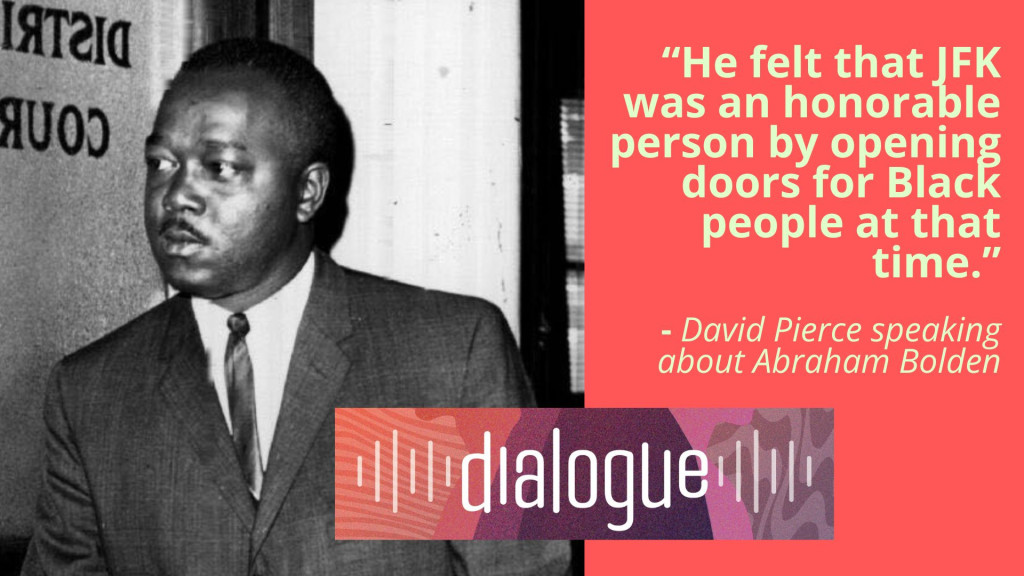
David Pierce: Yeah, he felt that JFK was an honorable person by opening doors for Black people at that time. And he as a Black man being a part of such a transformative opportunity, he felt that that was special because JFK had supported a lot of different movements with getting equality for Black people, and Abraham Bolden really appreciated President Kennedy for doing that.

[00:09:34]
Reginald Hardwick: So shortly after that, there is a federal case that's leveled against Abraham Bolden. What was that all about?

[00:09:40]
David Pierce: So Abraham Bolden was accused of selling a Secret Service document to a known fraudster who he had arrested previously.

[00:09:50]
Reginald Hardwick: He is actually convicted and sent to prison. Tell me about the court case and the punishment.

[00:09:56]
David Pierce: The court case — he ends up going to trial and it ends in a mistrial. From there, they go to a 2nd trial and he gets convicted. Abraham Bolden mentioned how there was one woman that was a juror — she was a Black juror at that. She didn't believe that he was guilty. And Abraham Bolden mentions in his book that the judge working that case had influenced jurors to say that he was guilty, and he's sentenced to 6 years — yeah, 6 years in federal prison.

He was bounced around to all different places throughout the Midwest where he had been. He was placed at your traditional prison setup where there was a yard and other prisoners. And he had been transferred to other facilities where he basically did manual work like lawn work and very physical work like that. Towards the end of his sentence, he went to a facility in Missouri, which was basically [for] those that have psychological needs. And from there, Abraham Bolden had shared how he was given this drug that caused him to basically be inebriated. And he said that the doctor that had given him this substance told Abraham Bolden that you won't even know your name.

[00:12:02]
Reginald Hardwick: And so I know there was a commission after President Kennedy's assassination. Was the idea to keep him from speaking on that — or speaking to the commission?

[00:12:15]
David Pierce: It's funny that you ask that because he was in Washington, D.C. — I believe he was preparing to speak because he was there for another training and he was preparing to speak with the Warren Commission about what he believes happened. And in the midst of that training, he was only there for no more than maybe 72 hours. And he gets called back to Chicago to investigate a money crime in a predominantly white area, which he found strange.

And it didn't make sense then because he gets this call to come back to Chicago from Washington, D.C. in such a hurry, like, pack, we already have your bags packed, just come back and we're going to get on the plane. And he can just feel something was off because just the silence and lack of information as to why he has to just be uprooted and shipped back to Chicago. And then he gets there and he's getting interrogated by his colleagues about this case that they've built of him possibly having sold this Secret Service document.

[00:13:29]
Reginald Hardwick: And that was before he was supposed to speak to the Warren Commission? So through all of this, of course, he doesn't go through this alone. Tell me about his family life and his wife who had to endure all of this with him.

[00:13:44]
David Pierce: Barbara — she held down the fort while he was gone. Barbara had supported him as he became higher and higher in ranks of law enforcement. You know, they had had 3 children together, and when he gets arrested on these accusations, she is the one that's holding the house together and constantly coming to see him even when he gets convicted. And she is the one that picked up another job before him having been convicted and continuing to raising the family, and Abraham Bolden doing different odd jobs to raise money for his trial, you know, taking out savings to spend for a lawyer — which was also his fraternity brother at the time, of Alpha Phi Alpha. And then he gets convicted after the 2nd trial. And she was the one that would come see him and travel through the Midwest to come see him and, you know, just comfort him.

[00:14:58]
Reginald Hardwick: How did he eventually leave prison and was he ever exonerated of his crimes?

[00:15:05]
David Pierce: So he was able to leave prison early. He spent about 3.5 years in jail. He was exonerated by President Joe Biden in 2022. But him having been released from prison in the late 1960s up until 2022, that decades-long, you know, fight — he spent decades in between then fighting to have his record cleared and to be exonerated. All throughout that time, he would go to different Supreme Courts and he had been denied. You know, he would look for his files in different federal libraries — nowhere to be found. So when he finally got exonerated by President Joe Biden, that was something that he had long waited for.

[00:16:02]
Reginald Hardwick: What did he do after prison?

[00:16:04]
David Pierce: He went on to work as an engineer.

[00:16:06]
Reginald Hardwick: Did he ever get to speak about his concerns about the Kennedy administration?

[00:16:12]
David Pierce: He did get to speak with a committee of the federal government about — and this happened in 2025 — where he did speak with a committee of the federal government about what had happened to him and how he felt that that was an injustice against him.

[00:16:30]
Reginald Hardwick: Where is Abraham Bolden now and what kind of condition is he in?

[00:16:35]
David Pierce: So Abraham Bolden is now 91 years old and he is hanging in there, you know, he's doing pretty well for himself, very alert. And, you know, still so full of a lot of wisdom about American politics and the Black experience. He is, you know, in a tough condition too as well because he has Parkinson's disease. You know, that makes it really hard for him to do some of the most basic things, which is, you know, eat and, you know, maybe get dressed and, you know, use the bathroom and different things like that.

[00:17:12]
Reginald Hardwick: And his family is in Chicago as well. I know his wife has passed. What was it like to sit and just chat with him?

[00:17:22]
David Pierce: It was amazing because he is 91 years old and to have this opportunity, it felt like once in a lifetime because he could have passed away in the midst of us having been working on this story and preparing to do the interview.

[00:17:43]
Reginald Hardwick: And we've made that mini documentary available on WILL TV as well as the Illinois Public Media YouTube channel. David, thank you for bringing us the story and thank you for talking about Abraham Bolden.

[00:17:57]
David Pierce: Of course, thank you for having me, Reginald.
Transcript Assistance
Illinois Public Media may use AI assistance for transcript generation and/or formatting. Transcripts that have not yet been reviewed for accuracy will be labeled.
To report a transcription error, or to request transcription of archival material, please contact will-help@illinois.edu.