








Transcript: Jim Clyburn talks about priorities if Democrats flip Congress and being South Carolina’s 9th Black congressman
Transcript: Jim Clyburn talks about priorities if Democrats flip Congress and being South Carolina’s 9th Black congressman
Dialogue
Jim Clyburn talks about priorities if Democrats flip Congress and being South Carolina’s 9th Black congressman
Read the full story at https://will.illinois.edu/dialogue/jim-clyburn-talks-about-priorities-if-democrats-flip-congress-and-being-south-carolinas-9th-black-congressman.
Transcript
// This is a machine generated transcript. Please report any transcription errors to will-help@illinois.edu.

[00:00:00]
Reginald Hardwick: From Illinois Soul, this is Dialogue. I'm Reginald Hardwick, news and Public Affairs director at Illinois Public Media. Dialogue is an exchange about culture straight from the soul. One of the most influential Democratic members of Congress made a stop in central Illinois recently. Jim Clyburn has served more than three decades in Congress, representing his home state of South Carolina. You may be surprised to know he's the 9th Black congressman from that state.

[00:00:47]
Jim Clyburn: Well, the book is about the first eight African Americans to serve in Congress from South Carolina. Now, there are 95 years between eight and yours truly, nine.

[00:01:06]
Reginald Hardwick: Clyburn's predecessors are the focus of his new book, "The First Eight: A Personal History of the Pioneering Black Congressman Who Shaped a Nation." At 86 years old, he shows no signs of slowing down. In early July, Clyburn talked about his book at the Abraham Lincoln Presidential Museum in Springfield. Shortly before the appearance, he talked with me one on one about his book and this November's elections, when Democrats hope to regain the majority in Congress and put a check on President Donald Trump's power.

[00:01:43]
Jim Clyburn: And so I'll be talking about this book, those eight people. But I'll talk a whole lot about what led to this 95-year gap, and why what we're seeing today is so reminiscent of that. In fact, when you see discussions about things like the [ACA], and then you read the [CERVAC], it reminds me so much of the kinds of impediments that were placed upon the voters back in the 1870s, [1880s], and [1890s], that led to that gap. And if we see ourselves about to repeat that history, we ought to be very cautious about how we approach the elections. And so I say in the epilogue of the book that the book is a cautionary tale.

[00:02:44]
Reginald Hardwick: According to NBC News, the conventional wisdom around this year's midterm elections has been that Democrats think 2026 has the potential to be a blue wave and that Republicans quietly believe they may be right. As of mid-July, most polls put President Trump's approval rating at record lows in the 30s or low 40s. I asked Congressman Clyburn if Democrats are taking those numbers and flipping Congress blue for granted.

[00:03:14]
Jim Clyburn: I don't think Democrats are overconfident. I don't know that they're even confident. You know, history has a rhythm to it, and a lot of people say it may not repeat itself, but it rhymes. History repeats itself. We ought to stop saying that, because it does. This country is always moving — sometimes to the left, and sometimes to the right. Now the question is, as George [Santayana] once warned us, are we learning lessons from that history, or are we going to run the risk of repeating that history?

So when you look at Reconstruction, it came to an end, and the country went way to the right. In 1954, the Supreme Court decision moved the country back to the left. And then we see what's going on now, the country moving back to the right. And it sometimes has short spasms. The country went left to elect Obama, right to elect Trump, went back left with Joe Biden, back right with Trump. The country is always doing that. And we have to be cognizant of the fact that that movement is always there. And how long the country stays left or right depends upon the participation of the voters.

[00:04:59]
Reginald Hardwick: Clyburn says if the Democratic Party retakes the House of Representatives and the U.S. Senate, their priorities should range from focusing on the economy to the nation's highest court.

[00:05:12]
Jim Clyburn: Well, the priority first [is] to make this country affordable. This country has gone unaffordable in too many ways. I saw some research the other day that said the average first-time home buyer has reached 42 — at the age of 42, I think I was retiring my first mortgage. And now we're saying that people are waiting until they're 42 before they can afford to purchase a home.

Is healthcare affordable for everybody? Housing — is it affordable? Education — how many students are going into deep debt that they'll never get out of trying to achieve an education? How many people go cold in the winters and too hot in the summers because we don't have affordable energy? So the first thing we've got to do [is] make this country affordable. After we do that, we can look at these other things and start — what we can correct here, what we can correct there.

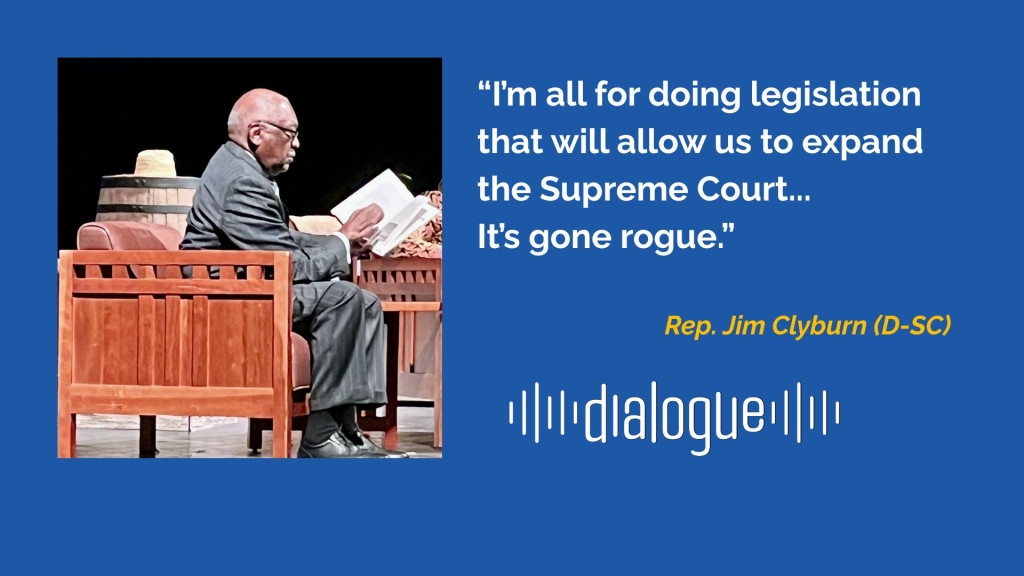
I'm all for us doing legislation that will allow us to expand the Supreme Court, because the Supreme Court has gone rogue. There's no other way to look at it. It's gone downright rogue, and you've got Clarence Thomas, just the other day, [who] said we need to take a look at birthright citizenship, and he talks about the time [having] outgrown that. Does he think the same about the Second Amendment? The Supreme Court has gone rogue, just that simple.

[00:07:13]
Reginald Hardwick: In May, the U.S. Supreme Court decided to undermine the Voting Rights Act. Here's a recap from NPR's Hansi Lo Wang.

[00:07:21]
Hansi Lo Wang: This ruling reinterprets long-standing protections against racial discrimination and redistricting. And it's going to make it much, much harder to challenge voting maps — not just for Congress, but at all levels of government — with claims that the maps unfairly weaken the collective voting power of racial minorities in places where white majority voters and minority voters of color tend to prefer different candidates.

[00:07:45]
Reginald Hardwick: The Supreme Court's decision could reduce the number of Black congresspeople. During his visit to Springfield, I asked Congressman Jim Clyburn his concerns about that.

[00:07:55]
Jim Clyburn: Well, that's fair. If you know — you remember, my district was targeted. This White House has been sitting there targeting these districts all over the country. But when South Carolina stood up and said we're not going to do it, the next week Georgia followed suit. Up until that point, everybody capitulated, capitulated. South Carolina said no, we're not going to do it. The state is still there. And then Georgia says we're not going to do it. And then Mississippi says, well, we're going to postpone it until two years from now. Well, what happens two years from now depends upon what happens in November of this year. So we know exactly what's waiting down the road. Are you going to sit around knowing what's going to happen, or are you going to do what you can do to intervene?

[00:08:49]
Reginald Hardwick: You've been listening to South Carolina Congressman Jim Clyburn during an interview with me on July 7th at the Abraham Lincoln Presidential Museum in Springfield. His book, "The First Eight: A Personal History of the Pioneering Black Congressman Who Shaped a Nation," is about the African Americans who served his state in Congress after the Civil War and before the Jim Crow era.
Transcript Assistance
Illinois Public Media may use AI assistance for transcript generation and/or formatting. Transcripts that have not yet been reviewed for accuracy will be labeled.
To report a transcription error, or to request transcription of archival material, please contact will-help@illinois.edu.