Transcript: The Nolan Wells case prompts discussions about Black teens being in mostly White spaces
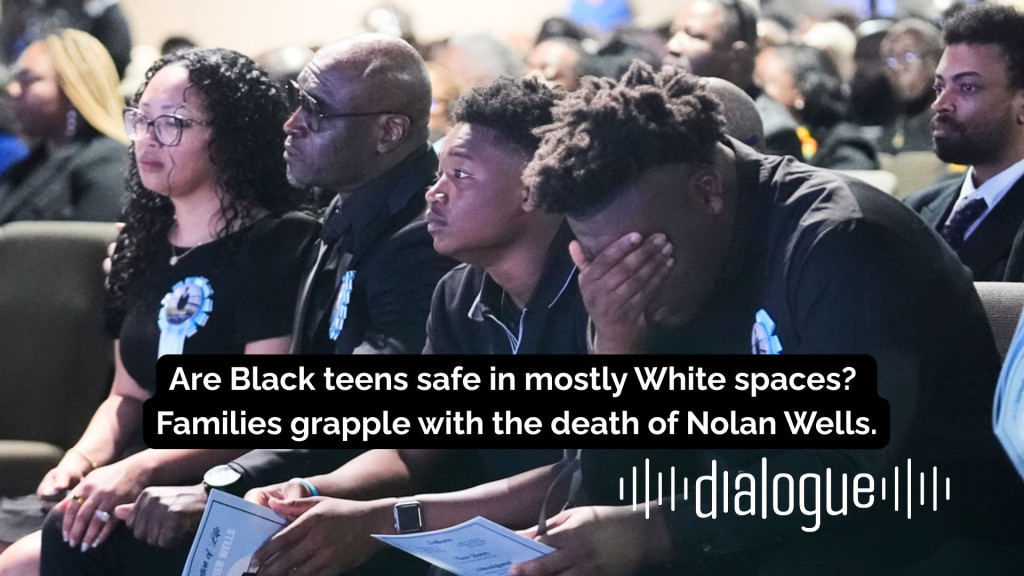
Transcript: The Nolan Wells case prompts discussions about Black teens being in mostly White spaces
Dialogue
The Nolan Wells case prompts discussions about Black teens being in mostly White spaces
Read the full story at https://will.illinois.edu/dialogue/the-nolan-wells-case-prompts.
Transcript
Reginald Hardwick: From Illinois Soul, this is Dialogue. I'm Reginald Hardwick, News and Public Affairs Director at Illinois Public Media. Dialogue is an exchange about culture straight from the soul. For many Americans, July 4th, 2026, was full of families and friends celebrating our country's independence, but for the family of 18-year-old Nolan Wells, it was the start of a nightmare. The Black college football player accompanied his white male friends on a holiday boat trip to Horn Island off the Mississippi coast, a place with no shelters, no facilities, no communications. Hours later, his friends made it back home. Wells did not. His body was found face down in the water two days later.

On July 20th, his parents, Christine Wells Wonsley and her husband Elmore, spoke at Nolan's funeral service paid for by media mogul Tyler Perry.

[00:01:21]
Elmore: You were not just making a name for yourself on the football field, the basketball court, and the baseball diamond, but you were also laying the ground, laying the groundwork for your little brother Elmore. I nicknamed you Mr. Cool Hands because it seemed like you was kissing a touchdown every game. You want to be the best. So, I poured all my knowledge into you.

[00:01:04]
Christine Wells Wonsley: Thank you, Lord, for the beautiful 18 years that you blessed us with, with him. Thank you for the joy he brought not only to our family, but also to his friends and everyone in the community whose lives he touched.

[00:01:52]
Reginald Hardwick: One major mystery: Nolan Wells' phone. Civil rights attorney Ben Crump, who is leading his own investigation into the death, has alleged that messages appear to have been deleted from his phone, which was found with the young men who returned from the island without Nolan, along with his keys.

[00:02:11]
Ben Crump: We thought that it's only fair if we're going to look at Nolan's phone, we should look at the other people who were with Nolan that day, because again, we just want equal justice. We think that if Nolan was on that boat, roles were reversed, they would look at his phone, and so that is going to be important. We have not established a time yet of when we're going to do the mutual inspection of the cell phone. We have to do some technical things. We're getting our experts together, working with phone companies and so forth, but we hope to do that sooner rather than later.

[00:02:49]
Reginald Hardwick: His death has captured national attention with nearly nonstop online videos commenting on the case, the victim, and the always present dynamic of race in America. For the rest of this segment, we're going to turn it over to University of Illinois Urbana-Champaign student and Dialogue summer intern Curtis Beasley IV.

[00:03:10]
Curtis Beasley IV: Today we are joined with Joseph Omo Osagie, who has been involved in community outreach, social justice, and mental health for the past 38 years. He was a counselor at Parkland College before his retirement. So, Joe, when you first heard about the Nolan Wells case, what went through your mind?

[00:03:27]
Joseph Omo Osagie: Fear. I mean, the case of Nolan Wells evoked fear and discomfort in me because I have two young men … my sons who are in that peer group. One's 19, one's 22, he'll be 23 in what's today's date? almost exactly a month from now. And it is important that we have those conversations about life and death and how our friendships, or how their friendships, are evolving, so that they can be safe and know who to go to when the issues of race ever come into play. And I think a lot of times, as a culture, we don't want to talk about it, but the reality is, it's always present. It's always there and we always have to be able to face it. And face it with your peers and face it with people that you care about also.

So, yes, when with Nolan, it always came up. It always comes up in my mind, and I broached the subject with my sons also about their friendships and their peer group. How, how are you guys thinking about these things?

[00:04:41]
Curtis Beasley IV: For sure. And just a little note in terms of the idea that you bring up that when it comes to racial issues, as a society, we're kind of comfortable brushing over those things, or overlooking them, or just not wanting to address those uncomfortable truths. If there's anything that you wish could be different about that, what would it be?

[00:05:00]
Joseph Omo Osagie: In depth. We talk about race, but we don't talk about race in depth. Why do we have these issues? It goes beyond just a Black and white issue. It goes into issues of economics. It goes into the sociology and anthropology of it and the politics of it. We have to be willing to look at all the different extraneous factors as we look at what and why things are the way they are.

Yes, Africans, or people of African descent, have been in the United States 500 years. The only people who are indigenous to this culture are the native indigenous people. And five hundred years, we still have not really been willing to talk about how come we came here. Not just Black folks, but how come white folks came here, too. And if we do look at the history of Europe, I mean, Europeans were savaging each other, and they found another group to savage the Africans and also the Native Americans. And those are the kinds of conversations that we are unwilling to have as a culture.

[00:06:10]
Curtis Beasley IV: OK, and in terms of young Black men and Black fathers in your circle so your friends, your peers, and maybe even your sons and their friends, how are they processing this case from your perspective?

[00:06:24]
Joseph Omo Osagie: I mean, when it comes down to one of my sons, my oldest, TJ, says, "Oh, it's like that couldn't happen to me." But my younger one, he has, I mean, I call his peer group a United Nations, because he has a peer group that they came over for the Super Bowl party, and I think pretty much every continent was represented in at least twenty different countries. They were all American students, but they all were like my kids who are second-generation kids who had parents who were born in other countries. So, he has a very diverse friend group, and I don't see them going camping. But my older son has friends who do go camping, and since he's now been working in construction management, he has a different peer group, and a peer group that's evolved. It's predominantly a white male peer group.

[00:07:21]
Curtis Beasley IV: Sure. And in terms of coping mechanisms for dealing with this case, do you feel as though there are any that you could speak on for other young Black men?

[00:07:31]
Joseph Omo Osagie: First and foremost, be willing to have open and honest conversations with your peers, and also knowing the fact that, OK, when things go down in this society, if you're in a group of four kids and three are white and you're the only Black kid, more than likely they're going to turn to you if things go south, you're going to be the one that's questioned first. Are you willing to have that conversation with your peers and say, "Hey, are you there for me? Are you with me? Or are you just a good time friend and not a friend who will be there when it comes to things that are really, really important?"

[00:08:13]
Curtis Beasley IV: Sure. And also, for possibly the parents of Black children.

[00:08:16]
Joseph Omo Osagie: Oh, I mean, definitely having that constant conversation. To me, it's not a conversation you have once. It's not that when you're driving, you put your hands on 10 and 2, or you don't run from the police, or things like that. You just need to be able to have that constant conversation about what's going on in your life and how do you address uncomfortable situations with law enforcement, or with adults in your life, or with faculty in your life.

I use the example of way back when my oldest was in high school, Colin Kaepernick had at that point taken a knee. And one of his teachers, it was a business class where they had to kind of buy stocks and things like that, and my son wanted to buy Nike stock, and this teacher was very [worked up], not about Nike, but going off about Colin Kaepernick because Nike supported Colin Kaepernick at some point also. And my son was concerned about getting involved in the conversation, and he texted me and I said, "You're not supposed to be texting in class" but he said, "I did something, I just wanted to get involved in that conversation." He texted me and I said, "Go ahead and say … be respectful, say your part, say what you need to say, and don't be disrespectful to your teacher, but if you have facts, talk about the facts. Don't talk about the emotion behind it but talk about the facts as you know them to be." And he did.

And I think his teacher ended up being uncomfortable. He had a test the next week, his teacher summarily gave him a D, and I said he's a bright kid and he was, he said, "This is not correct," because he could see that some of the answers were correct. And so, we asked for a meeting with the teacher. My partner and I went in for a meeting, and, by the end of the meeting, TJ's grades were changed from a D to an A because, "Oh, I made a mistake here, I made a mistake here."

But I think those are the conversations that we have to have as parents but also let our kids know that we support them. We would hold them accountable for things that are wrong, but if there is something right that they have done, we want to be able to support them but also hold them accountable, because accountability is really the most important aspect of things that we can teach our children: to be accountable for your behavior and actions.

[00:11:06]
Curtis Beasley IV: In understanding that Nolan's case does echo a trend in American society in terms of Black parents losing their children not necessarily in the context of death, but I mean we have Tamir Rice and Trayvon Martin, and even someone like Sonya Massey, who was killed in Illinois, who is still someone's child, right? So, what do you have to say to Black parents and youth who are struggling in this moment?

[00:11:39]
Joseph Omo Osagie: One of the most important things that we can do is keep building community. Build our support systems where we know that we can find trust and hope. We have to know that there is something, or somewhere, that we belong to. The Black church is always a very important aspect of our need to belong. But if you're not a churchgoing person, do you have a friend group where you belong?

I was talking to Reginald yesterday about being a part of a theater production of "Ragtime," and it's important for us to come together as a group, to support one another, no matter what else is happening around us. How do we belong? Belonging is foundational. Erikson's stages of development talks about belonging being one of the most important things. The Lakota Sioux Native Americans … belonging is one of the essential pillars of community. And really, Erikson stole some of those ideas from the Native Americans, but belonging is essential. Who's your peer group? Who do you belong with? How do you know that you've got support? Who's got your back?

And that's what we as parents ought to do … we talk to each other. It ought not to be competitive, and I think unfortunately we live in a society where competition is raised about everything. Our children are our children, and our children are what we send into the future as representatives of us. And how do we make sure that, as a community and as a society, we support one another, we support one another enough to make sure that our children know who to come to?

I always say to my kids, when they were younger, "If you're lost or if you feel uncomfortable somewhere, look for a Black woman." And more than likely, the Black woman will support you and will say, "Hey, come here, honey, let's go find your mom, or let's go find your dad," or whatever. And not that white women wouldn't do the same, but it's more than likely that a Black woman will support our children.

[00:14:04]
Curtis Beasley IV: So many people online, anyway, in terms of the discourse around Nolan's case, have brought up and drawn attention to the fact that this occurred in Mississippi, and it kind of creates this notion that you should know better than to associate yourself with certain groups of people in Mississippi, or to do things being the only Black person in the group in Mississippi. What do you feel is inaccurate about this notion that these people are putting out on the internet?

[00:14:35]
Joseph Omo Osagie: Oh yeah, because it's easy to say it's those people over there. It's those people in the South. That's how the South acts. But we had lynchings in Illinois. We have quite a few sundown towns around Champaign-Urbana. Champaign-Urbana is kind of an island in between places where things could occur. Especially,  I think I mentioned earlier my son went camping, and he went camping in a small community. And yes, I thought about it while he was out there. I said, "OK, is this a safe environment?" Because we're in Illinois and Illinois is a blue state and Champaign-Urbana is a somewhat liberal community, doesn't mean that once you go 10, 15, 20 miles outside of this, that we are all safe and we're all singing kumbaya. That's not what happens. We've got to be aware of our environment. We've got to have these conversations.

[00:15:38]
Curtis Beasley IV: So, understanding that you come from Nigeria and have assimilated to the culture in Champaign-Urbana, in Illinois, and in America, how has your life journey to this point informed the way that you see racial issues?

[00:15:52]
Joseph Omo Osagie: It's been an evolution. It's been a really big evolution. When I came to the United States, for lack of a better word, I did not see myself as Black. Although I am still the darkest person in almost every room, I'm in. I did not see myself as culturally Black. I saw myself as an Igbo person who grew up in Lagos speaking Yoruba and eating pounded yam and Efo Riro and Egusi and all those things. But evolution kept creeping in because, although I did not see my blackness, I saw myself as a person like most white folks see themselves. I did not see my blackness till I was confronted with it over and over and over again.

And when my children were born, I mean, they're biracial. I realized just that, "Oh wow, they're not going to see their whiteness." They're going to see them as young Black men that are 6'4" and 6'5" and big. They're going to paint them just one color.

[00:17:12]
Curtis Beasley IV: Thank you so much for this discussion. We've been speaking with local counselor Joseph Omo Osagie.

[00:17:19]
Reginald Hardwick: you. Thank you to U of I student and Dialogue intern Curtis Beasley IV for that important conversation.
Transcript Assistance
Illinois Public Media may use AI assistance for transcript generation and/or formatting. Transcripts that have not yet been reviewed for accuracy will be labeled.
To report a transcription error, or to request transcription of archival material, please contact will-help@illinois.edu.