








Transcript: Recapping the only debate in the Illinois governor’s race
Transcript: Recapping the only debate in the Illinois governor’s race
The 21st Show
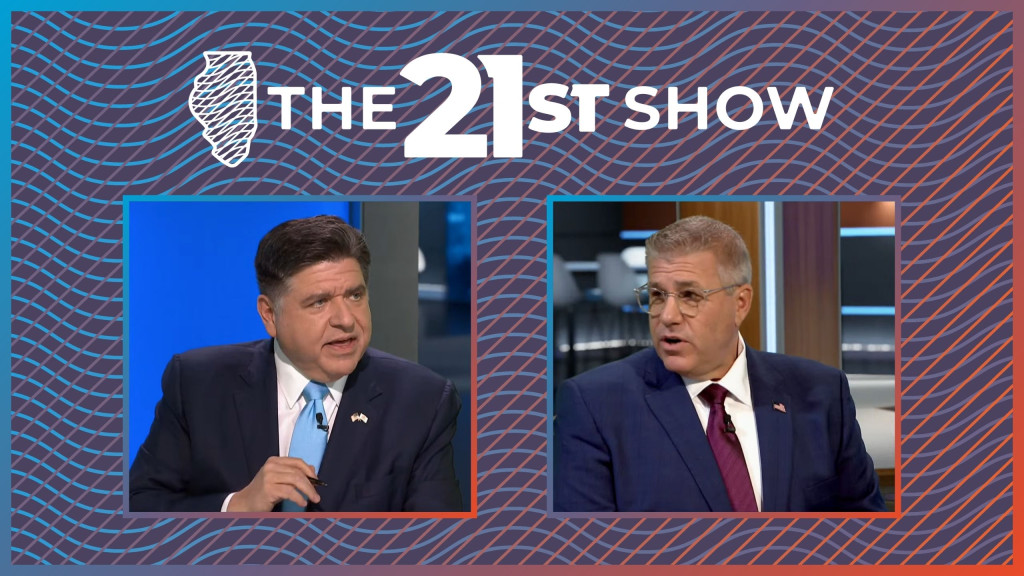
Recapping the only debate in the Illinois governor’s race
Read the full story at https://will.illinois.edu/news/recapping-pritzker-and-baileys-only-debate.
Transcript
// This is a machine generated transcript. Please report any transcription errors to will-help@illinois.edu.

[00:00:00]
Brian Mackey: From Illinois Public Media, this is the 21st show. I'm Brian Mackey. Governor JB Pritzker and Darren Bailey faced off in Chicago this week in a live forum hosted by the PBS station WTTW. This was the incumbent Democrat and repeat Republican challenger's only scheduled joint appearance of the election campaign, and the format leaned more toward moderated conversation than a traditional debate. At least that's the way moderator Brandis Friedman set it up. It didn't take long before Pritzker and Bailey were going back and forth, sometimes talking over each other, sometimes past each other. They hit on issues ranging from property taxes to how much people like Indiana, to who's moving to Indiana, changes to the grocery tax, and this back and forth on the Safety Act, which in part eliminated cash bail.

[00:00:56]
Speaker 1: If there is danger to the community or danger to anyone in the community, they ought to be kept in jail. That is what the Safety Act allows. And then one last thing, have you been victims' rights organizations, victims' rights,

[00:01:08]
Speaker 2: [Katie Abraham], can you say that? Don't sit there and tell us if you're

[00:01:12]
Speaker 1: going to interrupt, let's — let's — let's not have a discussion. Let's not have a debate if you're going to [sit] at stake. You are not listening. I would like to respond to that if I may. This is very important.

[00:01:25]
Brian Mackey: There's a reason we have a term in broadcasting called crosstalk. It's very difficult to understand what is happening when two people are talking at the same time. Joining us now to process what happened in the forum is Mawa Iqbal, statehouse reporter for public radio stations across Illinois. Mawa, welcome back to the show. Hey, Brian. We are taking calls about this just for the next 14 minutes and 40 seconds of our program today. If you wanna join us, 800-222-9455 is the number. Did you watch the forum? It was on Tuesday night. What did you think? Has your mind changed about either of the candidates since they last faced off four years ago? The number again, 800-222-9455. That's 800-222-9455. All right, Mawa, what were the governor and Mr. Bailey's overarching messages they were trying to get across at this forum?

[00:02:19]
Mawa Iqbal: You know, it's interesting. I, so like you said, right in your intro that it seemed like the forum was set up by WTTW to be more of like a conversation about policy and a moderated discussion, but it really did devolve into kind of like what you'd see in more hotly contested debates where like both candidates are kind of jabbing each other, they're going back and forth, they're talking over each other, but I would say that like their overall messages have been pretty consistent with what they have been campaigning on these past several months, where, you know, Governor Pritzker, his overall message was that Darren Bailey is basically a Trump acolyte, you know, that he is way too extreme for Illinois and that you need someone who like himself is reliable and has done work to keep the state's finances on track. It's important to note that, you know, Governor Pritzker came into office in 2019. He inherited a really bleak fiscal state where, you know, his predecessor Bruce Rauner had led the state through a two-year budget impasse, and, you know, there was a $17 billion bill backlog. There was, you know, no contributions to the rainy day fund. There were the pension unfunded liabilities were increasing, so it was — it was a pretty — credit ratings were down, right? And it was — it was not looking good. And Pritzker has made it a cornerstone of his administration to be fiscally responsible, pass balanced budgets, get the state's credit ratings back up, and that sort of was his overall message. I would say the two-prong, you know, attacking Bailey for being so similar to President Trump and then also talking about like all the great things he's done for the state of Illinois, whereas Bailey's overall message again is something that we've been hearing on the campaign trail too, is attacking Pritzker for raising taxes and particularly property taxes, not doing anything to cap those even though those are mostly controlled by local municipalities, and then also promoting this idea that, you know, he's all about the kitchen table issues, that Bailey's all about affordability. He's not — he's staying away from these social cultural issues that he campaigned on last time when he ran against Pritzker in 2022, so like gun rights, abortion access, he's just not talking about that as much. He — he says he's — he's laser focused on affordability and the quote-unquote kitchen table issues.

[00:04:54]
Brian Mackey: All right, let's listen to another clip. Uh, this is Darren Bailey responding to a question — you mentioned that, uh, um, Governor Pritzker is, you know, always talking about President Trump, and Darren Bailey mentioned that himself. So let's listen to him responding to a question about President Trump's tariffs.

[00:05:12]
Speaker 2: We're all ready for the tariffs to end. I think we're ready for the war in Iran to end, but these questions, it sounds like this is a, uh, uh, this is a debate about the presidency of the United States with President Trump.

[00:05:26]
Brian Mackey: All right, the moderator Brandis Friedman did push back on that. She noted how the actions of any president affect people in individual states. So that said, say a little bit more about how President Trump's actions in particular, uh, you know, beyond what Pritzker has long made his, uh, you know, sort of main platform here, um, what that has — you know, how that colored the conversation on Tuesday night.

[00:05:49]
Mawa Iqbal: Well, one of the most, um, standout moments for me watching the debate was that during their intros when the forum was just starting, Darren Bailey basically, um, had the audience participate in a drinking game where he said that, um, you know, I encourage anyone who's watching tonight whether they have an iced tea or a lemonade or whatever drink you have, um, take a — take a drink every time Pritzker mentions President Trump. And you know what's interesting about that is it's certainly from the Pritzker camp, but that President Trump has been a dominant focus of their campaign, you know, I remember covering the primaries, election night watch party that Pritzker had, and he, you know, of course won the Democratic primary and his winning speech, his victory speech was mainly about President Trump, you know. A lot of his uh his ad spending too that he's released in this campaign, in this election cycle — where, you know, like he's spent a lot of money on digital ads and, and, and you know, anyone with a with a phone or a laptop has probably seen ads against Darren Bailey paid for by the Pritzker campaign, and they're all tying Bailey to President Trump and trying to paint him as very extreme. So, so hitting them on, you know, tariffs — like, like you mentioned, the war in Iran, high gas and grocery prices, high diesel prices for farmers — those are issues that also came up during the forum on Tuesday night. And you know, it's — it's — it makes you think too, like, obviously Pritzker is widely, widely seen as eyeing a presidential run in 2028. And one thing I'll also add too is that during his campaign — or this campaign season — Pritzker had created this PAC, this $20 million PAC that is meant to help Democrats win in races that are typically held by Republicans, or — or I guess how they word it is Trump-friendly districts, um, and — and it's — it's districts all over the country, right? So, so he's certainly elevating his national profile, um.

But you know Darren Bailey, like he — he got President Trump's endorsement right this time around, even though he wasn't necessarily seeking it or really touting it once he got it. He — he did get it, um, when he ran back in 2022 against — Trump — or I'm sorry, against Pritzker, he did also get Trump's endorsement back then, um. The other thing I'll note too is that Darren Bailey, when the Republicans are having their mini RNC in Texas, Darren was sitting in the president's box with President Trump. But like I said before, you know, he — Bailey has tried to really not mention Trump that much. I think he even senses that President Trump's popularity nationally is hitting an all-time low, and especially in a state like Illinois where it's reliably blue, you know, Trump is not a very popular figure to sort of like hedge your bets on, you know, it's — it's almost like — like Trump has kind of became sort of an albatross around these Republicans, Illinois Republicans, you know, like how much do we associate with him, how little. And so you know, to Bailey's — I guess Bailey's credit to his campaign style — I guess he has tried really hard to like not mention Trump, but but he still comes up, of course, right? And especially

[00:09:15]
Brian Mackey: mentions Trump, which is he keeps putting himself into the conversation, you know. I've talked to a lot of Republicans this election cycle, and one thing I I often ask them is, you know, what they think, like, because my — my hypothesis is if there's a clear dividing line, and it's when Trump came down the escalator. You think back to 2014, [three] Republicans elected statewide. One of our two U.S. senators was a Republican. Trump comes down that escalator in 2015 and no Republican has won statewide since then, and you know, I don't know what else works as a hypothesis for explaining the Republican difficulties in recent years. So, uh, let's — let's talk about some of the other policy things that came up though, right, because education was a big topic. The candidates were asked about, for example, Chicago public schools putting $150 million in state funding into the city school budget, something that state lawmakers did not put into the actual state budget earlier this year. There was a sprawling conversation then that followed out of that about education funding and the quality of our schools. Where — where did the two of them take that?

[00:10:20]
Mawa Iqbal: You know, yeah, the — the CPS funding has been an issue that's been popping up this summer, um, mainly with, uh, the — the Chicago Teachers Union, the Illinois Federation of Teachers, both are really big, uh, teachers lobbies, very powerful teachers lobbies, um, public school lobbies in Illinois. And um you know it's — Governor Pritzker kind of stayed on message, right, even when the IFT and the CTU were calling him out earlier this summer for not adequately funding CPS or — or — or public schools in general too. Pritzker, his response then and continues to be that, you know, we are funding public schools. We — we've passed this evidence-based formula, uh, law back in 2016 — I believe — uh, correct me if I'm wrong, Brian, but I believe it was 2016, and, um, there, you know, the idea was that the — the state funding, that the share of the state funding towards public schools would target underfunded schools first with the goal of getting the most underfunded schools up to 90% adequacy of funding. And critics, you know, education funding advocates and critics do say that the state is not on track. That's something that Bailey brought up as well. And, and, you know, there was a really, uh, tense moment during the debate where Bailey said that you are stealing these children's futures. It was — it was like one of those moments where they were talking over each other, things were getting tense, um. I — I think, I think, you know, that this certainly — like a debate tactic you will see a lot of candidates using where if you just interrupt your opponent you can kind of get under their skin and sort of throw them off a little. And um I think you know with with education like this is — I think Bailey understood that this is something that Pritzker has been getting hit on by the CTU and the IFT, so maybe perhaps he thought this was an opening. Right, but — but they, yeah, you, you know, it's — education funding will continue to be something that they talk about, I think, during veto session when lawmakers come back to Springfield, uh, next month, you know, it's, um. It's — that that was definitely something that that, yeah, like you said, it — it devolved into like a kind of a sprawling topic about education in general, right?

And I think from there Bailey has also taken it to, you know, he was talking about his own school, the private school that him and his wife Cindy run, Full Armor Christian Academy, and he blamed Pritzker for the threats that that school has been receiving. He said that, you know, because of Pritzker's ad that the campaign has been putting out about the school teaching all kinds of things like dinosaurs existing when humans were — were on the earth at the same time, and some of the other curriculum basically, right, right, right, and — and — and basically Bailey said that like because of all the threats that we received from your ads we've had to shut down our school like twice, or I think for two days is what he said.

[00:13:13]
Brian Mackey: Well, we are running short on time. Just, uh, one little fact check. You weren't even covering Illinois at the time, so you were very close. I had to Google it. It's 2017 that the funding law passed, um, and I — I was covering the statehouse at that time. All right, last thing I wanna ask you about probably, uh, cause I think you — you actually filed a story on the side of the debate. There's been a lot of talk among everyday people about data centers in Illinois, right? Governor Pritzker used to be vocal about bringing them here. His position has now changed. Bailey, uh, you know, tried to make something out of — out of that. Just — just help clarify where these two men are on the issue of data centers, which, as I said, has been a hot topic for a lot of people.

[00:13:55]
Mawa Iqbal: It has, and you know, Pritzker — Pritzker's kind of changed his tune recently, you know, like like the state was offering tax breaks for data centers to build in Illinois, and as a result of that they've essentially doled out $666 million in tax incentives for the construction of new data centers in Illinois. But, but recently, like — like I would say this year during his budget address, Pritzker announced a two-year pause on those tax incentives. And his reason for that was because, you know, there — there's all kinds of issues with how much strain these centers are putting on the electrical grid and not being able to provide their own power sources has — has meant that they've been taking electricity from the grid and therefore rising — or contributing to the rise of people's utility bills. And that was something that that Darren Bailey, you know, he didn't necessarily disagree with Pritzker on that. But it was interesting when he was talking about just energy in general. Bailey is very opposed to the Climate and Equitable Jobs Act, which was passed a few years ago by lawmakers, a landmark bill that essentially was trying to help move the state — or aims to move the state in the direction of being carbon neutral and carbon free by 2045 and 2050, right? And to only use clean renewable energy like wind, solar, and nuclear. And to Pritzker and Democrats, like this is the answer, right, for grid reliability and for making sure we're not overloading the electrical grid, is to bring more renewable energy sources online, take the coal power plants offline. But Bailey — like, like most Republicans too, I should note — is very much against nuclear. He says that we should not — we should — we should restore the moratorium on nuclear plants in Illinois. And um but but I will say he didn't really offer like an alternative solution. He kind of mostly just stayed to the message of we need to repeal — excuse me — repeal the Climate [and] Equitable Jobs Act and then also stop data centers at the same time.

[00:16:00]
Brian Mackey: All right, [Mawa Iqbal], statehouse reporter for Illinois public radio stations, thanks so much for being with us and sharing your reporting with us. Appreciate it. Thank you. And we will be talking with Mawa again, uh, next week after the Senate debate — or Senate candidate forum — also on WTTW TV and public radio stations — or public TV stations — across Illinois. More to come after a short break. This is the 21st show.
Transcript Assistance
Illinois Public Media may use AI assistance for transcript generation and/or formatting. Transcripts that have not yet been reviewed for accuracy will be labeled.
To report a transcription error, or to request transcription of archival material, please contact will-help@illinois.edu.