








Transcript: Black voters drive Democrats to flip seats across America
Transcript: Black voters drive Democrats to flip seats across America
Dialogue
Black voters drive Democrats to flip seats across America
Read the full story at https://will.illinois.edu/tags/black-voters-drive-democrats-to-flip-seats-across-america.
Transcript
// This is a machine generated transcript. Please report any transcription errors to will-help@illinois.edu.

[00:00:00]
Speaker 0: 2026 has been a record-setting year for deadly severe storms in Illinois. Currently lead the nation. We're over 200 tornadoes across the entire state this year alone. That is 3 to 4 times our normal average. On November 12th, IPM's [Tnisha Spain] talks with storm survivors and weather experts to answer the question, Is Illinois now part of Tornado Alley? That's Thursday, November 12th at 7:30 p.m. on WILL-V.

[00:00:42]
Reginald Hardwick: From Illinois Soul, this is Dialogue. I'm Reginald Hardwick, news and public affairs director at Illinois Public Media. Dialogue is an exchange about culture straight from the soul. Some are calling it a blue wave, others say it's a tsunami. November 3, 2026 will be remembered as an epic night as the Democrats swept the U.S. House and Senate. The party also flipped multiple governor's offices in an election that serves as a rebuke to President Donald Trump. No matter what community we come from, Georgia is not defined by one moment in time or by one person. It's been defined by all of us, and I will be a governor for everyone in this state.

[00:01:39]
Speaker 2: It's up to my fellow Wisconsinites, we are not a red state. We are not a blue state. We are not defined by rural and urban. We are one people, one Wisconsin, and tonight we choose to move forward together, y'all.

[00:01:59]
Speaker 3: This campaign didn't happen by accident. It happened because of faith. Because of family. Because of hard work and because the people of Nevada decided that our best days are still ahead of us. But Mr. President,

[00:02:17]
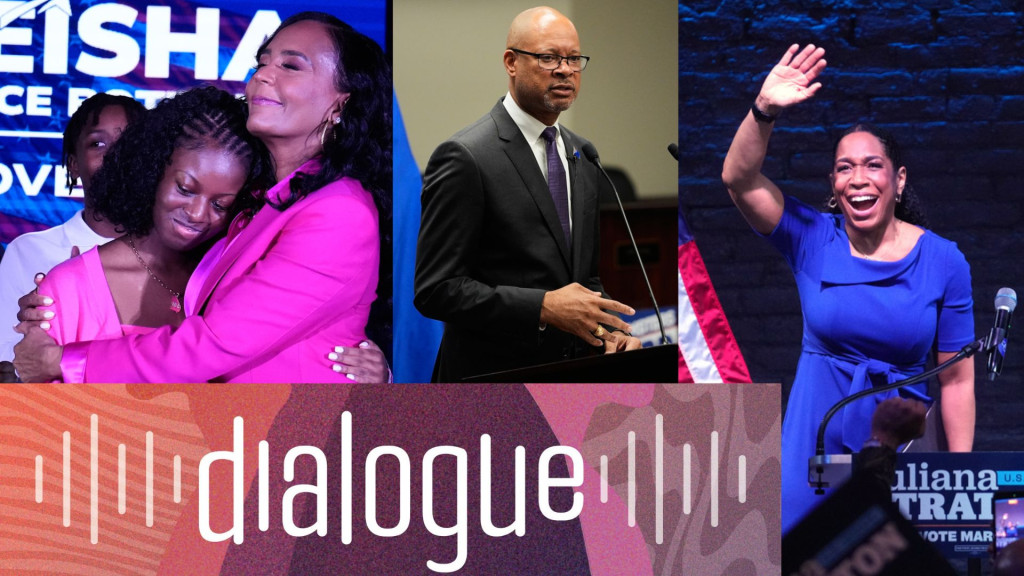
Reginald Hardwick: I also wanna tell you thank you for your support and thank you for being in my corner. We are gonna build the economy to heights never even thought we will be a top 10 global economy as your next governor. That was Democrat Keisha Lance Bottoms, governor-elect from Georgia, Democrat David Crowley, governor-elect from Wisconsin, Aaron D. Ford, the Democratic governor-elect of Nevada, and Republican Byron Donalds, governor-elect from Florida. All four are the first Black politicians to lead their states. Maryland Governor Wes Moore was reelected in Maryland.

And there were big wins too here in Illinois. Democratic Governor JB Pritzker won a 3rd term to serve as governor of Illinois. There's one question I've gotten a lot over the last few months. What's next? The answer is simple. I'm going to ask you to continue to hope, to wrap yourself in hope, in courage. We climbed one mountain tonight, but we are sitting at the base of another. Kristen Mitchell is the lieutenant governor-elect. The person who held that seat for the last 8 years is [Juliana Stratton]. The University of Illinois Urbana-Champaign graduate, lawyer and mediator is now the 2nd Black woman elected to represent Illinois in the U.S. Senate. Let's hear more from Mariah Wolfel.

[00:03:47]
Mariah Wolfel: In her victory speech, Stratton wasted no time building on the anti-Donald Trump messaging she ran on. Working families have been left to pick up the tab for the wealthy and well connected while the crook in the Oval Office enriches himself and his allies. [Stratton paigned] on increasing the minimum wage to $25 an hour and abolishing Immigration and Customs Enforcement. Stratton easily toppled her Republican opponent Don Tracy. She did not acknowledge him in her victory speech. Stratton will be sworn in on January 3rd.

[00:04:21]
Reginald Hardwick: That was Mariah Wolfel reporting. Stratton is the fourth Black person to serve in the U.S. Senate from Illinois. The first was Carol Moseley Braun, elected in 1992. The second was Barack Obama, elected in 2004. After he resigned to become U.S. president in 2008, Roland Burris was appointed to Obama's seat. There were also several wins for Black politicians downstate. Curtis Beasley the Fourth has more.

[00:04:48]
Curtis Beasley IV: In Illinois's 2nd congressional district, Democrat Donna Miller has defeated Republican Mike [Noick]. Miller succeeds Congresswoman Robin Kelly to represent a district that spans from Danville to the south side of Chicago. State Representative Carol Ammons has won her bid for reelection Tuesday night. As of Wednesday morning, she had 88% of the votes against the write-in candidate Keith Smith. Ammons and her husband Aaron, the Champaign County clerk, were indicted on federal charges last summer. They both pleaded not guilty.

Ammons leads in his race, but it may be mid-November when all mail-in ballots will be counted when we know if he'll be able to declare victory over Republican Alan Anderson in the state House District 104 race. Mary Catherine Roberson has flipped the district from red to blue. Republican Brandon Schweitzer has conceded the race to his Democratic challenger. Roberson is a lifelong resident of Danville. She currently serves in Congresswoman Robin Kelly's office. The mother of three also worked with the Champaign County Community Coalition to develop the community gun violence reduction blueprint. She will expand the Democratic Party supermajority in the Illinois General Assembly.

Doris Turner kept her seat in the Illinois Senate. The incumbent Democrat was declared the winner in Tuesday's midterm election, fending off a campaign from Republican candidate and Navy veteran Frank Lesko. Turner secured a comfortable 19 percentage point margin over Lesko, a sharp contrast to her first election in 2022 when she won by about 1,500 votes. She says this lead was because of the work she put in after winning office.

[00:06:10]
Doris Turner: The next day after I was elected 4 years ago I went to work. I went to work meeting my constituents, uh, talking with them, being present and, uh, listening to their concerns and delivering on what they needed.

[00:06:26]
Curtis Beasley IV: Turner will continue to represent Illinois's 48th Senate district. For Dialogue, I'm Curtis Beasley the 4th.

[00:06:32]
Reginald Hardwick: As mentioned before, the Democrats took back control of both houses of Congress. They also won key governor's races in Georgia. Keisha Lance [Baddens] became the first Black woman governor of a U.S. state and the first Democrat to get elected to that office in more than 20 years. Stacey Abrahams is a former Georgia state representative and former minority leader there. She ran for governor in 2018 and 2022. She spoke with NPR's Michele Martin on the day after the election about Black voter turnout.

[00:07:07]
Michele Martin: What does this mean for Georgia?

[00:07:09]
Stacey Abrahams: It means that we will not only hold the governor's seat, and I'm so proud of Keisha, we also won the attorney general's race, the secretary of state's race, and we flipped the state House to Democratic control, which one staves off an expansion of the state-based authoritarianism that we've been watching. But more importantly, it gives us an opportunity to start correcting and restoring rights that we've seen lost across the South for more than 20 years.

[00:07:36]
Michele Martin: Give — say more about that. What do you mean by that?

[00:07:39]
Stacey Abrahams: We have watched the erosion of our voting rights, the erosion of our reproductive rights, the erosion of our voices in the South. There are very few opportunities to use things like ballot measures and so you've been beholden to trifecta governments that have forestalled participation, and with the election here in Georgia, with what we just watched happen in North Carolina, across the South we have seen the breaking of supermajorities, the flipping of chambers. And what that means for people on the ground is that the legislation closest to their lives will start to look more like the people who live there.

[00:08:18]
Michele Martin: By trifecta government, you mean a government controlled by one party that controls both the governor's office and both houses of the state legislature. Exactly. Can I just ask you this briefly, because I do want to talk about your broader work. You've had a very varied career. I mean, you're obviously sort of an important lawmaker in Georgia, but you've also sort of been organizing across the South. But I do want to ask about Georgia for a minute. What went right for Keisha Lance Bottoms that did not work for you when you were running for that office?

[00:08:46]
Stacey Abrahams: I, I wouldn't, I wouldn't frame it that way. This was a building process. Became minority leader in November of 2010, which was the worst year for Democrats since Reconstruction. We lost every statewide office. We went into super minorities within a few years in the Senate and close in the House. And so the work that I was able to be a part of and help lead in part was about rebuilding the party, but more importantly, rebuilding the trust of the people, and that work takes time. And each election cycle, each interregnum between those election cycles was about continuing that work, and I'm just grateful that in 2026 that work that we have been constructing led to this outcome — that she won and that we were able to win up and down the ballot — because it signals that that conversation, that investment and that consistency can pay dividends.

[00:09:40]
Michele Martin: Well, talk about what some of that voter mobilization work looks like. I mean, you've also been working in Mississippi where the Senate race there is still too close to call, which is newsworthy in and of itself in a state that has been so Republican-dominated as Mississippi has been and where the president won by, you know, double-digit margins. So, so talk about what does that voter mobilization work look like that you think has led to these outcomes.

[00:10:10]
Stacey Abrahams: First, it's the refusal to leave after a loss. Uh, I've been incredibly relentless about remaining engaged, about being in conversations, about being in communities that are so often overlooked. Two, it's about not just chasing swing voters, going after those who voted for the other side. It's about going after those who've never voted. I do not believe in voter apathy. That's victim — [bla]. There's no one I've ever met who doesn't care about their lives. What we are seeing is voter despair, and that's being reflected across this country. It's why, you know, Deb Holland became the first Native American governor elected, and we are seeing these wins across the country. People want to know you will solve the problems in their lives, and the work that we've done in Mississippi and Georgia and across the South has really been about reconnecting voters to what government should be able to do, especially at the state and local level, and it's the fact that we were able to leverage resourcing. We don't have billionaires spending $180 million in a race, but we have had solid investment from folks across the philanthropic spectrum who've been willing to invest in the political side but also invest in the work that you have to do to touch people's lives. They have to see that you're going to deliver between elections and whether you're in power or not.

[00:11:31]
Michele Martin: You know, the Supreme Court earlier this year weakened much of what remains of one of the civil rights era's biggest achievements, the Voting Rights Act. I mean, the conservative Republican-dominated Supreme Court has consistently weakened sort of voting rights protections, but there are those who argue that these wins for Democrats means fears about weakening these protections were unfounded or overblown.

[00:11:54]
Stacey Abrahams: I think that is incredibly cynical. Participation does not eliminate or cloud discrimination. What we saw were organizations and members of communities who understood that this isn't just politics as usual. We have an authoritarian regime that has been using democratic institutions to strip us of our rights. In the state of Georgia, there is a body count of women who have lost reproductive rights. Across this country we have seen this government take the lives of citizens. We have children who are incarcerated in Dilley, Texas. And so what we saw and what people responded to was a Supreme Court that refused to protect their rights. They saw a Congress that was inert. They saw a president who was willing to expand his powers to crush theirs. And so I think the [Calais] decision was a concentrating moment — people's minds that no one was going to save us except ourselves — but that does not eliminate nor does it reduce the extraordinary harm of eviscerating the Voting Rights Act.

[00:12:59]
Michele Martin: OK, so this is a longer — this is a longer conversation — but how do you think Democrats and progressives should build on this momentum?

[00:13:05]
Stacey Abrahams: We should build at the state and local level. I'm incredibly proud of what we've done at the congressional level, but legislation moves faster at the state and local level. We've flipped 7 state House majorities. We've broken 9 supermajorities. Democrats have at least 45 majorities. Now is the time for all Democrats to come together and work with anyone willing to do so to prove that democracy can deliver.

[00:13:27]
Michele Martin: That is Stacey Abrahams. She's the founder of Fair Fight Action. Stacey Abrahams, thank you so much.

[00:13:32]
Stacey Abrahams: Thank you for having me.

[00:13:38]
Reginald Hardwick: More on the national elections in a moment, but first updates on a few issues on the ballot. The Champaign school district seems ready for a fourth middle school. Unofficial election results show 66.5% of voters support Unit 4's plans to rebuild its aging middle schools with 100% precincts reporting. School board president Tony Bruno says Unit 4 staff have worked hard to open the middle schools for tours, and he says the community worked hard to learn about the middle school's issues. There weren't many people who walked through those schools and left thinking that they were in good shape.

Champaign Unit 4 asked voters to support the district issuing bonds to build a new middle school. The bonds would also rebuild or heavily renovate Jefferson, Franklin, and the middle school component of International Prep Academy. The bond sale would not raise taxes, but if the referendum fails, taxes could go down.

Voters in Rantoul appear to have approved a referendum to elect village trustees to at-large seats instead of by district. As of Wednesday morning, unofficial results show about 55.5% of voters approve of the change, with all precincts reporting. The decision would reverse a 2018 referendum that divided the village into six districts. Here's Rantoul Mayor Sam Hall. All of the 6 trustees would be elected at-large, which means that everyone in the village that's registered to vote would be able to vote for trustees.

Based on unofficial results, it also looks like Rantoul voters have passed an advisory referendum, 57 to 43%, to overturn the village's current ban on cannabis dispensaries. Mayor Sam Hall says the referendum would still need approval from the village board. It could mean revenue, revenue that we don't have. We, you know, go down that road, so that — that's always good to think about is additional revenue, but for now, we gotta clear a few hurdles. Rantoul trustees first voted in 2019 to prohibit cannabis-related companies from operating within the village borders.

President Trump pushed Republican-controlled state legislators last year to change their congressional maps mid-cycle to boost Republican chances in the midterm election, but as the election results show, that effort did not work out as planned as Democrats won in several congressional districts that Republicans had redrawn. One of the people who had been working to help Democrats respond to these efforts is Eric Holder. He's the chairman of the National Democratic Redistricting Committee. He also served as attorney general during the Obama administration. He spoke with NPR's Michele Martin on Wednesday morning.

[00:16:54]
Michele Martin: Why do you think it is that these redistricting efforts didn't pan out as expected?

[00:17:00]
Eric Holder: Well, I, I think that we have to first understand that the redistricting efforts that they had didn't just fail, they were dismantled. Um, we went after them, we challenged them in court. There was a strong Democratic response, for instance, in California with a reconfiguration of the maps, and then we had people in the grassroots who went to the legislatures, for instance in South Carolina and in Georgia, and did it very peacefully but made clear to people in the legislature that if you do these mid-cycle redistricting, we will hold you politically accountable, and they backed off. And so I think it was the dismantling of that which they tried to do as opposed to the failure of the effort itself. It didn't structurally fall down. We pulled it apart.

[00:17:42]
Michele Martin: Do you think that in part it was that voters were angry at these efforts, or that this was a motivator for some to go to the polls just because they were offended — I mean, at this effort to kind of manipulate their votes?

[00:17:56]
Eric Holder: Absolutely, and I think, you know, we'll have to look at the numbers, um, but my sense is that we saw a huge turnout of African Americans, uh, Latinos, uh, in response to their efforts by the Republican Party to dilute their power, to take away power from those communities. I'm looking at [Himari] Figures, for instance, in Alabama, uh, where he won in a seat that was specifically drawn to exclude him, um, from a suit that we won for him in connection with a lawsuit brought under the Voting Rights Act. Uh, a huge Black turnout there I think is what propelled him to victory. But I also think that, um, not only African Americans and Latinos, but white folks were offended by the attempts by Republicans to put their thumb on the scale and to have put in place a system where they simply couldn't lose. And I think there was a lot of reactions, a lot of negative reactions to that.

[00:18:46]
Michele Martin: You know, the Democrats' efforts to respond were not without controversy, as you, you know, pointed out — that in Democratic-controlled states there were efforts to redraw the maps there. And, you know, former California governor Arnold Schwarzenegger, for example, who is a person who had been outspokenly against gerrymandering, opposed these efforts. He's saying, you know, two wrongs do not make a right. So what do you say to that?

[00:19:07]
Eric Holder: Well, it was interesting, I worked with Governor Schwarzenegger as we tried to, you know, oppose gerrymandering and did a whole variety of things with him — op-eds, you know, public appearances. And I think the question people have to ask is, once Trump and the Republicans did what they did, what were Democrats supposed to do? Uh, do nothing, you know — come on NPR, write an op-ed, clutch my pearls — or respond in a way so that we met the moment, always focused in the end on fairness. So, you know, save our democracy now and then heal it later. And that's, I think, what we tried to do and that's, I think, what we're going to be in position to do. We stopped what they tried to do, and with the power that we have, we'll now try to put in place systems such that this doesn't happen again — for instance, by having a national ban on partisan gerrymandering, a national ban on mid-cycle redrawing.

[00:19:54]
Michele Martin: How does that work? Do you need legislation for that? How would that work?

[00:19:59]
Eric Holder: Yeah, you need legislation, but, you know, the Constitution is clear that Congress has the ability to determine the manner and means by which elections are held. And so Congress could simply ban, uh, you know, partisan gerrymandering. We already have a bill that we have, uh, we have drafted, one that people on the Democratic side — leadership on the Democratic side — have had a chance to, uh, look at, and our hope would be that that bill will be introduced relatively soon in the new term.

[00:20:27]
Michele Martin: Beyond that, though, I mean, you've been very clear about the fact that voting rights — as voting rights protections as had been in place for decades — have essentially been eviscerated by the conservative-dominated Supreme Court. I mean, the kinds of things that Republicans were able to achieve would not have been possible under previous frameworks, because they would have required preclearance, for example. If it had the effect of suppressing the votes of specific constituencies, those would not have been permitted by the Justice Department. What do you do now that those kinds of protections have been struck down?

[00:21:01]
Eric Holder: Well, I, I think we go back and look at those Supreme Court decisions and come up with new measures to put in place, uh, those protections that no longer exist. Uh, you know, the one that took out the ability to preclear was based on the fact that the coverage formula was not up to speed, up to date. And so, all right, let's come up with a new coverage formula, a new way of determining where these preclearance requirements might be put in place. And I think there are — and if you look at the [Calais] decision, for instance, the court did not say that the Voting Rights Act Section 2 was unconstitutional. There were a whole variety of other reasons why the court, um, went at that section. So I think there are legislative responses that can be done to Supreme Court, um, edicts, and, and people need to understand that that is in fact the way it has always operated — we've always operated in our country. Only recently have we simply deferred to the Supreme Court without the legislature or the Congress ultimately determining whether or not there should be a way in which you modify, change, or even overrule a Supreme Court decision, which you can do as long as the Supreme Court doesn't say its ruling is of constitutional dimension.

[00:22:08]
Michele Martin: Before I let you go, I have to ask you a question I asked Stacey Abrams in an earlier hour. There are those who look at these extraordinary — the extraordinary Black turnout across the South, and also turnout of other constituency groups in other states — and say that this is evidence that it doesn't matter that these voting rights protections were eviscerated, were eliminated, or were substantially weakened. And they say, look, see, the system worked — just without these protections, without this kind of legislative support. What would you say to that?

[00:22:40]
Eric Holder: Well, I, I'd say that I'm glad at the results that we got last night, but this is a generational — this is a generational election, um, maybe not since the post-Watergate election have we seen anything like this, and I'm not sure that you can draw, um, you know, results or draw conclusions based on a truly, truly extraordinary, um, election. I, I think there's still the need for those protections, and the protections are based in fairness. And I think that's what the American people want to see — contests based in fairness where we're focusing on ideas, for instance, with regard to gerrymandering, as opposed to who can draw the lines the best.

[00:23:15]
Michele Martin: OK, that's Eric Holder. He's chairman of the National Democratic Redistricting Committee, a former United States attorney general. Thank you.

[00:23:23]
Reginald Hardwick: In the coming weeks on Dialogue, watch and listen for interviews about what's ahead for both Democrats and Republicans in statewide, regional, and national seats as the next congressional session gets started in January. Coming up next on this program, meet the newest voice at Illinois Public Media and Illinois Soul, and later, school lunch programs across the country are facing higher costs for food and labor. At the same time they're dealing with changing federal policies. It's really kind of turning into the perfect storm, so to say. The squeeze on school lunch programs when Dialogue, an exchange about culture straight from the soul, returns. Stay with us.

[00:24:22]
Speaker 0: 2026 has been a record-setting year for deadly severe storms in Illinois. Currently lead the nation. We're over 200 tornadoes across the entire state this year alone. That is 3 to 4 times our normal average. On November 12th, IPM's [Tnisha Spain] talks with storm survivors and weather experts to answer the question, Is Illinois now part of Tornado Alley? That's Thursday, November 12th at 7:30 p.m. on WILL-V.

[00:24:50]
Reginald Hardwick: When local stories break, you need a newsroom you can trust. Illinois Public Media is proud to be named the best small-market radio station of the year by the Illinois News Broadcasters Association. From award-winning political reporting and breaking news to local podcasts like Dialogue, we are committed to the stories that shape East Central Illinois. Thank you for making us your first choice for news on Soul FM 101.1 and ipmnewsroom.org. This is Illinois Public Media.

[00:25:19]
Speaker 0: You're invited to our annual Friendsgiving Open House. Visit our radio and TV studios, meet our hosts, and enjoy some snacks and go home with giveaways. We'll see you at Friendsgiving Wednesday, November 18th from 5 to 7 p.m. at Campbell Hall at the University of Illinois Urbana-Champaign.
Transcript Assistance
Illinois Public Media may use AI assistance for transcript generation and/or formatting. Transcripts that have not yet been reviewed for accuracy will be labeled.
To report a transcription error, or to request transcription of archival material, please contact will-help@illinois.edu.