







Transcript: From Illinois to Rome, how we got an ‘American Pope’
Transcript: From Illinois to Rome, how we got an ‘American Pope’
The 21st Show
From Illinois to Rome, how we got an ‘American Pope’
Read the full story at https://will.illinois.edu/tags/from-illinois-to-rome-how-we-got-an-american-pope.
Transcript
// This is a machine generated transcript. Please report any transcription errors to will-help@illinois.edu.

[00:00:00]
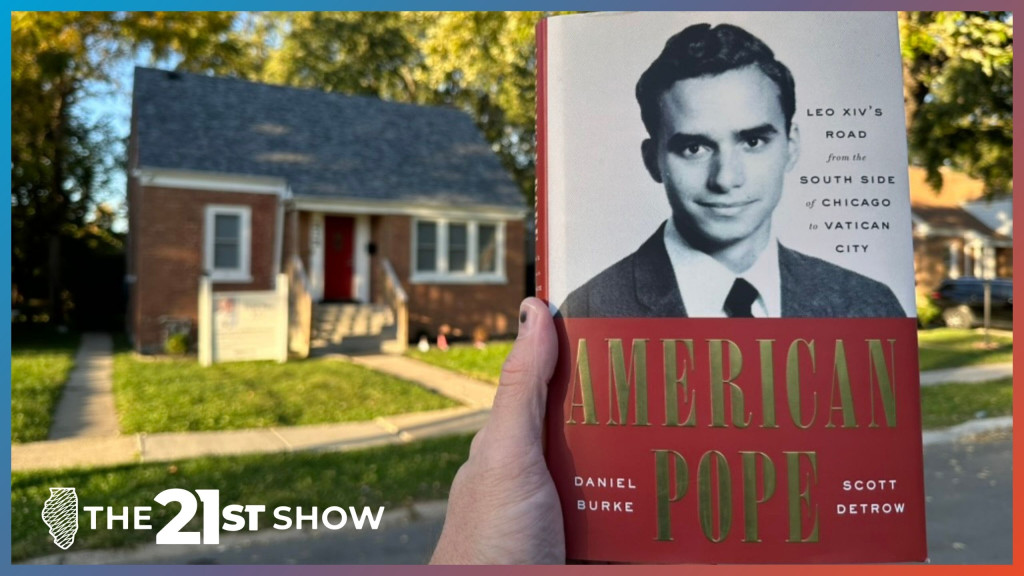
Brian Mackey: Today on the 21st show, how did an altar boy from Illinois rise to become the leader of the global Catholic Church? NPR's Daniel Burke and Scott Detrow spent a year researching the backstory of how Robert Prevost became Pope Leo. To do that, they talked with more than 100 people on six continents about a man known variously as Bob, Roberto, and even Louis. Their book is "American Pope: Leo the [Fourteenth's] Road from the South Side of Chicago to Vatican City." I'm Brian Mackey, and that's all coming up today on the 21st show, which is a production of Illinois Public Media airing on WILL Urbana, WUIS Springfield, WNIJ Rockford DeKalb, WVIK Quad Cities, WSIU Carbondale, and Tri-States Public Radio in Macomb, Galesburg, and Keokuk. But first, news.

From Illinois Public Media, this is the 21st show. I'm Brian Mackey. Before we begin, I do want to acknowledge the gubernatorial candidate forum that happened last night between Governor JB Pritzker and his Republican challenger, Darren Bailey. This is to be their first and only formal meeting of the campaign, and we'll be talking about that on tomorrow's show. Today, the story of how Robert Prevost went from an altar boy on the south side of Chicago to the leader of the global Catholic Church. Last year, when the news broke, people here in Illinois lost their minds.

[00:01:43]
Speaker 1: [Habemus papam.] And that is Latin for "we have a Pope" and he's a Chicago native. There is a lot of pride on this block here in suburban New Lenox because this is where the Pope's older brother lives. He is John Prevost, a retired Catholic school principal. You hear the name and you do say — think, feel —

[00:02:10]
Speaker 2: What? Shock, disbelief. Uh, a whole lot of pride, a whole lot of "is this for real?" Um, now what are we gonna do? Cubs

[00:02:22]
Speaker 1: or

[00:02:22]
Speaker 2: Sox? See, they had it wrong. He's Sox, and then the radio announced Cubs and that's not true.

[00:02:28]
Speaker 1: You heard it here: his White Sox.

[00:02:31]
Brian Mackey: All right, it's White Sox. Well, how a young man so devout his fellow altar boys called him Father Bob went on to become Pope Leo the 14th is the subject of a new biography by my guests today. Daniel Burke is a senior editor covering religion and spirituality for NPR. Scott Detrow is a co-host of All Things Considered. Together they covered his election as Pope in Rome and went on to document his life before the papacy in their new book, "American Pope: Leo the Fourteenth's Road from the South Side of Chicago to Vatican City." I should also say before we begin, we're also processing the more serious news that Pope Leo the 14th has been diagnosed with a type of lung cancer. That said, Daniel Burke, Scott Detrow, welcome to the 21st show. Thank you for being with us.

[00:03:18]
Scott Detrow: Hey, thank you so much for having us.

[00:03:20]
Brian Mackey: And listeners, you can join us throughout the hour today at 800-222-9455. What do you think of Leo's papacy so far? How, if at all, do you see his Illinois and Midwestern roots showing up in his work? And how has his tenure affected your view of the church? 800-222-9455 is the number to join us today. 800-222-9455. We also got some text messages from listeners. We'll be sharing later this hour. But um I do want to begin with this news that Leo announced this weekend he'd be undergoing surgery for a nodule on his lung. This morning, many of us woke up to the news that that has been diagnosed as a form of lung cancer as the doctors were expecting. Uh, Daniel Burke, what, what else can you tell us about that? I saw online where you had talked with, uh, several, or at least one expert I should say, in, in this sort of diagnosis.

[00:04:15]
Daniel Burke: Yeah, so I spent some time talking to two experts in this type of lung cancer, and they say a couple of things. One, that it's a very common type of lung cancer, and second, that the prognosis is actually pretty good because if he had surgery, they said it means they caught it fairly early, hopefully before it had spread. So they were fairly optimistic that he would have a good recovery, a fairly speedy recovery. You know, a couple of weeks or so he'll be sore and he'll be in the hospital. This will be something that he will have to monitor long term. He has a family history of cancer unfortunately, but you know some of the doctors I talked to were even mentioning the possibility of him maintaining a trip to Peru next month, which would be a pretty vigorous trip. So all in all it looks like this was a health scare but his long term diagnosis looks pretty good.

[00:05:06]
Brian Mackey: Scott, you, uh, also posted online this morning, or maybe it was yesterday, that Prevost's mother had had cancer, and you write about this in the book. She was in and out of treatment for six years before her death. What can you tell us about that?

[00:05:18]
Scott Detrow: Yeah, that's something Daniel and I were thinking a lot about yesterday as we process this news, especially yesterday, just that shocking diagnosis, and luckily as we made some calls and did some reporting, it felt a little bit more reassuring. They'll say one thing Vatican officials are saying is they need to wait for that full pathology report to come in the coming days to really have a full understanding of what this is, but so far it looks like, like, looks like this is the right path forward. One of the many documents we came across over the course of our reporting was this letter that he wrote to two friends back in America in 1984 at a period of time where he was living in Rome, and he talks about all sorts of things. He talks about kind of not really being sure what's coming next in his life, but in a postscript, he writes about his mom struggling with cancer and he says, you know, she's in chemotherapy, she's tough, she's, you know, she's she's really tough, and knowing that makes it easier for me to be so far away. So this is something. I mean, so many of us live with this in in our lives and with with with loved ones, but he went through this with both his parents, with his mom, especially, a long, um, drawn out fight with cancer. So he understands the toll it can take on family members and close friends, but I did in the past day or so reach out to several of his friends who have been in touch with him. They said he's as responsive as ever. He's getting back to their notes quickly. He is taking this in stride and his spirits are the same that they've been, you know, we saw him walking into the hospital confidently greeting crowds that had gathered there. You know, we now know that he had a pretty good idea that that the suspicion that this could be cancer going in, and yet you still saw his demeanor. He seems pretty steady.

[00:06:51]
Brian Mackey: Was it surprising, Daniel, to you that he announced it himself during a service on Sunday and not, you know, through a spokesperson or a written communication as as may have happened in the past?

[00:07:03]
Daniel Burke: Yes, that was surprising, honestly. I sort of half joked that under previous popes we would have gotten a cryptic press release three days after the surgery, but here was the pope himself somewhat straightforwardly describing this medical procedure that he was going to have. The cancer diagnosis was a bit of a surprise yesterday. It did seem to be a bit more serious than he had mentioned on Sunday during that address, but certainly, toward the end of Pope Francis's papacy and the beginning of Pope Leo's papacy, there's been a lot more transparency about the medical situation with popes, but just in the Vatican more generally, it is much less of a closed shop than it had been under previous popes.

[00:07:50]
Brian Mackey: Yes, a document in Latin probably several days later. Exactly. All right. Well, let's turn now to the book, uh, which again is called "American Pope: Leo the Fourteenth's Road from the South Side of Chicago to Vatican City." We talked briefly about his mother, but you actually begin the story several generations before that. And so I wanna start where you did and ask who was Suzanne Fontaine?

[00:08:15]
Scott Detrow: Oh boy. It was such a remarkable story, um, and I think on both sides of of Pope Leo's family, it is a fundamentally American story. Suzanne Fontaine is a young woman who in the wake of, you know, right at the, at the peak of World War One, moves from Normandy, France to the United States of America. First she settles in New York City. And this almost Dickensian name — she, uh, she settles briefly at this place called the [Home for Friendless French Girls]. Like I couldn't believe it. It felt like a [Roald Dahl] or a Charles Dickens name of an institution. Um, then she makes her way to Illinois and um apparently finds work as a language instructor and there she meets a man named Salvatore Rigatano, who is this dashing, charismatic, fellow immigrant from Sicily who is teaching uh romance languages up and down the Mississippi River, which also sounds like an archetype character, like the Music Man or something like that. They fall in love. Um, the problem is that Salvatore Rigatano was already married to a woman named Daisy Hughes. And it was technically and sporadically enforced illegal to have an affair in that sort of way in Illinois at the time. The police get involved because Salvatore Rigatano's wife presses charges and Suzanne Fontaine finds herself on the run. First she flees Chicago to Quincy, Illinois, where Rigatano had family. The police catch up with her there. She eventually flees the country. Briefly moves into Canada, comes back into the United States in upstate New York, and there she has a son, and that son is Pope Leo's uncle. Amid this scandalous story, uh, Rigatano and Fontaine form a new life together. Uh, they then have a second child, uh, Pope Leo's father. And the amazing thing is they do a very American thing. They create out of whole cloth a brand new identity. They take the surname Prevost, which was Fontaine's mother's maiden name, and they create new identities for themselves. Salvatore Rigatano becomes John Prevost and starts life anew with this new family in Chicago.

[00:10:25]
Brian Mackey: So this is the — I'm trying to, to get the, uh, the understanding here. This is the Pope's grandmother, I guess, and so many details in this story fascinated me. One, that the Chicago police would track someone down in Quincy over adultery. Uh, and like what else —

[00:10:42]
Scott Detrow: I think a lot of things were happening in Chicago at the time that the police could have occupied themselves with.

[00:10:46]
Brian Mackey: Indeed, and, and I love the way the local news or the newspapers at the time called it being "mixed up improperly together." OK. So that's one branch of the family. Uh, on, uh, on his mother's side, you write about the Creole ancestry that included people on both sides of American slavery, sometimes in the same person. Marie Jean [Davian], if I'm saying that correctly — who, who is that?

[00:11:12]
Scott Detrow: That is an ancestor of Pope Leo's on his mother's side. I believe she was on Mildred's — from Mildred's mother's line of the family, and she is somebody who — and just this just shows how how lines were so much more blurred than we realize — she is somebody who is enslaved, who has children with her enslavers. She herself is freed, he dies, and as a widow, even as a former slave, she purchases slaves herself. So she is a slave and then later a slave owner. Um, you know, the, the Martinez family on both sides generations back lives in, in Louisiana, in, in and around New Orleans for, for, for more than a century of its history, and it is only when Pope Leo's grandparents, Mildred Martinez's parents, decide to move. They, they are on the early wave of the Great Migration, which resettled millions of people from, from the Deep South to places like Chicago. They moved from Louisiana to Chicago. We don't know what spurred it. We don't know why, but what we do know is that they were registered as Black in the census in Louisiana. When they arrive in Chicago, they're registered as white, and from that point forward, they identify and present themselves as white, which is a story told over and over again in so many different ways throughout American history, especially in that early part of the 20th century.

[00:12:36]
Brian Mackey: Yeah, and you write that their Creole roots would be obscured for decades. How did this come to light?

[00:12:44]
Scott Detrow: Well, I think Leo was elected Pope and we all focused in on it, you know.

[00:12:49]
Brian Mackey: Oh, so it's not something the family had known beforehand. That's — I was, you know —

[00:12:52]
Scott Detrow: That's a little bit murky, and that is one of the things where I will say that that Leo's brother and Leo himself have kind of given slightly different answers, and I think it's not entirely clear. At one point when I was interviewing his brother John, I tried to press and I said, how much did you know? And he said, my parents were working class people in the in the 1950s and 1960s. They didn't really talk about themselves at all, you know. But uh people who are Leo's classmates said that they did recall, in retrospect, other mothers whispering about Mildred Martinez and her racial identity, people using, you know, disparaging terms, even racial slurs to talk about her. So I think it was, it was known that there was something there that was kind of mysterious and not quite talked about, but I think it was by and large a mystery until those amazing few days after he became Pope where, you know, professional genealogists were digging in and that whole story about Salvatore Rigatano and Suzanne Fontaine. That actually came from this online collective of amateur genealogists who just started digging and realized that that John Prevost had this mysterious business partner named Salvatore Rigatano, and they quickly realized this is the same person, and they put that together, and it was, it was just an amazing series of [finds].

[00:14:02]
Brian Mackey: Amazing. All right, well, let's talk about the Pope's parents. And, and we can start with, uh, was it Louis or [Louis] Prevost in, in World War II, um, to talk about who he was.

[00:14:13]
Scott Detrow: Yeah. Daniel, do you — I feel like I'm talking too much.

[00:14:16]
Brian Mackey: We're — Daniel and I should say I never know with a, with a dual authored book who to direct the questions to. So feel free to, to bounce back and forth.

[00:14:24]
Scott Detrow: I'll take this one just because I went deep on the genealogy stuff and then Daniel came in after that, but we, we kind of did — we, we almost divided his life in half and we would excitedly tell the other person the stuff that we found. But yeah, his dad Louis Prevost, um, you know, kind of picking up — so Salvatore and, and, and Suzanne settle into the south side of Chicago and for all the drama involving them getting together, really settle in and, you know, have a stable family life going forward and raise a family together of two boys. Louis Prevost grows up in Hyde Park. He's a he's a so-so college student. I saw his college transcripts, but it makes sense because a lot's happening in the world. World War II is happening. He enlists in the Navy and after he graduates he is sent to England to prepare for the invasion of France and I think this is one of these amazing history rhyming moments. His mother is from Normandy and he takes part in the D-Day invasion that frees Normandy from Nazi occupation. He was not storming the beaches. He was in a support craft, but we found the records, the daily reports from the ship that he was on, and they were out in the middle of the Channel ferrying supplies to the beaches, and then they would bring back wounded soldiers, you know, including some Germans, so American and British troops, but also some Germans who were wounded and ended up in their care and they ferried them back to England to drop them off for medical help and went back and forth. Eventually, Louis Prevost ends up, uh, you know, in in France several days after D-Day. He takes part in another invasion of southern France later on that's not as, you know, well known as D-Day, and actually at one point his ship goes right by Winston Churchill in a review of, of, of, of sailors on their way to this invasion. But here's another cool thing: he's on leave on May 8th. The day he's in Rome. He and his friend are walking around and they suddenly hear this explosion and they're worried something's going on, some sort of attack or a guerrilla attack, and they realize, no, it's fireworks and it's fireworks because the war is over. And this is May 8th, 1945, 80 years to the day where in that very same city his son would be elected Pope.

[00:16:31]
Brian Mackey: Amazing. All right, we are talking with Scott Detrow and Daniel Burke, both of NPR and more to the point for our conversation, co-authors of "American Pope: Leo the Fourteenth's Road from the South Side of Chicago to Vatican City." You can join us today at 800-222-9455. We've heard from people in our texting group. Vicky in Centralia says Pope Leo is truly a man of God. He's restored my faith in the Catholic Church and moreover, has given me hope for humanity. Again, you can join us 800-222-9455. We'll have more after a short break. This is the 21st show. Stay with us.

It's the 21st show. I'm Brian Mackey. We are talking today with Daniel Burke and Scott Detrow, both of NPR and co-authors of a new biography called "American Pope: Leo the [Fourteenth's] Road from the South Side of Chicago to Vatican City." It's about how we here in the 21st state got our first pope. Daniel and Scott were in Rome when the Pope was elected. Many of us here in Illinois were shocked by the news.

[00:18:03]
Speaker 5: I was overwhelmed by an emotion I can't even describe. I mean it just — it didn't seem

[00:18:11]
Speaker 6: real. This news just, just, just, I mean we embrace the news. It's going to change the way people think and feel because we've got a person that made it all the way to the top with the with the faith of God that's from here,

[00:18:22]
Speaker 7: you know, Leo's a man of the world as is Chicago is a home to so many people on the street here. We've talked to Filipinos and Polish and African and it's just it's happening all right here and that's what Chicago has always been.

[00:18:37]
Speaker 8: So I heard the Pope might be a fan of the White Sox, but I'm a Cubs fan, so I'm going to go with that he's a Cubs fan. And because that just makes more sense to me.

[00:18:46]
Speaker 5: I taught the Pope how to understand the Bible. You don't figure that's going to be part of your life. It sounds so strange.

[00:18:55]
Brian Mackey: All right, some reactions from when Pope Leo was announced last year. I have to share my own little tiny little connection. I grew up 5.5 blocks away from the Pope's childhood home. I'm about 20 years younger than he is, uh, and one parish over, but uh, I myself was a Catholic school student in, in that area.

[00:19:16]
Scott Detrow: Well, that one parish over makes a big difference,

[00:19:17]
Brian Mackey: huh? It sure does, yeah. Although it's, it's funny because I mean, my, my parish was 3 blocks from my house. I know his was a 3 minute drive from his. It just goes to show how, uh, you know, saturated at the time the Catholic faith was in, in that part of the world.

A few more notes from listeners. Franny in, uh, Hinckley says Pope Leo is awesome. He's humble, compassionate, and is trying so very hard to bring people together. I'm so sad to hear about his recent health issues. I'll pray for his speedy recovery. We need more leaders with that kind of character. Tony in Champaign says, I have to admit, I tend to see religion as a failure in terms of it's getting us to behave well, but I can see how Leo influences people in a good way. And on that note, Jesse in Mattoon says, I think the most poignant characteristic is the kindness. I've heard from countless people that Illinois has the most kind and accepting population. He's a good man and represents the best of the faithful.

If you want to join us, 800-222-9455. We're talking today again with Daniel Burke and Scott Detrow, co-authors of the new biography "American Pope: Leo the Fourteenth's Road from the South Side of Chicago to Vatican City."

So let's talk about the south side of Chicago, or actually Dalton, Illinois. So his church, his parish was in Chicago, but his home was in Dalton, a few blocks south of where the parish was. That's where his parents moved. They were, they were, uh, married. He was 27, she was 36, an unusual — uh, strikes me anyway as an unusual age gap. But, but talk about their early life together, the move to Dalton. Uh, what were they like at that time?

[00:20:57]
Daniel Burke: Sure. So I, I can say a little bit.

[00:20:59]
Brian Mackey: Um,

[00:21:00]
Daniel Burke: they met at DePaul University where they both studied education. And, um, just to tell you a little bit about Mildred, she was, um, she loves singing, she loved Catholic education, things like that. She, but she, but really her, her role with Robert Prevost, her son, is introducing him to this idea of marrying spirituality, Catholic spirituality and action. So Mildred was the kind of person who said the rosary in the living room every night. She drove her sons to mass at 6:30 in the morning on Fridays, but she was also the person who made sloppy Joes for kids who couldn't afford hot meals at school. She was the person who set up clinics to give people vaccines for polio. So many things that we found in the church bulletin that the family attended — it was, if you wanted something to be done, you asked Mildred Prevost. So she was this incredible woman who was able to do so many things for the parish there in Dalton, and that was like their whole world. Their church was the center of their social lives, their spiritual lives, obviously, but so many other parts of their life come from this church where they were deeply a part of.

[00:22:14]
Brian Mackey: And it's not just sort of the sort of public role and instruction. You mentioned the personal — you know, you write in the book that the family prayed before meals, before bedtime, the rosary in the evening. And, and they did the idea — what is this, the idea of Catholic, right? Good works. Um, talk about the Christmas gift, the Christmas truck.

[00:22:37]
Daniel Burke: Yeah, Scott, do you wanna —

[00:22:37]
Scott Detrow: Yeah, this is, um, this is something that he told a reporter in one of the very few interviews that he's given, and, um, it, it really tracked with a lot of our own reporting that we brought to it, um. He loved trucks. He was obsessed with trucks. There was a neighbor who lived on their block who was a truck driver, and young Robert — he went by, it's interesting, he goes by so many different names at different points in his life. His, his siblings all called him Rob. So young Rob would look out the window at this truck and it kicked off a lifelong obsession with vehicles. His brother talked about how on road trips, Robert would be looking out the window, naming the make and model of the cars that passed by, and he said, yeah, for all my brother's talks about how I wanted to be a priest from a young age, like there's some truth to that, but I just wanted to be a truck driver. So one year he gets a truck for for Christmas and he opens it Christmas morning. And then his mother says that, you know, there's there's a nearby family who who can't afford Christmas gifts in the way that we can. How would you feel about giving your truck to a boy who needs it? And Pope Leo said that, you know, like any kid he was disappointed at first, but he came around to the idea and he said that was, that was one of the many moments of my parents modeling what faith looks like, you know, active sacrifice, thinking of somebody beyond their needs over your needs as opposed to just this theoretical idea. So I thought that was, that was a strong, that was a strong moment of his parents saying this is what it looks like to give something up for someone else.

[00:24:08]
Daniel Burke: He did eventually get a truck back in some way when the year after he was elected Pope, Ford made him a special Pope Leo custom-made Explorer with the Chicago skyline on the on the seats. The license plate read "Du Pope" and Leo the 14th, and if you look at the video of him accepting this gift, he looks like a kid on Christmas. I think there's some good karma there that came around,

[00:24:34]
Scott Detrow: though it is, I mean, I mean, one of the, one of the current sacrifices in his life is — one of the ways he relieves stress and relaxes himself has always been to go for long car rides in Peru, in America, in Europe. It's just how he focuses his brain. Of course he can't get on the road and joyride anymore, but we know that he has, he has golf carts at the at the papal retreat in [Castel Gandolfo], and he gets around that way. And also he seems to love sitting in the cockpit of flights when he's flying back and kind of watching the pilots do their thing. So I guess that's an upgrade.

[00:25:04]
Brian Mackey: Oh wow, yeah, privilege — I guess rank has its privileges there.

[00:25:08]
Scott Detrow: Which I think for the safety of the flight — I would be so nervous with the Pope sitting next to me if I was an airline pilot, but they've got a system. Every time he's coming back to Rome from, from one of these international trips, he seems to sit in the cockpit for part of the flight.

[00:25:23]
Brian Mackey: I don't know. Maybe you feel like you've got some extra protection on your side, yeah, yeah, uh, you know, this is, this is a sidebar, and you, you hear these stories, you know, we've seen the photos of people bringing him White Sox baseball caps. I think I heard someone — I don't know if this was somebody joking or somebody actually brought him Aurelio's pizza, which is —

[00:25:42]
Scott Detrow: They did, and he ate it to the shock of his friends. They were like, what — and apparently another time somebody [intervened] and said like, Holy Father, this is this, this pizza has traveled to another continent. You cannot eat it. It's not safe. And he gets Peeps a lot too, and actually to the point where he's gotten so many Peeps he now gives the the Peeps he gets to the Swiss Guard who really, you know, enjoy this novelty American candy.

[00:26:06]
Brian Mackey: We're gonna see a spike in their weight, uh, soon, probably. You know, it's, it does speak to how many sacrifice, right? He's never gonna go to the Aurelio's Pizza in Homewood where I, you know, hung out with my friends in high school. He's never gonna see a White Sox game in person, probably. Um, yeah, fascinating.

So, OK, we mentioned it'd be a big news story if he did. Well, that would be epic. Uh, maybe next year, as we say in Chicago, uh. So you mentioned Saint Mary of the Assumption. The Prevost boys, uh, well, I'm, I'm not sure if the brothers did. I know, I know, uh, Rob, as he was known, as you said to his brothers, went there. Yeah, OK. So talk, talk about, you know, the sort of the central place a parish would have in the life of a mid-century American Catholic.

[00:26:54]
Scott Detrow: Yeah, it was, it was the center of their world. We, uh, we interviewed Cardinal [Wilton Gregory], who grew up on the South Side of Chicago and is actually a part of the conclave that elects him, and there's this powerful moment where he talks about from one South Sider to another, um, but we talked to him and the way he put it is, you know, 3 or 4 blocks away might as well have been a different world, you know, you take the bus through neighborhoods, parish to parish, neighborhood to neighborhood. There's, they're, they're, they're, they're different ethnicities, they're different races, they're just totally different cultures. And St. Mary of the Assumption, and as you know, growing up in a similar location at a slightly different point in time, was the be-all end-all. The kids went to school there, as we talked about. All of their social life was there, school dances, things like that, basketball games. The parish would put on big productions. They put a lot of effort into their musical productions and his mother Mildred was a part of them. She was in Fiddler on the Roof. She would do Broadway cabaret performances. They, they would have big holiday bazaars, all sorts of activities and his classmates would tell us about how this was just such an isolated world. You know, I would ask when he's in, in, in 6th, 7th, eighth grade, it's the late '60s, there's so much tumult happening, especially in and around Chicago. I said, did that ever bleed into life in the parish and they said no we just felt we were in our own bubble and that bubble popped in eighth grade as we were spit out into different high schools and the rest of the world but but it really held, you know. I was looking at the church bulletin in the summer of 1969, so much is happening culturally and St. Mary's is like we're having the polka dance this week, you know, it just doesn't feel like the late 1960s to me in that moment.

But he, he's the, he's by all accounts the smartest kid in school there. He wasn't too much of an active participator in sports, you know, the other boys would play soccer and football at recess. Everybody said he would kind of stand around and talk with a couple other guys and watch other people play sports. He'd enjoy watching sports but not necessarily playing himself. And as you mentioned, he gets involved with the altar boys from a young age, takes it really seriously to the point where the priests kind of ask him to help train the young altar boys, and that's the moment when he starts thinking, I think I do want to be a priest. And he, uh, it's something called a junior seminary which doesn't exist anymore. It's a high school where they're starting to train future priests, so he is making this decision at age, you know, 12, 13. He gets to high school, this junior seminary, just before he turns 14 years old.

[00:29:21]
Brian Mackey: Yeah, what would it have — before we get to the seminary, what would it have been like to be an altar boy and especially part of this is before the Second Vatican Council when the mass was quite different at the time?

[00:29:32]
Daniel Burke: Yeah. Yeah, first of all, it was in Latin, right? It was in a language that most young boys of that age would not understand. And the other thing is that because it was in Latin, laypeople — the people in the pews — didn't participate as much, so it was really up to the altar boys to carry the service forward with the priest, to know what exactly each moment called for, when they had to bring up bells and the cross and things like that. In fact, there's a line where Robert Prevost tells the younger altar boys, oh, you guys have it so easy now. You didn't have to learn the mass in Latin. It was so difficult for us. So like it was a huge dramatic shift. There's so many times where we noticed where the Catholic Church itself is changing around him. And the way he kind of navigates those changes early in his life, it's really interesting. I'm sure we'll talk about this more as we go on, but they change how they train young priests like him. They change where he goes to college. They change so, so many things just in his lifetime during the Catholic Church.

[00:30:36]
Brian Mackey: Yeah. All right, so you mentioned this idea of minor seminary. Basically religious high school preparing men for the priesthood, as opposed to, I guess, major seminary would be where you go in college. So, Holland, Michigan, it's a lovely place. Many people from Chicago have taken a summer vacation there, but it's a long way from Dalton. Why does he end up there for school?

[00:30:57]
Daniel Burke: Yeah, the short answer is they recruit him. He is a devout young boy. Two of his brothers go to an Augustinian high school where his mom also sometimes volunteers as a librarian, so they know him and he knows a little bit about the Augustinian order because his father would occasionally bring over a Spanish friar to family dinners and they would kind of talk about the church and the order and missionary work and things like that. So he decides to go to this high school as you mentioned in Holland, Michigan and the draw for the Order of St. Augustine is that it is so isolated, it's physically isolated from its surroundings. It's a 550-acre campus with just, you know, lined up against Lake Michigan so there's really no trouble the boys can get into except, you know, physical — falling out of a tree or something like that. It is woods and beach and and grass, and they have a ball. It's a relatively small high school, you know, his graduating class was 13 people, so they really got to know each other. It was a really tight environment and it was, as you imagine for young boys studying for potentially the priesthood, it was a deeply religious environment, so they're getting up you know, very early for prayers or for mass. The religious life is kind of stitched into the day throughout, where they're doing prayers or retreats or things like that.

But even in that environment he stands out as particularly religious. You know, he's not an opinionated person. He doesn't share his opinions all that often. One of his friends from Illinois calls him the male Mona Lisa because it's so hard to get an opinion out of him, but one of the few things that he did express an opinion about — we found this in the school newspaper while doing some research for this book — is that he doesn't think that the people in the seminary pray enough, particularly for the missions in Peru. So he's encouraging them at a, you know, he's a freshman in high school and he's telling them, hey guys, we got to pray more for the mission in Peru. It's very unusual, uh, to say the least, uh, among the research that we've done. No other high school student is writing about that in the high school newspapers.

[00:33:06]
Brian Mackey: You know, you mentioned this Augustinian order and for people who are not steeped in the, in the Catholic faith and traditions that may be a bit difficult to sort of understand. There are different orders — Jesuit, you know, priests, for example, uh, and Dominican nuns are known as educators. Others focus on the poor, uh, or medical care. What are, what are the Augustinians known for? Why is this appealing to Rob Prevost?

[00:33:31]
Daniel Burke: They're primarily known as educators. They run a lot of high schools. They've run a couple of colleges, but they're known as a really hands-on order where, you know, they're soccer coaches and football coaches and math teachers and things like that, so they're not kind of set off in a — from the very beginning of their founding in the 1200s, the Pope wanted them to be an order that goes out and meets the needs of the church. So whatever a community needs, whether it's, you know, impoverished people or a school or this or that, that's what they go and do. They're relatively small — you know, you think about the Jesuits who have, I think, like 17,000, 15,000 people. The Augustinians have like 2,000. So it's a small, tight knit order. They all live together in community. Community and unity are really key values for them. And actually the order becomes the center of his life. He is living in Augustinian communities from the time he's 13 all the all the way up to 2015 when he becomes a bishop in Peru.

[00:34:30]
Brian Mackey: Wow. All right, we need to take another break on the program. We're talking today with Daniel Burke and Scott Detrow, co-authors of the new biography, "American Pope: Leo the Fourteenth's Road from the South Side of Chicago to Vatican City." If you want to join us today, 800-222-9455. This is the 21st show.

It's the 21st show. I'm Brian Mackey. We're talking today about the new biography of Robert Prevost, the man we all know as Pope Leo. It's called "American Pope: Leo the 14th's Road from the South Side of Chicago to Vatican City." The authors are Daniel Burke, who's a senior editor covering religion and spirituality for NPR, and Scott Detrow, co-host of All Things Considered at NPR. Together they covered Pope Leo's election in Rome last year and went on to document his life up through that moment. 800-222-9455 to join us.

Helen in Springfield says, I admire Pope Leo for his willingness to express his disagreement with President Trump. Perhaps the Pope's ability to express his beliefs in such a straightforward manner came partially from growing up in the Chicagoland area, equally as influential in his becoming a spiritual powerhouse was his willingness to live outside the United States and thereby become a world citizen. 800-222-9455.

Well, what do you think about that? Just before the break, you said some people sort of called him a Mona Lisa for his unwillingness to share his views.

[00:36:15]
Scott Detrow: I think there's a few things there, but I think one of the things we've thought a lot about is, you know, I — you know, was a longtime political reporter. I covered the White House. I covered presidential campaigns, and to me, I think one of President Trump's political superpowers is that when he gets into a disagreement with somebody, when he gets into a back and forth with somebody, so often the person on the other side of that sparring moment becomes the worst version of themselves or kind of loses their discipline or slips up or oversteps, and Trump is able to benefit from that politically. Pope Leo is one of the very few people who has tangled with Trump publicly and not debased himself in any sort of way, and I think that is for a few different reasons.

Pope Leo has always been incredibly careful talking about politics. That goes back to his time in Peru when he was in Peru in really dangerous political moments. There was a creeping authoritarianism in the government. There was a terrorist campaign happening throughout the country, and Pope Leo, Robert Prevost, would caution the young priests that he was training to be really careful about engaging in politics. He said, you know, speak about the values that we have, speak about the church teachings, but don't get entangled with a political party because that sets you up — puts you in danger and it also kind of minimizes your moral authority if people think you're acting in a partisan nature. So he's always been really careful, but one thing he hasn't ever shied away from is speaking about church teachings that are near and dear to him. We saw that recently with the death penalty with him speaking out against this at a time when the Pentagon was talking about live streaming an execution. We saw this with the way that he spoke out against how the Trump administration has been treating migrants in Chicago and Minneapolis and elsewhere. We saw it with the Iran [War] and when Leo was asked, you know, are you — aren't you getting too political? He said, I'm speaking the gospel. I'm speaking church teaching and I'm not afraid to do so. So I think that's the that's the way that he thinks about it. He doesn't make it a tit for tat political argument, but he says these are my beliefs.

[00:38:22]
Brian Mackey: Well, one of the other interesting things — I, uh, things I found most interesting in the book — is you explore his time at Mundelein, or I should say, um, sorry, I'm getting my, my terms confused. Mundelein had closed, yeah, yeah, yeah. So Mundelein Seminary closes — let me just set this up — so Mundelein Seminary closes. That's where he might have gone to school in Chicago. He goes to Villanova, East Coast. We're in Illinois show. I'm gonna let people read that in the book. He spends a year in contemplation in St. Louis. Then he moves back to Chicago to study at the Catholic Theological Union. That is the name I'm searching for here. You describe this as a locus of progressive Catholicism. What does that mean day to day for a student there in the 1970s?

[00:39:04]
Scott Detrow: I asked one of the nuns who was teaching at the time the best way to describe the mood at the time, and she said it's like we were on drugs, which is really something to hear from a nun, but, but she just — like everyone was so impassioned at that moment in time, they viewed Vatican II as a license to experiment, to throw things against the wall, to kind of think about things in a new way. You know, up until that moment, uh, seminaries and, and higher education, uh, in [the] Catholic world were really about just kind of memorization, cram the facts into your brain, don't ask that too much about it. And the people who founded Catholic Theological Union really felt like the Catholic Church was so far behind different Protestant faiths in terms of how they were training their ministers. So they purposely put this school right in Hyde Park, right near the University of Chicago and a bunch of other seminaries that already exist, and they kind of just experiment and everyone is so filled — you know, another nun had another great quote. She said, we worked hard, we prayed hard, we played hard, you know. This is a place where, where kids are earnest — not kids, they're in their 20s — earnestly debating theology with each other in the classroom, outside of the classroom. They're learning how to minister in the real world. Pope Leo works on this program at this parish in Calumet City where he's he's, he's basically working with people who are struggling with alcohol and substance abuse addictions and, and sitting with their family members and running eventually, uh, you know, confrontations, interventions where family members are really in painful ways talking to people about how their addictions are [affecting] their lives. This is one of his first experiences with real world ministry and how hard it can be.

So he's doing that, but at the same time they're also, you know, they're they're partying. All of the different religious orders who sent students to Catholic Theological Union would host parties. One year, you know, he's there right as "Animal House" comes out. The Augustinians throw a toga party. So, so it's kind of an interesting environment where they're engaging in things, but they're also really pushing the boundaries of church teaching and rules. And one of the things they get in trouble for is a lot of the faculty and a lot of the students are really pushing for for women to be ordained as priests, making the argument that it makes sense for the church to do, even organizing some some confrontational protests to that end. There's no indication he was ever involved in any of that, and in fact, most of his classmates truly cannot remember how he came down on the issue. He was kind of more quietly listening than participating, but it's a really interesting time and that forms his his view of theology in concrete ways.

[00:41:40]
Brian Mackey: Yeah, there's a woman student there who's admitted as a student, and you describe this ceremony where the men who are studying become deacons and there's a sort of call and response to that, right? And I think I can't remember the exact phrase. I don't have it in front of me, but it's like I am, I am ready, right? And maybe tell that story, yeah,

[00:42:00]
Scott Detrow: sure. This is, this is something that — it's I'm trying to not give you the 20 minute, two chapter version of it the way we're used to thinking about it, but what happens is Pope John Paul II makes his first trip to the United States and it's this amazing triumphant trip. He says mass in, in, in Grant Park in Chicago among other places, but there's this moment where he's in Washington, D.C., and several nuns challenge him respectfully but firmly, and they stand up and make the case for women's ordination. And and John Paul had just given a big speech in Philadelphia saying this is not something that's going to happen. So that inspires a lot of the young students, including the students at Catholic Theological Union, and they form their own protests a year later. This is at a at a ceremony ordaining future priests as deacons. And like you said, there's a moment where the bishop asks each of the men about to be ordained, are you ready and willing to serve the church? This woman, [Judy Connolly], and others with her interrupted, and they stand up and say, I'm ready and willing to serve the church. And and kind of they they let this ceremony eventually move forward, but they make it very uncomfortable and they pause it and the bishop presiding over the ceremony is furious and a few days later, the cardinal in Chicago calls the head of CTU in and says this can never happen again. You have to stop talking about women's ordination right now or the Vatican is going to investigate your school.

[00:43:24]
Brian Mackey: You know, this word [synodality] gets tossed around a lot, right? And we don't have to go too deep on the theology of that, but I love how you describe this in the book, which is one of the teachers at the uh uh Catholic Theological Union is asked about this the next day, and he says, look, liturgy is the work of the people — I'm reading here — the bishop did what he was supposed to do. The ordained did what they were supposed to do, and the faithful believers who were convinced the church should move in this direction did what they were supposed to do. There was a confrontation, they backed down to authority. It was a perfect reflection of where the church is. As you say, the Chicago archdiocese did not view it that way. But this, this is something we do see more of in the church, though, this dialogue between — under — and I don't know, you can speak to how, you know, these sorts of experiences may have informed where the Pope is today on some of these matters.

[00:44:13]
Scott Detrow: Well, I think Daniel, that's a good way — I'll flip it over to you, but that's a good way to think about the kind of listening first approach and the kind of less hierarchical approach that we have seen Pope Leo embrace over the years.

[00:44:24]
Daniel Burke: Yeah, it's, it's funny. They interviewed some of the women who worked at the Vatican with Pope Leo late in his career as a cardinal, and they said one of the striking things about him is he did not have to learn how to work with women. He already knew. And it begins at CTU. It begins actually with his mom, who's this really strong Catholic influence. It carries through Catholic Theological Union, but he also sees it in Peru. When he goes to Peru in 1985 and follows up with later visits, it's a church that's pretty well devastated. It doesn't have very many Catholic priests, so by necessity they create this new model of the church that empowers laypeople including women to run it. And so this one woman that we interviewed in Peru who became sort of like a de facto parish priest — one day they were having mass at a rural church and he asks her to give the homily. And honestly she balks. She says, I'm from a traditional family. We don't do that. What do you want me to talk about? And he says, just talk about your work with the church, how you're organizing people and making life better for people. And she said, I took a deep breath and I did it. So he's a guy, you know, he wasn't trying to like thumb his nose at the Vatican. He's a missionary. He's trying to work with the people who are around him. He is very much a rule follower, but he's also made clear that he values the input of women. He solicits it. He wants them to be involved in running the church, and carrying that in little ways like in Peru in that one little ceremony, but also through the synod process that Pope Francis really resurrected, Pope Leo is inviting laypeople to Rome, to the Vatican, to say help us, you know, figure out a response to some of these modern postmodern issues that the church is facing.

[00:46:10]
Brian Mackey: All right, let's go to the phones. Just a few minutes left in the show today. 800-222-9455. Penny is calling from the Auburn Gresham neighborhood of Chicago on the south side. Penny, thank you for calling.

[00:46:20]
Penny: Oh hello. Uh, I'm not, I'm not actually there in Auburn [Gresham]. I'm here in east central Illinois and, um, I grew up in that neighborhood. I'm a boomer, you know, and went to Saint [Efarita] on the south side, so my brother and my brother went to Mendel, and I am, I just want to thank you to —

[00:46:44]
Brian Mackey: Mendel,

[00:46:44]
Penny: OK. He did. Oh great. OK. Um, and uh this is so, uh, refreshing. That was good stuff for all of us back then. Uh, my family owns [Swiss coiners] on the Chicago South Side and did garments for everybody, you know, every religion. And uh but you're right on what I've heard. I had to call because uh our neighborhood churches — we walk to school. Uh, we knew who was safe, um, and Dad was in the local tavern after work some days, and if we went in there, everybody knew whose kid you were and it's, it's, it's wonderful and, uh, the [face], um, wow.

[00:47:38]
Brian Mackey: Penny, Penny, thank you so much for calling in. I really appreciate it. We're almost out of time. I also want to acknowledge Jim called in from Carbondale, couldn't stay on the line, uh, but he did note that, uh, when Robert became Pope in 2025, he recalled Chicago style popcorn and says Chicago can now claim two of the greatest things on the planet, the Pope and popcorn. Um, exit question to, to, to either one of you, uh, can take this. How do you see his Americanness and maybe even his Illinois roots or Midwestern roots sort of working their way through this, this papacy?

[00:48:16]
Scott Detrow: You know, can, can I just say one very quick thing to — my parents knowing, knowing, um, and, and, and trusting each other — that that enormous snowstorm in 1967 which I think a lot of listeners would, would, would remember, [there's] a great story about how Mildred Prevost makes her way up to school. She walks up in the middle of this, this surprise snowstorm that shut down the city for a week, and she grabs her kids and she grabs all the neighborhood kids and she marches them all home because that's how it was. Everybody knew what house all of the kids lived in and mothers and dads would kind of help each other out in that way and I thought that was such an amazing image of this small community.

I think one thing we thought about is just how media savvy he is. He's careful. He doesn't do that many interviews. He hasn't historically. He understands how to give a message and the different forms to give a message, and I think that has really come through in the way that he has pushed back against the Trump administration. Sometimes it's a, it's a, it's a broad tweet from the papal Twitter account that isn't specifically referencing the White House, but you know what he's talking about. Other times Pope Leo will walk up to a bank of reporters and have 6 or 7 microphones in his face, and he will speak bluntly and in English in a way that he is well aware will rocket all over American media.

[00:49:28]
Brian Mackey: Amazing. Master of the subtweet, Pope Leo the 14th. The book is called "American Pope: Leo the 14th's Road from the South Side of Chicago to Vatican City." I learned a lot reading it. Daniel Burke and Scott Detrow are the authors. Thanks so much for taking the hour to share your work with us today on the 21st show.

[00:49:46]
Scott Detrow: Thank you. It's great to be here. This was an amazing conversation. Thank you for having us.

[00:49:52]
Brian Mackey: And that is it for us today. Coming up on tomorrow's show, there are growing concerns about the integrity of the upcoming midterm elections, people asking questions about what the federal government can and cannot do. We'll talk with a representative from Protect Democracy, a nonprofit group explicitly working against authoritarianism in America, debunking some of those claims. Also recapping the governor's debate that happened last night. That's it for us today. The 21st show is a production of Illinois Public Media. I'm Brian Mackey. Thanks for listening.
Transcript Assistance
Illinois Public Media may use AI assistance for transcript generation and/or formatting. Transcripts that have not yet been reviewed for accuracy will be labeled.
To report a transcription error, or to request transcription of archival material, please contact will-help@illinois.edu.