Transcript: GOP congressional candidate Jeff Wilson on tariffs, energy production, and immigration policy
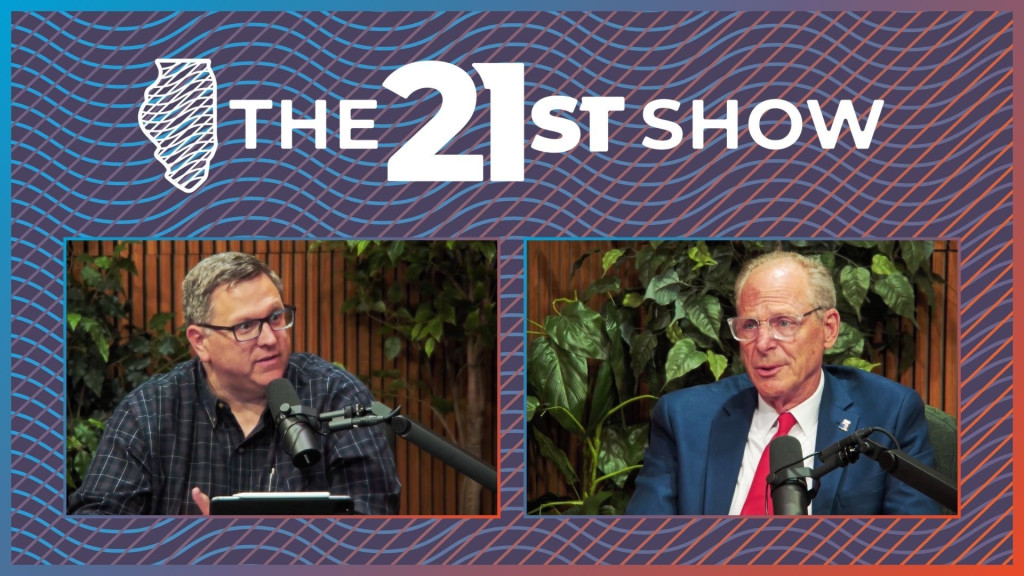
Transcript: GOP congressional candidate Jeff Wilson on tariffs, energy production, and immigration policy
The 21st Show
GOP congressional candidate Jeff Wilson on tariffs, energy production, and immigration policy
Read the full story at https://will.illinois.edu/tags/gop-congressional-candidate-jeff-wilson.
Transcript
[00:00:00]
Speaker 0: Today on The 21st Show, Jeff Wilson is running for Congress from central Illinois. He's a Republican nuclear engineer competing in the Democratic-leaning 13th District. We'll talk with him about, among other things, immigration, abortion, and tariffs.

[00:00:17]
Jeff Wilson: On the main, on the net, I'd say it's beneficial. It hasn't resulted in the catastrophic economic debacle that so many people projected.

[00:00:29]
Brian Mackey: I'm Brian Mackey with Jeff Wilson for the hour today on The 21st Show, which is a production of Illinois Public Media, airing on WILL in Urbana, WUIS in Springfield, WNIJ in Rockford DeKalb, WVIK in the Quad Cities, and WSIU in Carbondale. But first, news.

From Illinois Public Media, this is The 21st Show. I'm Brian Mackey. Today, the Republican nominee for central Illinois's 13th Congressional District. For more than a century, this seat was held by Republicans, but after the most recent census, it was gerrymandered to elect a Democrat, and that it has done. By uniting the urban centers of Urbana, Champaign, Decatur, Springfield, and communities in the Metro East, Democrat Nikki Bu[d]zinski has won two terms and is now campaigning for a third. We spoke with her yesterday on the program.

My guest today is Republican Jeff Wilson, who's hoping to break through that creative mapmaking. Until recently, he was a member of the Champaign County Board. He says he's resigned to focus on this campaign. He's also a veteran of the United States Navy, serving first as an enlisted man on a nuclear submarine and later as an officer in the reserves. He went on to a career in nuclear power generation.

I spoke with Wilson Tuesday afternoon, so no calls today. You can let us know what you think by emailing talk@twentyfirstshow.org. Before we get into it, I do want to say it was our request to put this interview on tape. We've heard some listeners accusing candidates of being cowardly for not wanting to face live callers. So let me be clear, this was our decision. And that's because we recorded this interview and Bu[d]zinski's on camera. At this time, it's a little too complicated for our small team to do both on-camera and live radio at the same time. So, in our attempt to reach audiences who might not encounter the show over the air, this is the choice we've made. Given that, if you're curious about what we look like or you're willing to support the show, please seek us out on YouTube. You can do that by searching The 21st Show. All right, on with the interview. Mr. Wilson, welcome back to The 21st Show.

[00:02:59]
Jeff Wilson: Hey, Brian, it's a pleasure to be here and thank you for such a warm introduction. Yes, my name's Jeff Wilson. I'm running for U.S. Congress, Illinois District 13 here in central Illinois. As you know, it starts in Champaign. You said it was slightly gerrymandered — slightly, a little bit, right? Did I say slightly gerrymandered?

[00:03:17]
Brian Mackey: [unclear]

[00:03:18]
Jeff Wilson: It starts in Champaign, makes it through Monticello, Decatur, ends up in Springfield — a lot of Springfield, maybe two-thirds of Springfield south. All of Mc[D]onough County and then maybe half of Madison County in the northwest corner of St. Clair County on the East St. Louis, Dupo, Belleville is the furthest south — 175 miles.

[00:03:38]
Brian Mackey: Yeah, it's long. And let me just say as a content note before we get into this conversation, our program is being produced in partnership with the League of Women Voters of Champaign County and the NAACP of Champaign County. Yeah, the Cook Political Report calls it the creative centerpiece of Illinois's gerrymander. They rated it a solid D. So how are you approaching that?

[00:03:58]
Jeff Wilson: Yes, solid D — they started as a D3 if I remember correctly, and then now it's a D5, and it depends on how you look at it, whether it's a tossup or not a tossup. My gut feeling, Brian, and as we travel — I don't know, it's been 18 months up and down the district — people are ready for a change. People want someone with common sense, no more nonsense, someone that has life experience, a veteran, sterling education, served in the nuclear industry, has common sense values and a family. So all those things pretty much represents all of central Illinois. As you know, central Illinois — how it was carved up — I think it's about 18% rural, 80% urban, but it has every, I think it has every part of the economy represented in central Illinois, from manufacturing, farming, education, hospital — all those things are right here in the heart of the Land of Lincoln, and we're ready for a change here. We're ready for someone that can take the voice of all the people in central Illinois to Washington, D.C., and fight for the benefit of Illinois. Because as a U.S. congressman, my goal is, well, support and defend the Constitution of the United States, but also to advocate for what's best for Illinois, and I'm ready for that.

[00:05:20]
Brian Mackey: So I want to begin with policy, and we asked listeners for questions sometimes. We got a text message from Tony in Champaign, who asks, "What three goals do you have that will most impact my life?"

[00:05:34]
Jeff Wilson: Well, Tony, thank you for your question. Three things impact your life. Well, No. 1 is the economy. The debt just got to $40 trillion, and I think that's a travesty. And what we need is structural reform at the federal level, and with statutory requirements to work towards a balanced budget, work towards decreasing the deficit. Because no one likes paying interest, and the U.S. is paying a lot of interest on that $40 trillion [debt]. So No. 1 is the economy. That results in jobs here in Illinois.

And then with my energy background, military background, I want to shore up the benefits and all the different [programs] that could help our veterans.

And then also we talk about energy. We need more energy right here in Illinois — even though 50% of our energy is from nuclear, 50% — yet we're still seen to be structurally deficit in energy and we sell it to other places. So we just need more energy. We need more energy, more nuclear power plants, more coal plants that work 24 hours a day, and grid stability, grid modernization here in Illinois.

And then just supporting our families — education and safeguarding parental rights — those are key things that I would like to focus on in my next term in Congress, or my first term in Congress.

[00:07:04]
Brian Mackey: I can't help but notice you mentioned the debt and the deficit. There is unified Republican control in Washington right now. So what is your understanding of why Republicans have been less interested in tackling the debt as an issue than they were, say, 2008, 2010, in that era? It's really exploded in recent years.

[00:07:26]
Jeff Wilson: It has exploded. It's exploded almost year over year for maybe the last 20 years, if I recall. So Republicans have not always been in control.

[00:07:35]
Brian Mackey: Fair, but they have been certainly for the last two years.

[00:07:38]
Jeff Wilson: I don't disagree with that. I don't disagree with that. But Brian, to your point, we just need common sense. I'm there to bring common sense. I'm here to advocate for reduced spending. That's what I want. And I want us to have — because national security is not only on the military side, I agree with a strong military, but it's also economic. We need both. We need economic security and national security, and part of that is just fiscal responsibility for Congress to pass appropriation bills on time. We just need to do that. I would like to see structural reforms where you have to pass the budget, and if you can't pass the budget, then you're stuck with the previous one until you figure it out. So I would like us to just manage the money appropriately, and that again would result in better affordability, better lifestyle, and especially will help us here in Illinois.

[00:08:34]
Brian Mackey: One of the issues that has animated Republicans in Washington for many years now is trying to take apart the Affordable Care Act. The party has not really agreed on an alternative. What do you think is the path forward for healthcare, which is something that people cite still as a cost driver in their lives here in Illinois and across America?

[00:08:55]
Jeff Wilson: Brian, that's a great question. There are a lot of cost drivers. I would probably say energy is up there. It's about 20% of our cost is driven by high energy prices, because you need energy for everything — whether you're going to make something, use something, do something, you need energy.

But on the health care issue, there needs to be a common sense approach, and not a knee-jerk approach in the United States. The preamble of the Constitution is that we would have general welfare, general protection, some security, but not guaranteed security. Because I 100% agree that health care is needed, but I also 100% [believe in] our own responsibility to take care of our own lives, whether it's from a job, or it's health care or it's family. It is not the federal government's role to take care of every issue that affects our lives. It's not like [the attitude in] New York, where "I'm the government, I'm here to save you." I mean, that's like Reagan said, the worst thing you would ever have to hear is "I'm the government, I'm here to help you." And our structure of our government as structured in a federalist society is there's limitations on what the federal government can do. Anything that's not articulated for the federal government belongs to the states and to the people. So I would like to see the states themselves step up to the plate to take care of the people in their jurisdiction.

[00:10:29]
Brian Mackey: Of course, the states cannot backstop what the federal government has been spending on health care. We've heard that repeatedly from Governor Pritzker as the Trump administration has been cutting health care spending, especially to states like Illinois that are not on board with his program in many ways. So where does the funding for that come from, or do you favor an entirely private system? I mean, you know, Medicare, Medicaid —

[00:10:56]
Jeff Wilson: Good question. Medicare, Medicaid, Social Security needs to stay as is. In fact, Social Security needs to be shored up, right? So by 2032, the capacity of Social Security to maintain its requirements is down to 78% in 2032. I would like — and right now there is some move in Congress to have a commission to try to shore up Social Security, kind of like we did back in 1983 with Reagan and Tip O'Neill where they shored up Social Security — we need to focus on those core benefits for our seniors. But universal health care, no way. I'm not for that at all. I think it's inappropriate.

[00:11:39]
Brian Mackey: Do you think President Trump and the Republicans in Congress made the right call to let the subsidies for the Affordable Care Act plan — the thing that helped people be able to afford private insurance — to let those come to an end?

[00:11:58]
Jeff Wilson: Yes.

[00:11:58]
Brian Mackey: Say more.

[00:11:58]
Jeff Wilson: I don't believe that it's the government's role to subsidize everything. And some of those subsidies, especially the high-dollar subsidies, were egregious. I 100% agree with [a] safety net. I'm not sure, Brian, that subsidies — significant subsidies — is the way to help our people.

[00:12:24]
Brian Mackey: How would you lower the cost of living as a congressman from Illinois? What could you do as an individual congressman from Illinois?

[00:12:32]
Jeff Wilson: Good question. Energy. Expanding the role and the use of energy in the state of Illinois. Because when you look at Illinois, I think they're probably No. 1 in nuclear energy. It started in Chicago, right? [The] Chicago Pile, right? And there's a lot of research here. There's research at the university. The university is getting an MMR — micromodular reactor — at the university. And we could focus on shoring up energy, especially in southern Illinois in the [MISO] area, right? The [mid-continental] — transmission versus [PJM], which is the Chicago area. But here south of [Interstate] 80, [MISO] is the king, and we need to shore up our capacity markets here in Illinois, and that comes through having reliable energy and [through] small modular reactors.

[00:13:28]
Brian Mackey: Governor Pritzker has talked about trying to pave the way for that here in Illinois, and there's been some legislative and regulatory changes. What else needs to happen to incentivize — because I'm sure you well know, probably better than most of us, how long it takes to bring online a nuclear power plant and the costs. And the General Assembly here in Illinois has had to keep providing subsidies and incentives to these nuclear power companies, which come back every few years and threaten to close a plant. How do you speed that up? How do you make it more attractive for businesses to want to invest in nuclear?

[00:14:06]
Jeff Wilson: Excellent question. I don't know if we've finished the first question, right? The first question was more energy in Illinois, and part of your question was reducing costs. So, less regulation, less onerous regulation. You always have to have some regulation, but onerous, unchecked regulation drives cost up. Absolutely does. So what is the reasonable amount of regulation? Get rid of the unreasonable regulation.

And then as far as energy, well, you work with the Department of Energy, especially the sub-department of Nuclear Energy, and then we streamline and work towards streamlining the regulation. Because some of that regulation, as I know — being involved in the nuclear industry, being involved in nuclear power plants, being involved in the small modular reactors — some of that regulation is just very difficult, very challenging, and some of it not necessary. So what we need to do — what I would drive to do — is what is the absolute necessary, what is safe for the community, what is safe for the environment and gets us energy. Some of those requirements take years and years to resolve. So we can have a streamlined, cookie-cutter process because SMRs — small modular reactors — think of it as Lego sets. So you have a Lego set, and then you stack another next to it, and you stack another next to it. Make it streamlined, make it modular, make it repeatable. And therefore, once you've got your license and once you've got your siting, then you could start your construction. And then you also need to open up the supply chain. So part of the weak link in this is the supply chain. So we need to shore up our supply chain, shore up our manufacturing, so that when we build the SMRs they're ready to go. We've got to shore up our turbines — the turbines that spin around that take somewhere from five to six years just to get a turbine. So we've got to shore up that industry so that we can have better, more affordable energy. So energy would drive construction costs down, it drives material costs down, which drives housing costs down. All those things work together, but it's not like that, right? But it does take time, it does take effort. I know how to work the industry. I know how to be involved in the industry. All these things I bring to the table — some common sense, practical solutions to help us here in Illinois.

[00:16:34]
Brian Mackey: All right, let me reintroduce the conversation. My guest today is Jeff Wilson. He's the Republican nominee for the 13th Congressional District in central Illinois, facing Nikki Bu[d]zinski, the two-term Democrat running for reelection. We spoke with her on the program yesterday. You can find that conversation at our website, twentyfirstshow.org, or you can check both of these out on camera on YouTube by searching for The 21st Show.

Coming up after the break, we're going to be talking about abortion, LGBT rights, flock cameras, and more. This is The 21st Show. Stay with us.

It's The 21st Show. I'm Brian Mackey. Let's get back to my conversation with Jeff Wilson. He's the Republican nominee for the 13th Congressional District, which includes parts of Springfield, Decatur, and Champaign-Urbana, as well as communities in the Metro East, which is the Illinois side of the St. Louis metropolitan area. Wilson is a retired nuclear power engineer and a veteran of the U.S. Navy. He was also until recently a member of the Champaign County Board.

In order to get today's conversation on camera, I spoke with Wilson earlier this week in our studios in Urbana. You can find this interview and one I had with the incumbent Democrat Nikki Bu[d]zinski on YouTube. Just search for The 21st Show. Also, because the program is pre-recorded, we're not taking calls today, but you can always share your thoughts by leaving a voicemail at 217-[300]-2121. You can call that number anytime, day or night: 217-300-2121.

What do you think of the tariff system that has become so popular under the second Trump administration? As we're recording on Tuesday, Aug. 25, there's been news about Canada this morning. How do you rate how that's gone for America?

[00:18:56]
Jeff Wilson: I rate it on the net, on the big picture. And as you may know, tariffs are not unique to the Trump administration. And tariffs started with our 2nd and 3rd presidents — Adams and Jefferson — because when we won the Revolutionary War, the British said, "Oh, but we're going to beat you economically," and they undercut the American markets, and so tariffs were imposed to protect the American market.

So three things a tariff accomplishes: One is it protects the national markets — manufacturing, whatever market you have. Two, it does generate income for the United States, and we've generated a lot of income over the last two years. Certain markets have been very helpful, like the local manufacturing — the major manufacturers have been helped here in Illinois. And then No. 3, it's a negotiating tool. It is a big-time negotiating tool, as you can see, as you can find out over the last couple of years.

On the main, on the net, I'd say it's beneficial. It hasn't resulted in the catastrophic economic debacle that so many people projected. In reality, the tariffs on net right now is tracking to be 0.5% impact on GDP.

Now, some people are adversely affected, like [the] agriculture [market], or farmers. So as an Illinois representative, I would like to advocate for more — for supporting our agricultural market because some of our sales are declining because of China, etc. But on the other side, we're learning to diversify our market and we're also learning to improve our supply chain so that we're not only counting on certain countries to support our supply chain. So big picture, on the net, I think it's neutral. Some industries are beneficial, a lot of income has been generated to the United States, some industries are hurt, and I want to support those industries, particularly our farmers.

[00:21:07]
Brian Mackey: Do you have a, for instance, of the industries that have found the tariff system to be beneficial — excepting the ones that, you know, go to the president and seek special exemption, like Apple and others?

[00:21:16]
Jeff Wilson: [That's] a political statement, but that's OK.

[00:21:20]
Brian Mackey: That's a factual statement.

[00:21:24]
Jeff Wilson: That's OK.

[00:21:25]
Brian Mackey: I'm using an Apple product, but I mean, it is a fact that —

[00:21:28]
Jeff Wilson: Tim —

[00:21:28]
Brian Mackey: — Tim Cook went to the president and seemed to have gotten iPhones exempted from his tariffs.

[00:21:36]
Jeff Wilson: Well, we don't live in a perfect world, we don't have perfect presidents, although I'm going to be a really good representative. But anyway, let's look at this. So we've got $118 billion in one year of increased revenue. Some of the industries that have been affected in a positive sense — I'm just reading here.

[00:21:56]
Brian Mackey: Is there a company in the 13th District that's like, "Yes, these tariffs have been great for us," that you've heard from?

[00:22:03]
Jeff Wilson: It helps steel. It's the steel industry in Granite City. It does that. But I did say it adversely affects agriculture. It does that. There's just no doubt about that. But I still am convinced on the main, on the big picture, it's an overall net positive for the United States. And I would like to see agriculture not be hit at all, frankly, but definitely not hit as hard as it is. That's how I see it.

[00:22:37]
Brian Mackey: All right, I want to move to some social issues. This obviously is something that animates a lot of voters. Would you support a national law prohibiting abortion?

[00:22:49]
Jeff Wilson: Well, what does the Constitution say right now?

[00:22:53]
Brian Mackey: Since the Dobbs decision, you tell me.

[00:22:57]
Jeff Wilson: Well, it's a states' rights issue. That's it.

[00:23:02]
Brian Mackey: So would you oppose a national law that [says] no state shall allow abortion past 6 weeks, 8 weeks, whatever it is? Mr. Wilson from Illinois votes aye or nay.

[00:23:15]
Jeff Wilson: Well, let's — what is abortion in the first place?

[00:23:19]
Brian Mackey: I think we have a widely agreed-upon definition, right? I mean, what are you —

[00:23:25]
Jeff Wilson: Well, the reason I'm — I'm pulling your string on this, and [it's something] you're not going to answer — but I would say it's the ending of a life.

[00:23:36]
Brian Mackey: A philosophical position —

[00:23:38]
Jeff Wilson: Biological position. There's nothing philosophical about it, it's biology. So either there's life or there's not. And then how is life created? Is it created philosophically? Is it out of the atmosphere somewhere — we now have life and we don't have life — or is there a biological function? Is there something going on biologically that's life? And biologically, it's undeniable biologically that there's life there. And now there's the choice: Does the choice of a person [lead them to] want to terminate that life for their own personal desires, or is it to propagate life? I think we should pursue life. I think we should propagate life. I think we should nurture life. Just like your question here about the economy — well, we want to be prosperous in the economy. Think about how [much] better our economy would be if maybe those 70 million-plus individuals that — not out of their choice, they had no freedom of choice, their life ended — maybe that would have been more [of a] benefit for the United States. So I love life. Right now we're breathing, right now we're talking, right now we had breakfast this morning — we talked about all that, our life functions. I just can't see what the reason for terminating life is.

[00:25:09]
Brian Mackey: OK, well, let me be more specific then. I didn't think we were going to get as philosophical here. Let's say you have a 30-year-old woman who wants to have children and, for whatever reason, [there] becomes an ectopic pregnancy, right? Which is a fertilized egg[s]. But there are instances now under certain states where doctors are nervous about doing anything about that, and [they] send the woman to another state, or she has to seek medication on her own, because there are questions in some states that have such restrictive laws about whether that medical procedure can be done.

[00:25:41]
Jeff Wilson: That's a state — not a federal. You just said state, didn't you?

[00:25:46]
Brian Mackey: I did. But I'm asking you: If somebody then tries to bring that sort of [law] — like, "Oh, you know, we, the Republicans like what happened in Texas, let's put that law in place nationwide" — in a Republican Congress, how do you vote on that?

[00:26:01]
Jeff Wilson: I vote with common sense [and] scientific background, understand biology, and we'll just have to wait and see. But I'm telling you philosophically — scientifically, which is biology, [that] is science last I understood it — [that] there's life and we should do everything we can, the best that we can, to preserve life.

[00:26:24]
Brian Mackey: I also want to talk about the rights of our fellow Americans who are gay or lesbian. Do you think that marriage should remain legal?

[00:26:34]
Jeff Wilson: Do I think marriage should remain legal for —

[00:26:36]
Brian Mackey: — gay and lesbian, same-sex marriages.

[00:26:40]
Jeff Wilson: It is what it is. It's not my choice. I am not a homosexual. I'm married. I have 8 kids and 11 grandkids. I believe that's — for me — a great way to live. But you, Brian, if you want to be married to a guy, then be married to a guy. However, [for] me, myself, and I — I love my wife. I love our children. And that's my preference.

[00:27:11]
Brian Mackey: Sure. How would you vote if a bill were to come before the Congress that would outlaw same-sex marriage nationwide?

[00:27:19]
Jeff Wilson: I haven't seen the bill yet. I haven't seen how it's written, so I'm going to make no comment on that.

[00:27:25]
Brian Mackey: OK. Should the Congress pass a federal law regulating trans high school and college kids' participation in sports?

[00:27:38]
Jeff Wilson: That's a bizarre question.

[00:27:40]
Brian Mackey: It's been introduced by members. I believe [Darin LaHood] had a — or maybe it was Mike Bost. I'm going off the top of my head here. [The] Protecting Women in Sports Act or something like that, seeking to impose a federal standard about the very small number of trans athletes who want to compete in school sports.

[00:28:04]
Jeff Wilson: Brian, let's go back to biology. And in this case we're talking about chromosomes. There's no way that a guy — regardless of what he thinks he is — should be competing in a female sport, or be in a female locker room, female safe space, or female prison. There's just no way. So let's just go back to biology. You're either a male or you're a female, biologically. And there is a substantial difference between a male chromosome['s] muscular structure, skeletal structure compared to a female. It just is what it is. So let's talk about fairness. [Your] concern — maybe the underlying concern of your question — is what's fair, right and just.

[00:29:03]
Brian Mackey: My underlying question is, I guess, would you support legislation that your colleagues might introduce along these lines?

[00:29:09]
Jeff Wilson: Common sense. And it is stupid. It is ludicrous that any guy should compete in a female sport. Let a guy be in a male sport, let a girl be in a female sport. Why is that so difficult?

[00:29:27]
Brian Mackey: Why do you think this is such an animating issue?

[00:29:29]
Jeff Wilson: I don't know.

[00:29:30]
Brian Mackey: It's politics.

[00:29:32]
Jeff Wilson: Is it American politics or is it universal? I don't know why — it's common sense to me. Men are [in] men's sports, not in women's sports. Women need to have their protected space. Let's just do that. It's common sense.

[00:29:49]
Brian Mackey: What do you think about attempted legislation to ban medical care for people who have this diagnosable psychological condition called gender dysphoria?

[00:30:01]
Jeff Wilson: Right. There — you just said right there, psychological — you answered your own question. So you need psychological help. As you know, there have been many hospitals that have been closed — exposed for inordinate, inappropriate treatment of minors in that aspect — that's resulted in devastating, long-term, lifetime issues. So let's go with your theory that it is psychological. Then the answer is psychological, not physical.

[00:30:38]
Brian Mackey: Would you support legislation banning what many medical professionals say is a preferred way to deal with this, which is helping people live the life that they feel they want to live?

[00:30:49]
Jeff Wilson: Many do and many don't. So how many is "the many"? Are you saying every single one —

[00:30:52]
Brian Mackey: What do you think about it? What do you think about this? I feel like you may not be wanting to take too many positions here on some of these social issues.

[00:31:01]
Jeff Wilson: I am. I just told you what my position is.

[00:31:04]
Brian Mackey: How would you vote? I want to know how you would vote.

[00:31:09]
Jeff Wilson: I already told you. My philosophy is that life matters and that there's a distinction between a male and a female. Males should not be in female sports. That's my position. If you can't figure that out, I don't understand [it].

[00:31:23]
Brian Mackey: OK. Sam in Urbana wants to know: Do you oppose warrantless searches of license plate reader data? You may be aware of Flock cameras. This is a company — they've got thousands of cameras all over Illinois now that read license plates as cars go driving by. Sam wants to know: Do you oppose warrantless searches of license plate reader data?

[00:31:50]
Jeff Wilson: Well, of course, we should not have warrantless searches. Isn't that one of the first of the 10 [amendments in the] Bill of Rights?

[00:31:58]
Brian Mackey: It is the [4th] Amendment, but this is a private company, and so law enforcement agencies have been obtaining their data just on the open market and finding out where cars go — essentially like tracking vehicles.

[00:32:11]
Jeff Wilson: Well, if we're talking about ALPRs, we're talking about the company Flock. So if we talk about ALPRs — automatic license plate readers — used in a justifiable manner to solve a crime, fine. But the ubiquitous use, or intended, or potential untethered use of private information should not be allowed.

But I could talk about — and you may remember this, Brian, maybe about a year ago — there was a triple homicide in [Mahomet]. Two kids and a mother shot in their home in [Mahomet]. The individual that did that action got in his car and drove up to Chicago. Well, it was the ALPR that tracked the person down to Chicago, and when they caught him, he wanted — he shot dogs and wanted to shoot the police, and then he died. So now we're looking at thousands of missing persons and crimes solved with that technology.

But on the other hand, there needs to be a hedge around it of protection, so that those with the need to know only [have the] need to know, and those that inappropriately use it are prosecuted accordingly.

[00:33:36]
Brian Mackey: Yeah, those that want to find out where the woman who won't return their phone calls is —

[00:33:40]
Jeff Wilson: Right.

[00:33:41]
Brian Mackey: — but it does happen.

[00:33:43]
Jeff Wilson: I'm not [going to] disagree with that. It's human nature. There's bound to be one or two — or more — bad apples in a good apple bunch. But on the big picture, I just talked about that terrible tragedy, and I went to the funeral. I went to the visitation. I knew the person — [had a] part of their family members — but that tracking down that person is wonderful.

[00:34:09]
Brian Mackey: If you're just joining us, my guest is Jeff Wilson, the Republican nominee for the 13th Congressional District in central Illinois. He's challenging Democratic Congresswoman Nikki Bu[d]zinski, who is seeking a third term. Both this conversation and my interview with Bu[d]zinski are available right now on YouTube. In fact, this interview with Wilson is in a longer form there since we had to cut roughly 10 minutes for air. No calls today because our program was pre-recorded, but let us know what you thought: talk@twentyfirstshow.org. Coming up after a break, I'll ask Wilson about immigration enforcement, the war in Iran, and more. This is The 21st Show. Stay with us.

It's The 21st Show. I'm Brian Mackey. Let's get back to the conclusion of my conversation with Jeff Wilson, the Republican challenging incumbent Democrat Nikki Bu[d]zinski for central Illinois's 13th Congressional District. Wilson is a retired nuclear power engineer and a U.S. Navy veteran. We spoke on Tuesday afternoon, and the version of the conversation you're hearing had a few questions and answers cut for time. You can hear the full interview on YouTube. Just search for The 21st Show. While you're there, you can also watch our interview with Bu[d]zinski, whom we had on the program yesterday.

Another issue I wanted to ask you about has to do with the Trump administration's campaign of deportations. How do you think that's gone?

[00:35:51]
Jeff Wilson: Well, let's see — there has been over 500,000 deportations. Right now it's averaging about 50,000 a month. Out of those 500,000, [7] have died — it could be up to 15 [injured]. So let's say there's 10. So that's 1 out of 50,000. I'm sorry for the [10]. I don't want any of those 10 to lose their life. But that's a better record than driving on the road. That's a better record than almost anything, when you have 10 out of 500,000.

When used appropriately, effectively, with the right procedures, the right standards — it's trespassing. If you're tres— I thought about this. So Brian, let's just assume someone pulls up a camper in your backyard, if you have a backyard — assume you do. And they just parked there. And then they start using your water, they start using electricity, they start using your sewer system, and then they bring in another trailer, and then they bring in another trailer. You would say, well, that's trespassing. It is trespassing. So why not, Brian, follow the law of the land? Every country that's worth its salt has borders and has immigration rules and has entrance and exit requirements and visa requirements and student requirements. Every country does. You yourself in your own home do. Why not just follow the law? The challenge that people have is they don't — [they] can accept the law, maybe — they just hate when it's enforced.

[00:37:48]
Brian Mackey: What do you think about agents operating with masks on, no name tags, things like that — that the county sheriff, Urbana police, Champaign police, Springfield police would not be allowed to do, right? They have to show their faces. They have to have badges with numbers and name tags on their uniforms. Would you support — because I've talked to many Democrats who say if they do get into power, they want to mandate some of those things among federal agents to operate more like the police that we're used to in our communities have to operate?

[00:38:25]
Jeff Wilson: Well, you have to look at both sides of the equation, Brian. That person's face will be put across the internet, across social media. Someone will track down their family and hurt their family. That doesn't happen with the Champaign County Police. That doesn't happen with the sheriff. Because it's such a political issue, the radical left, the DSA, would weaponize that against that individual's family. So now you've got to ask: What's the balance? Do we want that person's family to be safe because they are exercising their job? Or do you want them to be destroyed? You can't sit here and tell me that no one would not attack that person's family. It's going to happen. So because of that, because of the safety of the officer, I'm for the safety of the officer carrying out their sworn duties.

Here's a tip: Just follow the law. Just follow the law as written that we have for our country — that every single country has. Imagine you trying right now to go to Gaza or to Tehran and saying, "I have a right to be here." You would probably last about 30 seconds.

[00:39:53]
Brian Mackey: Was [Aiden Freddy] not following the law, exercising his Second Amendment rights, filming police officers when he was shot to death?

[00:40:01]
Jeff Wilson: Well, you know, [whether] federal agents [were involved,] that hasn't been decided yet. So whether it was [Renee Good] or [Aiden Freddy] or [Peretti] — last I checked, it's still under investigation. You and I — well, in that state, you have Second Amendment rights, or he's allowed to do it, so he's allowed to do it. I don't know all the details, and so I'm going to trust in this case the judicial system to resolve that.

[00:40:30]
Brian Mackey: The administration is not cooperating in the way these things are usually investigated.

[00:40:35]
Jeff Wilson: Interesting question. So is the state itself cooperating as they should cooperate? Why does the state create sanctuary cities? Why does the state create barriers? And why does the state do that? So, plus or minus, both sides are maybe wrong. So let's let the court system figure out what's right.

[00:40:54]
Brian Mackey: It's an interesting question. Would you favor federal policy that seeks to penalize or persuade states to not adopt some of these so-called sanctuary policies?

[00:41:05]
Jeff Wilson: It's extraconstitutional.

[00:41:09]
Brian Mackey: How so?

[00:41:11]
Jeff Wilson: There's no provision in the immigration law that Congress established that sets forth [or] prioritizes sanctuary policies. It's not in the U.S. Constitution. So now you're talking about states' rights versus federal rights. So there's no way the federal government can commandeer the states to do what the federal government wants them to do.

[00:41:36]
Brian Mackey: So [what about laws that say] you have to — you can't drink alcohol until you're 21, or [the] DUI limit —

[00:41:41]
Jeff Wilson: In general, society agrees with something like that, in general, right? So as you know, it's informed by the people, it's a government by consent. So in general, we've all consented that this is probably the legal limit for drinking. And then there's probably the legal limit for signing up for the military. So now you have a battle between states — some states fully comply with the federal government, some do not, some cooperate, some do not. We've got to figure out what the right way is. But either way, if you're trespassing illegally, you're trespassing illegally. That's just what it is. And you could choose with your dollars to do that or not do that. Federal dollars should not be supporting illegal aliens.

[00:42:30]
Brian Mackey: It's been about half a year since the United States and Israel carried out an attack on Iran, killed the supreme leader of the country and other government leaders, [and] started a war that is still ongoing. How do you assess how that's been going for America — the Iran war?

[00:42:52]
Jeff Wilson: Excuse me. No way on God's green earth should the Iranian radical political Islamic regime have a nuclear weapon. Period. If they had one, they would use it. They are — yes, they would absolutely use it. So I'm all in to get rid of [the threat of Iran having] nuclear weapons.

[00:43:29]
Brian Mackey: Are you all in on the way the Trump administration is going about it? Because Iran did not develop a nuclear weapon in the previous decades without having us go to war — and [have] our aircraft carrier — I mean, you're a Navy veteran. We've heard these reports of really stressed crews on the Abraham Lincoln aircraft carrier, potentially even attempted suicides there, deployment stretching months beyond the usual time frame. Is this an appropriate use of America's military power?

[00:44:04]
Jeff Wilson: Yes.

[00:44:09]
Brian Mackey: OK.

[00:44:10]
Jeff Wilson: We cannot have Iran have a nuclear weapon. Period.

[00:44:16]
Brian Mackey: I thought the program was destroyed last summer when we bombed [them in] 2025.

[00:44:22]
Jeff Wilson: You did, didn't you? But apparently it wasn't completely destroyed.

[00:44:24]
Brian Mackey: I only [thought that] because that's what the president told us.

[00:44:27]
Jeff Wilson: Um, obviously more news came out, right? More information came out.

[00:44:33]
Brian Mackey: Is there any cost of the way we've been approaching this that would not be worth bearing? You know, gas is — I think it was $4.30 when I drove past a gas station this morning.

[00:44:41]
Jeff Wilson: OK, well, so there you go —

[00:44:45]
Brian Mackey: A little out of date then.

[00:44:46]
Jeff Wilson: 20% of oil —

[00:44:47]
Brian Mackey: $5.06 gas. Where is there a point at which, you know, enough is enough?

[00:44:57]
Jeff Wilson: Let's talk about the objective. The objective is no nuclear weapon. That's a period. I mean, you don't want it, I don't want it, nobody wants it. It would be catastrophic and cataclysmic — whatever — it'd be a super bad day. And they would use it in a heartbeat because the United States is their sworn enemy — every day, "Death to America," every day, "America is a great [Satan]," every day, five times a day for the last — what — 45 years, 47 years since '79 or whatever. It's that way. They absolutely believe it. They absolutely believe it. And if they have the capability to do it, they would do it. That's just how they are.

The problem with the United States — or [the] problem with Western civilization — our mindset is not the Mideast mindset. It is not the same.

[00:45:56]
Brian Mackey: We're coming to the end of our time together. I've been trying to end these interviews with a sort of big-picture philosophical [question]. We're at a time where trust in our society is really at a low ebb right now — trust among our fellow Americans, trust in institutions that people used to revere, be it government, church, universities, the media frankly, the law and courts. What steps do you think we should be taking to rebuild trust across our society?

[00:46:33]
Jeff Wilson: That is a philosophical question. And I feel that — and I think all society, especially in the United States — there have been a number of failures. Let's just take COVID for example, and how that was managed and Dr. Fauci and all the things that he did or did not do, all the things that they hid. That was terrible. Or how could you trust [the situation] when the Democrats had the presidency and what they did with that — with Joe Biden? And then you have the media.

But I think it's returning to the roots — foundations. So when the foundation is secure, then the structure is secure. If the foundation is not secure, then the storms [and] vicissitudes of life will destroy the building. So I would advocate for going back to our original roots of what makes our country great. It's life. It's liberty. It's the pursuit of happiness. It's partnership with one another, and community, [and] family — all those things to rebuild institutions. So go back to the foundations, [the] purpose, [the] meaning — why do you have that institution — and then shoring up the cracks.

But the DSA — like the DSA — they want to just totally destroy everything. [They want to] let's burn it all and start all over again. Our American foundations, our American institutions, were founded properly and correctly. We need to stay with that and shore it up and not burn the whole thing down.

And trust, as you know, Brian, it's not just a given item, it's an earned item. I mean, I could trust you to at least not stab me when I walk through the door, but on the other hand, to what degree do I trust you? And that trust is through relationships. [It's] foundational — where are the foundational reasons why we can communicate and cooperate. So I'd go back to the foundations, and then restore trust. And restoring trust is actually over time and service.

So my mission going to Congress is to prove to this community that I represent them with trust and integrity — reachable, approachable, willing to listen, [and to] come up with a common sense, collaborative solution. I'm asking you to trust me and to vote for me in this upcoming election to be your next representative in District 13.

[00:49:29]
Brian Mackey: Jeff Wilson is the Republican nominee for the 13th Congressional District in central Illinois. Mr. Wilson, thank you for coming in.

[00:49:38]
Jeff Wilson: My pleasure, Brian, as always.

[00:49:41]
Brian Mackey: That is it for us today and this week. Coming up on Monday's show, we'll talk about Illinois's new law ordering schools to restrict the use of cell phones during the school day. Let us know what you think about the policy and what questions you have about it. talk@twentyfirstshow.org is our email address. That's talk@21stshow.org.

Our interviews with the 13th Congressional District candidates were produced in partnership with the League of Women Voters of Champaign County and the NAACP of Champaign County. Special thanks to DJ Roach for overseeing the video recordings.

The 21st Show is a production of Illinois Public Media. I'm Brian Mackey. Thanks for listening. We'll talk with you again on Monday.
Transcript Assistance
Illinois Public Media may use AI assistance for transcript generation and/or formatting. Transcripts that have not yet been reviewed for accuracy will be labeled.
To report a transcription error, or to request transcription of archival material, please contact will-help@illinois.edu.