








Transcript: Illinois author Daniel Kraus, from ‘Night of the Living Dead’ to a Pulitzer Prize
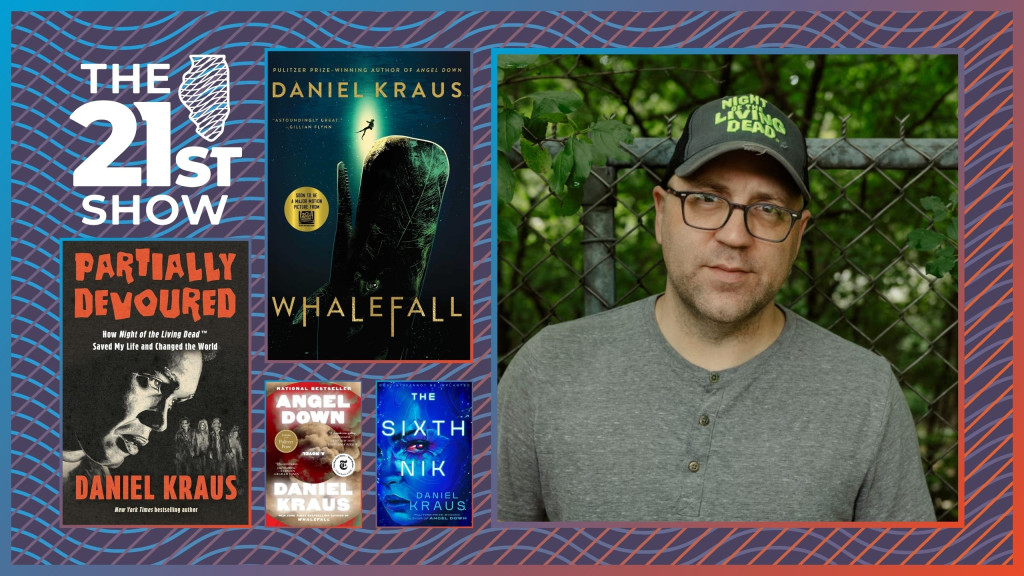
Transcript: Illinois author Daniel Kraus, from ‘Night of the Living Dead’ to a Pulitzer Prize
The 21st Show
Illinois author Daniel Kraus, from ‘Night of the Living Dead’ to a Pulitzer Prize
Read the full story at https://will.illinois.edu/tags/illinois-author-daniel-kraus-from-night-of-the-living-dead-to-a-pulitzer-prize.
Transcript
// This is a machine generated transcript. Please report any transcription errors to will-help@illinois.edu.

[00:00:00]
Brian Mackey: Today on the 21st show, Illinois-based writer Daniel Krauss has been having a heck of a year. In May, he won a Pulitzer Prize for his novel Angel Down. Another, Whalefall, has been made into a movie that came out in theaters last week. And he's published his first book of nonfiction about how the classic horror movie "The Night of the Living Dead" saved his life. I'm Brian Mackey. We'll talk with Daniel Krauss for the hour today on the 21st show, which is a production of Illinois Public Media, airing on WILL in Urbana, WUIS in Springfield, WNIJ in Rockford DeKalb, WVIK in the Quad Cities, WSIU in Carbondale, and Tri-States Public Radio in Macomb, Galesburg, and Keokuk. But first, news.

From Illinois Public Media, this is the 21st show. I'm Brian Mackey. And my guest today is the writer Daniel Krauss. Based in Evanston, Illinois, he's been having a remarkable year. In May, he won a Pulitzer Prize for his novel Angel Down, about a group of World War I soldiers who encounter a wounded angel on a mission in no man's land. A month later, his latest novel was published. It's called The Sixth [Nick], a melding of science fiction and horror. And then last week, there was a major movie released based on his 2023 novel, Whalefall, starring Josh Brolin. Krauss has also collaborated on books with filmmakers Guillermo del Toro and posthumously George A. Romero, the creative force behind the horror classic Night of the Living Dead. And that film, incidentally, is the subject of another Krauss book published this year. That one is called Partially Devoured: How Night of the Living Dead Saved My Life and Changed the World.

And on that note, this coming Tuesday, Krauss will be at Champaign's Virginia Theater for a screening of Night of the Living Dead. He'll also take part in an onstage conversation about the film and his book. Full disclosure, our home station is sponsoring that event, but our program is editorially independent and frankly, I didn't even know about the sponsorship when we booked this interview. Nevertheless, we'll have more information about that on our website after the show today. twentyfirstshow.org is the address.

All that said, I'm excited to be joined now by Daniel Krauss. Welcome to the 21st show. Thanks for being here.

[00:03:13]
Daniel Krauss: Thanks for having me.

[00:03:13]
Brian Mackey: And we are live for the hour today. You can join us at 800-222-9455. That's 800-222-9455.

All right, I'd like to begin with Whalefall if, if we can. This is a story about a teenager who goes diving to recover the remains of his father who died by suicide. They had a very difficult relationship. You say he felt swallowed up by his father's recriminations, his judgment. And on the journey, the boy is literally swallowed alive by a whale. Where did that idea come from?

[00:03:13]
Daniel Krauss: It came from a viral video, really. There's a number of videos out there of people ending up in the mouths of whales. So this is more common than you think and it has to do really with — it's ecological really in nature, like we're — throughout history we've kind of encroached into whale territory and spend more time where whales used to sort of be in peace. But anyway, what happens is often a whale, usually a humpback whale, will breach the water and sort of slam down where there's kayakers or something of the sort, and someone will end up in the mouth of a whale. Now, that's not a good thing, to be in the mouth of a whale — you could still get injured — but you're not going to be swallowed. Their throats are very, very small.

[00:04:09]
Brian Mackey: Because they eat little shrimp and plankton and things like that.

[00:04:11]
Daniel Krauss: Yeah, like humpback whales are baleen whales, and so they're eating krill — they're not even toothed whales. But when I heard about one of the videos, it made me wonder if there was a whale that could swallow somebody, and if so, would there be a way to survive it. So I contacted some whale experts and they all agreed that yes, uniquely a sperm whale — only sperm whales have much, much larger throats. And that was what I needed to hear, and that set me off on a few months of research with them to figure out how it could happen and how one might survive it.

[00:05:00]
Brian Mackey: And maybe this is a good time to mention another of your Illinois connections, which is that master's degree in library and information science from the U of I, which you have said has helped you do a lot of research for your books. And I gotta say it really came through in Whalefall, whether it's the texture of kelp or how icy rivulets of water feel when let into a wetsuit to regulate body temperature, or how loud it must be to hear whale sounds from inside the beast. So talk to us about your research process for a book like Whalefall.

[00:05:29]
Daniel Krauss: Yeah, I always do a lot of research. I really like research. I didn't start that way. Most writers, most novelists don't. In fact, they tend to skew the other way — like that's why they're into this, so they can just make stuff up. And I think for a lot of novelists, research is something they try to avoid, actually. They kind of do it when it's necessary, but I love it. It tends to bend the stories that I want to tell in a really fruitful way. Usually once I start researching, it really changes the story and plot that I'm working on.

For this one, it was different because there weren't really any resources to consult. There's plenty of books on whale behavior and I did consult those. But there was nothing really about the interiors of a whale aside from some really academic or biological text that just had sort of photos of whale autopsies.

[00:06:37]
Brian Mackey: And some [seamy] accounts you might say about people who allegedly had been in whale stomachs and been cut out.

[00:06:46]
Daniel Krauss: Yeah, there's lore about that. Like, the New York Times even reported on one back in the whaling and sailing days about someone — a whaler who had fallen off a boat, and then they caught a whale and they cut it open and the guy was still alive inside. And he was like insane, and his skin was bleached white — all these great details, but none of them add up. Like, you couldn't survive without air in a whale's stomach. That's why my character has to have a full scuba outfit. He has to be a scuba diver. But yeah, so because there were no sources, I just spent three months with scientists devising what was possible.

[00:07:28]
Brian Mackey: The reason I ask about this, and spent time on this research, is I'm a little envious of the leap that you and other writers of fiction are able to make, right? I mean, I've written probably hundreds of thousands of words for newspapers and magazines and public radio, and to the best of my knowledge, zero of those are sort of flights of fancy based on fact. So what do you understand about yourself that lets you start with true facts and then make imaginative leaps?

[00:07:55]
Daniel Krauss: Well, I don't know. I really rarely start with the facts. I start with the imaginary leaps and then I sort of texture it with facts. We all really started from that imaginative leap too, like — it was like, could this happen? But typically it's even more so. Typically it's like, you know, if I'm writing Angel Down or something, I'm just like, well, there's an angel who gets shot out of the sky during a war. There's nothing factual about that. But the facts texturize it for me and they make it sort of granular.

Once I start layering in details about weapons and mud and smoke and artillery and all these things, it starts to feel lived in. And I think a real benefit of it is it starts to feel really real to the reader. The weird thing about detail — like historical detail and especially scientific detail or technological detail — the reader doesn't really have to follow all of it. Every once in a while, I'll even purposely overwhelm the reader in a way that I know they're not really going to be able to follow everything. But that's not the point. The point is not to follow. The point is to sort of bask in the texture and feel this confidence in the writer — that you feel confident that the writer knows what they're talking about. And that's really more important.

[00:09:34]
Brian Mackey: This is maybe why I like Star Trek. I like Star Wars too, but Star Trek has that reputation for like, we're going to reverse the polaron flow or whatever, where they sound like they know exactly what they're talking about even though it's all made up. It has that sort of air of scientific authority to it.

[00:09:54]
Daniel Krauss: Yeah, same thing, except I actually really do try to typically back it up with actual science and actual research.

[00:10:01]
Brian Mackey: So this is now a major motion picture, thousands of movie screens around the world. You participated in this film. So talk to us — what was the process of adapting Whalefall for the screen? What was that like?

[00:10:15]
Daniel Krauss: It was really fun. So, just to give credit where credit's due, I co-wrote it with the film's director, Brian Duffield, and we were very simpatico on it. There weren't a lot of — I don't think there were any arguments or that kind of struggle within it. It was more a matter of we both really wanted to stick to the book mostly. So it's a very faithful adaptation — like, what happens in the book happens in the movie. And the stuff in the whale, like — I exhausted what one can do inside of a whale. There's nothing you could really add to it or subtract from it and have it make sense. So that part was kind of ironclad — the same things were gonna happen.

The challenge was more the flashback structure, because in the book it flashes back constantly to his relationship with his dad, and in the movie we're not gonna have 50 or 100 of these little flashes — we're gonna have five or six. And how do we communicate all the things that we need to? Because all those flashes are teaching Jay — the diver's named Jay — teaching the future him how to escape the whale. So how do you pack that in in an elegant way into just a few flashbacks?

[00:11:42]
Brian Mackey: Yeah, and the structure was so great. And especially for — maybe it's my own sort of 2026 social media-addled brain — but each chapter is like a page, 23 at most, and it goes back and forth, back and forth.

[00:11:56]
Daniel Krauss: Yeah, it's the first time I ever used really short chapters, and that was really to communicate a sense of running out of breath. I liked that idea, because most of the chapter titles are how much air he has left — or PSI ratings. So having the short chapters allowed me a chance to show the PSI gauge a lot, and I wanted that sense of like, every time you end a chapter, it's like another gasp of breath.

[00:12:26]
Brian Mackey: You know, some writers — I've heard Michael Lewis say, the great nonfiction writer, that when he has a book optioned for a movie, he's happy to cash the check and he wants nothing to do with it after that. Maybe he'll go see it when it comes out, because there are often a lot of compromises. You describe this as a very faithful adaptation, but on a participation scale, did you have to be convinced? Were you eager? Were you reluctant?

[00:12:51]
Daniel Krauss: I was eager. I've had all sorts of experiences with my movies being adapted — some good, some bad — and most of them never actually get all the way to the point where they get made. But this book was always really important to me, and I wanted to see it through. And yeah, from the start, from meeting Brian, I had a really good feeling about it. Like, it just felt like he was in it for the right reasons and got the story really deeply. I continued to be involved all throughout filming, really — through pre-production and on set — and I think that's pretty rare too, but everyone involved just sort of embraced the book in a way that one doesn't need to.

So yeah, I understand that viewpoint of wanting to leave it alone. I've certainly been in that spot too, where I'm happy just to turn over a property and whatever happens happens. But this was a truly unique experience where I just enjoyed every bit of it. I'm really happy with the final product and just couldn't have gone better, really.

[00:14:12]
Brian Mackey: And that's the interesting thing — you alluded to this, but that's something I didn't really know, and I think it was actually that same Michael Lewis interview — how many books are optioned for movies, and that's the end of it, right? It doesn't really happen.

[00:14:25]
Daniel Krauss: Yeah.

[00:14:26]
Brian Mackey: Talk about that experience.

[00:14:28]
Daniel Krauss: I mean, I've written — I don't know — 31, 32 books, something like that. And almost all of them have been optioned, if that tells you something. And sometimes it just completely depends. Like sometimes the option comes with a big check, sometimes it comes with a very, very small check. Sometimes things get optioned and re-optioned and re-optioned, and there's always someone trying. Sometimes you get one nibble and sometimes you get zero nibbles. And they very, very rarely make it to the finish line.

So the proper response is to not get excited at all, and typically I don't, because it happens all the time. You have to be completely satisfied with the book. When I'm writing books, I certainly don't think about a potential movie adaptation — that's the last thing on my mind — because they generally don't happen. And there's also this kind of weird sense out there that when you get a movie adaptation, you've somehow done something notable, which isn't — I don't think that's necessarily true. Like, bad books get made into movies all the time. It doesn't mean the book's good. And then the book is a finished product, you know — it's not an audition piece for a movie. Everyone ought to be, and I know I am, perfectly happy with a book just being a book.

[00:16:04]
Brian Mackey: Yeah, it probably says something more about the relative rise and fall of movies and books and other forms of mass culture in modern life. But we can talk more about that.

[00:16:16]
Daniel Krauss: And it is true that even a terrible movie is gonna be probably the most publicity your book is ever gonna get. So that is true.

[00:16:25]
Brian Mackey: Yeah. All right, we are talking with the writer Daniel Krauss, based here in Illinois, educated partially at the University of Illinois Urbana-Champaign, where he got a library and information science master's degree. He is the author of books including Whalefall, the Pulitzer Prize-winning Angel Down, and this year, Partially Devoured: How Night of the Living Dead Saved My Life and Changed the World. We're gonna talk more about that after a break. He's actually gonna be coming to Champaign for a screening of Night of the Living Dead and will take part in an onstage conversation about that. That's next Tuesday. We'll have more information about that on our website. If you want to join us today, the number is 800-222-9455. That's 800-222-9455. We'll have more after a short break.

This is the 21st show. I'm Brian Mackey. We're talking with the writer Daniel Krauss, based in Illinois. He's the author of Whalefall, The Sixth [Nick] that came out this year, Angel Down — which won a Pulitzer Prize this year — and Partially Devoured: How Night of the Living Dead Saved My Life and Changed the World, which also came out this year. It's about Night of the Living Dead, the great horror classic by George Romero. Incidentally, Daniel also collaborated with Romero posthumously on the novelization of Night of the Living Dead and another of his stories.

If you want to join us today, 800-222-9455 is the number. 800-222-9455.

All right, you were 5 years old when you first saw Night of the Living Dead. This is a well-known fact for people who've followed your career. You're on a shag carpet under a homemade quilt. Your mom is not shooing you from the room. What else do you remember about that early experience?

[00:18:36]
Daniel Krauss: It's kind of an amalgam. You know, Night of the Living Dead, because of its copyright status, was always on TV. And I remember less a single viewing than I do just a sort of perpetuation of viewings. Back then, if you're old enough, you remember how you just watched what came on, and often you didn't watch from the beginning. It would just suddenly be on TV and you'd watch the middle section, or you'd watch just the beginning, or more commonly you'd pick up somewhere in the middle and watch to the end. It was sort of the age — this is pre-HBO even — where you would see a movie 20 times before you ever saw the beginning of it, because you would just stumble upon it midway.

So I just remember kind of a positive feeling toward it back then because my mom would laugh at a lot of it. That's one of the amazing things about Night of the Living Dead — it can be really viewed a number of different ways. If you have the right audience, you can really have fun with it, and in a different audience, it's deadly serious. Also back then the versions being shown looked terrible — they were blown out and grainy, bad copies — and I would have guessed that a lot of the scariest moments were sort of unintelligible. So fear is not the emotion that I think of when I think of those early viewings. The movie actually got scarier as I got older and began to understand it better, I think.

[00:20:25]
Brian Mackey: Yeah, it's interesting. I think we're roughly the same age — I was born in 1976. So sometimes I talk to my kids about what life was like before Netflix, right? It's hard for them to imagine. But you mentioned that fragmentary experience, and yet you estimate you have now seen this movie more than 300 times. So what drove you to watch and rewatch this, as opposed to what I presume were the same reruns of the Brady Bunch and Gilligan's Island that you also could have been watching at the time?

[00:20:58]
Daniel Krauss: Yeah, it's a great question — kind of the obvious question. I'm not an obsessive rewatcher of things. Generally most movies I watch once. And it goes for books too. I'm not a big rereader. I'm always seeking out new material in every format. So yeah, it stands really alone in that — like, why do I keep returning to this? And Partially Devoured is kind of my attempt to figure that out. Like, why am I so obsessed with this one thing?

And I think at the end of the day, what I discovered — and it's cool too, because I don't often write books and really learn something about myself, but I think I did with that book — I think Night of the Living Dead stood in largely for the horror genre at large, and it became important to me. As I got older — and I'm talking about middle school age or so — mastering my feelings and fear over the horror genre was a way of building a suit of armor for myself, I think. Regardless of difficult things going on in my life or at school, I was watching movies that no one else my age was able to watch, and I was mastering fear in a way that I could then transfer over to real life.

And that held true for the entire genre, but Night of the Living Dead was — I think because I encountered it so young — always the top of that heap, and it was the one that I kept going back to because it felt comfortable. A lot of the horror I was partaking of in that adolescent age did not feel comfortable. I was purposely always pushing myself, and sometimes would push too far and see things that really upset me. But Night of the Living Dead was always kind of my home base, and I would go back there almost like a soldier would run back to their headquarters and sort of regroup before heading out again.

[00:23:15]
Brian Mackey: That's interesting that you say your experience of horror films helped you understand fear. I can't remember if you use the phrase "conquer fear." But talk about that, because I am someone — I did watch some horror films in high school, right? Gathered with the kids to do that. But man, I cannot stand them now. I cannot sit through it. I'm too weak-kneed maybe. But I can read horror books, right? Stephen King, your own work, no problem. What is it about you — what do you understand about yourself — that has — talk more about your experience of being able to consume this type of content.

[00:23:55]
Daniel Krauss: I think I've always been the type that heads toward the fear. And that doesn't extend everywhere — like I have some real-life fears.

[00:24:07]
Brian Mackey: Like, are you a skydiver? That kind of thing?

[00:24:09]
Daniel Krauss: Yeah, I mean, that doesn't interest me that much, but I'm not scared of it. Like, I would — if for some reason someone was like, I'll give you a $1,000 skydive, I'd take it. Sure, I'll do it. I'm not really scared of it. But there are things — a lot of them are bodily — like I have kind of a phobia of getting blood drawn. And people who can't watch horror movies, they have no problem with that. So we all have our certain peculiarities.

But I can remember being really little and that age where you are kind of scared of the space under your bed — and actually, in the middle of the night, getting out of the bed and going under the bed and just kind of lying there and sort of taking on that fear. I don't know what that is exactly, but it's how I've always been. I can't — I remember vividly various movies that I saw as a kid and as an adolescent that scared me, really scared me, to the point of physical illness, like just feeling really, really bad. And I would retreat, but it wouldn't be too long before I would watch that movie again. I just wanted to master it. I was very intrigued by my reaction to fear.

So people like you — you in horror movies, there's a reaction where you go to the movie, it's scary, you don't like the feeling of it, and you're like, well, I'm not gonna do that again. And that makes perfect sense. It makes more sense, probably, than my reaction, which is: I really disliked that, and that's intriguing to me. Why did I have that reaction? I want to prod that and learn about that more.

[00:25:50]
Brian Mackey: Do you still consume — like, are you — I mean, that's famously one of the genres that's keeping physical movie theaters alive, right? Horror movies.

[00:26:00]
Daniel Krauss: Yeah, I do. Of course. I mean, I watch and read everything — and I mean everything. There is no genre that I don't partake in, and I do them relatively equally too. But yeah, horror is always my home. I always have the most love for that genre because I feel like it was most helpful to me and was there when I needed it. And so yeah, if all things are equal and I can't find something that feels like I wanna watch it, then I'll pop over to [Tubi] or something and just find some absolutely obscure oddity made in 1982 and watch it and just feel really happy about it.

[00:26:50]
Brian Mackey: So for people who haven't seen Night of the Living Dead, can you briefly summarize what the film is like, what it's about?

[00:26:59]
Daniel Krauss: Yeah, first of all, what is your problem? Like, if you haven't seen it, it's insane. This is a true American classic. But whenever I do screenings of it, I am surprised that half the audience hasn't seen it. So despite what I just said, I'm very, very happy when I have new people in the audience and excited to introduce them to this, because everyone's heard of it, even if you haven't seen it.

It's about zombies, I guess. It's the movie that sort of invented our modern understanding of the zombie as a flesh-eating, living dead type of creature. And it's about a small group of people who have boarded themselves up in a farmhouse in the middle of nowhere against this new rise of zombies. In a way, the zombies aren't really the point. It's largely about the arguments that these people have, and because of their inability to come to terms with each other and to work together, they're all sort of doomed.

[00:28:14]
Brian Mackey: Like Lifeboat, right? There's a great tradition of this — 12 Angry Men — in American cinema. So what — early in the book you say this film is America, right? What do you mean by that?

[00:28:30]
Daniel Krauss: Well, it's hard to answer in an interview because that's the whole book — the whole book is the answer to that.

[00:28:37]
Brian Mackey: And I guess this is a good point — I need to be honest with you. I make an effort to read, or at least read through, every book I talk about with an author. I've been reading Whalefall — got it right here — Angel Down. My copy of Partially Devoured is still being processed at a carrier facility, so I have not been able to read it. I read what previews I could on Amazon, but I'm at a bit of a disadvantage in this conversation, and I apologize for that. But, you know, to the extent you can summarize — I mean, I guess I'm a little more familiar with the idea of Dawn of the Dead, the one about consumerism at the shopping mall and how that's a metaphor for America. Like, what particular aspects of American life is this one about?

[00:29:18]
Daniel Krauss: You know, it's kind of all aspects. There's the element of sort of technological advancement, because the zombie uprising has to do with a Venus probe that was shot down. So there are elements of positive American attitudes in there — there's some of that. But mostly it's a critique about different segments of society — class, race, gender — and what happens when you throw those all together and there's discord, and an inability to treat each other as sort of human equals.

And I think it's — you know, this problem is bigger than America, but it feels like a very American problem, where we create our own demise. The crazy thing about Night of the Living Dead is that everyone should have been fine. Zombies are really, really slow. There's no reason any of these characters should have died. All they had to do is just agree — like, let's just go out together, we'll walk slowly, we have a gun, we're gonna be fine. But their discord, their inability to share the world that they're given, is their downfall.

And there are moments in the movie that point toward a better world — like, the main characters for most of it are a Black man and a white woman, and they're not ever like a romantic thing, they're not a couple or anything, but they sort of point that direction. Like, there's a way we can all sort of get along. And it's just destroyed by people who don't want to share what they have.

And you've got to remember, this came out in 1968, so there was a struggle happening between an older generation who felt like they had worked for some sort of reward, and it was all being deconstructed by a younger generation that was upending society and trying to let other people into the good parts of America. So that's a short version.

[00:32:04]
Brian Mackey: You might say that people wanted to make America great again in 1968.

[00:32:08]
Daniel Krauss: I use that exact quote in the book. There's a character — if there is a single antagonist, it's this character, Mr. Cooper. And yeah, that's exactly how I describe him. He wants to keep America great, in his mind.

[00:32:31]
Brian Mackey: You know, and you alluded to this earlier, but there's also kind of the meta-story of its life, and as you mentioned, some of that has to do with the copyright status. And you tell this early on — apparently it was just an oversight in the actual physical production of putting the title on the film that led to all this trouble.

[00:32:53]
Daniel Krauss: Yeah. I call it — and this is in the early part of the book, so you probably got to see this part.

[00:32:53]
Brian Mackey: I did.

[00:32:53]
Daniel Krauss: I call it the most important title screen of all time. So when the words "Night of the Living Dead" come up on the screen, there's not a copyright — it's called a copyright bug, like the little C with a circle around it. It's not there. And the reason is that the movie was called Night of the Flesh Eaters, but there was another movie that had just come out called The Flesh Eaters. And so to avoid a lawsuit, they changed the title at the last second. And when they did that, whoever at the company — Continental Films, who was putting it out — whoever put the new title on the film didn't put the copyright on it.

Today laws are a lot more rational in that regard. But back then, that was it — that was the whole ballgame. They didn't own the copyright because that little symbol wasn't there. And people didn't really notice that right away, but over time, over the decades, it came to light that this movie was not copyrighted. And that's why it began to be played everywhere. And that's why when VHS came about — anyone our age can remember there would just be bins of VHS tapes at a grocery store — there was always Night of the Living Dead that you could buy for $3. Anyone in the world could put out Night of the Living Dead on VHS or DVD.

[00:34:24]
Brian Mackey: Amazing that our copyright law was basically the dibs system.

So all right, we need to take another break. We will have more with Daniel Krauss, the Illinois-based Pulitzer Prize-winning novelist, when we return. This is the 21st show. You can join us by the way — 800-222-9455. We'll be back after a short break.

It's the 21st show. I'm Brian Mackey. We are talking today with the writer Daniel Krauss, based here in Illinois. Winner of the Pulitzer Prize for Angel Down, author of Whalefall, which was just made into a movie that came out last week. The Sixth [Nick], his most recent novel, came out this summer. And earlier this year, Partially Devoured: How Night of the Living Dead Saved My Life and Changed the World, which is part memoir, part very close analysis of this horror classic. He's actually gonna be in central Illinois next week in Champaign at the Virginia Theater for a screening of Night of the Living Dead, and an onstage conversation about the film and his book. We'll have more information about that later today at our website twentyfirstshow.org, as well as how you can go.

If you wanna join us, 800-222-9455. 800-222-9455.

So, Daniel, when in your writing life did you feel comfortable taking bigger literary swings, you know, culminating, for example, in an entire book consisting of part of one sentence?

[00:36:12]
Daniel Krauss: I think with my fifth project, which was called The Death and Life of [Zebulon] Finch, which was split into two volumes because it was just so huge. I don't know exactly what it was, but after I finished my fourth book, Troll Hunters — which was co-authored with Guillermo del Toro — I just had this well of ambition that I wanted to do something kind of monumental. So I wrote this just gigantic historical fiction book that sort of came out of nowhere. It wasn't all that successful commercially, but it was something where I pushed myself in a way I never had before. I essentially wrote 1,500 pages in two years, which is insane.

And the floodgates sort of never stopped. And then the book after that, which was Blood Sugar, is a relatively very small book actually, but uses language in a whole new way. And I think what it really comes down to is me not wanting to get bored. How I choose to write a book — a lot of it, I think, is based on what I wrote previously. Like if I just wrote a sci-fi book, the next thing I'm gonna write is gonna be a western, and it's gonna be from a completely different point of view, and it's gonna have short sentences instead of long sentences — just completely different. And when you do that, if that's your guiding light, if that's your lodestar, you're going to start experimenting, and in fact you're probably not going to stop experimenting. And that's kind of where I have gone. Now when starting a project, I find myself pushing into further and further out-there territory in terms of everything, but mostly in terms of language and format and just how I'm approaching any topic.

[00:38:31]
Brian Mackey: And maybe I was a little too vague there. I should explain to people who haven't picked it up yet — Angel Down is essentially one long sentence, no periods in the book. Every paragraph, at least to the best of my memory, begins with the word "and," and it's just a breathless story from start to finish. When I started reading it, I sort of came to this light bulb moment where I realized I needed to inhabit the voice of — uh, the Raymond Chandler detective Philip Marlowe, or maybe Herbert Morrison, the journalist who's best known for that radio report on the Hindenburg disaster. Feel free to take issue with my description there, but how did you come to decide on the voice for this story?

[00:39:14]
Daniel Krauss: Well, I had started writing Angel Down in a kind of more traditional format, and this is kind of what I was just talking about — like, it was working fine, but it wasn't lighting me on fire, and it felt kind of like something I had done before. Not topic wise, but just style wise. And I was unsatisfied.

So I started thinking about the theme of the book. One of the themes is really about how, in my hypothesis, World War One was the beginning of mechanized, self-perpetuating warfare. And once we started down that technological road, there was no stopping war — ever. And then I thought, well, can I mirror that by making the whole book one sentence that loops back on itself, so that once you start reading it, there's really no way out? Like you're trapped in this circle forever.

So that's what I did. I started writing the whole thing as one sentence. And right away — I wrote one — you can, although it's weird to call it a paragraph, I don't know what else to call it, but the first kind of stanza — I knew right away this was the way to do it. I didn't know if anyone would like it, but it definitely was exciting for me.

[00:40:35]
Brian Mackey: Yeah, well, and obviously the Pulitzer committee liked it. So talk about that — what is it like? First off, how do you even get entered in a contest like that? Is that up to you? Is it up to your publisher? How does that work?

[00:40:47]
Daniel Krauss: The Pulitzer?

[00:40:48]
Brian Mackey: Yeah.

[00:40:49]
Daniel Krauss: I have the slightest — I don't think there's any —

[00:40:56]
Brian Mackey: Is it like Skull and Bones? You just get the tap on your shoulder some night?

[00:41:00]
Daniel Krauss: Yeah, yeah, that's exactly it. There's no short list, there's no long list, there's no awareness that you're being considered at all. It all happens in secret and they don't even call you to tell you you won — they just put the news out. So it's a complete bolt from the blue. Never once crossed my mind.

[00:41:24]
Brian Mackey: How does it — I mean, you mentioned you've written what, 30-plus books at this point. Does it change your relationship to a given work to have it be recognized with a major award, or be commercially successful, or not?

[00:41:40]
Daniel Krauss: I don't know that it changes my relationship with it. Like, I was really happy with it — but like before it even came out, I had been calling it to friends and people I know my favorite book of mine. I just really like it. It goes full tilt and it does what it does all the way, and I really, really liked it. And that's really all that matters to me — I'm a very inward-focused writer. It helps that I generally don't read reviews or anything like that. So it's just — if I'm happy when a book comes out, then I'm gonna be happy with it forever, because nothing else really touches it.

So it hasn't changed my relationship to the book. And it hasn't changed my relationship, I think, to how I'm approaching future books either. What it's changed is the situation around it. To be more specific, it's just taken away all my time. I was always, you know — I'm so prolific obviously as a writer — my schedule was extremely full, and this just made it tenfold worse. Like, this new book that I've been writing for the past, I don't know, six months or so has been written entirely on airplanes. The Pulitzer doesn't change my writing, it doesn't change my approach, but it's changed my life — my daily life — so radically that it's changing the situational realities of how I'm writing. I'm writing on airplanes, I'm writing in airports. And it's been very difficult, honestly. I keep saying, jokingly but not that jokingly, that I penciled in next summer to enjoy winning the Pulitzer. Because in the short term, it's been kind of rough. You get all these invites all over the world that feel kind of impossible to turn down because they're so incredible, and suddenly you're being grouped in this company of true legends, past and present. These things are often impossible to turn down, so I do them and I'm glad and it's wonderful and it's gonna make me all these incredible memories and I don't regret any of it. But the immediate effect is I have very little time, I'm not home much at all, and I'm really looking forward to 2027, which looks a lot better.

[00:44:25]
Brian Mackey: I mean, I wonder if this gives you a — you know, I noticed The Onion, right? I don't know if you saw this, but The Onion —

[00:44:32]
Daniel Krauss: Of course.

[00:44:32]
Brian Mackey: — "Whalefall writer reveals story inspired by time he ate a scuba diver."

[00:44:37]
Daniel Krauss: I tell you, I got more — it was like I won the Pulitzer again when that Onion story came out, which was — I think yesterday? Was it just —

[00:44:46]
Brian Mackey: Tuesday, I think, yeah.

[00:44:47]
Daniel Krauss: I got a million texts all over again, and people were like, is this better than winning the Pulitzer?

[00:44:55]
Brian Mackey: Everybody wants a piece, right? Whether it's the Onion writers or public radio interviewers or —

[00:45:01]
Daniel Krauss: Yeah, but I tell you what — there are moments, and I'll probably appreciate all these moments in time. It's too hectic right now to really focus on anything, but I got to throw a first pitch at Wrigley Field a few months ago, and it was one of the greatest days of my life. It's something I've been wanting to do since I was a little tiny boy. And there are moments like that where I've felt a little bit of the magic and the gratitude and the fortune — and the luck. Let's be honest, the luck of being in this spot. So I will absorb more of that soon, I think.

[00:45:48]
Brian Mackey: Well, you mentioned you've been working on another book on airplanes. What can you say about it? What are you working on next?

[00:45:56]
Daniel Krauss: It's a western.

[00:45:57]
Brian Mackey: A western.

[00:45:57]
Daniel Krauss: Yeah. So I've done almost every genre, but I've never done a western, and in a way it's kind of my white whale — to talk about whales again. It's the only book that has defeated me in the past. Like I tried to write it a decade ago and I failed, and I tried it a few years later and failed. And I've been lucky that I've never really had projects that didn't work — I start a book and I finish it, and that's always been the way it is, except for this western.

So post-Pulitzer, I was like, this is the time — I'm gonna sell this book and I'm gonna do it. And it is the most difficult thing I've ever written, and it's not helped by the fact that I'm only writing it on planes. But I'm getting there, and I'm super excited about it. It's just going really much more slowly than I'm used to. I'm used to writing 9 to 5, six days a week, and that's just not the situation anymore.

[00:47:05]
Brian Mackey: And again, if you're willing — to the extent you're willing to talk about it — are there any stylistic challenges you've set for yourself with this one?

[00:47:12]
Daniel Krauss: There really are. It's nothing I can really describe well out loud, but the prose is inflected with the voice of the main character, and so it's very, very specific writing where the syntax of the sentences isn't normal. And so I have to think about every single word that I'm putting down, because it's just not typically how we construct sentences. So everything about it is a challenge.

[00:47:45]
Brian Mackey: Does it make it — you know, I would imagine that if you were in a different place in your career, it might be harder to sell a book that might be challenging to some readers. You see on BookTok, right? — TikTok videos, people coming up to authors unironically saying, hey, couldn't get into your book because it was in third person. Does it get easier for you now at this point?

[00:48:08]
Daniel Krauss: I mean, I suppose it is, but I'm not making it any easier on myself. I'm making it harder. And I'd be doing that anyway. Like, I wasn't in a carte blanche position when I sold Angel Down either. I just had an idea for this and I did it and I didn't tell anyone I was doing it. I just wrote it and no one knew I was writing it in one sentence. I just believed in it. And then through force of will — or, you know, if you wanna say just success of the book as a work of art — it won over other people. And that's kind of just what I'm trying to do.

I don't think — regardless of the Pulitzer — this would have been my next book, and I would have written it the same way. Nothing really alters me from my path. And the biggest proof of that is that this is the way I've run my career — which is a terrible way to run a career. To change genres every book is really, honestly, the worst thing you can do for your career. And so I've had many opportunities to stop doing that and I just don't. It's the only way I can stay interested, I think, and stay vital. And so I'm just gonna keep doing what I'm doing, and it will continue to work sometimes and not work sometimes.

[00:49:37]
Brian Mackey: Well, Daniel Krauss, congratulations on the success and the recognition, and I hope you get some time to write when the tray tables are in their locked and upright position.

Daniel Krauss is the author of Whalefall, Angel Down, The Sixth [Nick], and Partially Devoured: How Night of the Living Dead Saved My Life and Changed the World, among dozens of other books. He's gonna be at the Virginia Theater next week for a screening of Night of the Living Dead and be talking about that book, which is again part memoir, part analysis of this American classic. Daniel, thanks so much for being with us.

That's it for us today. The 21st show is a production of Illinois Public Media. I'm Brian Mackey. Thank you for listening. We'll talk with you again on Monday.
Transcript Assistance
Illinois Public Media may use AI assistance for transcript generation and/or formatting. Transcripts that have not yet been reviewed for accuracy will be labeled.
To report a transcription error, or to request transcription of archival material, please contact will-help@illinois.edu.