Transcript: Route 66 in Illinois: American Giants Museum keeps Americana alive
Transcript: Route 66 in Illinois: American Giants Museum keeps Americana alive
The 21st Show
Route 66 in Illinois: American Giants Museum keeps Americana alive
Read the full story at https://will.illinois.edu/tags/route-66-in-illinois-exploring-the-american-giants-museum.
Transcript
// This is a machine generated transcript. Please report any transcription errors to will-help@illinois.edu.

[00:00:00]
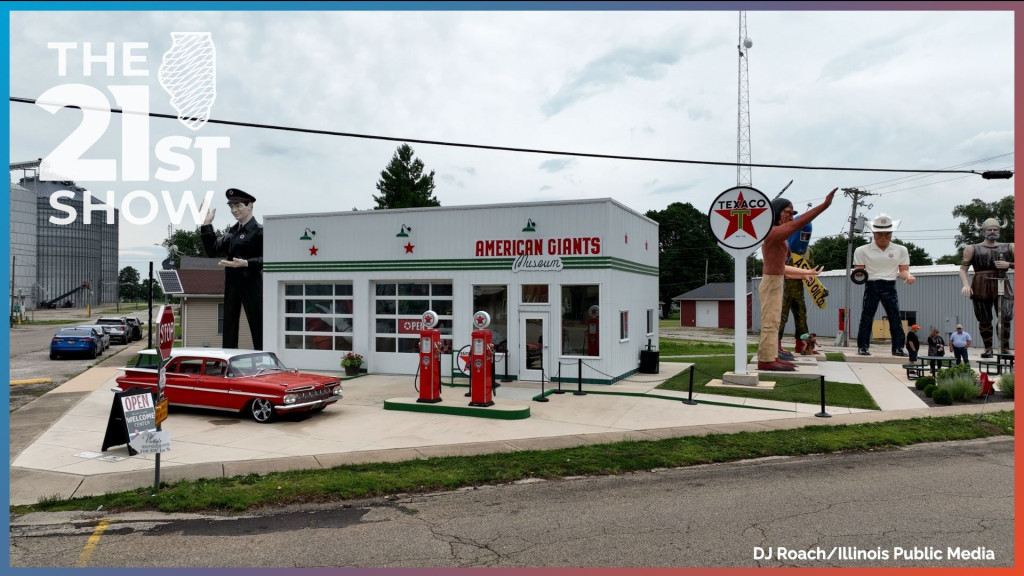
Brian Mackey: From Illinois Public Media, this is the 21st Show. I'm Brian Mackey. We are continuing our journey on Route 66, and today we begin in Atlanta, Illinois, at the American Giants Museum. As the name suggests, its collection features giant statues of brand icons that were once a staple of Route 66, serving as attractions for passersby. But like many things associated with the mother road, they have faded into memories, both metaphorically and also physically.

And that's where the museum comes in. They're collecting and restoring these statues and set up the museum as a home for travelers to check them out. DJ Roach, producer for our Illinois Public Media sister program Prairie Fire, spoke about this with Joel Baker, founder of the American Giants Museum, about the work they do. We're bringing you that conversation today here on the 21st Show. Because of that, we're not taking any calls for the first part of the program, but we still appreciate hearing your Route 66 stories. So here's one from Terry in Champaign.

[00:01:20]
Terry: In 1954, when I was about 5 years old, my dad loaded the entire family — Mom, Grandma, my brother and I — into a car and we drove all the way from Peoria to California so he could attend his youngest brother's graduation from college. Route 66 at the time, I remember a lot of blacktop roads, two-lane blacktops that ran through towns rather than around them, and the only way that you knew you were still on Route 66 was the occasional wooden sign nailed to a telephone pole or a tree. There were no such things as motel chains. It was tourist cabins and that sort of thing. And Dad would always ask to see the room before we would rent it. Dinners along the route were all mom and pop, no change or anything like that. So it was a very different experience than what it is today.

Back then you really had a sense of getting across the country in four days being some kind of a miracle, and today it's more like how fast can you get there. I enjoyed it. I remember most of it, and I think about it every time I hit Route 66.

[00:02:40]
Brian Mackey: Thanks for calling our voicemail line, Terry. If you have a Route 66 story, we'd love to hear it. 217-300-2121 is our voicemail line and you can call that anytime, day or night. 217-300-2121. And with that, let's learn more about the American Giants Museum, beginning with how Joel came to be interested in these statues.

[00:03:06]
Joel Baker: I discovered them in 2011 and started doing a bunch of research and was just fascinated by their history, and that has led to restorations years later and now here we are with a museum dedicated to these giants and their history, which is in Atlanta, Illinois.

[00:03:21]
DJ Roach: And the history of the Muffler Man is obviously fascinating and, you know, kind of how it ties into Route 66 and stuff like that. But can you just give me just a little bit of a history of the Muffler Man, how where it got — where it first started, where was the first — [the] origin story of —

[00:03:39]
Joel Baker: Right, right. So the story of Muffler Man really starts in Lawndale, California. Back in the very early '60s, there was a guy named Bob Pruitt, and he was a rodeo man. He was a cowboy. He loved horses and he was dabbling in fiberglass. He was making pools and he noticed that horse trailers were very heavy because they were made of metal and he's like, I should make a horse trailer out of fiberglass. So he made one and he wanted a horse in the trailer so it could model, and he didn't want a real horse because that's just a big mess. And so he had a lady named Gladys Brown, who was an artist and had her whole career in horses. She sculpted a horse out of plaster and, using his fiberglass skills, he created a fiberglass horse. Well, he went to the next rodeo and he got no orders for the trailer and he had about twenty orders for the horse, and he realized, OK, I'm onto something here. And so he went back and they started making horses. They made different breeds. They started making roosters and all kinds of animals, and he realized that there was a great market out there for all these businesses on America's highways that wanted to put cows at their beef restaurant and chickens at their chicken restaurant.

And that is where the Muffler Man came from, because in 1963, in the summer of that year, he hired an artist and sculptor named Bill Swan, and he said, Bill, I need a Paul Bunyan lumberjack for a restaurant in Sacramento — or so the story goes. And Bill built the first what we call today Muffler Man.

[00:05:17]
DJ Roach: Can you talk about kind of how it may have evolved over the years and the different incarnations — and maybe the ones, and then we can kind of go into the ones that maybe you have a personal story with.

[00:05:30]
Joel Baker: So as soon as that first Muffler Man was made, Bob Pruitt was like, OK, I'm onto something here, because he started getting orders. And so they made a number of the lumberjacks and they were 20 feet tall. They had that very distinctive arm position and that bearded face and that steely gaze and chiseled jaw that we [consider] iconic today. And it wasn't long before other companies started to notice what Bob was doing, and in the fall of 1963, early 1964, came along a company called International Fiberglass, and they were in the boat business, which wasn't doing very well, and they bought all Bob's molds. Included in that was the lumberjack, the Muffler Man. This company had a fantastic marketing team and so it really took off from there on a scale that Bob had never seen before.

And they took this Muffler Man and they put him in all the trade magazines. They would take him to conventions in Chicago, and Dallas, and different large cities for restaurants and whatever car dealerships, and they would advertise what these statues could do. One of the first things they did is they took that original Muffler Man Paul Bunyan mold, and they made different heads and different arm variations and so on to make different characters, and all of a sudden they just weren't providing a solution to people who needed a lumberjack. They were providing cowboys and chiefs and braves, and you could do construction workers and spacemen and pirates and carpenters, and amusement parks were now interested, and all kinds of restaurants and car dealerships. Pontiac started a program with them and they were making Muffler Men for the Midas Muffler Company, and [Phillips] 66 signed a contract with them for hundreds of giants. So by 1965, business is booming and these giants are going all over the country.

That lasts until the early '70s. In the late '60s, it starts to taper off, and by the early '70s, you have the gas crisis, the price of resin is going up. You have Lady Bird Johnson, who's doing her Beautify America campaign, and she considered billboards and neon and Muffler Men to be a part of America's problem with losing its natural beauty. And so it ran its course and by the early '70s, these guys are falling apart and International Fiberglass went out of business. They went into the construction business, actually. And so that was the end of an era and things are kind of quiet and the Muffler Men, the survivors, are basically lingering through the '70s and the '80s into the '90s. And then in the '90s, you have a group of guys called Roadside America and they're traveling across America making a book about different roadside attractions and they start bringing attention to these Muffler Men. And so that's really when the resurgence of these giants and renewed interest started back up.

[00:08:27]
DJ Roach: I want to get into a little bit of your history with the Muffler Men and just kind of walk me through what maybe originally attracted you to these and, you know, how it kind of progressed over the years into the hobby.

[00:08:45]
Joel Baker: So in 2011, you find me working a media job. I'm on a road crew doing media. I'm on a production truck, actually. I was actually driving a satellite truck in those days before we did streaming with the internet, and we were traveling all over the country. It was a great life. I was young and single and it was the perfect blend — a bunch of road guys — and we were in Florida and I saw my first Muffler Man. It was a [Paul] Bunyan in Dade City. And I got online, I checked out Roadside America — they had a map of where these guys were and they talked a little bit about the history — and I just thought, that is so cool. And something just clicked with me. And, you know, it was like, so many people are into cars and neon signs and airplanes, and they had YouTube channels and they researched it, and there was hardly anybody other than Roadside America — and that was just a small part of what they did — that was into Muffler Men. And so that's really where the passion started for me.

And I really started digging deeper. I wasn't just going to the Muffler [Man] and taking a selfie and posting it on the internet. I was knocking on doors, I was digging through old newspapers, I was trying to get old photographs. I was really digging deep into their history. And I think that was something that nobody had gone that far. And so when I started making YouTube videos around 2012, there was a lot of interest there — and Instagram and Facebook — and it's just really grown since then.

In 2015, I just kind of naturally fell into the restoration world of saving these, because they're falling apart. They're missing body parts and heads and arms. And so it just kind of was a natural fit, like, oh, replacement parts are needed, people need restorations, and me and my media buddies on this truck crew — basically on our weekends — we started, we turned a garage into a fiberglass shop and taught ourselves the skills needed to restore these. And that just continued to grow.

Around 2016 or so, because of a friendship I'd formed here in Atlanta, Illinois, with Bill Thomas with the Atlanta Betterment Fund, we started this discussion with this crazy idea of, hey, what if we pool our funds and we build you the building — would you loan your collection? And I've been collecting by this point in time for a number of years. And that's really the birth of the American Giants Museum. We wanted it to resemble a Texaco station because one of the giants I had in my collection was a very heavily damaged Texaco Big Friend, which is a rare survivor of International Fiberglass from 1966, when Texaco ordered 300 of these guys and ordered them all destroyed within a year, and six survived and I had managed to get one. And we thought, well, what if we make the museum like a Texaco station that resembles it and we put the Texaco guy there on one side, and then on the other side we can start adding, as we can, all these other giants — and that's eventually what happened. And here we are today with a very unique roadside attraction on Route 66.

[00:11:49]
DJ Roach: Kind of on that note, what is it you think about these that attracts people to it — just the fascination of it — just, what do you think it is that still, after all these years, people are kind of like — I mean, maybe now it's more of a nostalgia thing — but what do you think it is that these things have that kind of endures?

[00:12:11]
Joel Baker: Yeah, when I'm able to spend time in this museum and people come through the door, I'm always very amazed at how excited and interested [they are]. It's almost refreshing for them to walk in here. There are so many sites to see on Route 66, but this one is very different, and I think when people walk in this building, it's a little unexpected. Like, wow — you know, maybe they've seen a Bob's Big Boy in their past or something on the roadside that reminds them. But I can tell there's something about a larger-than-life giant. It's just something that's huge. It's not something normally that you can collect and have in any other place than the restaurant or the business that originally ordered it. So it's a unique experience where people can come in here and get up close and take selfies and talk about their childhood memories, and I think that's a big part of it — the nostalgia.

It's something from the 1960s and that fits very well with Route 66. That's why people travel it, right? They want to live a little bit of that time back in the '60s and get a little bit of that taste of what that was like. You know, they're driving the old cars and now they can come to this place and see all these old giants that once dotted our roadsides back in the '60s and get to relive a little bit of that.

[00:13:36]
DJ Roach: What's the best experience you've had so far as a collector?

[00:13:41]
Joel Baker: Right, right, right. Yeah. I think for me it's the hunt. That's my favorite part of all of this — is digging, finding that picture from 1965 of a very rare giant, whatever it may be. Maybe it's a Texaco Big Friend like we have here, and then starting to track it. You know, where did it go? Where was it in the 1970s? Oh, it was at this business in a different state. And figuring out where it was, and then the trail gets cold, and sometimes it's hard. You're knocking on doors, you're calling people that maybe once owned it, and you follow that trail until finally you get to maybe a barn or a field where you finally figure out it still survives and it's in poor repair. You know, like the Big Friend — it was behind a museum in Pahrump where it was in pieces — and to go there and pull that out, and oftentimes we can purchase these and fully restore [them]. That, for me, that's a rush and I love that. Hunting for — it's kind of like treasure for me.

Atlanta, Illinois is really the perfect place for this museum and it's really neat how the chips fell where they did. But there was already a hot dog guy here and a lot of people would stop to see him and he has history up in Cicero. And so it was a natural fit. It's just a neat, quaint little Route 66 roadside mid-Illinois town and it's really been fun to watch the population of giants grow in this town. It's not just the museum and it's not just the hot dog guy. Now we have other businesses in town like the Country Air, just down the street, that's got a Uniroyal Gal, and I've heard ideas of other businesses in this town that want giants. So I just think it plays into that — just a very unique experience you're going to have on Route 66.

[00:15:32]
[Music: "On the Road Again" by Willie Nelson]

[00:15:47]
Brian Mackey: Thank you again to DJ Roach from Illinois Public Media's Prairie Fire and Joel Baker with the American Giants Museum in Atlanta, Illinois. You can see Prairie Fire's visit to the museum at 7:30 tomorrow night on WILL-TV, or anytime on demand on YouTube or PBS online. More Route 66 to come after a short break. This is the 21st Show. Stay with us.

[00:16:17]
[Music: "On the Road Again" by Willie Nelson]
Transcript Assistance
Illinois Public Media may use AI assistance for transcript generation and/or formatting. Transcripts that have not yet been reviewed for accuracy will be labeled.
To report a transcription error, or to request transcription of archival material, please contact will-help@illinois.edu.