








Transcript: What the Illinois House speaker knew about a colleague’s harassment allegations — and when
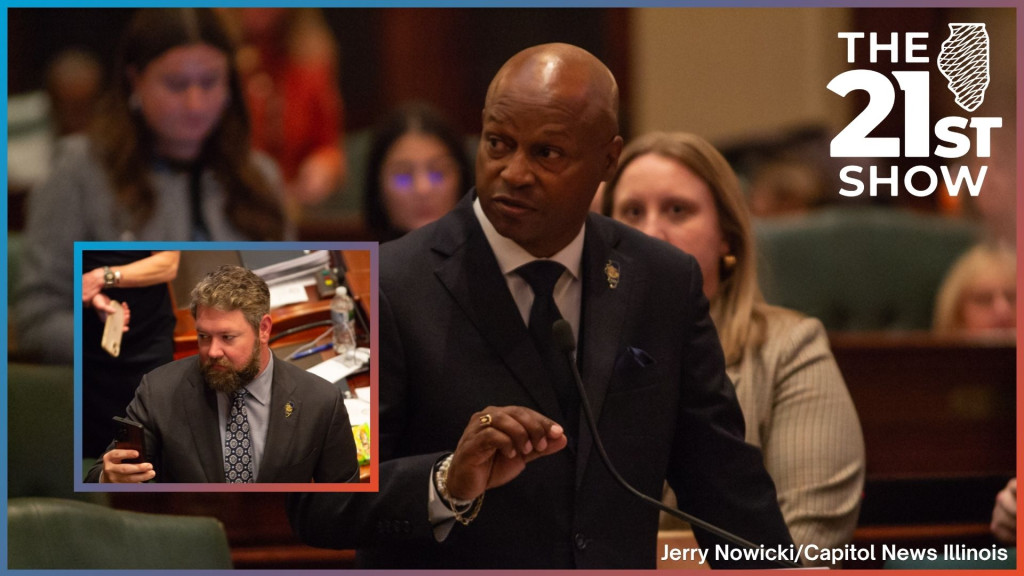
Transcript: What the Illinois House speaker knew about a colleague’s harassment allegations — and when
The 21st Show
What the Illinois House speaker knew about a colleague’s harassment allegations — and when
Read the full story at https://will.illinois.edu/tags/what-is-illinois-house-speaker-chris-welchs-role-in-harry-benton-alleged-sexual-harassment-case.
Transcript
// This is a machine generated transcript. Please report any transcription errors to will-help@illinois.edu.

[00:00:00]
Brian Mackey: From Illinois Public Media, this is The 21st Show. I'm Brian Mackey. And we begin today with a scandal in the Illinois House of Representatives. This summer, now former state Representative Harry Benton resigned from the chamber. The Democrat from Will County in the Chicago suburbs had been accused of sexual harassment. But beyond that case, there have been questions about how House Speaker Chris Welch handled this whole saga. Meanwhile, one of Benton's victims disputes official accounts, and some of the speaker's colleagues say he should have done more. Joining me now to talk more about this are two reporters who've written many stories about this case. Jeremy Gorner is state House reporter at the Chicago Tribune, and Rick Pearson is chief political reporter there. Jeremy, Rick, thanks for joining us today.

[00:00:56]
Rick Pearson: Thank you, Brian. Good to be with you.

[00:00:59]
Brian Mackey: You can join us too as well, listeners. 800-222-9455 is the number. If you have questions about this case or the way it was handled, we'd love to hear from you. Or if you have an opinion on it, you can share that as well. 800-222-9455. That's 800-222-9455. All right, Jeremy and Rick, and you know, I don't know how you both divided your reporting. So if one, if I direct a question to one of you and the other's better equipped to answer, feel free to bounce off each other. But Jeremy, I'm just gonna start with you. And let's start when this case first came into public consciousness, which is back in winter, uh, when Speaker Welch stripped then Representative Benton of his committee assignments. Talk about that. What did we know at the time?

[00:01:42]
Jeremy Gorner: Well, Brian, we really didn't know anything officially at the time. The Speaker's office didn't disclose why Representative Benton — now former Representative Benton — was stripped of his committee assignments and disinvited from caucus meetings. We had to rely on confidential sources to tell us that he was under investigation for sexual harassment. But beyond that, for months, this whole situation kind of lingered. It was really shrouded in mystery. We had no idea why Speaker Welch took such action as he did against Harry Benton, and then probably — I think it was in, that was in late February, and then in April — in a related news conference, we started asking more questions about Harry Benton, and Speaker Welch was very reluctant to even talk about it, but in his series of answers to reporters, he said he had to respect the rights of victims, which was the first time he admitted that there were vic — he acknowledged that there were victims as part of this case.

Subsequent to that, fast forward to July 1st, we suddenly get this statement from the Speaker's office. All we knew through sourcing was that a legislative inspector general investigation was underway, and just suddenly on July 1st — you know, this is a time where a lot of people are on vacation — the Speaker's office basically said that the investigation was complete, and he was urging Harry Benton to resign or, if he doesn't, the Speaker would kickstart expulsion proceedings in the House. But all he said was that whatever Benton was accused of, he exhibited clear patterns of, quote, "outrageous, unethical conduct that was unbecoming of a member of the Illinois House."

Then, through all of this, Rick and I had been doing some reporting behind the scenes. We talked to two victims of sexual harassment who had dealings with Harry Benton — one, a former staffer of his in 2023, and a lobbyist. Through that, we were able to report, especially through the young staffer, that the Speaker's office knew of allegations going back three years. So we reported all of this out two weeks before the [Legislative Inspector General] finally released its report, which really didn't say much more than what we already knew.

[00:04:23]
Brian Mackey: Yeah, we're gonna come to that story in a moment. The headline there was "Illinois House Speaker Welch's office knew of harassment claims against disgraced state Representative Benton years ago." Rick, can you pick that up and maybe talk about what some of these allegations were against the former representative?

[00:04:41]
Rick Pearson: So we're talking about a now former Harry Benton staffer, 22 years old, 23 years old, one of her first jobs after leaving college, looking forward to exploring a career in government and politics. She works for Benton and from day one, she said she was basically a victim of Benton's sexual harassment. And this continued — such things as telling her to make sure you wear something underneath your clothes, to things like, "By hiring you, I saved you from the pole" — like a strip club pole. I mean, just this constant harassment. She finally starts to really break down and goes to talk to someone and says, "What can I do?" She calls the chief of staff — then chief of staff — for Speaker Welch. The chief of staff is listed on a form of who do you contact if you're a victim of sexual harassment, and one of those is the chief of staff. She contacts them, then ends up sending a laundry list of harassment allegations, many of them mostly of a sexual nature.

The chief of staff says she should file a complaint with the legislative inspector general. She's young, she doesn't want to do the formal thing, she doesn't want to become a political pariah. She figures this is something that Welch's office can handle in-house, so she rejects that on a couple of occasions. Even a couple of weeks later, she sends another list of harassment complaints to the chief of staff. Finally, she's reached the breaking point and quits after six months, fearing for her mental health. She never really hears anything back. She's notified — apparently by Benton, to try to intimidate her — that there's a Zoom meeting with the chief of staff and the chief legal officer of the Speaker, and she writes back and says, "I'm not going to participate in this, and I don't know if this is intimidation or what." And that's basically the last time she hears back from them.

No action was taken against Harry Benton. The next year, the Speaker spends $1.4 million to re-elect Harry Benton, knowing all this — his office knowing all this — and then we fast forward to the two additional complaints, the two additional victims that are outlined in this report.

[00:07:34]
Brian Mackey: And this is worth noting — Speaker Welch is Speaker in part because his predecessor is thought to have — or many members of the House Democratic Caucus thought he mishandled harassment complaints from a young woman against not a member of the legislature, but somebody in that orbit. Yeah.

[00:07:53]
Rick Pearson: Correct. I mean, a campaign staffer, and it was, as well as Madigan's chief of staff and his harassment of people, that led a group of 19 women to basically start the proceedings that took away a lot of Madigan's power. It weakened him vastly, but of course it was ultimately the corruption involving [ComEd] that he's now serving prison for that led to his ultimate downfall.

[00:08:23]
Brian Mackey: So, Jeremy, what prompted you and Rick to keep pushing on this story — eventually leading up to that one where Illinois House Speaker Welch's office knew of harassment claims against disgraced state Representative Benton years ago?

[00:08:38]
Jeremy Gorner: Well, Brian, I think it was just too difficult to ignore. The Speaker's office — like I said earlier — there was just a lot of secrecy from February until really the end of session, through May, through June 1st, and even beyond that, as to what Harry Benton was officially accused of. Like I said, we heard from sources it was sexual harassment. There was just a lot of secrecy going on about this. And when something like this happens, Brian, it's not exactly something that politicians in power really want to talk about, even if the press corps is demanding answers day by day.

But like I said, in the background, we had spoken with two victims. They were reluctant to speak at first — understandably — a lot of fear of what could happen, of retaliation if they told their stories. But their stories were, as horrible as they were to hear, very compelling. Here was a young Benton staffer who was 22 years old at the time, has her whole life ahead of her. The allegations that she sent in an email in 2023 to Welch's then chief of staff — that was just not something that we could ignore.

And also, the lobbyist was kind of the breaking point here. That happened actually in January. She was at a bar in Chicago and ran into Harry Benton. She says that he showed her some sexually explicit photos on his phone and made some lewd comments to her. When you start hearing stories like this as part of a pattern, this is just not something that we, as reporters, can turn away from.

I think it should also be noted that with the former Benton staffer — and this is separate from whatever came out from the legislative inspector general — Speaker Welch had a personal relationship with her at some point. Before she worked for Benton, she was an intern in the Speaker's office. She was there briefly, and then she worked for another state agency before getting hired in early 2023 to work for Benton. And at some point after she stopped interning for the Speaker's office, the Speaker — you know, they would have conversations via social media. She showed us how Welch was responding to images of her on Instagram with heart-eye emojis, something that made her uncomfortable.

There was also another instance where she came to him for help asking how to expand her professional network — she's young and up and coming in politics, you know, how does she expand her network professionally. The speaker had offered to chat with her in person and indicated he wanted this conversation to move to the Signal encrypted messaging app, where he asked her to meet at a bar in suburban Chicago to discuss this. This was not a meeting that she attended. So that's kind of an addendum — as Rick and I were talking — to everything that's been going on here. There was just a lot of material that we had about this case beyond the Speaker's statements, so it was just too much to ignore.

[00:12:22]
Brian Mackey: Yeah. Rick, how has the speaker responded to this criticism, which has now come from both opponents and even colleagues of his who have been critical of his handling of this case?

[00:12:36]
Rick Pearson: Well, it's interesting because the speaker claims that this report vindicates his office and that it has acted appropriately all along, and that when there was a repeated harassment, they acted decisively. And nowhere in the report does it judge the speaker's actions — nowhere. That's his interpretation of it. And it's kind of interesting watching some of his supporters appearing on local television in Chicago saying, "Oh, well, this report isn't about the Speaker's office, this is about Harry Benton." Well, I beg to differ. You knew for three years that there was someone committing serious sexual harassment. It's unclear when that was reported if the Speaker even talked to Harry Benton. We just know what the Speaker's action was a year later — he gave him $1.4 million for reelection. And does it take other victims then to take decisive action? If this had all been addressed in 2023, there wouldn't have been two other women who were victimized by this guy.

I think it very much speaks to Speaker Welch's actions, but he again maintains that his office acted appropriately. And you even have the governor — even this morning — saying that while Welch is talking to members of his caucus trying to shore up support against any kind of revolt against his leadership, it's important that he basically comes public to answer and address these questions that are surrounding this, and not just issue vaguely worded statements. Throughout all of this, when we've asked pointed questions to the Speaker's office in our reporting, we've gotten generically worded statements that do not address any of the fundamental questions that are at issue in this case.

[00:14:46]
Brian Mackey: We need to take a break in about a minute here, but I think it's worth noting that when the speaker became Speaker as well, there were some questions about his past actions in a personal relationship. I don't know how much we want to get into that. Reportedly, women in the caucus talked to him at the time. There's a famous photograph I remember taken from like one of the catwalks in the convention center where the legislature was meeting because of COVID that year, where he sort of was talking with a group of Democratic women and addressing their concerns, and they seemed to be satisfied. But, you know, it wouldn't be the first time there was sort of any sort of question around him.

[00:15:25]
Rick Pearson: Oh, it certainly isn't. And, you know, that basically came down to, at that point in proceedings, there was no alternative for Speaker. And I believe if you talk to any of those women about that timing and how quickly everything was moving, that they were satisfied with whatever answers he gave them and they decided to vote for him. Is that a mistake? We don't know.

[00:15:56]
Brian Mackey: Yeah, well, we're gonna continue this conversation. We're talking with Rick Pearson and Jeremy Gorner of the Chicago Tribune about both state Representative Harry Benton, who was accused of harassment and resigned, and how House Speaker Chris Welch handled this case. When we come back, I want to talk about the ethics regime in the House, in the legislature in general, and whether it worked as intended here. This is The 21st Show. We'll be back in a minute and a half.

It's The 21st Show. I'm Brian Mackey. We are talking about the case of Harry Benton, former state representative here in Illinois, accused of harassment — I should say found to have harassed both a former subordinate of his, a young woman working in his office, as well as a lobbyist. And the legislative inspector general report that came out about this and House Speaker Chris Welch's handling of this case. My guests are Rick Pearson, chief political reporter at the Chicago Tribune, and Jeremy Gorner, statehouse reporter at the [Tribune]. They've both been covering this story for months. If you want to join us with questions about this, 800-222-9455, 800-222-9455.

You know, there are dozens of cases — maybe scores, maybe hundreds over the past few years, depending on how far back you go — filed with the Illinois Legislative Inspector General's office. That position has been held for several years now by a former retired federal judge named Mike McCuskey from central Illinois. Rarely do those cases become actual investigations. I just checked the numbers during the break. I think there were 24 cases filed in the first six months of this year. Six of them went on to be investigations. We may never know what any of those were about. Jeremy, can you put into context for us how rare it is that this report was actually made public and evolved in this way?

[00:18:06]
Jeremy Gorner: Well, yeah, Brian, I think anyone just needs to go — one needs to just go to the legislative [inspector] general website and find that before Friday, when the Harry Benton report was released, the last time the [Legislative Inspector General] released an investigative report — which they call found reports —

[00:18:27]
Brian Mackey: You know, Jeremy, I'm gonna interrupt you. Your feed is breaking up a little, so maybe I'm gonna redirect this one to Rick. And to pick up on the point Jeremy is making — 2019, it was case number 26-19-026, which tells you two things right there. One, it's been seven years since one of these reports came out. And two, there are dozens of reports every year, seemingly — that one of them had case number 26. Rick, this is really rare that it made it to this point. What does that say about the Illinois General Assembly's ethics regime?

[00:19:01]
Rick Pearson: Well, I mean, you look at the fact that there's this bureaucratic process before a report could even be considered founded and published. That involves a bicameral, bipartisan commission of eight lawmakers, and obviously politics is at play here as it is in everything, and that founded reports can be kept from being published. The fact of the matter is — and I believe if not to toot our own horns here — if it hadn't been for our story, I'm not sure that this report would have seen the light of day. Because as I said, while the Speaker maintains he acted appropriately, the report lays out the timeline that we presented in the paper, and this does not look good for Speaker Welch.

[00:19:57]
Brian Mackey: Even there, though, one of the victims has taken issue with some of the things in the report, says there are factual inaccuracies. Can you talk about that?

[00:20:10]
Rick Pearson: There are some differing issues here. One is about timing — when she said that she told somebody about her complaint or about Harry Benton's actions. There's an issue of whether there's a complete sentence in a statement, and she attributes that to [Inspector General] McCuskey not taking contemporaneous notes or whatever. I mean, were there mistakes made in the investigation or in the report? You know, perhaps. But I do kind of tend to think that looking at the inspector general is almost a diversion here — in part by some of Welch's supporters — to try to take some of the heat off the Speaker.

[00:21:02]
Brian Mackey: Well, fair point then. Let's talk about the Speaker. What has been the fallout for him from this, right? A few calls for resignation from Republicans. I haven't seen that yet from Democrats. Talk about that.

[00:21:13]
Rick Pearson: Well, there have been some Democrats that have been very strong in their criticism of him. And I think, you know, here it's one of those things where — how public are you going to get about this? And remember, the Speaker of the House basically controls the House and, for a great deal of it, controls the money and resources that his members get for re-election. So it's a pretty daunting kind of issue to come front and center and confront the Speaker of the House. That was true with Mike Madigan. It's still true with Chris Welch. And so while there is consternation in the caucus, does it rise to a level of a revolt? I don't know. We'll see.

To me, I believe that Welch is seriously concerned — for the extraneous issue of pledging that he would lead the effort to bail out the Chicago public schools in the fall veto session with an unknown plan that has virtually no chance of happening. That just shows me the extent that Welch is taking this to try to protect his speakership, and so that tells me he's concerned.

[00:22:34]
Brian Mackey: And there are factional considerations here too, right, Rick? Like, you know, Welch is an African American, the first African-American Speaker of the House, although not the first Black legislative leader. I'm imagining that is a part of the story as well.

[00:22:48]
Rick Pearson: Very much so. And so when you look at the Women's Caucus, there are like 47 members. The Black Caucus is 22, but obviously there's some overlap with some Black women. In much of the internal discussions that Welch has been having with these various caucuses, you can hear how some of these tensions are surfacing — where some are protective of Welch as the first Black Speaker of the House, and that we should just move forward from this, versus, well, what about accountability? What about accountability to the victims? What really is at stake here? Is it politics or the victims — what should matter here? I think that's a very honest question, and that's one that all of the members of the Illinois House should be asking themselves.

[00:23:38]
Brian Mackey: Jeremy, what are you going to be watching for as this story continues to unfold, right? We're in August. The political parties have big meetings coming up around the state fair. What are you gonna be watching for next?

[00:23:54]
Jeremy Gorner: Well, we're obviously going to see if Speaker Welch actually takes advice from Governor Pritzker and comes out publicly to answer some pointed questions about what's going on here. But we're also going to see what happens with some of these other lawmakers in the House Democratic Caucus. There have been some who have been very cautious about saying anything and offering some kind of reaction to our reporting and to the [Legislative Inspector General] report. There have been some who have come out and spoken publicly. More often than not, we've heard from lawmakers not wanting to be identified. There's a lot of hesitance among House Democrats to come out right away and say something about this.

Including, you know, we haven't really heard much from the 19 Democrats — from the Madigan era — who would not support his speakership in 2021. You know, some of those folks are in leadership now for Speaker Welch. So are any of them going to speak up one way or the other and say something? I mean, we don't know. So that's among the things that I'll be watching, and I'm sure other reporters are going to be watching as well.

Between now and November — and I say November because it's complicated by the fact that it is an election year — we'll see how much money the Speaker provides to some of these candidates in his caucus who have more contested races than others, and then go from there. It's the end of a legislative term. We're going to have a new legislative term beginning in January. It's August now, so we'll see in a few months whether this issue is weighing on Welch and is going to weigh on any decisions some of these lawmakers make as far as whether they want to retain Welch as Speaker.

[00:25:54]
Brian Mackey: [Jeremy Gorner] covers Illinois government for the Chicago Tribune. Rick Pearson is chief political reporter there. Rick, Jeremy, thanks for talking with me about this. Appreciate your time and your reporting on this story.

[00:26:10]
Rick Pearson: Thank you, Brian.
Transcript Assistance
Illinois Public Media may use AI assistance for transcript generation and/or formatting. Transcripts that have not yet been reviewed for accuracy will be labeled.
To report a transcription error, or to request transcription of archival material, please contact will-help@illinois.edu.