








Transcript: Why are we seeing more mountain lions in Illinois?
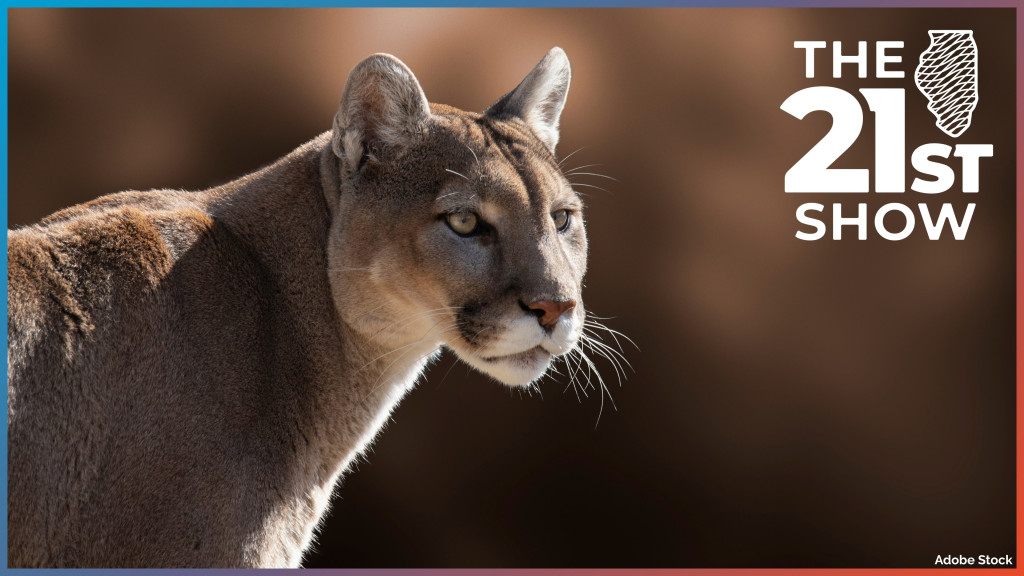
Transcript: Why are we seeing more mountain lions in Illinois?
The 21st Show
Why are we seeing more mountain lions in Illinois?
Read the full story at https://will.illinois.edu/tags/why-are-we-seeing-more-mountain-lions-in-illinois.
Transcript
// This is a machine generated transcript. Please report any transcription errors to will-help@illinois.edu.

[00:00:00]
Brian Mackey: From Illinois Public Media, this is the 21st show. I'm Brian Mackey, and we begin today with an unusual visitor spotted this month in far southern Illinois.

[00:00:18]
Speaker 1: A mountain lion may have made a temporary home here in Illinois.

[00:00:22]
Speaker 2: Multiple sightings have been reported in the Union and Jackson County area.

[00:00:26]
Speaker 3: Officials say they believe the sightings are the same animal [lions]

[00:00:30]
Speaker 4: and tigers and bears.

[00:00:32]
Speaker 5: Oh my.

[00:00:36]
Brian Mackey: Oh my indeed. Well, our phone lines are open for the next 15 minutes on this at 800-222-9455. What is your experience with mountain lions and other big predators in Illinois? What have you heard about how they got here and what would you like to ask a state wildlife biologist about them? 800-222-9455 is the number to join us today. 800-222-9455. We are joined now by Chris Jakes. He's got a PhD in wildlife and fisheries sciences, and he is the [wildlife] large carnivore and invasive species program manager at the Illinois Department of Natural Resources. Chris, welcome to the 21st show. Thanks for making the time.

[00:01:23]
Chris Jakes: Sure, thanks for having me.

[00:01:24]
Brian Mackey: So let's start with the basics. What exactly is a mountain lion?

[00:01:30]
Chris Jakes: Well, uh, mountain lion, um, it's, uh, it's a member of the, the, the [felid] family, right? Uh, that of, of cats, uh, so it's just, uh, it's, it's a, it's one of the biggest cats, uh, that we, we have recognized as a group of professionals, um, the 4th biggest cat in the world, um, and certainly, uh, the biggest cat here in North America. So, um, you know, they're very widely distributed species. They hold the greatest geographic range of any native nonhuman animal in the Western Hemisphere, so they're very, very widely distributed, stretching from Canada to the southern Andes in Patagonia of South America. So extremely widely distributed.

And yeah, they, uh, they seem to be uh frequenting the state, uh, at least in recent years with, with a little bit more uh regularity than, than uh the previous couple of decades. So.

[00:02:28]
Brian Mackey: Yeah, and just, just so we're clear on our terms, people might use the phrase uh cougar, puma, mountain lion. These are all the same species.

[00:02:37]
Chris Jakes: Yeah, this is, uh, you know, and not, not surprisingly given [how widely] distributed the animal is, it is also a species that has the greatest number of common names with over 40 recognized common names. So you'll often, you know, you'll often hear cougar and panther and catamount. Catamount is sort of, you know, combining the fact that it's a cat with where it lives in mountainous types of terrain. So catamount. You'll see puma, um, you'll see — and, and also an old Cherokee name, uh, [Claagi], which means, uh, it's, it's a, a cat, it's a name for cats meaning lord of the forest. So I think that's, that's a rather interesting one, but, uh, generally speaking, in the United States, you'll see mountain lion is the most commonly used common name. And just our friends to the north in Canada, they most often use cougar as the most common name for the species we recognize as [puma conkar], which is the recognized scientific name.

[00:03:43]
Brian Mackey: And just briefly, not bobcats — that's something different.

[00:03:47]
Chris Jakes: It is not a bobcat. No, it's a completely different genus than bobcats, and certainly, you know, the morphological and behavioral and, um, you know, uh, differences in habitat requirements of the two are, um, vastly different and, and also the, the size, of course.

[00:04:06]
Brian Mackey: All right, so, so, so how do we know that that one of these fellows — and, and do we know it's just one? I mean, yeah, take us through what we know about what's happening in southern Illinois.

[00:04:15]
Chris Jakes: Yeah, yeah, that, that mountain lion, we suspect, given how how often these things are reported, reported or have been since the early 2000s in Illinois — to frame this in in that context, we only had 11 confirmed sightings of mountain lions in Illinois since 2002, so they're not a frequent visitor of the state, but they they they do pass through the state. And of those 11, five of those have occurred since 2022, so we're seeing at least a relative increase in sightings of mountain lions in the state in the past four years anyway.

And the most recent being here in southern Illinois — our local district wildlife biologist, uh, received the, the initial report of this animal back in late August, I believe it was the 23rd of August, um, and he got that from a trail camera photo from a landowner, and he then visited the site to confirm the fact that this was an animal, the animal mountain lion standing in this particular spot on the landscape. Um, and then since then, uh, the animal has just been moving kind of around the southern Illinois area in and around the Carbondale area. So we got another report of that animal, um, in, in September — uh, or we've had several reports of it in September now — but the 23rd with the initial sighting in Jackson County just east of the Big Muddy River, uh, traveling toward [Murfreesboro]. And then a couple of weeks later on the 13th of September, we got another verified sighting of of additional trail cameras and a video actually of the animal just south of Carbondale, about 8 miles, and then again on the 25th last Friday, we got another sighting of the animal in Union County near Alto Pass, so he's kind of moving around in a circular kind of motion in and around the Carbondale area, about 8 to 10 miles south of Carbondale, in and around the Shawnee. So.

[00:06:33]
Brian Mackey: You know, you've mentioned trail cameras a few times. Part of me wondered, as a, as a city guy, this was somewhat, you know, the widespread presence of trail cameras is a little bit, uh, was unexpected for me. And I don't know if like every hunter in Illinois got one of these things for Christmas in the past few years. Could that be one of the reasons that we're seeing more now — is that we just have, you know, cameras that we couldn't have even imagined being possible 10, 20 years ago?

[00:06:58]
Chris Jakes: I, I suspect, yeah, that that there's probably a very strong association with at least increased sightings in the past 4 or 5 years with the fact that, yeah, trail cameras are, you know, like you say, every hunter seems to have at least one of these things in the woods monitoring for, you know, uh, huntable species. And it's it's not all that surprising that that mountain lions are out there walking in front of these cameras as well. So yeah, it's definitely a technology that is facilitating a much greater observation of these, and and in some ways making our job a lot easier to to monitor the, the movements of these animals as they, um, you know, maintain some temporary stay in Illinois.

[00:07:45]
Brian Mackey: All right, let me share a couple of messages we got from listeners, uh, in our texting group. Uh, we heard from Helen in Springfield, who says, "I hope the mountain lion can be captured and taken to a location where it will be safe. This is a poignant situation in which our growing human population leaves no possibility for a free and active existence for a mountain lion. For its own good, I hope it will be taken to a healthier environment. I hope it is not killed for no reason." Christopher in Brimfield though says it's a good thing to have them back, we can cohabitate with them. And we also heard Karen in [Champagne] saying yay for the return of mountain lions to Illinois. Uh, and she wants to know, do we think the mountain lions are spreading from South Dakota and Nebraska? What have they had to do to survive the journey? We're talking about this with Chris Jakes, who's a wildlife biologist at the Illinois Department of Natural Resources. So Chris, how about that? Do we think — I know in the past there was some DNA testing. What do we know about where this one may have come from, or what can we speculate about at least?

[00:08:47]
Chris Jakes: Yeah, we don't, we don't know specifically, you know, the, the, the natal range or the place of origin of this specific cat, but, but yeah, the, the, the [callers] are right in that we have traced back through some genetic analysis, uh, some of our more frequent, uh, you know, visitors to the state to a population in the Black Hills of South Dakota. So, they're making long-distance sort of dispersal movements out of their natal ranges in search of a permanent place to live, and often those movements — they go on a long walkabout. The longest that we know of to date through verified genetic analysis of an animal that ended up as a roadkill in Connecticut occurred about a decade ago, and that animal originated in the Black Hills. We've also had others that have been unfortunately struck and killed by — by a train of all ways to die — of of an animal from the Black Hills in Oklahoma, so they're making long-distance movements.

But that's pretty typical of these larger cats anyway. They are — mountain lions are a species that we describe them as an obligate disperser, meaning they, they are obligated to move away from the areas that they were born. And you know, otherwise they risk, you know, certainly injury by resident toms, resident dominant males, tomcats, or worse yet for these young dispersing males primarily. So they, they have not much of a choice other than to go on sort of a walkabout in a sort of a dispersal type of movement to try to find a place that they can call home. So.

[00:10:41]
Brian Mackey: Yeah, all right, let's go to the phones. We have Rick calling from DeKalb County on line one. Rick, I understand you have a sighting of a different carnivorous species here.

[00:10:51]
Rick: Yeah, yeah, so, um, I'm, I'm a naturalist. I have a master's in biology. I'm pretty good at animal identification. And I like hiking a lot in northern Illinois and about 8 years ago at Rock Cut State Park, I'm hiking through an area that's not really well traveled, and actually I was on my cell phone answering a call when out of the brush, literally 50 ft away from me, was a wolf. And I know coyotes. I see them all over the place, and this wolf — I mean this animal acted so much different than a coyote. It just, it just came out of the brush, stared at me, looked at me. I had my phone by then in my back pocket, didn't think for a second to take a picture. It was just staring at me, and I wasn't even scared. My eyes were just mesmerized together. It was a white, very blondish wolf. And then just turned around and loped it back into the cover, the big bushy tail behind him, and I was like, oh my God, that was the wolf. I'm positive.

And then I called my brother-in-law who's a fisheries biologist for Illinois, and he did a little investigating and sure enough they had a photograph from a trail cam in the Rockford area north of Rockford, [Brockton], of this white wolf going through someone's backyard. So that was kind of my confirmation, and it was just so neat. And then I went back days later and I saw a really large scat that looked bigger than a coyote would — with the fur and the way the way coyote's, uh, you know, [poo] is — but much larger, almost dinner plate size. But it was just a really neat encounter, and I just feel really — it's like my spirit animal now that I got to see this wolf. And, you know, I try to explain to my friends how, you know, I felt, and they're — I don't think they're skeptical anymore. I think they really believe I saw it.

[00:12:40]
Brian Mackey: Yeah. All right, uh, Rick, thanks so much for calling in. I appreciate it. Chris, how about that? I mean, we, we've had black bears, now wolves apparently. Um, is this, you know, uh, again, something that, that is a measurable thing we're seeing more of, or are we just catching more of it on these cameras? How are you thinking about this?

[00:13:00]
Chris Jakes: Yeah, I mean, we, we are certainly in addition to mountain lions monitoring, you know, sightings of, of, of black bear in the state as, as well as wolves. And, you know, the same sort of pattern seems to be emerging, are consistent with that of mountain lions for for black bear at least. Wolves are a little bit different, you know, they're, they're not quite as as as common as, you know, black bear, and it seemed like mountain lion and black bear sightings in recent years anyway. However, the caller did allude to, you know, that sighting of a of a wolf in the Rockford area, Rock [Cut] State Park area. And you know, our last confirmed sighting of a of a wolf was actually in the Rockford area. So I, I, I, I find that to be, you know, absolutely credible in that we have, have documented them there in the past, uh, that exact [part] that he was, he was walking in and had the encounter in.

But, but yeah, we, we just, um — and I think it's more of the same, you know, the cameras and people are just much more vigilant now — we continue to, you know, report of these sightings of these animals in the state. And and and species like a black bear, I mean they're they're pretty easily identified and more likely to be encountered by members of the public during the day, given their sort of diurnal types of movement patterns relative to that of of mountain lions, which are much more sort of crepuscular — active, you know, at the sunrise and sunset — and then of course primarily they're a nocturnal species. So the likelihood of encounter with these other species like, uh, black bear particularly, um, is, is not surprising and, and likely, um, relatively higher than that of these other more secretive predators like mountain lions.

[00:15:00]
Brian Mackey: Yeah, well, just, uh, less than a minute left and I'm gonna have to hold you to it because we're on a fixed clock. But if someone does encounter one of these, uh, mountain lions or any of these apex predators, what should they do?

[00:15:12]
Chris Jakes: Yeah, I mean, well, well, first of all, you might want to go buy a lottery ticket because, you know, you're you're among the very few that that have actually had an experience like this. So enjoy the experience. Certainly respect the animal and its space. It is a wild animal, so give it its space. Don't approach the animal. And you know, most importantly, if you could report that observation to us — just simply go to our [ID on our] website and [a] large carnivore sighting and report that observation to us. That certainly helps us to to monitor the, the, this animal as they're uh frequenting the state.

[00:15:54]
Brian Mackey: Well, fantastic, and we will make sure to put a link to that uh reporting page on our website, twentyfirstshow.org. Chris Jakes, wildlife biologist with the Illinois Department of Natural Resources, thanks for being with us and sharing some of your expertise with us today here on the [21st] show.

[00:16:10]
Chris Jakes: Yeah, thanks for having me.

[00:16:13]
Brian Mackey: More to come after a short break. Please stay with us.
Transcript Assistance
Illinois Public Media may use AI assistance for transcript generation and/or formatting. Transcripts that have not yet been reviewed for accuracy will be labeled.
To report a transcription error, or to request transcription of archival material, please contact will-help@illinois.edu.