Behind the scenes of a psychological thriller filmed in Central Illinois
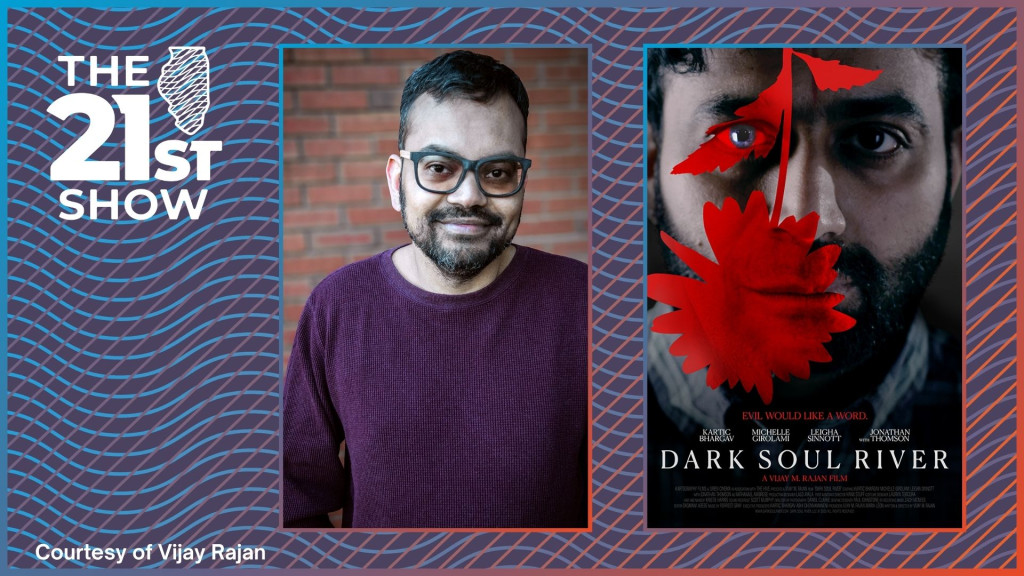
Courtesy of Vijay M. Rajan
// This is a machine generated transcript. Please report any transcription errors to will-help@illinois.edu.

[00:00:00]
Brian Mackey: It's the 21st Show. I'm Brian Mackey, and we are taking a detour from Route 66 to return to the growing field of moviemaking here in the 21st state. This weekend, another film shot in central Illinois is getting its public debut. It's called Dark Soul River. It's a psychological thriller. Let's listen to the trailer and be warned, this is kind of spooky, and there's a medium grade use of profanity.

[00:00:37]
Speaker 1: How many victims are there really, Nathaniel?

[00:00:40]
Speaker 2: I won't talk to you. But I will talk to him. This man from India. Marie's brother.

[00:00:56]
Speaker 1: Why him?

[00:01:00]
Speaker 3: I don't know why he chose

[00:01:02]
Speaker 4: me. He just wants to torture another family member, my

[00:01:05]
Speaker 5: mother, my

[00:01:06]
Brian Mackey: husband. I never even saw her

[00:01:08]
Speaker 5: again. Maybe a lot of people will finally find some peace.

[00:01:14]
Speaker 3: What he is

[00:01:15]
Speaker 1: is pitch black. It can twist your mind, make you believe damn near anything. The man is

[00:01:20]
Speaker 6: a monster. How are we supposed to figure out that sick son of a bitch is mine?

[00:01:29]
Speaker 5: Welcome, friend.

[00:01:32]
Speaker 1: We'll beat him together. As much as we love to pretend it doesn't, evil

[00:01:35]
Speaker 7: exists. Everything I say is important. Pay attention.

[00:01:45]
Speaker 8: We can't be frightened away from who we are. Not even by monsters.

[00:01:53]
Brian Mackey: Again, that was the trailer for Dark Soul River. A workprint of that film — we'll get into what that means — but a workprint of the film is being shown at 7:30 p.m. this Saturday, Sept. 19, at the Virginia Theater in Champaign. That'll be followed by a Q&A with some of the cast and crew, and we'll have more information about that on our website, twentyfirstshow.org.

The writer and director of Dark Soul River is ViJ M. Rajan. He joins me now from our Urbana studios. ViJ, welcome to the 21st Show.

[00:02:23]
ViJ M. Rajan: Hi, Brian. Thank you for having me. And listeners,

[00:02:25]
Brian Mackey: you can join us if you have a question about moviemaking in central Illinois. 800-222-9455 is the number. 800-222-9455.

All right, what is the genesis of this project? Where did the idea for Dark Soul River come from?

[00:02:41]
ViJ M. Rajan: Well, I grew up as a fan of so many classic films, and "The Silence of the Lambs" was always one of my favorites. And one of the things I really liked about "The Silence of the Lambs" is on the surface level, it is your classic psychological suspense thriller, but it also had quite a lot to say about feminism and the male gaze, and there's so much packed underneath.

[00:03:05]
Brian Mackey: It puts the lotion in the basket.

[00:03:08]
ViJ M. Rajan: And it does so much more than that, too. And so I wanted to do something in that vein but that also did for multiculturalism — and really putting multiculturalism and diversity in the spotlight — in this very genre environment.

[00:03:28]
Brian Mackey: Yeah, and I wanna come back to that point. Let's save that for a little later, but what's in a name? Dark Soul River.

[00:03:33]
ViJ M. Rajan: So, the basic synopsis is that a serial killer is finally going to — sorry — a serial killer is finally going to confess where the rest of the bodies are buried, but there's a catch. He is only going to confess to the brother of his last victim. The brother is an Indian Hindu who came from India only to settle his sister's affairs and is now caught in this intimate one-on-one confrontation with evil.

The dark soul in the title essentially comes from the way that I write — so much of what I do is I will find a word that is interesting to me from different directions that maybe even different cultures or different characters can see denotatively the same, but the connotation really provokes an interesting dramatic contrast. And this project actually began with that word "soul," which my Indian protagonist would call [Atma — review for accuracy], and how these two characters, the serial killer and the victim's brother, would define this word differently. And what that would mean.

[00:04:44]
Brian Mackey: Interesting. Is there a tradition of horror? You know, obviously India is well known for moviemaking. A lot of people associate Bollywood and kind of musicals and romance and stuff. Is there a horror film tradition, culturally?

[00:04:57]
ViJ M. Rajan: Absolutely there is. I would say that if there is a type of film, India probably does it. It is different. The horror tradition in India is different. I mean, it does come with music even in a lot of those movies.

For me, I think culturally what is so dynamic about the coming together of these different cultures is essentially the clash — the clash of ideologies and styles. So as you talked about Bollywood having music, one of the things I think is really cool about my film is the soundtrack, where we not only have a very cool, edgy synth piano-cello kind of soundtrack, but we also included [Miram Vina — review for accuracy], [itthar — review for accuracy], [Bonsui — review for accuracy], and other Hindustani and Carnatic voices making this new kind of mix that I'd never heard before. And I have to give huge props to my composer Forrest Gray for being able to navigate that cultural cohesion.

[00:06:04]
Brian Mackey: I really dig — I don't know if he also did the music in the trailer; I know sometimes that's separate — but it was very evocative. Tell people who are not familiar with his, you know, sort of IMDb page what he's known for.

[00:06:16]
ViJ M. Rajan: Well, he's done a lot of stuff. He scored the music for an original movie called "Barber" that featured Aidan Gillen of "Game of Thrones" fame, but he's also done music for "Bridgerton," "The Morning Show," "Finest Kind" — the movie with Ben Foster and Tommy Lee Jones. So he's a talent, and I'm very lucky.

[00:06:39]
Brian Mackey: All right. So let me remind listeners, this is the 21st Show. We're talking with the writer and director of a movie that was shot here in central Illinois, ViJ M. Rajan. It's called Dark Soul River. It's premiering at the Virginia Theater in Champaign this Saturday. More information about that at our website, twentyfirstshow.org. And you can join us at 800-222-9455.

So why central Illinois? How did you — I understand the movie is set around the Kansas River, which, as the name suggests, is largely in Kansas. Why shoot here?

[00:07:13]
ViJ M. Rajan: So I've lived in central Illinois for five years now. I'm a Champaign resident and I suddenly started realizing so many of the production benefits of filming here, and that was threefold. Sure, there's a very generous tax rebate here, but I also became aware of Flyover Film Studios in Rantoul, where —

[00:07:37]
Brian Mackey: Yes, we've talked with them on the show.

[00:07:38]
ViJ M. Rajan: Yeah, it's terrific what they're doing here. And to have a 100,000-square-foot soundstage where we could build sets — my primary interrogation room set was at Flyover — and also the way they were able to connect me to production resources, it was a phenomenal working relationship.

And the third part was really the community itself. I have previously shot movies in California, and I can tell you the crazy thing about making movies in central Illinois is how excited people are about it here. When you ask someone, "Hey, can I use your business as a location?" or "Can I use your home as a location?" people are still super excited by the movie industry. Just the support of the community was phenomenal. That's why I wanted to do the premiere here before we really went off on the film festival circuit.

[00:08:29]
Brian Mackey: That's a great point, because good luck finding somewhere in the greater LA area that hasn't been in some TV show or movie or something at some point.

So, you know, one of the interesting things about making a movie — as so many workplaces in [2020 — review for accuracy] are, right — you shoot it here, but it's an intercontinental production team. How is that process working?

[00:08:50]
ViJ M. Rajan: Well, things have changed a lot since I started filmmaking in the early 2000s. So much stuff is remote. Our VFX team worked out of India, my music composer [worked out of] LA, my sound designer and re-recording mixer — that was New York. My editor was based out of the Pacific Northwest, so we definitely had a very wide-ranging crew.

I will say, though, my favorite part of it is still in person. You can do so much technologically now, but there is something to the artistic value of just working next to someone, staring at the same screen together. So I took a trip out to New York and did that with my sound designer, and I'm so happy that my colorist and cinematographer is local so I could just go over to his house and do that post-production there.

There are so many resources and opportunities and talented people here that I can't really think of any reasons why I shouldn't be filming many more properties here.

[00:09:56]
Brian Mackey: So as I mentioned in the introduction, you're showing what's called a workprint. What does that mean for people who are not in the industry?

[00:10:02]
ViJ M. Rajan: So a lot of people have been like, "Oh, does that mean it's a rough cut?" No, it's not a rough cut. The movie is done. A workprint essentially is the first export to a format called DCP, which is a Digital Cinema Package, and that's the format that can play in a theater. So it's the first time I'm seeing it in a massive theater. It's the first time many of the crew are seeing it at all at this screening. And so while we might make some changes to the mix in terms of color and sound, the movie is done, but it is an opportunity to see it in its first complete state.

[00:10:44]
Brian Mackey: Yeah, and at the Virginia Theater, which people locally know has a lot of local history. It was the home of Ebertfest — RIP — you know, what's it like for you showing this, or having your first screening there?

[00:10:56]
ViJ M. Rajan: I think it's terrific. To be honest, when I moved to Champaign, for the first couple of years I worked remotely for a theater company out in California, so I didn't meet many people here. It's only in the last three years that I feel like I've been out and about and have really become a part of this community.

In my other life, I'm also the executive director of the [Champaign]-Urbana Symphony Orchestra, and through the course of making this film, the connections that I made have really made me feel welcome. And the Virginia Theater is no different. I am so impressed by how much they've been helping us market, putting the word out there and just championing us as a locally produced film. Just this morning, I went by the Virginia and I saw that the marquee is up with our name, and it's just a really cool feeling of being a part of this kind of special community.

[00:11:52]
Brian Mackey: So just a few minutes left in our time together. You mentioned the multicultural dimension of this work. You know, this is a time when there are a lot of people in America who've made the growing diversity of our country a major issue in their politics, something to resist. How do you approach a movie like this in that context?

[00:12:11]
ViJ M. Rajan: Well, that's why it's a genre film rather than a political screed, because I do think that is such a great point, Brian, because we are living in a time when many politicians would tell the average American to be frightened of and suspicious of anything foreign. So, to make a film in which a very American serial killer is decoded through a foreign lens does feel very timely right now. But you have to do that within a story that is twisty, exciting, a mystery — has all of these things — so that people are able to absorb it narratively in a way that operates in the subconscious and in the context, rather than directly through a political screed.

I think it's a very interesting time to be an American. And what I thought was so crazy about what [John — review for accuracy] [Pdt — review for accuracy, possible last name] said in the previous section about how Route 66 was diverse and the interstates and the other highways became more homogeneous — that's how I feel about indie film in general. Independent film is Route 66, where you have weird mom-and-pops and all kinds of conflicting things, and the studio system to me is the highway system where you kind of get the same things in the same big-box stores popping up. And there's such a value in that, because I think it's the Route 66s that really challenge people's perceptions and allow an underlying empathy to grow and to be fostered.

And I'm so grateful that Illinois and the communities of central Illinois seem to understand this to their intrinsic core, and this is just a great place to be and a great place to premiere my film.

[00:14:04]
Brian Mackey: Well, you can see Dark Soul River — it's premiering this Saturday, Sept. 19, 7:30 at night at the Virginia Theater in Champaign. ViJ M. Rajan is the movie's writer and director. We'll have more information on all of this at our website, twentyfirstshow.org. ViJ, thanks so much for sharing your work with us

[00:14:25]
ViJ M. Rajan: today. Thank you so much for having me, Brian. Pleasure to be here.

[00:14:42]
Brian Mackey: And that is all we have time for today. Tomorrow, we are back on Route 66. We're gonna pay a visit to the American Giants Museum — those large roadside statues that you see, men holding mufflers and flags and missiles and that sort of thing. And then we will talk with the author of a book about Route 66 and America and central Illinois in the Prohibition era.

That's all coming up tomorrow here on the 21st Show, which is a production of Illinois Public Media. I'm Brian Mackey. Thank you for listening. You can find a podcast of this program at our website, twentyfirstshow.org. That's it. We'll talk with you again tomorrow.
This weekend, a film shot in Central Illinois is getting its public debut. It’s called “Dark Soul River,” and it’s a psychological thriller.
A workprint of the film will be shown this Saturday at the Virginia Theatre in Champaign. That’ll be followed by a Q&A session with some of the cast and crew. The writer and director of “Dark Soul River” is Vijay M. Rajan. He joins the program today.
GUEST
Vijay M. Rajan
Writer and Director, “Dark Soul River”