







Collin Corbett, independent candidate for Illinois governor
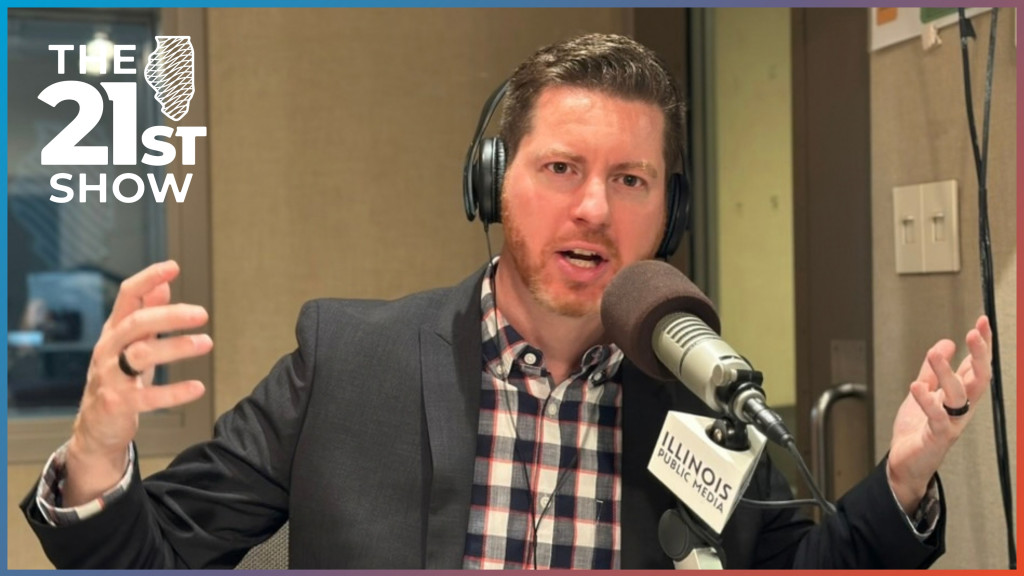
Collin Corbett on "The 21st Show" on Tuesday, Sept. 29, 2026, at Illinois Public Media's studios in Urbana. Brian Mackey/IPM
[00:00:00]
Brian Mackey: Today on the 21st show, Collin Corbett was a Republican political consultant and a podcaster. That is until a few months ago. Now he's an independent candidate for governor. He'll join us live for a conversation on Illinois politics and policy, and what it's like campaigning outside the two-party system. We'll also take your questions, so give us a call at 800-222-9455. I'm Brian Mackey with Collin Corbett for the hour today on the 21st show, which is a production of Illinois Public Media, airing on WILL in Havana, WUIS in Springfield, WNIJ in Rockford DeKalb, WVIK in the Quad Cities, and WSIU in Carbondale. But first, news.

From Illinois Public Media, this is the 21st show. I'm Brian Mackey. This year, Illinois voters are going to have three options when they cast their ballots for governor: incumbent JB Pritzker, the Democrat; Republican challenger Darren Bailey; and a third, independent candidate by the name of Collin Corbett. Corbett was, until a few months ago, a Republican. He worked for many years as a political consultant, and he hosted an Illinois politics podcast called Smoke Filled Room. He left all that behind to mount this campaign for governor. Though, it would probably be more accurate to say the Republican Party left Corbett. That's exactly how he put it in the final episode of his podcast. "My beef is with my team," Corbett said. "My team has failed and has failed miserably." Corbett has acknowledged his campaign is a long shot. It nevertheless raises many interesting questions, including: What do voters mean when they declare themselves to be independent? Why hasn't an independent majority made itself better known in our political system? And where does real change actually happen in American politics? Here to talk more about all of this and his campaign is Collin Corbett himself. Welcome.

[00:02:20]
Collin Corbett: Thanks for having me. This is great to be here.

[00:02:23]
Brian Mackey: So Mr. Corbett is with me live in studio in Urbana. I invite you to also join us live at 800-222-9455. Maybe you are one of those people who are frustrated with both political parties. Maybe you tell pollsters you're an independent. Maybe you do actually think you're aligned with one of the parties, but you don't like what some of the actual elected officials in your party have been saying and doing of late. Wherever you are, we want to hear from you at 800-222-9455. That's 800-222-9455. All right, I'm going to start with channeling my father and the question he always wondered about politicians, which is: Why on earth would anyone want to run for office?

[00:03:05]
Collin Corbett: Yeah, it's funny because I said the same thing for years. I trained over 3,500 candidates throughout the country, and I always thought every single one of them was nuts, and here I am doing it myself. But I think you have to reach a certain level of frustration, a certain level of realizing we need to change things, and I can't believe I'm saying this, but I may be the only one who can actually make that change happen. That's the conclusion my wife and I came to when we really felt like something needed to change in our politics, and we went out and we recruited. We tried to find somebody who would run, and we met hundreds of people who said, "I love what you're doing. We'll back what you're doing, but heck no, I'm not going to step out and be the candidate." So it turned out that either I ran or this just didn't happen, so here I am.

[00:03:50]
Brian Mackey: "Only I can fix it." That rings familiar. So tell me, what is the change you're trying to bring? You say that you're the only one who can do this. You tried to recruit. What were you recruiting for?

[00:04:02]
Collin Corbett: Getting people to realize that if we don't start letting these politicians know that our votes are important, that our votes are not something that they can take for granted. Right now with the two-party system, especially with gerrymandering and everything else, because there's a lack of competition in politics, most of these elected officials on both sides of the aisle really take votes for granted. They take their reelections for granted. And most of that is because voters in the middle — the mainstream, the independents — either stay home or are irregular voters. If we're going to get change to happen in Illinois and around the country, it takes bringing people back to the political system, getting people to participate in primaries, to participate in general elections, to participate in the process.

And so what I want people to recognize is that there is a different option. It doesn't have to be red or blue. It doesn't have to be Republican or Democrat. And if we can do that — I'm not saying we're going to go elect independents in every seat. Frankly, this has been a two-party country for a very long time, and I respect that fact. But if we can get the two parties to recognize that if they don't stop this destructive path that they're on chasing the two extremes and force them to come back to the middle, then maybe independents, maybe a third party could dwarf them in the political process. And so that's the change we can create in our politics.

[00:05:20]
Brian Mackey: So you've acknowledged your candidacy is a long shot. Sketch out for me what would be your path to victory here in this two-party system where one of the candidates happens to be, if not the, maybe the second-wealthiest politician in America.

[00:05:34]
Collin Corbett: Yeah, so I owned a polling company for a long time. So as you said, I'm aware of the odds. I'm aware of the likelihood of me winning. But I wouldn't have gotten in this race if the odds are zero. There is a chance that it could happen. The clearest path to that — which this will not happen, but you asked the question — the clearest path to that is if the Republican candidate were to get out. He's incredibly unpopular, especially throughout the suburbs, and his polling is underwater, again, especially throughout Chicago and the suburbs. We actually have data that shows that while Bailey is polling anywhere from 14 to 20 points down head to head with Pritzker, an independent is only down two. And so if we had the resources to run a race and if we had a two-person race, we could make Pritzker real scared. He probably would still win — as you said, he's a billionaire, he's the incumbent, he has all the natural advantages. But unlike the Republican candidate in this race, who has struggled to make this any bit of a contest, if we had a two-person race, we could actually make it a contest. That's unlikely to happen. But as an answer to your question, there is a path to victory for us, whereas for the Republican candidate there is not.

[00:06:37]
Brian Mackey: What do you mean by independent voters? You talk about an independent majority. That's what you're trying to build here — if not for your own victory, then perhaps down the line somebody else can come in and inherit this seed that you're planting today. How many metaphors can we mix in here? Talk to me about what your theory of the case is that there is some independent majority out there in America.

[00:07:01]
Collin Corbett: Yeah, Gallup did a study — they do it every year — where they identify how many people are independent versus how many self-identify as Republican or Democrat. And as of the end of last year, it was 45% in America were independent, only 27% Democrat, 27% Republican. CNN did their own study just a few months ago. They found that it was 47% independent. This number has been growing since 2008. It's primarily driven by Gen Z, millennial, and Gen X — especially Gen Z and millennial. I'm a millennial, so I'm sure it's no surprise then that I feel the same pull that many of the people in my generation do, where we're pulling away from the two parties. It doesn't mean we're all in the middle. It simply means that we're frustrated with the two parties.

And so I'm not saying that there's a 47% that we can control in the middle as a movement together as a majority. That number, if you're looking more towards left, center, right in Illinois, [is] more like 38%. So the latest poll that we did before I stepped away from my polling company found that 38% of Illinoisans are moderate, 35% conservative, 27% liberal. This is still a working-class, center-right on fiscal issues, center-left on social issues, state. And so there is still a plurality in that middle of people who are more mainstream. So no matter which way you slice it, whether you look at independents versus the two parties or moderates versus liberal versus conservative, the middle is still the largest group within our politics. We're just constantly told that if you don't vote for one of the two parties, you're wasting your vote. But actually, the truth is if we banded together, they'd be wasting their votes voting for the two parties. We've never done that in our politics, but we're seeing this movement around the country where this very well may start to happen, not just in Illinois, but in states throughout the country.

[00:08:44]
Brian Mackey: You know, when a voter says "I'm independent" to a pollster, a lot of times they mean "I don't like labels," right? Like, maybe I don't think the Democrats are liberal enough — I wish Bernie would have been in there. Or maybe I think Illinois went wrong when it didn't elect Alan Keyes 20 years ago or something like that on the Republican side. Well, PTSD for your listeners — that's a deep cut right there. How do you disentangle this idea that people don't like labels in America, but maybe that doesn't mean that you're going to get these people to band together in some kind of way behind — I don't know what the platform would be.

[00:09:29]
Collin Corbett: Yeah, well, actually you hit on it at the very end there: the platform. So my running mate and I are rolling out an actual platform starting this week, because I'm frustrated with this thought process that many people have — that if you're in the mainstream, if you're a moderate or if you're an independent, you're just half a Republican and half a Democrat. That you really are just somebody who, you know, puts your finger up in the air, feels where the wind is blowing, and that's the direction you go. I resent the idea that those of us who are in the mainstream don't have strongly held beliefs just because we aren't on the far end of the spectrum.

[00:10:00]
Brian Mackey: No, Americans are weird. I grant you that. Like, compared to most elected politicians, most people have a strange mix of views, right, that don't fit into what Gallup would want. So yeah, go ahead.

[00:10:11]
Collin Corbett: Yeah. And so what we're going to roll out is the things that we've been talking about over the past few months. If you look at my social media, you see very few one- or two- or three-sentence posts that are designed to get maximum engagement. I've run social media for campaigns for decades. I'm aware of the best way to get the algorithm to give you views, but our whole goal here has been to provide solutions. It doesn't do us any good if we just go elect another politician who has no solutions to the problems we face. And so we're rolling out an actual platform that shows you can stand for something while still being an independent or being a moderate.

And as I mentioned, owning a polling company, I've got years and years of polling data on specific issues where I know where the mainstream position is on every single position. And I can tell you that it's typically a 70, 80% positive position when you pick that mainstream position. In fact, one of the things we're doing in our campaign that no one else has access to: we bring 56 regular people around the table, we pick a hot-button issue — take abortion, guns, immigration, something that tends to light people on fire a bit — we put them around the table, and every single time in less than a half hour, everyone arrives at a consensus that they all agree with. The only thing that tends to make us disagree with each other is the injection of partisan politics. Once you remove that, there's a common-sense position on every single issue, and frankly it's not hard to find. And we're going to emulate that with our platform in this campaign.

[00:11:35]
Brian Mackey: All right, we're going to come to policy in a little bit. Let me remind listeners this is the 21st show. We're speaking with Collin Corbett, who is an independent candidate for governor of Illinois. We've already spoken with the Democratic incumbent JB Pritzker and his Republican challenger Darren Bailey. You can find those interviews at our website, 21stshow.org. If you want to join us today, 800-222-9455. That's 800-222-9455. Before we get into the weeds of policy, tell me a little bit about yourself. What is your sort of Illinois origin story?

[00:12:06]
Collin Corbett: Yeah, so born in Batavia, then my family moved to the northwest suburbs, and I grew up in Palatine. Spent a little time in [Lake Zurich] and Hawthorne Woods as well, but grew up in Palatine. Moved out when I was 18, then found my way back to Palatine, and I've been living there ever since. My wife and I, we raised our little boy there. She's pregnant with our second. He's a boy. We're excited about it. Well, I'm excited about it. My wife's gonna feel a little outnumbered, but we'll make it work.

And I really had a passion for getting people involved in the political process. That has been what I've worked on for the last two decades. Again, didn't expect to see myself on this side of the curtain, but it really was all about: if we could get everyday people, regular people, to get engaged in the process, to run for office, that's how we're going to change things. And so that's what I've worked on for the last few decades. But I got my first job at age 12, my first full-time job by 15, helping take care of the family. Didn't get a chance to go to college because we just didn't have that opportunity. But I've been working as long as I can remember. So putting in the effort to build something like this isn't new to me. I'm an entrepreneur. I've started a number of businesses and organizations, and so starting something from scratch isn't new for me. I know the challenges of that. And yeah, this is new for many people — I'm only the third independent to make the ballot for governor in 86 years. So this is a new idea for people, but I'm in for building this well beyond November.

[00:13:28]
Brian Mackey: What got you interested in politics?

[00:13:31]
Collin Corbett: It was the ability to have a career, to make a living, to have a job, but also help people — being able to do both things. For many people that I knew, it was either/or. It was: do your job, and then if you can find some time on the weekend, go volunteer for something that you care about. Or be a do-gooder and then struggle to pay your bills. I really loved the idea that I could get involved in politics, I could build a business, I could work, I could take care of my family, while also all day making an impact and making people's lives better. That's what really drew me to it.

[00:14:02]
Brian Mackey: What is your political awakening, right? So I'll give you an example. For me, in high school in the early '90s, Contract with America, Newt Gingrich, the Republican majority — that's kind of where I first started paying attention to politics. How do you enter the scene?

[00:14:16]
Collin Corbett: My story is so dumb and boring, but I'll share it with you, which is: I was doing events. I was traveling throughout the Midwest, putting on events. And I was driving a lot, and right around that time was when gas prices skyrocketed. And it was the first time in my life that I realized — this was 9/11, so this was 20 years ago, so it would have been a little bit after that — and it was the first time in my life that I realized these things you hear about on TV, these policies that these politicians put forward, oh wait, it actually impacts my life. And so that clicked in my brain and that was the turnaround for me. So I don't have some big, the-skies-parted sort of story. And the issue itself of gas prices is obviously sometimes big, like now it is, but other times it's not. But that was the aha moment for me that public policy actually impacts my life. And once I came to that realization, I couldn't help but get involved.

[00:15:13]
Brian Mackey: All right, we are talking with Collin Corbett. Again, if you want to join us today, 800-222-9455. That's 800-222-9455. We're gonna be talking about policy. I'm gonna share a few of the text messages we've gotten, and you can address some of these when we come back. Kevin in [Farina], Illinois, says: "As a former Republican, are you running interference for Mr. Bailey? I mean, I like what you claim to be doing, but I'll not take the risk of that man winning the race." Christopher in Brimfield says: "Wow, all we need is another podcaster. No, thank you." And Lloyd in Danville says: "JB has done the work to improve the state's credit rating, among other notable things. Bailey is not in touch with traditional Republicans. Corbett must clearly define how he plans to, against headwinds, bring a global economy to Illinois."

So we're going to tackle some of these questions when we come back. Again, my guest today for the hour, Collin Corbett, independent candidate for governor of Illinois. If you want to join us, you can do so at 800-222-9455. That's 800-222-9455. We'll have more here on the 21st show after a short break.

I should also mention coming up later this week, we're going to be taking stock of where America's war in Iran is. If you'd like to participate in that conversation, you can go to our website, join our texting group, or send us an email with your questions. That'll be coming up tomorrow on the program. But more with Collin Corbett after a short break. This is the 21st show. Stay with us.

It's the 21st show. I'm Brian Mackey. We are talking today with Collin Corbett, running as an independent candidate for governor of Illinois. If you want to join us, 800-222-9455. That's 800-222-9455. All right, let's talk policy. Taxes are something you often hear from people in Illinois when you ask them what they think about state government, what they feel about living here. Talk to me about what you might do to change Illinois's high taxes, if you would.

[00:18:11]
Collin Corbett: Yeah, and I, when we have time, definitely want to make sure I cover some of those text messages that you brought up. But yeah, I love getting into policy, so let's do it. We are a state where it is too unaffordable to live, and taxes are a part of that equation. The primary tax that's brought up to me — the one that frustrates voters the most — is the property taxes. We're the highest or second highest, depending on how you compare, in the country on property taxes. And really what I hear from voters is: voters are willing in this state to pay a little more than maybe other states, but we want better services in exchange, and they feel like they're paying a lot more than other states and they're maybe not getting the value for those taxes. And so we've got to do a better job on both sides of that equation. How do we lower the tax burden on working families, and how do we make sure they're getting more for the taxes that they do spend? My running mate and I have — we actually talked about it all last week and rolled out a whole plan on how we lower property taxes. I'm willing to go as into the weeds as you'd like me to on this one.

[00:19:10]
Brian Mackey: All right, because how do you do it, right? Because this is the problem: the state is not funding education, so local governments are left to make up the shortfall, even though the Constitution says the state shall have the primary responsibility for funding the system of education. In Illinois, the Illinois Supreme Court has said that does not mean what it seems to mean, at least [to] several generations of advocates. So where does that — where do you get the money? The money has to come from somewhere.

[00:19:35]
Collin Corbett: Yeah, exactly. Well, you mentioned the problem. Illinois provides 24.5% of the funding for local school districts. It's down from 27% when JB Pritzker took over. The national average is 45%.

[00:19:46]
Brian Mackey: And that's despite them putting in $350 million more pretty much every year through this bipartisan [evidence-based funding formula] —

[00:19:52]
Collin Corbett: Which, by the way, has not kept up with inflation. So under Pritzker, they've done the bare minimum of the [EBF] increases, but because of — thank you very much, I can get into the jargon too much — but because of inflation, which is driven nationally, that is a D.C. problem and that's Republicans. I blame them a lot for that. So this is both parties here. But in this state, under Democrats, the funding increases for education have not kept up with inflation. And on top of that, for school construction, it's even worse. Over the last 30 years, Illinois has provided only about $3 billion in school construction funds. As a result, the state is over $14 billion behind, which is why so many districts have to go to referendum — because they can't keep up their buildings because the state isn't helping even on infrastructure.

And so this is a state-driven problem, and that fully falls at the feet of the governor and the legislature. We spend the seventh highest on education overall per student in the state. That's about where we should be — in a state with a high GDP like Illinois has, high wealth that we have, we should be about seventh in the country. So our overall spend on education is where it should be. So it's not like these school districts are burning through your money and overspending. It's the fact that they're not getting the funds from the state that other states are, and they have to make up that difference. And the only place they have to go is your property taxes. Same with municipalities — the state keeps cutting [LGDF], and so where can these municipalities go? Well, property taxes. This is the problem: the state isn't fulfilling its obligations, and then local government, which doesn't have the ability to balance their budgets through borrowing and fund sweeps and other things — they actually have to balance their budgets, they have no choice but to go to taxes.

And so if we're going to resolve this problem, the first step is we've got to get Springfield more fiscally responsible and get our budget under control. And then as those funds are available, we need to invest — not in new shiny projects and exciting things that you can put on a TV ad. There are three places that money needs to go: we've got to fully fund education, we've got to get [LGDF] back where it's supposed to be, and we've got to pay down our pension debt. None of that is going to be some sexy ribbon-cutting for some politician, but that's how we actually get the state more responsible, and then ultimately that's how we lower property taxes.

We're going to put in place an accountability system for your tax dollars that makes sure we know exactly where our tax dollars are going. Where they're being spent wisely, great, let's keep going. Where they're not meeting their desired goals, let's either reform those programs or reduce — especially COVID programs that were supposed to end anyway post-pandemic.

When we do that, we're going to freeze discretionary spending. We've got bonds rolling off in 2030 and 2033. There are opportunities here as we grow as a state where all of that realized additional revenue goes in those three places, and then we tie it to a program that rewards local governments for lowering property taxes when they get more of our state tax dollars. This is how you do it. It's going to take a decade. It's in the weeds as we're talking here, but this is the only way you can lower property taxes. This idea — I mean, Darren Bailey says he'll snap his fingers and with his magic pixie dust he will institute a 1% property tax cap. Well, legally he can't. And even if he did, that would [slash] half your teachers and firefighters and 25% of your police officers, which nobody wants. And then on JB Pritzker's side, he just keeps saying, "Well, it's all your local politicians' fault. It's not us at the state," which isn't true. I'm the only candidate out there that not only admits that the state has a role in this and admits that it's going to take a decade to fix — I have an actual plan to do it.

[00:23:21]
Brian Mackey: You know, you mentioned the wealth in Illinois. And I think, to be fair, I think Pritzker and the Democrats — maybe they wouldn't defend this anymore, but for a time they did try to institute a graduated income tax, a progressive income tax in Illinois, where people with greater means would pay more. That failed. That was defeated here in Illinois by the voters in their wisdom. Where does the money come from under your plan, right? Because, OK, you can talk about freezing and eliminating waste in government. That is not going to cut it, right? We're talking billions of dollars here.

[00:23:52]
Collin Corbett: Yeah, well, first of all, I want to make clear I didn't talk about — like people on the Republican side who say we're going to eliminate waste and it's going to free up billions — I'm coming at this clear-headed knowing that this is going to be incremental and take time. But that additional revenue is going to come from modernizing the sales tax. Our sales tax system is regressive in this state. We tax the basic necessities that people rely on, while higher-end services have no tax whatsoever, and that's highly regressive — even more regressive than our flat income taxes. And so if we're going to do something to not only bring more revenue to try to solve this problem and lower property taxes, this will also help solve the regressivity of our tax system in this state. We can extend the sales tax to higher-end services and then reduce or eliminate it on those basic necessities like diapers and formula and school supplies and groceries and all the things that are basic human necessities. That's our plan on the regressive tax system, plus also generating that additional revenue that you're going to need if you're going to make our property tax plan work.

[00:24:53]
Brian Mackey: So you're talking about a services tax here in Illinois, right? The idea is my kids go to buy Legos, they know that whatever the price they see on the sticker, they've got to add 10% to that. But somebody who hires someone to clean their house or mow their lawn or do their taxes or whatever — they are not paying any tax on that. You would change that. How — why hasn't that happened before now? How do you get to 60 plus 30 on that in the Illinois General Assembly?

[00:25:18]
Collin Corbett: The reason that hasn't happened is nobody's been willing to take the political hit, because my opponents — very easily — can say, and by the way, one of them has said a few times, "Oh, he just wants to raise taxes," because you ignore the fact that the end result of this is lower taxes for working families on their sales tax and lowering property taxes long term. So the goal of this is lower taxes. But what will happen if any politician proposes this: all of their opponents will immediately say, "He wants to raise taxes on your services," and ignore the rest of it. And so that's the political liability. But if you have independent leadership in the governor's office, you've got people who, frankly, don't have to answer to party bosses, don't have to answer to special interests. We can take those politically risky positions where we say, "You know what, if I don't get reelected, I don't get reelected. It was a lightning-in-a-bottle sort of thing that even got me elected in the first place." So I'm not going to sit here and just focus on my reelection. I'm going to do the things we need to do, including taking those tough choices.

If you have leadership at the top, then that allows your legislators to blame you while they ultimately vote for that thing that they're blaming you for. I mean, that's how politics works. So if you had a stronger leader in the governor's mansion — which we don't have right now, JB Pritzker, every problem is somebody else's fault, every problem is for you to solve, you hear him on the Bears and on energy and "I'm waiting for the legislature" on data centers to do what they need to do — in states where you have strong governors, they step up and say, "Here is what we need to do." That gives cover to those legislators to vote for you, and then in their ads or their mailers say, "Well, it was all the governor's fault." I don't mind if they blame me, as long as we make things better for working families in Illinois.

[00:26:55]
Brian Mackey: All right, let's go to the phones. 800-222-9455. We have John calling from the Quad Cities. John, thank you for calling in.

[00:27:04]
John: Hey, thanks for taking my call. We talk a lot about draining the swamp here in America, and Republicans' talking points on that. But the big elephant in the room regarding the swamp is special interests and the money that they provide to candidates to run their campaigns, which is tied to Citizens United. I'd like to know your position on Citizens United and what steps you would be willing to push to get rid of Citizens United and give people the power back over their elected officials versus corporations and special-interest money. Thank you.

[00:27:40]
Collin Corbett: Yeah, it's a great question. Thanks for calling in. There's little we can do at the state level, and one of my rules is I always want to tell the truth to voters. I have a lot of opinions on national politics, and they slip out a bit. I've shared my frustrations with D.C. and with the White House and the president, and I'll keep doing that. But as your governor, I want to always be honest and say what we can influence. And unfortunately, when it comes to Citizens United or some of the national issues with money in our politics, there's nothing that we really can do about that.

What I can do something about is the special-interest money in politics, where I've seen it firsthand for two decades — where you don't get elected if you don't keep specific [interests] happy, whether it's special interests or party bosses. If you don't keep them happy, you're not going to get reelected, because it's insanely expensive to run for office. Again, I've dealt with this. I've run over 850 campaigns in my life, so I know what you're talking about, about the challenges of money in politics. And in this race, I'm up against a billionaire. I don't have the funds to compete. So money in politics is a significant problem.

Which is why under our reform plan, we're talking about reforming the way that we fund our campaigns. We're talking about reforming the disclosure process to make it clearer where money is coming from and where it's being spent in our politics. We're talking about reforming the system that allows — here in Illinois, we allow party bosses, party leaders to spend unlimited amounts on campaigns while everybody else is capped. This was an old Madigan-era rule that was put in place so that Madigan could control the process, and we've never done anything about it even post-Madigan. And so there are things at the state level we can do that make our elections more competitive and that make money less of a deciding factor in any election. But this is a problem on both sides of the aisle. Obviously my frustration is going up against the billionaire who's left of center. Money is a problem. He can buy his victories and buy support, which I cannot do and other campaigns cannot do. So I'm living the problem you're talking about, and there's a lot of work we have ahead of us to change it.

[00:29:40]
Brian Mackey: While we're on the subject of small-d democracy reforms, Karen in Champaign texts: "What does Corbett think about instant runoff voting, ranked-choice voting? Basically, would he be willing to change the two-party system to allow for a more-than-two-party system? There are laws in Illinois and local government that prevent other parties from being on the ballot. Libertarian, Tea Party, Green Party or independent have all tried."

[00:30:03]
Collin Corbett: Yep, yeah, I lived it. I mean, I had to get five times as many signatures just to get on the ballot. Then I was challenged by one of the two parties, and I had to spend an enormous amount of time and money defending my petitions to stay on the ballot. There's a reason why I'm only the third independent for governor in 86 years, because of that problem that was just mentioned.

So yes, you are right. I believe we need to pair an open primary system with instant runoffs. One or the other doesn't solve the problem. You've got to have both. So the idea would be that you open up the primary process so we don't have a situation like this last March where fewer than 23% of voters participated, because the rest either didn't see a candidate they liked or didn't want to have to declare a party. You should have an open primary system where the top four or five make it to the general election, and then you do instant runoff or ranked choice in the general election. That's how we could have a truly open process.

And while we're trying to fix gerrymandering, this is how we could actually bring competitive elections back, because over 80% of our districts in this state on the November ballot will not be competitive because the district is either deep red or deep blue. And so the nominee from the primary has already won. The race is already over before we've started. If we're going to change things in politics, we've got to bring back competition to our election process.

[00:31:22]
Brian Mackey: Oh, so many directions we could go right now. So —

[00:31:26]
Collin Corbett: Can I answer some of the texts that you teased?

[00:31:29]
Brian Mackey: Well, hold on. So I just want to stay on this vein of the two-party system and how you try to break that. I think of that great Simpsons episode, the "Treehouse of Horror," where the two candidates are revealed to be Kang and Kos, the aliens, and —

[00:31:46]
Collin Corbett: "Whirling towards freedom." "American flags for everyone."

[00:31:48]
Brian Mackey: "It's a two-party system. You have to vote for one of us." And someone says, "I could choose a third-party candidate," and — "Go ahead and throw your vote away." We are in a moment that is so hyperpolarized, and the rhetoric — people hear, and I think the true belief people have — I will go further than that and say the true belief people have is this: that we're in an existential moment and every election is existential. And if we elected Kamala Harris, we would become a communist, socialist country — people would lose property rights and their bank accounts. I do believe some number of people think that. And you have Democrats who see what's happening now and see masked federal agents on the streets and government programs being cut — not the least of which is, or maybe the least of which is, public funding for public media, for example, but the Department of Education, civil rights enforcement, things like that. How do you overcome the idea that if people don't wear the blue jersey or the red jersey, America is over?

[00:32:58]
Collin Corbett: Yeah, they're overcoming it for us. If you look at the data since 2008, the trend line for the number of people becoming independent — it was tied between independents, Republicans and Democrats in the 2000s. And then towards the end, about 2008, they started going in very opposite directions. And so time, and even just their own rhetoric and actions, are doing that already for us. When people say this has been tried before, "you're wasting your vote on a third party" — that was true previously when you had more Republicans and Democrats than independents. But now independents are almost double each of those two political parties, and that trend continues to grow.

Do you really believe in the 2028 presidential election that Republicans and Democrats are going to nominate reasonable candidates for president? It's highly unlikely that's going to happen. And so in the coming years, this is only going to exacerbate the situation, where more and more people feel left behind by the two parties and look for an alternative. I believe that time, and as we continue through this political process, that's going to solve that exact problem for us. And if we can provide that home, provide that opportunity for something different over these coming years, people are going to be looking for that alternative.

[00:34:05]
Brian Mackey: I think I can hear Democrats whispering in my ear right now — not literally, but saying like, well, in 2020 the Democrats did choose the moderate candidate, right? They came together to reject Bernie Sanders and Elizabeth Warren and went with boring Joe Biden, whereas the Republicans went far to the right. We can talk more about that after a break. We'll also talk some more policy, and I will let you respond to some of those text messages. If you want to join us, 800-222-9455. We're going to take a short break. We'll have another 15 minutes with Collin Corbett, independent candidate for governor of Illinois. This is the 21st show. Stay with us.

It's the 21st show. I'm Brian Mackey. We're talking today with Collin Corbett, independent candidate for governor of Illinois. You can hear our interviews with the incumbent Democrat JB Pritzker and his Republican challenger Darren Bailey at our website, 21stshow.org. We are live, only 15 minutes left in the show. So if you want to join us, 800-222-9455. All right, Mr. Corbett, I promised you would get to respond to one of — or several of — the texts. I think the one that piqued your interest was Kevin in [Farina], who — I'll read that again. "As a former Republican, are you running interference for Mr. Bailey? I mean, I like what you claim to be doing, but I'll not take the risk of that man winning the race."

[00:35:46]
Collin Corbett: It's a really good point, and I can tell you that we made a pledge, both publicly and privately, that if Republicans were to nominate somebody reasonable, we would not have done this — which is why we were starting behind the eight ball, because we had to wait until March 18th to see who the voters nominated. They ultimately chose Darren Bailey. And with all respect to this person putting in this question, that race was over when Republicans nominated Darren Bailey. I have no impact on that result. Darren is polling anywhere from 14 to 20 points down. He's already lost the race. The race will be called at 7:01 or 7:05. Whether I'm in this race or not, I do have a better chance of winning should he get out, but he's not going to. Let's be real.

So it's not my fault that Darren Bailey is likely to lose that race. What we have to start to do, though, is start to create some balance in this state. And that's what I'm trying to do. This is step one of a long-term plan to actually create some balance in Illinois. It's why when I go to Democrat events and talk to Democratic voters and even leaders, they have told me they hope I succeed — not against Pritzker. They're with Pritzker in this race, and I respect that. But post-November, they hope I succeed, because even they recognize that we need some balance in our politics. And in Illinois, there is none. The Republican Party has failed to provide that. And so an effort like what we're bringing forward — which is center-right on fiscal issues, center-left on social issues, more mainstream — we could succeed at actually providing some balance in our politics in Illinois, and we need that.

So yes, 2026 — I don't want to see Pritzker win either. But you know what, that's the fault of all y'all who nominated Darren Bailey in the Republican primary. I didn't choose that. Meanwhile, we've got to start to think not just about 2026, but the coming years as well. How do we actually change things in Illinois and make the state more affordable and get it growing again? We're only going to do that if we bring some balance back, and that's what our effort is trying to achieve.

[00:37:39]
Brian Mackey: Why do you think a Republican has not won statewide since 2014?

[00:37:43]
Collin Corbett: Yeah, Republicans have failed to put forward a common-sense alternative, somebody voters could actually vote for. You know, I was — Bruce obviously won his one race, but he didn't govern like he ran, unfortunately. I was with [Dillard] in that primary, Kirk Dillard, for a reason. You know, I think if we had nominated and then elected somebody like a Kirk Dillard, he probably would still be governor right now, and the state would be in a heck of a lot better position.

You know, you see states like Illinois around the country — I've done politics around the country, so I can compare our state to other states — and we've seen tremendous success when a party, in this case your question was about Republicans, when the party puts forward governing leaders, reasonable leaders, someone who can work with both sides of the aisle, someone who can actually get things done but is more reasonable in their approach. Unfortunately, the candidates we see coming out of the Republican primaries, people like Darren Bailey — somebody who just cannot play in the suburbs. You can rebrand him however many times you want. Go up there by me where I live and ask them about Darren Bailey. Every single one of them has an opinion, and it's very rarely a positive one. And they're not happy with the direction Illinois is going. They want to see change, but they can't vote for the personalities that the Republican Party puts forward. They don't like Trump. They didn't like [Rauner]. They don't like Bailey. They like fiscally responsible policies. That's why at the local level they're voting for fiscal conservatives in these deep-blue areas throughout the suburbs. But when you add a party label, and when it's a personality like a Bailey or a Trump, they're not interested.

[00:39:16]
Brian Mackey: Is there a difference between or among being conservative, being Republican, and being Trump right now? How do you see that?

[00:39:27]
Collin Corbett: Yeah, I mean, Trump has created MAGA, right? This sort of — and on the Republican side you've got your MAGA, and on the Democratic side it's the DSA — you've got these groups that are outside the mainstream. And I think people on the right of center need to recognize that. What is left of the Republican Party is the people who didn't leave to create this MAGA organization that's behind Trump, and they are tremendously fractured between those two groups. And you're not going to win an election if you take your entire side of that equation and split it up like that — just like the left runs into problems during their primaries where you've got more progressive candidates who maybe are outside the mainstream of their districts. It's a problem on both sides. But Donald Trump is not the head of the Republican Party. He's the head of MAGA, and those are two very different things. And that's going to continue to be a problem for Republicans for the foreseeable future.

[00:40:25]
Brian Mackey: In Illinois, maybe not nationally though, right?

[00:40:28]
Collin Corbett: I mean, I see that problem in plenty of other states. The only difference is in states that are actually in play, you see MAGA and the Republican Party lock arms and work together to win elections — just like we see in Illinois where you see progressives and the Democratic Party lock arms. Winning solves a lot of problems. And the only states I see that are like Illinois — where right of center, they're as dysfunctional as Republicans are — are states where Republicans have been losing for a long time. So you want to win something? Fine, I'll turn my guns on my own side and create the circular firing squad, because then it feels good that I can actually win something. You see this in other states like Illinois, but in states like Ohio, Pennsylvania, North Carolina — even Texas, I've done a lot of work there — you still see that split, but they work together.

[00:41:16]
Brian Mackey: So let's say you do fall short of a plurality of votes and you're not the next governor. How do we judge — how will you judge — whether this was a successful use of your time this year?

[00:41:29]
Collin Corbett: I'm an overachiever, so I'll tell you that my goal is higher than it should be. The rule in politics is you should always set expectations as low as possible to maximize your odds of beating those expectations. Third-party candidates, independent candidates in Illinois, almost never get more than 3 to 5%. Only once did a third-party candidate get over 10%, and that was a protest vote against [Blagojevich] and [Topinka] in that race.

So if I were to set reasonable expectations and a goal to try to beat it so I could look good, I'd say upper single digits. But I'd be lying. I'm shooting for more like 15%. I'm unlikely to get there. I'll be honest. I understand I'm setting a high bar. But that's how I've achieved success in the businesses that I've built and the organizations that I've built. I always set a high goal. I would love to see mid-teens. And the reason for that is for what this looks like post-election day. We don't need 50% to succeed and to change our politics. We only need to control the middle, control the margin in our elections. And so if we control that 10 to 15% in your battleground areas of the state, that's the winning margin.

So we don't have to go elect an independent in every position to change our politics. All we need to do is provide an anchor at reasonable, an anchor at the mainstream, so that the two parties have to come to us. And that's why we went independent instead of going third party, because we're going to work with reasonable Democrats, we're going to work with reasonable Republicans moving forward, because the goal is to create an incentive for people to be reasonable, to govern instead of playing this two-party game and joining the two-party circus. It's OK if you're an R or a D, as long as you're willing to actually help people. We'll have your backs. And so if we can create that kind of an era in our politics in Illinois, we don't need more than 10 to 15% to change how everything works in Illinois politics.

[00:43:15]
Brian Mackey: You know, one of the biggest divides in American life right now and in politics is not really between left and right, or conservative and progressive, or Democrat and Republican. It's the relatively small number of people who actually are engaged with this stuff and pay attention. And God knows, as a former statehouse reporter, the number of people who pay attention to politics and pay attention to state politics is like a fraction of a fraction. How do you overcome that, right? Is there any thought of reaching this large disaffected group — the non-[voters], right, the people who don't even follow this stuff, the non-likely voters, the people who are disengaged?

[00:44:01]
Collin Corbett: That's the extent [of our focus]. Every dollar that I'm spending in this campaign, and as many minutes as I can, are spent on that exact group that you're talking about — disaffected voters, the 77%-plus who didn't show up in the primary. That's why these questions about am I stealing votes from one side or the other just make me chuckle a little bit, because I'm not focused on that at all. In fact, I have turned down opportunities to speak at Republican events or Democrat events, because I have no interest in taking Pritzker's or Bailey's votes.

It's the vast majority of Illinoisans who have pulled away from the process. And so we do things like private events where we promise no video, no photos — just come out, let's talk, no pressure. We're taking meetings in the community with community leaders who are nonpartisan and just are focused on leading in their communities. That's the extent of our time. And when we put out whether it's advertisements or text messages or social media posts, we are focused on that disaffected voter who tends to be more in the middle, in the mainstream. That's where all our efforts are going.

And so with my opponents, they might do a bus tour or do some events and have a dinner. Well, the room is full of either Democrats or Republicans depending on their party. So it looks like they're running — "Oh look how active their campaign is" — but they're spending no time and money on those persuadable swing voters or just disaffected voters. I'm spending all of my time and all my money on those voters. It's not — you're not going to have a big event with hundreds of people in that photo that says, "Look at all this momentum." But if we're ever actually going to meet those voters, they're not showing up to a town hall, they're not showing up to a political event. But they might come out and have some coffee. They might come out to a bar and watch a ballgame and talk politics occasionally while we talk about how great the Bears are. These are the kind of conversations that we can have as an independent that a purely partisan Republican or Democrat just cannot have.

[00:45:45]
Brian Mackey: We got another text message in. This is another policy question. "Much of what the candidate" — this is Frank in Bloomington — "much of what the candidate is saying is appealing to me. I tend to vote Democrat due to environmental issues. In Illinois, we have a huge, well-documented problem with agricultural pesticide overspray and encroachment. What would the candidate do to address this?"

[00:46:05]
Collin Corbett: Yeah, so I'm going to be that politician who for once tells you the truth: I don't know enough about ag issues. I've been trying really hard to learn it. I've been super involved with, let's say, manufacturers — I could talk manufacturing all day — but I actually had two meetings yesterday with people who know a lot about that industry. I respect it. I know how important it is, but I am still learning in that space. So I will admit that.

I don't know enough about this issue to give you a straight policy answer, but I can give you where my heart is and where my gut is. My wife and I are proud environmentalists. We want to pass a better world on, a cleaner world on to our little boys than what we inherited. When I was a Republican, I was a Teddy Roosevelt Republican, and I was proud of it. And so anything I can do to make sure — yes, protecting our ag industry and taking care of our farmers and making sure they can continue to grow food to feed our state and feed the world, of course I want to do that. But along the way, we've got to protect the environment. And so I'll always be open. That's why I've got a plan on energy. That's why I've got a plan on data centers. We've got a lot of plans we've put forward that you wouldn't typically see from somebody who spent time in the Republican Party. Maybe that was part of why they kicked me out. But I really do think we need to spend more time and effort actually protecting this planet. My wife and I travel the world for a reason. We love this planet. It's a gift that we've been given, and we've got to protect it more.

[00:47:26]
Brian Mackey: Last question — big picture. There has been just a decline in trust across American society in recent decades, a decline in trust in major truth-seeking pillars of our civic life: the law, the media, universities, government. What would you do to help rebuild the trust and the trustworthiness?

[00:47:51]
Collin Corbett: I can point to — I've had a lot of discussions on the Iran war, for instance. We're talking about gas prices and the need to lower gas prices, and the Iran war is a big driver of higher gas prices. And I bemoan the fact that I have no idea where we are in Iran. One side says that they're just a smolder, a pile of rubble that's smoldering. And the other side says this war has done nothing and it's exactly how it was before, and there are no sources to just get the facts. I just want to know what has actually happened over there. Have we reduced their nuclear capacity, their ability to produce a bomb — which all of us want to see, no one wants a nuclear Iran? I don't know. We can't get the facts. And I think so many people are frustrated. Yeah, you can go to your MSNBC or your Fox News and get your spin, but I want the data. I want the facts.

And so what we're trying to do is show a better path. And [for] what little one person can actually influence: my running mate and I, our goal has been to put forward the data and put forward the facts regardless of whether it's convenient for your argument. And so if you look at our platform and you look at some of the things we've put out, in many cases we're complimentary of the governor, because in some areas he has done things right. Just last week I was complimentary of Darren Bailey on something that he put out that he has done right. We want the facts to drive what we're doing. And in a small way, if we can show that with the facts driving our conversation, the facts driving our politics, how much better things could be — that's exactly why we're trying to lead by example. I'm not going to pretend like I, some 40-year-old, is going to go out and just change that problem and restore trust in all of our institutions in this country. But if I can lead by example, it's the way I can really impact this.

[00:49:29]
Brian Mackey: Well, I would invite you to listen tomorrow to the 21st show, when we will be talking about Iran. It's been seven months since Iran and America and Israel started fighting. We'll be talking with an Iranian-American scholar about the latest developments and what the war means for the Middle East, America, and the world.

But my guest today has been Collin Corbett. He is an independent candidate for governor. You can find this interview as well as our interviews with Governor JB Pritzker and his Republican challenger Darren Bailey at our website, 21stshow.org. Collin Corbett, thank you for coming in and taking the time to speak with us today on the 21st show.

[00:50:05]
Collin Corbett: Thanks to you, Brian, and your team.

[00:50:08]
Brian Mackey: That is it for us today. The 21st show is a production of Illinois Public Media. I'm Brian Mackey. Thank you for listening. We will talk to you again tomorrow.
This year, Illinois voters are going to have three options when they cast their ballot for governor: incumbent Democrat J.B. Pritzker, Republican challenger Darren Bailey, and an independent candidate by the name of Collin Corbett.
Until a few months ago, Corbett was a Republican political consultant. He also hosted an Illinois politics podcast called “Smoke-Filled Room.” But he left all that behind to mount a campaign for governor.
Corbett has acknowledged his campaign is a long shot, but it raises a number of interesting questions: What do voters mean when they declare themselves to be independent? Why hasn’t an “independent majority” made itself better known in our political system? And where does real change actually happen in American politics?
GUEST
Collin Corbett
Independent candidate for Illinois governor
Former Republican strategist, founder of Cor Strategies