








Seeking third term, Congresswoman Nikki Budzinski talks rising costs, data centers, and AI regulation
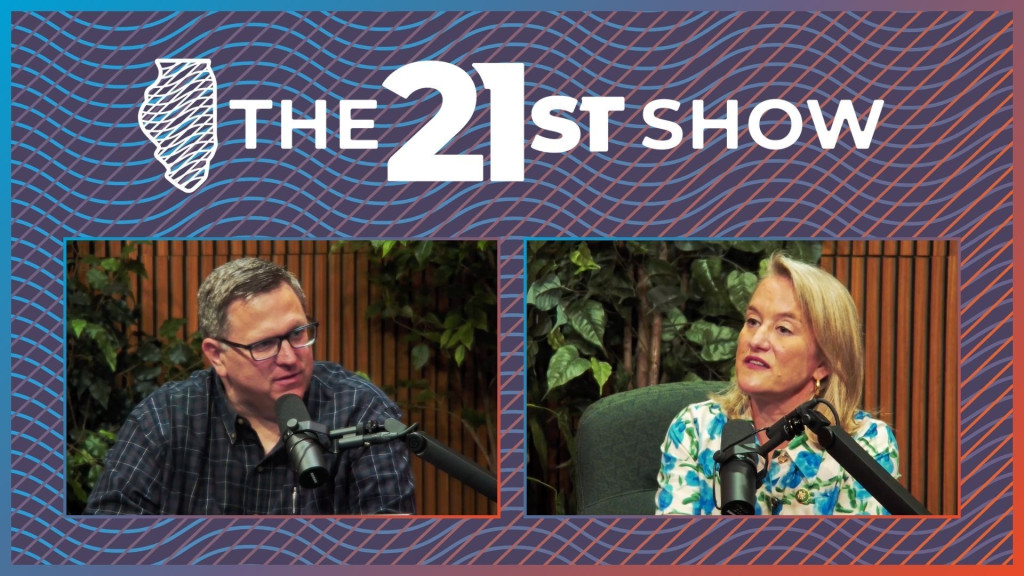
Jose Zepeda/Illinois Public Media
[00:00:00]
Brian Mackey: Today on The 21st Show, central Illinois Congresswoman Nikki Budzinski is seeking a third term. The Democrat says her party ought to focus on both the cost of living and investigating the Trump administration.

[00:00:14]
Nikki Budzinski: This is the most corrupt White House that certainly I have seen in my lifetime. I think in probably many of your listeners' lifetimes. We need to hold that administration accountable.

[00:00:26]
Brian Mackey: We'll talk about her priorities for a potential third term, how Democrats should respond to Republicans' hardball tactics, and hear her respond to critics on the left who say she's not progressive enough. I'm Brian Mackey with Congresswoman Budzinski for the hour today on The 21st Show, which is a production of Illinois Public Media. But first, news.

From Illinois Public Media, this is The 21st Show. I'm Brian Mackey. The Cook Political Report calls the 13th Congressional District the creative centerpiece of Illinois's gerrymander. Until a few years ago, the last time a Democrat held this seat was in 1895. But it turns out if you connect the liberal urban centers of Urbana, Champaign, Decatur, Springfield, and communities in the Metro East, you can get a solidly Democratic district. My guest today has won it easily in her two previous campaigns.

Nikki Budzinski worked in the administrations of Illinois Gov. JB Pritzker and President Joe Biden before her first run for Congress. She's now seeking a third term against a challenge from Jeff Wilson, a Republican who just resigned from the Champaign County Board, so as to focus on this campaign. We've talked separately with him, and that conversation will be tomorrow's show.

A couple of content notes. Our program is being produced in partnership with the League of Women Voters of Champaign County and the NAACP of Champaign[e] County. I also want to say, we chose to tape this conversation ahead of time so we could have it on video. We've heard from listeners calling out some of our political guests for not wanting to face callers, that sort of thing. So let me be clear, this is our decision to keep things a little more simple for our small team. At the moment, we're doing video or live radio, not both at the same time. It is our decision. If you want to see us, look for this segment on our website, twentyfirstshow.org, or search YouTube for the [21st] Show.

All right, here now is my interview with Democratic Congresswoman Nikki Budzinski. Congresswoman Budzinski, welcome back to The 21st Show. Thank you for having me, Brian. I'm going to begin just by asking you top three priorities for a third term.

[00:02:51]
Nikki Budzinski: Well, it's all about lowering costs. I mean, I do think that the word du jour, I think of this election cycle, what's happening right now, what I hear the most when I'm visiting constituents in the district is rising costs. So whether it's healthcare, fixing a broken healthcare system that isn't working for people, is unaffordable, inaccessible for people.

I would also say energy, energy prices, utility bills in particular. We have a president that said he was going to cut energy bills in half when he took office, but we know for a fact that in this area we've seen a 16% increase in utility bills.

I would also say housing. We made some progress on a bipartisan — the 21st Century Road to Housing was a bipartisan bill I voted for. It helped to expand some affordable housing options, building more affordable housing options, but that should really only be the beginning. We need to continue to work to address those issues.

I would also say family care. You know, I still believe that we have a childcare system that is broken, but I would also highlight senior care. I don't think we talk enough about that. I've actually met many constituents in my district that refer to themselves as people in the sandwich generation. So they're people that have young kids at home while struggling to actually take care of an elderly parent in their home. We don't have a system that is set up to support that individual that might be trying to juggle work.

And then I'd lastly say taking on these tariffs with this administration, and we just saw the news. In Canada, one of our strongest trading partners is being punished with a cudgel of a tariff that actually tariffs, in my opinion, really just translate into a tax increase for working people, and that's bearing itself out in our grocery stores all across this district.

So I would actually not limit myself to three. I would say really the top five issues, but costs should really drive them.

[00:04:48]
Brian Mackey: You mentioned the sandwich generation. It reminds me of this great New Yorker cartoon where there's a guy with one of those baby carriers on the front and an old man on his back. So I get what you're saying.

You know, this is a live debate right now in Democratic politics, though — how much do you focus on the price of beef, price of eggs, price of gas, that sort of thing, versus going after what a lot of people see as the excesses of this administration in terms of, you know, masked agents on the street shooting American citizens who are, you know, attempting to exercise their Second Amendment rights, as we saw in Minnesota, for example. How — where do you — how do you strike that balance?

[00:05:25]
Nikki Budzinski: Both are important. Both are very important. And I would just say for Democrats, I'm of the opinion that I think we are going to take back the House majority in January. I think we need to demonstrate to the American people that we can walk and chew gum at the same time, and what I mean by that is — this is not one of — this is the most corrupt White House that certainly I have seen in my lifetime. I think in probably many of your listeners' lifetimes. We need to hold that administration accountable, and I think we need to take that accountability seriously.

[00:05:59]
Brian Mackey: Put some meat on that, because I think people say it's the most corrupt — if you're not, you know, on Blue Sky or Twitter and following every little thing that's happening, give us some for instances of —

[00:06:07]
Nikki Budzinski: Just one that pops to the top of mind is the fact that we have a president that has personally profited since being in the White House by $1.4 billion. In my opinion, if you're in public service and you're making that kind of money while in public service, you're doing public service wrong. I mean, we should not be in it to make money. I have a piece of legislation out there called the [PREDICT] Act that cracks down on those in public office that are utilizing the prediction market space to actually use sensitive government information to profit off of that on the prediction markets. My bill, which is bipartisan, would eliminate the president and the vice president and their dependents from being able to profit off the prediction markets. I think that's a common sense piece of legislation that we can utilize to crack down on this administration.

But I think we need to also, for Congress, we need to reassert our separate but equal branch of government. I mean, we should be demanding information from these agencies. You bring up immigration. We need significant overhauls of the Department of Homeland Security, specifically ICE and Border Patrol, when we see what they are doing with immigration enforcement in this country, which is truly ripping families apart — ripping families apart right here in central and southern Illinois. That has to end. And when we have gavels in January, it will be our job to demand answers and accountability to this administration in their reckless policies.

Those are just two things right off the top of my head. I mean, we could talk about — as I mentioned at the top of the show — tariffs, the war in Iran, how the war in Iran — they have basically still not been able to articulate what our exit strategy is, or what was so imminently dangerous that would require American service members to go overseas. And we've lost 18 service members in this senseless war, in my opinion.

[00:08:13]
Brian Mackey: What do you understand to be the reason that we are at war with Iran, you know, aside from the past 40 years?

[00:08:19]
Nikki Budzinski: Yeah, I mean, there's a long history, obviously. I think one of the things — I think what they would say is that we cannot allow Iran to obtain a nuclear weapon. I think that is — yes, of course, we don't want Iran to, you know, obtain a nuclear weapon. But there was no proof that that was actually imminently to happen. And I think it was incumbent upon this administration to come to Congress to make the case as to why — was something that was imminent? They have absolutely failed to do that, and so I think, you know, that's their rationale, but since then they have not further articulated what success looks like now that we're there.

It is costing billions in taxpayer dollars every day — maybe not billions every day, but collectively the cost of war. We're losing American service members, and then you're hearing very disturbing stories about service members, specifically those that are serving in the Strait of Hormuz, doing historically long tours of duty without any regard for their mental health, for the conditions on these ships. Our American service members and their families deserve a lot better. The American people, the American taxpayer, deserves better. And these are the kind of things that I believe, and I know in a House Democratic majority, we're going to demand answers for, and not a single dollar are we going to want to be spending on any of these endeavors without answers to these questions.

[00:09:56]
Brian Mackey: As you mentioned, this war was not congressionally authorized. Most military actions haven't been, right? I think the last time Congress actually declared war was 1943. Do you think — is there — is it time for a rebalancing of that, and how do you do that, especially if it's just the House, not the Senate, not the presidency in the Democratic column, so to speak?

[00:10:19]
Nikki Budzinski: Yeah, I think we need to utilize the tools that we all have in our toolbox in the House. You know, we've been able to pass successfully what they refer to as war powers resolutions, which is to basically reassert — try to reassert — Congress's authority and their role. Specifically within — you know, this administration hasn't full-out said they're declaring war, but by anyone watching at home, it looks like war. We're losing service members. We are depleting our treasury. Very concerning at the Department of Defense, the weapons that we've been able to use, and now the outrageousness of this administration coming with a very large price tag — asking taxpayers to then replenish those same weapons when they still haven't made the case for why in the hell we're over there in the first place.

So I think that there are things that we can do in the House. Certainly, the war powers resolutions are one way of asserting that, but the appropriations process is really ultimately what we need to use to flex. I will share — I'm hoping to get on the House Appropriations Committee, if I'm honored to be reelected again, and I plan to, on that committee, use that as an opportunity to demand answers to these questions.

[00:11:35]
Brian Mackey: I fact-checked myself. It was June 5th, 1942, against Hungary, Bulgaria, and Romania. Thank you to —

[00:11:40]
Nikki Budzinski: Our producers for calling me out on that. But it's been a while.

[00:11:45]
Brian Mackey: It has been a while. Let's talk about economics. You've been advocating for a while now for the workers at Granite City Works, a steel manufacturing plant in the Metro East. It's been through a lot of uncertainty in recent years. There wasn't any production at all for a time there, but last year the announcement came they'd restart one of the blast furnaces. What does everything that has happened there tell you about the state of domestic manufacturing?

[00:12:11]
Nikki Budzinski: Well, first, let me just say what it says to me about the people of Granite City — is the grit and resilience and the fight that these people have. For over 100 years they've been making steel in this community. It is the bedrock of this community, and they're not going to let a corporation — U.S. Steel, Nippon Steel — shut it down without a fight. And I've been very proud to be a part of that fight with them, but the credit really goes to them. Because this was a fight that had been waged well before I got to Congress. I've just been proud to pick up that mantle.

Look, I think investing in American manufacturing is something that should be a top priority. How are we onshoring the things that we need from a national security perspective, from an economic development and livelihood perspective in central and southern Illinois? And what we're seeing is an administration — the Trump administration — that has said that they are investing in manufacturing and onshoring manufacturing, but the facts demonstrate that we have lost manufacturing jobs since the Trump administration took effect.

I will say, in my first term in office, one of the things I was really most proud of was being a part of advocating within the Biden administration, which passed the CHIPS and Science Act, to win one of 12 tech hub designations. And that's directly benefited Urbana-Champaign and the corridor between Decatur, Monticello, and Urbana-Champaign, which often, locally in Champaign-Urbana, is referred to as [IFAB]. It's biomanufacturing and fermentation. We are becoming national, international leaders in biomanufacturing and fermentation because the community put forward an incredible application. There were well over 600 applications to be considered for a tech hub designation. Out of that 600, we won one of 12, and it was a $51 million federal investment.

I think what's important about that story in particular of American manufacturing is that it's that sweet spot between public-private partnerships. We have great partners in the University of Illinois, in the [IBRL] lab that's right here, the [bios research lab] here on the campus of the University of Illinois, but we also have great private sector partners that have more than matched tax dollars and federal investment in American manufacturing — private sector investors like ADM and [Preent] [🚩 Verify spelling of "Preent"], for example, that have helped to make this successful. And it's really something that I think, if fully realized for our communities, could be a $200 billion new industry. I like to coin the phrase on the House Agriculture Committee that I represent Silicon Valley, and that's what, to me, the [IF] [🚩 Verify acronym expansion] and all of this biomanufacturing opportunity represents.

So while the fight continues — getting back to your original question — the fight continues in Granite City and making sure that steel production continues robustly here, and that we make sure that we don't see cheap Chinese steel, for example, being dumped into the United States, offsetting what we're making here in the United States. That's what good, sound trade policy would actually do, something that I don't think the Trump administration understands. But I think there are, from the Biden administration, some successes around the story of investment and what that looks like in incubating manufacturing.

[00:15:47]
Brian Mackey: All right, let me reintroduce our conversation. My guest today is Congresswoman Nikki Budzinski, a Democrat from central Illinois, seeking a third term in the House of Representatives. She's won her previous elections in the district easily. Her Republican opponent is Jeff Wilson, who until recently was a member of the Champaign County Board. He says he departed that position in order to focus on this campaign. I did interview him separately, and we'll hear that conversation on the show tomorrow.

We taped this Tuesday morning in part so we could capture it on video. If you want to watch us, visit twentyfirstshow.org or look us up on YouTube by searching The [21st] Show. Because we're on tape, no calls today, but you can always let us know what you thought by emailing talk@twentyfirstshow.org. That's talk@twentyfirstshow.org.

And let me say about that, we appreciate putting your questions to candidates and our other guests on the program. Here are some of the things we're working on in the weeks ahead. Illinois has a new law banning cellphones from classrooms statewide. We want to know what you think of that, especially if there are young people in your life. What do they think of that? Are cellphones in the classroom a distraction, a positive? Do they want to argue for it? We'd love to hear their perspectives. If you want to email us, have them send us a voicemail.

We're also working on a segment on flock cameras. I know that is of interest to a lot of listeners out there. We've heard from some of you about that. Let us know what questions you have. Again, the email address is the best way to get in touch with us. talk@twentyfirstshow.org.

All right, more to come. This is The 21st Show. Stay with us.

It's The 21st Show. I'm Brian Mackey. Let's get back to my interview with Congresswoman Nikki Budzinski, who is seeking a third term in the 13th district in central Illinois. She's a Democrat, and the district unites the Democratic parts of Urbana, Champaign, Decatur, Springfield, and the Metro East, the urban area on the Illinois side of the Mississippi River across from St. Louis. Her opponent is Jeff Wilson, a retired nuclear engineer who until recently was a member of the Champaign County Board. I spoke with both Budzinski and Wilson on Tuesday. Because of that, no calls today, but you can get in touch by emailing talk@twentyfirstshow.org. You can also watch both of these conversations on YouTube. Just search for The [21st] Show.

Before the break, we were talking about efforts to maintain the steel mill in Granite City, Illinois. Congresswoman Budzinski mentioned the CHIPS Act, one of the Biden administration's big pieces of legislation. We'll pick up the conversation from there.

The CHIPS Act is an interesting case study in legislating and how you try and do something big in the Congress in this modern, polarized moment. And there have been critiques that President Biden and the backers of that went out of their way to include red states in it. And we've seen President Trump excluding blue states as much as he possibly can, right, whether it's through disaster funding or social insurance programs. Do you think it was a mistake, and should the Democrats be taking a more hardline approach, you know, and finding ways to channel future investments — be it the CHIPS Act, the Inflation Reduction Act, things like that in the future — into places that support Democrats and play hardball, you know, tit for tat? Because there are a lot of people in your coalition —

[00:19:23]
Nikki Budzinski: That —

[00:19:23]
Brian Mackey: — who might argue that we're going to be enthusiastic cheerleaders of that.

[00:19:27]
Nikki Budzinski: No, I don't think that's what's good for our country. I think all of us as public servants should be looking for what's best to serve our country and not just dividing ourselves and, you know, kind of siloing ourselves into blue America and red America. I think that's a very tricky and dangerous road to go down.

Unfortunately, as you've correctly mentioned, the Trump administration has done that over and over again and held up federal grants. We still are fighting for some of the federal grants that had been actually awarded and appropriated last Congress that the Trump administration is asking some of the communities that I represent to reapply for under completely different criteria — which I would argue is actually illegal, because this was federal dollars that had actually already been awarded. But here we are.

I don't think following the Trump administration is where this country should be going. We need to find a path that is again lifting all boats. I think the CHIPS and Science Act was a good example of it, in the sense that everyone had competitive proposals on the table. There were some blue districts and some red districts that won, and I don't think that the Biden administration was specifically saying, "Gosh, we've really got to get three or four red districts into the mix." I think these were the best proposals, and to their credit, they didn't penalize people because of their politics. They did what was best for this country. And I think getting us back to that place is something that I want to be a part of.

[00:21:10]
Brian Mackey: How do you respond to people who say it's too late, or let the other side show that they want to come back to that place, because it's sort of one side playing by the, you know, Marquess of Queensberry boxing rules and the other side is doing kickboxing or ultimate fighting or whatever you want to say?

[00:21:26]
Nikki Budzinski: I guess I would say I think that's playing a short game and not a long game. I think that, you know, we're celebrating our 250th anniversary, and you have to ask yourself, what does the next 250 years look like? And to me, what I hope it looks like is that we can get back to finding some common ground and some commonality and some opportunity to work together — not on everything. We disagree on some very fundamental issues that I care very passionately about, but there are some areas where we can — manufacturing should be one of those issues where we all care about those issues, workforce development, supporting our growers, building an economy that is innovative and can be competitive worldwide. Those are things that we should all care about and we should all be working together toward. And maybe it might not feel — understandably right now — like we're doing much of that, but I think the work ahead of us is: how do we get back to that?

[00:22:23]
Brian Mackey: One of the areas of economic growth in the past few years, at least as measured by the stock market, has been these artificial intelligence companies, which rely on a lot of data centers. And this has been something that we have heard a lot about on our program. I'm sure you've heard about it out there. We've seen public officials — you know, Gov. Pritzker, a few years ago, was proposing tax incentives for data centers. Now he's going the other way. We've even seen Republican governors — I think, yeah, exactly. So talk to me about, you know, how are you thinking about AI and our economy and government regulation?

[00:22:57]
Nikki Budzinski: Yeah, it's a very important question, and you're right, Brian. It's something I hear a lot about in the district. What I would say is that communities have very real, very legitimate concerns that have to be heard and have to be addressed before any data center, in my opinion, were to successfully come into a community.

It has to be laid out — as far as in my mind, the things that are top of mind for me — are the cost issues. So I think a data center developer would have to come in and make the case that that development is not going to increase a single resident's utility bill by $1. I think that's really critical, that they be able to address that with transparency, and then there needs to be accountability for that once they've made that commitment.

There are also very real concerns around water consumption. I know some of them, from some data center developers, have been addressed through what they refer to as the closed-loop system, so they don't have to continuously go back for fresh water — that it's something that can be recycled — but that is a legitimate concern as well. There are additional legitimate concerns as it relates to the environment, as it relates to noise.

There are also opportunities. There are opportunities as it relates to increased taxes, tax investments in communities that might not otherwise see that level of investment, if a community decided for a data center to come in. And then, of course, there are union job opportunities, and it does create a lot of union job opportunities in the construction phase, for sure, of a data center.

Each community has to weigh those. For me in particular, I want to make sure that those cost drivers are particularly addressed, but these data center developers have to come in with a plan. They have to sell that plan. And they have to be transparent and accountable to it. And so I think that's the way I look at it, and I think every community is kind of looking at it differently. But those concerns are very real and they have to be addressed.

[00:24:56]
Brian Mackey: Beyond the data centers themselves — once those blue collar jobs are done, it's built — then you're talking about, you know, the best-case scenarios. Well, I suppose there's one scenario where it doesn't really do anything and it kind of peters out, but if the backers of this, you know, have their way, a lot of white collar jobs could be disrupted by this. To, you know, maybe we're all enslaved and become human batteries or something, in the science fiction doomer scenarios. Where are you on — yeah,

[00:25:25]
Nikki Budzinski: I particularly care about the workforce side, and those are the issues that I've been particularly leaning in on. And some of the reason why I raised that is we don't exactly know. I mean, I've heard the same statistics that will maybe disproportionately impact white collar jobs versus blue collar jobs, but the reality is we really need more data around this information. We need to be able to better articulate what those jobs are of the future — potentially, how do we mitigate? How do we do job training? How do we look at how this is going to impact our public education system? How do we help students that — I think understandably — are going to college right now at the University of Illinois and are unsure and are scared about a degree that they might be getting into and the longevity of that degree for a career in an AI-based society?

I think we need more data-driven policy proposals, and I'm working on those in Washington to better articulate what the impacts are going to be so that we can help to prepare. I think that — you know, that's kind of what mostly concerns me about AI, but I think that to say that AI is going away, I think that is an irresponsible position to take. I think that it's why I've been a part of the New Democrat Coalition in the House of Representatives, which is the center-left group within our Democratic caucus that put forward an innovation agenda that isn't afraid of having these conversations. I think we need to be leaning in on innovation and technology so that we can be prepared, we can prepare the communities that we're representing, and certainly support the workforce of the future.

So I think there's a lot of work to do, and I do worry, Brian, that because of so much of the gridlock in Washington, the public policy isn't catching up fast enough to how fast this technology is moving. And so that's definitely something that I think is going to be a huge focus of this next Congress. And I think as we pivot to the 2028 presidential election, I could certainly see AI being a very big piece of that debate and how we work through those issues.

[00:27:46]
Brian Mackey: Do you think it would be appropriate — I mean, we're talking, so that's the economic side of it. Even if you set aside the sort of science fiction Hollywood scenarios of what could go wrong with this stuff, we've seen this software escaping its constraints and, you know, engaging in bad behavior. And yet, these companies and the people who run them — the very small number of people who run these companies — are multi-multibillionaires. What should the Congress be doing to reassert — or do you think should this be treated the way we treated nuclear development, for example, where the government takes a stronger hand in ensuring it's done safely, in the national interest, in humankind's interest?

[00:28:33]
Nikki Budzinski: Yeah, I mean, we have to create safeguards, and that will be the responsibility of government, I think, to create safeguards around this technology. The modeling is something that, in particular, I think the government is going to need some transparency around. But we need regulation, and what you're seeing right now is — because the federal government has been unable to come together on a federal regulatory framework that works — you're seeing states step up. Illinois has really led the way in putting some safeguards in place as it relates to AI. You're seeing other states like New York and California do that, too, but we really needed a more federal framework. In the absence of that federal framework, though, we need states to take the initiative, because we can't allow this technology to get so far out of the barn that we're unable to put it back. I mean, I really am very concerned about that, and I've heard about exactly the cases that you're talking about, where these models have kind of jumped the rails, so to speak, and not been able to bring back in. And so what that means — and I definitely think there needs to be not just transparency but accountability and safeguards — the government does have a role in that.

I say all that and also believe that this is innovation that is happening. We can't completely squash innovation, but there is a way to do both, that I think will be to the benefit of the communities I represent.

[00:29:59]
Brian Mackey: We talked about costs earlier. Another cost driver in the American economy is healthcare. A lot of Democrats, especially first-time candidates, are increasingly supporting the ideas of, you know, Medicare for All, perhaps even single-payer — some version of government-backed healthcare. Where are you on this issue?

[00:30:18]
Nikki Budzinski: I think we need to put forward proposals that [provide] relief on healthcare. I think that yes, of course, we need to reinstate the tax credits. We need to roll back the cuts to Medicaid that were very significant, but we need to go much, much further than that.

I mean, I'm a very big supporter of a baseline plan that would be provided on the exchange that could be affordable for everyone. I think that will help to create more competition. I think more competition in the healthcare system actually makes for a better healthcare system, but will also bring down costs.

I think we need to pass legislation on day one, if we can, that's going to ensure that it is doctors that are dictating the healthcare that you're getting, not an insurance company. I also think we need to be exploring price caps — not just on prescription drugs, but on how we're looking at hospital billing. We need to make sure that medical debt is not bankrupting families and then being held against them in a credit report that's going to prevent them from, down the road, being able to own a home.

My concern around Medicare for All is that — looking at this administration alone — to say that a government-run, exclusively government-run program would be held hostage potentially to the political whims of any one White House. I mean, the idea that Robert Kennedy Jr., who would be overseeing a single-payer healthcare system — if that were in place today, I think that's terrifying.

So what I think we need is to find — and we do have proposals that'll provide immediate relief — pursue those, and that'll bring down costs and make sure that healthcare is affordable and accessible for everyone in this country. And it should be — I do believe it should be a right and not a privilege. In the richest country in the world, we have to fix this broken healthcare system.

[00:32:10]
Brian Mackey: 25 years ago I heard the great Chicago doctor — and I'm paraphrasing here — but he said something like, any healthcare system that fundamentally, you know, has a profit motive at its base is fundamentally immoral. What do you say to that?

[00:32:23]
Nikki Budzinski: Well, I think we do need to get the profits out of healthcare. I don't know that I believe, though, necessarily, finding one government-run program that everyone has to subscribe to is necessarily the best way to do that. I think there are other ways to do that. Like I said — price caps. I think it's something we've made some real progress on with insulin. You're seeing some prescription drug costs going down now. I think that's a drop in the bucket, quite frankly.

And I would just share with you, I know this is an incredibly real pain point in this district. I have a constituent, Laura Petty from Alton, Illinois, who was my special guest at the State of the Union. And I brought her because, you know, we talk about those ACA tax credits and the expiration of them — which, by the way, has completely, in a lot of ways, destabilized the ACA marketplace, which the Republicans have really been chipping away at since Obamacare, or the ACA, passed. So this was another kind of cudgel that they used to destabilize that marketplace. In some ways, they were successful, and for a lot of families, Laura and her family — Laura is a housekeeper, her husband is a carpenter, they own used cars, but they have a mortgage, they go on vacations — they saw their premiums increase from $300 a month to $800 a month. So now that's a whole different set of household decisions that they're making because their premiums more than doubled. I think that is a story that could be told across central and southern Illinois, and I would actually venture to guess across the country.

And that's why we need immediate relief. I think there are common-sense proposals — whether it's streamlining, you can say prior authorization, people don't know what that necessarily means, but basically it's putting the power back in the hands of a doctor to determine the healthcare you get, taking it away from insurance companies. Again, capping costs, more transparency, more competition. We're seeing the consolidation of the healthcare industry like we're seeing the consolidation in the grocery industry, the rail industry. We need to break that up. I think there are these kind of common-sense measures that we can really act on and get immediate relief for people now, that we need to be taking.

[00:34:37]
Brian Mackey: All right, let me reintroduce my conversation with Congresswoman Nikki Budzinski, running for reelection in the 13th district against Jeff Wilson, a Republican challenger. We'll be talking with him tomorrow on the show. More to come after a short break. This is The 21st Show. Stay with us.

It's The 21st Show. I'm Brian Mackey. Let's get back to my interview with Congresswoman Nikki Budzinski, who is seeking a third term in the 13th district in central Illinois. She's a Democrat, and the district unites the Democratic parts of Urbana, Champaign, Decatur, Springfield, and the Metro East, the urban area on the Illinois side of the Mississippi River across from St. Louis. Her opponent is Jeff Wilson, a retired nuclear engineer who until recently was a member of the Champaign County Board. I spoke with both Budzinski and Wilson on Tuesday, so no calls live today. But you can always let us know what you thought by emailing talk@twentyfirstshow.org. We also recorded both of these conversations on video, and you can watch us on YouTube by searching for The [21st] Show.

Since the start of the second Trump administration, there have been at least nine deaths linked to the campaign of mass deportations. And although this hasn't been in the news as much this summer as it was last winter, there are reports that that's really just because the government has been less flamboyant about bragging about what they do on social media, and that deportations are actually just as high, if not higher, than they were before. What sorts of things would a Democratic Congress — with you as a member of it — or a Democratic House, I should say, do to hold ICE and Border Patrol accountable for what's happened?

[00:36:28]
Nikki Budzinski: We have to do that. That has to be a top priority. And I would say it's why I voted three times to not give another single dime to CBP, to Border Patrol, or to ICE until there is — break it down to the studs — real reform in their tactics and how they're operating within our communities.

[00:36:47]
Brian Mackey: Are you verging into abolish ICE territory?

[00:36:49]
Nikki Budzinski: No, I'm not. I'm not for abolishing ICE, because I do believe that there needs to be some type of immigration enforcement in this country. That is very important.

[00:36:58]
Brian Mackey: I mean, there are people who say, maybe you can't — you obviously have that functioning government, but the Department of Homeland Security, as you well know, it's not that old, right? It's one of the newest cabinet agencies. Maybe that whole system and the way we've approached it, you know, it's so corrupt. The people that have now been speedily hired into this agency are so —

[00:37:16]
Nikki Budzinski: Oh, I agree — the training, there is no training for these officers. I mean, I completely agree that there should be a system-wide reform of what we're looking at, but it doesn't change — whatever you want to call it — we need immigration enforcement in this country. We need border security in this country. But we can do it in a way that is humane and is not ripping apart families. And it is ripping apart families right now. And you're absolutely right — there have been people that have died at the hands of ICE, murdered at the hands of ICE.

And so it's why I thought it was an important priority. I visited the St. Genevieve facility in Missouri with Congressman Wesley Bell, who represents St. Louis. It's interesting that anyone that might be detained, even as far east as Urbana-Champaign, would be sent to St. Genevieve. I wanted to see the facility myself, and I was deeply disturbed by those conditions. And we raised those concerns with those that were operating the facility, and we continue to work with it.

[00:38:15]
Brian Mackey: Give me a for instance. What did you see? Like, do you think they cleaned it up when two members of Congress were coming by?

[00:38:21]
Nikki Budzinski: Well, they didn't do good enough of a job if that was the case. And what I mean by that is, I had the opportunity to visit with a constituent from Collinsville that had been detained in the facility, and she — and in an independent conversation with a separate constituent, this one of Congressman Bell's — told us that they were having to rely on water from a shower head in order to get a cup of water. I mean, that in and of itself is very deeply disturbing. We saw, in this one facility as well, that people were sleeping in what amounted to kind of just crates on the bottom of the floor. They had very slim mattresses, but these are situations that you or I would never want to spend a night in.

And what is tragic is that you're hearing that rather than — a lot of these folks that are being detained, by the way, these are not violent offenders. These are folks with no criminal records that are being detained in this facility. They're opting to self-deport rather than continue to live within these detention centers. And I think that too also says a lot about what's happening.

The thing that is very interesting, in representing a lot of the communities on the western side of the district, is that kind of a tale of two states — from the state of Illinois to the state of Missouri. In Missouri, there is a financial incentive for a local county jail to actually detain and hold ICE detainees. In Illinois, obviously, we have a law against that. But there's almost, in some ways, a perverse incentive for local county jails to actually detain and hold ICE detainees. So it raises other questions, because you're having a mixed population — sometimes those that are detained on criminal cases that are not immigrants, and those that have been detained by ICE — and then there is the incentive that, on a per-head basis, an ICE detainee carries a financial incentive for that jail.

So, there is so much — in short, there is so much that is wrong with all of this. And I think, again, when we have gavels in the majority, we will be able to hold this administration accountable, and certainly, again, on the appropriation side, when they're looking for funding, until there is fundamental change that is happening, I can't support additional funding to either ICE or [CBP] And by the reforms, I would say — with the officers — I think these are common-sense reforms. I don't understand why they haven't just been adopted. The reason I say that is our local law enforcement here in Champaign or Urbana have to abide by these changes, whether it's not wearing a mask, properly identifying your name on your uniform, wearing a body camera, having a warrant to go into someone's home. I mean, we live in the United States of America — you should have to have a warrant before you go into someone's home. These are the kind of common-sense reforms that we're going to be pursuing and making sure, holding them accountable to making them happen.

[00:41:44]
Brian Mackey: So we're coming to the end of our time together, and as you know, there has been a dispute — a fight — within the Democratic coalition. Progressives, democratic socialists on one side. You had a primary challenger, although you won easily, 75% of the vote. We did hear from a listener, Cassidy in Urbana, who said, "I voted for Dylan Blaja in the primary. I wish Nikki was more progressive." So what do you say to voters like that about, you know, your entire district, your approach to governance, to this — because this is going to be a live fight if the Democrats do take control of the House of Representatives?

[00:42:22]
Nikki Budzinski: Look, I think that I have spent the entire time in Congress that I've been here — one, delivering for this district. I think that has been critically important, and we could go through the different $34 million I've been able to bring back. But it's not just about delivering. It's also — during this Trump administration — it has been about standing up to this administration. And I've been very proud to do that, whether it's calling for the impeachment of Kristi Noem or — I did vote to move forward an inquiry into looking into the impeachment process of Donald Trump. I have stood up and have spent my entire career working on issues that support working people, whether that's maintaining or making sure that voters have access to healthcare, standing up for women's right to choose, being an ally to the LGBTQ community. I have done all of those things consistently and will continue to do that if I am reelected again in November.

This is a very big district, and I've always said very clearly that I'm a workhorse, not a show horse. I'm not looking for those clicks on social media. I'm wanting to do a good job and represent this entire district, and I lead that with my values. I stand up to this administration, and I continue to fight for the issues that matter most to the voters in this district. And I'm going to continue to do that.

[00:43:52]
Brian Mackey: Some of the fights ahead could be around the Supreme Court. There are those who say that any substantive reforms — whether it be campaign finance or the regulatory state — it's going to get shot down by this current Supreme Court. Would you support any sort of expansion or jurisdiction stripping or term limits, or any of the things that can be done by statute through the Congress?

[00:44:12]
Nikki Budzinski: Well, I would say first — the easy thing — I think we need ethics reform, reform of the Supreme Court. I mean, the fact that they're able to accept some of these gifts, the lack of transparency — I think that's something first and foremost that needs to happen immediately.

Look, I think we need to be looking at all options — all are on the table. I haven't committed to one set of reforms, but I think there are people that are talking about term limits on the Supreme Court, expanding the court. I think we should be looking at all those things. I think we have a very ideologically driven Supreme Court that has, just like House Republicans and Senate Republicans, abdicated authority and responsibility to Donald Trump. And that's deeply concerning, but we do need to overall be able to maintain separate but equal branches of government. I think looking at reforms in the Supreme Court is something we need to do, but I would start with ethics reform and then examine what's possible and how we would accomplish those reforms as well.

[00:45:20]
Brian Mackey: I know we have limited time. Last question, and I've been trying to ask this of as many candidates as I can this cycle: big picture, you know, we're at a time of significantly declining trust in American institutions — be it government, the law, courts, universities, journalism, frankly. What can you, as an elected official, do to maintain and rebuild trust in our political system?

[00:45:48]
Nikki Budzinski: Well, I think something that we need to do is create more accountability and transparency for elected officials. I mentioned the PREDICT Act, which is just one simple measure that says, if you're serving in public office and you're on the prediction market space, I have a bipartisan bill that says you can't be monetizing — making a profit off of sensitive government information. You would think a lot of people, when I share this bill, they're like, "Well, of course." I'm surprised that that's not already illegal. But I think that there are things that we can do.

I'm a very big supporter — I think we need a constitutional amendment to overturn Citizens United. I do think that there is too much money in our politics. We need to get that out.

I think if we could create more accountability and transparency in the system — and doing that while also not losing sight on the fact that our communities are expecting us to go to Washington to not be a bunch of show horses, that we are there to get things done with the people that we can work with and accomplish that to make the lives of the constituents that send you to D.C. a little bit better or a lot better. And there are people that I will say in this district that are struggling every day, that don't pay attention to politics and government because they just don't think that it works for them anymore.

And I think through, again, more transparency and accountability — I also think focusing on getting things done and delivering real results, don't be a part of the political noise, something that I always talk about, I never want to be a part of, and I don't think in the four years I've been in office we've contributed to that. That's going to be my North Star, and that's what I continue to focus on. And I hope that in doing that, it will, through some progress — albeit maybe incremental — start to win back the trust of the American people.

[00:47:44]
Brian Mackey: Congresswoman Budzinski, thank you for joining us. Thank you for sharing your views. Thank you. Congresswoman Nikki Budzinski is seeking a third term in the 13th district representing central Illinois. Her opponent, Republican Jeff Wilson, will be my guest on tomorrow's show.

Before we go, I want to take a few minutes to share some listener feedback we've gotten in the past few months. We love hearing from you. Email us, or better yet, leave a voicemail.

[00:48:08]
Speaker 2: This is Terry from Melbourne, Florida, and I wanted to compliment you on the June 4th program that was concerned with climate change. It was a good reminder to all of us. And I guess to some degree we all kind of take it for granted that this will continue to be put off, but it is kind of shocking to realize that this subject broke into the open in 1979. And here we live with an administration that's actually rolling back programs that would perhaps help to limit the damage of climate change. That's all.

[00:48:50]
Speaker 3: Bye-bye. John from Springfield, Illinois, again. I just want to thank the staff of The 21st for, one, doing this program and, number two, for keeping it going and getting so many great topics that really [mean] a lot. Thank you very much.

[00:49:13]
Brian Mackey: Thank you for those kind words. You can share your thoughts with us again. The email address is talk@twentyfirstshow.org, or call our voicemail line anytime, day or night, 217-321-2121. That's 217-[300]-2121.

The 21st Show is produced by Christine Hatfield and Jose Zepeda. Our digital producer is Kulsoom Khan. Video production help from DJ Roach. Technical direction and engineering from Jason Croft and Steve Morck, and Reginald Hardwick is our news director. You can get a podcast of this show at our website, twentyfirstshow.org, or you can look us up wherever you listen. Search us on Apple, Spotify, YouTube. Just put in The 21st Show. The 21st Show is a production of Illinois Public Media. I'm Brian Mackey. Thank you for listening. We'll talk with you again tomorrow.
Until a few years ago, the last time a Democrat held the 13th district congressional seat was in 1895.
However, Congresswoman Nikki Budzinski won it easily in her two previous campaigns. She worked in the administrations of Illinois Governor JB Pritzker and President Joe Biden before her first run for Congress.
She’s now seeking a third term and running against Jeff Wilson, a Republican member of the Champaign County Board. He will be appearing on the program tomorrow, while Budzinski discusses what's been accomplished for the 13th district so far and what her future plans are if given the opportunity to serve a third term. The extended version of the conversation can be found here.
Note: Today's program is produced in partnership with the League of Women Voters of Champaign County, and the NAACP of Champaign County.
GUEST
U.S. Rep. Nikki Budzinski
D-Springfield IL-13