








Former ambassador says the U.S. has ‘diplomatically disarmed’
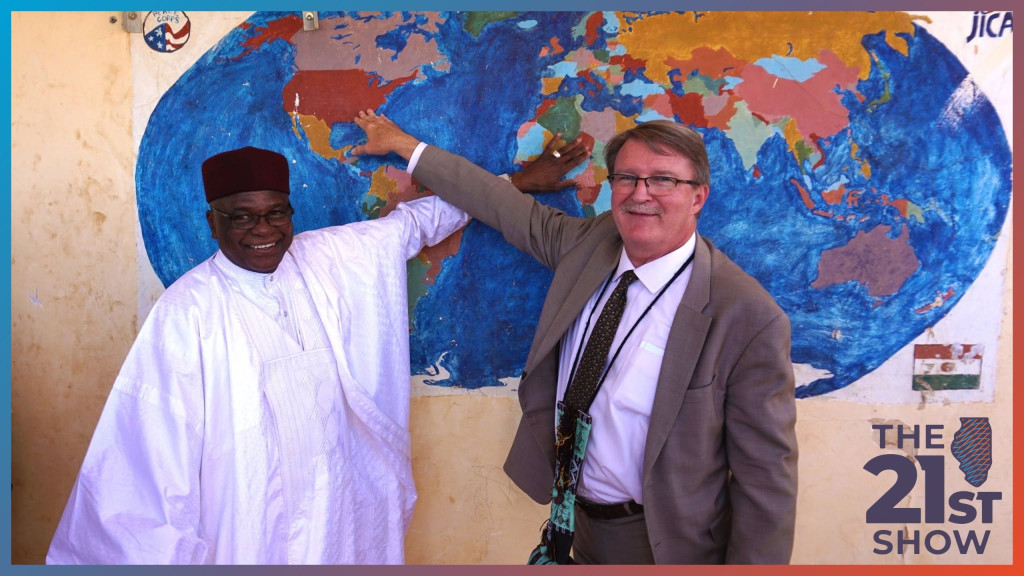
Eric Whitaker, right, was U.S. Ambassador to Niger from 2018–2021. U.S. Embassy Niamey on Facebook
// This is a machine generated transcript. Please report any transcription errors to will-help@illinois.edu.

[00:00:00]
Brian Mackey: Today on the 21st show, retired American diplomat Eric Whittaker, born, raised, and educated in Illinois. He would join the Peace Corps and eventually the U.S. Foreign Service. His postings included South Korea, Sudan, Baghdad, and the region of Western Africa known as the Sahel, where he was U.S. ambassador to [***]. We'll talk about what's happening around the world, significant changes to the diplomatic corps under President Trump, and the future of American foreign policy. I'm Brian Mackey. That's all coming up today on the 21st show, which is a production of Illinois Public Media, airing on WILL in Urbana, WUIS in Springfield, WNIJ in Rockford DeKalb, WVIK in the Quad Cities, WSIU in Carbondale, and Tri-States Public Radio in Macomb, Galesburg, and [Kaka].

But first, news.

From Illinois Public Media, this is the 21st show. I'm Brian Mackey. One year ago, the retired American diplomat Eric Whittaker spent an hour with us. We talked about his road from DeKalb in North Aurora to the University of Illinois, the Peace Corps, and the United States Foreign Service. He spent most of that career in Africa, and from 2018 to 2021, he was the U.S. ambassador to [***], a landlocked country in the region of West Africa known as the Sahel. That conversation focused a lot on his life and work. Today we're turning to the world as it is right now, and there is a lot to talk about. The State Department has laid off more than 1,300 people, and it's now recruiting again. The U.S. Agency for International Development, USAID, has been shut down with what's left folded into the State Department. And more than eight months after the U.S. and Israel launched strikes on Iran, there is still no deal to end that war. And I should also say, in [***], soldiers tried to overthrow the country's military government this summer. Eric Whittaker joins us now from our studios in Urbana. Ambassador, welcome back to the 21st show.

[00:02:21]
Eric Whittaker: Oh, good morning, Brian and our listening audience. We're delighted to be with you again today. Thank you.

[00:02:26]
Brian Mackey: And listeners, you can join the conversation throughout the hour at 800-222-9455. If you have questions or comments about U.S. foreign policy, especially as it relates to Western Africa, join us again, 800-222-9455. And if you have questions or comments about other parts of the world, well, uh, not necessarily the ambassador's area of expertise, but we'll do our best. 800-222-9455. That's 800-222-9455.

All right. Last year, you told us you'd have a hard time explaining tariffs, deportations, and travel bans to the countries where you served. One year later, how would you describe America's relationship with the world?

[00:03:14]
Eric Whittaker: Changed, but unfortunately mostly in a negative direction. We have unilaterally diplomatically disarmed. We have stepped back. We were in the mix. We were the country to be followed. We are exemplar. Uh, when I serve overseas, our European, uh, our counterparts typically look to the United States — what were we thinking? What were we doing? What programs were we supporting? And for some reason, this current administration has decided to step back. It speaks of America first, but that seems to mean America alone. We've sort of become a cowboy country. Alliances and partnerships are less important, but of course they sustained us over the decades. NATO, 60-plus years, is a tremendous success story. So what we see — this is disappointing. The United States has become hyper-nationalist. It's really quite a shock to so many of us to see us stepping back from a central role of power. When we had that opportunity, why would we give it up? Believe me, Russia, China, and others see this as a good thing for them. They're filling in. There's the saying, nature abhors a vacuum. Well, so does China. And they're filling in where we have left open space.

Let me remember something. Secretary of State George Shultz, a Republican, would bring outgoing ambassadors into his office, and he had a globe, and he would spin it and he would say, uh, point to your country, and they would dutifully put their finger on Bolivia, Burma, uh, let's see, Poland, Botswana. And he would stop them and he would lift their hand, turn the globe, and put their finger back down on the United States of America. This is your country. This is what you serve.

And remember, our diplomatic facilities — 269 of them, embassies, consulates, missions — we're there to serve and protect American citizens. That is the very first and most important reason we are there: to help them with passports, visit them in jail or in prison, see them when they're in court, uh, to help them with [wars], all manner of uh, assistance. That's what we're there for. Secondly, is to maintain a productive and constructive bilateral relationship with the host country. And it appears we're going to close a number of posts. We're understaffing a number of posts. Uh, again, we're asking them to take deportees. We're closing consular sections and refusing to issue visas. We are issuing far fewer to international students, and of course one of the strengths of the University of Illinois — and I was here six years — was the number of international students, and they come in and they pay full freight. This is very good for our economy and it adds to diversity of the university context. We're issuing far fewer visas to international students, and I think that's an unfortunate thing.

So a number of things are going on: backing away from Ukraine, cozying up with Russia, uh, calling a non-declared war — not approved by Congress — on Iran, um. Taking things in a transactional sense: we'll do this if you give us that, we'll help you with health if you give us rights to your minerals. This transactional approach — before, we did things because they were the right things to do. Yes, they were for America. They helped us, but they also engendered friends and allies who would vote with us in the United Nations, who we could openly trade with. These are very positive things, and we've given a lot of this up. So it's unfortunate, the changes that we've seen during this current administration.

[00:07:11]
Brian Mackey: Well, so many things that I want to get back to that you mentioned there. And probably the biggest one happening right now is this war in Iran, and I know that's outside of your, you know, sort of area where you served and your expertise, but, um, I just wonder what is your read on what has been happening between the United States and Iran in this year, right? Obviously we could take this history back to the 1970s or even the 1950s, but what's happening now between the U.S. and Iran?

[00:07:39]
Eric Whittaker: Well, I agree with you. We would go back to the 1950s to our overthrow of [Mossadeq], a democratically elected prime minister of Iran, and Iranians have not forgotten that. We tend to be focused on the very short term. Most other countries take history into account.

Well, this past February we launched attacks on Iran with a claim that they were within weeks of developing nuclear weapons. Well, the previous year we had multiple attacks on Iran and quote obliterated their nuclear program. Well, if it was obliterated, why would we need to turn around and attack yet again? When a deal perhaps could have been made to purchase their fissile material. At this point we can't even return to the deal of the Obama era, which was much maligned but much more productive than the current situation. Under the previous agreement there were inspections by the International Atomic Energy Agency. Now there are attacks — this very week, small here and there, not well publicized, but it's going on. And this of course has raised the cost of fuel. Remember, Iran is an immense country, 93 million people, very long coastline, very rigorous and mountainous terrain, and its facilities are disseminated throughout the country. It is a very difficult enemy to pick a war on.

Yes, I think most of us would like to see Iran returning to a more democratic state where human rights are observed and it's a more open society, rather than one led by ayatollahs and the Iranian Republican Guard. Yes, we'd like to see that, but the current way is probably not the best means to accomplish this end. It appears that Gulf states might be intercessors in this process, but we're in an unfortunate situation, uh, noting Tuesday's short-term political changes in the United States. And we'll see how this takes place during the coming months, including the War Powers Act and the right and responsibility of Congress to declare war. Thank you.

[00:09:54]
Brian Mackey: Yeah. So, well, let me, let me ask you about that. So what, how do you read the midterm results Tuesday in terms of changing American foreign policy? I mean, the Congress, as you said, has not approved this war. Um, where does it have real power over diplomacy?

[00:10:12]
Eric Whittaker: OK, let me start by stating that I'm personally a moderate independent. I'm a son of Illinois. I voted in both — for both parties over a span of my lifetime. And as a foreign service officer, we're not supposed to say "former." We're supposed to say "foreign service officer" because you still represent — our oath is to the Constitution of the United States of America. We support the foreign policy of the administration and we serve anywhere, any place, any time. So that's where our loyalty lies. So, um, I don't think I'm getting to the heart of your question. Uh, could you bounce that?

[00:10:50]
Brian Mackey: Well, yeah, so I'm just, I'm wondering where, where, you know —

[00:10:53]
Eric Whittaker: The two states.

[00:10:55]
Brian Mackey: Well, where does — yeah, where does Congress actually have power to affect what's happening? Because, as you said, they haven't declared war — well, since 1943, I think. But I mean, they haven't, you know, authorized the use of military force specifically in this case, and the other mechanisms that have been used in past uh, foreign uh, adventures of the United States. So, so where can — what can they actually do here?

[00:11:18]
Eric Whittaker: Well, there's been workarounds to get around the declaration of war — authorized use of military force, for example — and it has its own acronym, and it's been used for the Gulf Wars and such.

Tuesday we saw a tidal wave of change, amazingly, and not just in the House and the Senate, but in governorships, and not just in one or two states but throughout the United States of America. Uh, the change is phenomenal. We'll see how this takes place come January and thereafter. We're seeing a squaring off between the executive and the legislative branches of our government. It'll be interesting. Now, when I describe our politics overseas — which is a big part of my job as deputy and later as the ambassador — is to explain that Americans like change and they're quick to change their votes and vote in a different party. Uh, this is something that we do. Uh, we need to wait and see how this will come out, because the spectrum of Democrats who have come in are anywhere from social Democrats to moderates to relatively conservative Democrats. So it's a broad spectrum of people that will be new to office. I do note, though, uh, we will have three Black governors for the first time in history, including the first Black woman governor in history. Uh, Native Americans, Hispanics in large numbers — it's going to be a very representative government. It will offer great opportunities for change, but this is an opportunity and the door is there. Let's see how it's opened.

[00:12:57]
Brian Mackey: Yeah, OK. So, uh, we already have some reaction to some of the things we've been talking about. And let me invite listeners — if you want to call in, 800-222-9455. We've also got our email address, you can find that on our website, twentyfirstshow.org. And we got an email from Tony in Champaign, who uh, says, I just don't buy that China is a global threat. In fact, I think we — the United States — are a far greater threat. Look at our abuse of Cuba, for example. Would your guest try to convince me otherwise?

[00:13:27]
Eric Whittaker: No country is perfect. We have made mistakes throughout our history. We've also done a lot of good. We've given far more to other countries than they've ever given to us. We were the driving force behind victory in World War I, World War II, and the Cold War. Please give us, uh, credit for those accomplishments. We've made mistakes in other military ventures. This is absolutely true.

China, about four to five years ago, surpassed us in its number of diplomatic missions overseas. They're everywhere — nice big embassies, lavish receptions — looking for political favors, for U.N. votes, for markets for their products, uh, for extractives: oil, gas, and critical minerals. China is out there and loaning money, which becomes a problem in debt-equity swaps where countries like Sri Lanka have to give up ports in lieu of their inability to pay back debts that have been incurred. Uh, China's out there — a blue ocean navy which is surpassing ours in the number of ships, developing a large air force, the People's Liberation Army. It is phenomenally large and growing. They're flexing their muscles. They're seeking to get Chinese officials elected to offices in the U.N. and other international organizations. Uh, these changes across the board cannot be ignored. Now, China will say, oh, we're just a developing country, South-South cooperation with Africa, but the Africans see what they're there for. They're there for the extractives. They want things, and people realize this. China is a competitor. Uh, I don't like to use "conflict" or a more adversarial term. It's a country in competition, and this competition can be managed. It can be productive. There can be win-win solutions such as in scientific research, medical research, uh, space exploration. But China's out there, and from what I've seen across the course of my career, uh, it is mounting, uh, things that should be of concern to all of us. It is phenomenal — a country of 1.4 billion people, four times our population.

[00:15:49]
Brian Mackey: You know, it's interesting — we had a comment when we were talking last year on the show about USAID and the good it does, you know, delivering food aid, for example, around the world. And, you know, maybe we need to take a break in a minute here, and I know I would have to cut you off. But one of the comments that came in from listeners — you can think about this uh, during the break and we can talk about it when we come back — is they were contrasting the USAID approach: we give food away. And they said, well, China's out there teaching farmers to be more self-sufficient in different countries around the world. I suspect you may have some pushback to that, but we will take it after the break. If people want to join us, we are speaking with Ambassador Eric Whittaker, who was a U.S. ambassador to [***], uh, from 2018 to 2021. He's actually been called back into service a couple of times since then, but he has also served in posts around the world. What questions do you have? Let us know. 800-222-9455 is the number to join us today. 800-222-9455. We'll continue this conversation after a short break.

One quick correction: 1942, not 1943 — I always get that wrong — is when the Congress declared war against Hungary, Bulgaria, and Romania. That was the last time we sort of met the constitutional definition of that. All right, more to come after a break. This is the 21st show. Stay with us.

It's the 21st show. I'm Brian Mackey. We are talking today with Eric Whittaker, who was U.S. ambassador to [***] from 2018 to 2021. He was educated in Illinois, as well as being raised here in the suburbs of Chicago. He went to the UI. He's also served in the Peace Corps. His postings have included South Korea, Sudan, Baghdad, and primarily the region of Western Africa known as the Sahel, which is where [***] is located. If you want to join us today, 800-222-9455. 800-222-9455.

So when we spoke last year, USAID was still much in the news. We were learning about programs ending week by week, it seemed, after Elon Musk had quote "fed it into the wood chipper" one weekend in February. Um, I know there were programs in Illinois that were affected, that were working with people in Africa. One of the criticisms we got after one of our conversations — I had made maybe sort of a flippant comment on the program about, you know, what name do you want to see on a bag of rice distributed around the world, right, the United States or another country. Um, and, uh, somebody wrote back and said, you know, China is actually teaching African people how to grow rice. It's this idea of flags on bags versus tools in hand. Uh, we had a little back and forth over email. So, uh, how do you respond to that? That, you know, maybe there's a better approach than what USAID was doing, or, or take it where you will.

[00:19:09]
Eric Whittaker: Again, no organization is perfect. And this past Tuesday, USAID would have celebrated its 65th anniversary. Of course it's not legally over because Congress created USAID — it takes an act of Congress to formally end USAID. But of course, uh, the food portion has been moved over to the U.S. Department of Agriculture, and there's certain logic behind that. And the rest has been folded into the State Department within a couple of bureaus, and some of those employees — a couple hundred — have been transferred over into the State Department, and that's largely health now. Uh, we've lost a lot of expertise, and strangely enough we're trying to hire them back, but it seems the government doesn't want them. USAID is perceived as a tool of the Democrats, of the liberals, of the progressives. It's seen as woke and too much DEI. Well, I've worked overseas with AID in a lot of countries. They're doing democracy and governance, agricultural and natural resources, uh, health programs — a broad spectrum of things. So we've lost expertise.

Um, it's very hard for them to get new jobs. I mean, that's not a reason to keep them, but it's very tough times because what they did was unique. It was a function largely not being done by others. And I attended a clapping-out day. This is where you came to USAID down on 14th Street, the Ronald Reagan Building — Republican. And people had 15 minutes to take a box into their office, clear out their personal effects, and come out. Of course, they came out crying. People in the audience were crying, and they were clapping for them. The TV, the news, everyone was there. They even closed down the street. Pretty amazing.

OK, we do help farmers to be more productive. Things we do through the Peace Corps — I'm a former Peace Corps volunteer — nutrition, uh, health education, uh, these are some of the things that I did in the field, uh, insect and rodent control, vegetable seeds, uh, best practices. Also universities — Kansas State and Purdue. I'm sure there's a linkage with Illinois. I just don't have it at my fingertips, but most universities have some linkage abroad, often in agriculture, because our agronomy and other sectors of food production are so strong. I'm sure this includes livestock and fisheries as well. So we're doing a lot of things through different channels.

USAID did — and I witnessed this in the field — where they're helping women raise poultry so the women could stay home and they could sell eggs, broilers, and layers. They were making money three different ways and staying at home with their kids at the same time. They learned to feed their chickens productive foods using local products. It was really quite inspiring. But remember the food aid that we give — what is it? It's American surplus from American farmers, largely in the Midwest. It's dried milk powder. It's vegetable oil. It's wheat and wheat flour. It's soybeans. It's sorghum. I've seen this in the warehouses. I've been to the distributions. I was in Burkina Faso in a village where the women were cooking using American surplus foods we had donated through USAID. And Catholic Relief Services was providing this program locally, so the women had a job, the kids went to school because — guess what — they got to eat. So here we had emergency humanitarian aid and long-term economic development going on at the same time in a singular program that was highly successful. We are doing a lot of good things out there. They just don't tend to blow their own horn a lot, but a lot of food is from the United States. It's just amazing the quantity and the different things we're doing — a lot of scientific research, on and on.

[00:23:13]
Brian Mackey: So let's talk about what's been happening in uh, the Sahel, uh, the area of Africa where you were an ambassador in [***]. Um, you saw the first — I think — democratic transition of power in that country, uh, when you were in the mission there, or in the post, or however you say that. Uh, that was then ended later, uh, in a military coup. A different military group tried to take power from the military group that was in command, and I guess Russia's Africa Corps came in to help [***] put that down. I wonder what you can say about the status of, you know, the country where you were ambassador so many years ago.

[00:23:51]
Eric Whittaker: Well, again, that was 2017 to 2021, which we call the good old days. I served in Chad, Mali, Burkina Faso, and [***]. So I've done the central Sahel, uh, like 12 years of my life, so my heart is still there in many respects, uh.

[***], Mali, and Burkina Faso are all three military juntas, which limits by law our ability to assist them. We can do humanitarian, but we can't do development. We can do police assistance but not military assistance, so we're limited in what we can do. Each of the three is food insecure. These are countries in the Sahel — meaning the shore of the desert — and the northern portions of Mali and [***] are very much in the Sahara region. They're very poor. They're landlocked, which raises costs immeasurably. Populations are increasing quickly in these countries. A number of things going on, and terrorism — different factions, ISIS factions, al-Qaeda factions — it's very complicated. But terrorism, criminality, and trafficking in all manner of arms and ammunition, narcotics, counterfeit goods, bootleg goods, uh, trafficking in persons — people trying to get across the Sahara to go up to the Maghreb to cross the Mediterranean to perhaps get a job somewhere in Europe to send back money. It is very complicated. We're very limited in what we can do right now. They're no longer in AGOA, the African Growth and Opportunity Act, because they don't meet its legal standards — U.S. law. Uh, they were dropped from the Millennium Challenge Corporation because it's a junta — it's a non-democratic form of government. USAID, of course, had to leave, but the embassy is much smaller than it used to be when I was there. We had seven federal agencies represented. We were doing all manner of programs. We were very welcome.

But after [Mahamadou Anja] there was a coup to restore democracy, because he wanted to overstay past his second five-year mandate. Then President [Isufu] was elected — a five-year and then a second five-year — fine, open, free, fair elections declared by a broad range of audiences, not just us: Carter Center, EU, African Union, etc. And then he stepped down. [Bazo Mohammed] was elected, but he's Arab — 1% of the population — from the east, not a Westerner. And after a while, the military overthrew him, July — 15 months after he had been duly elected, 55 to 45% in the election. He's still a prisoner with his wife at the presidential compound. Uh, and a military junta came in and still runs it. It was the director of the presidential guard, uh, and he is still in charge today with his folks, and they have a new government. And it's unfortunate, and it's very limited what we can do with these three countries.

As you note, the Africa Corps is present in all three countries, purportedly to help them fight terrorism, but civilian abuses, slow to pay bills — gold dust is mysteriously disappearing and showing up in Dubai. The Russians are helping to finance their invasion of Ukraine by vacuuming up gold dust here and there. They're not up to much good, and the fight against terrorism has not been a smashing success. Of course the French have been kicked out. The U.N. peacekeeping operations have been kicked out. Our security assistance, of course, had to end following that coup, which is unfortunate because we were helping train them to counter terrorism. So it's just remnants of what once was a very productive relationship. It's very unfortunate.

[00:27:41]
Brian Mackey: Well, I saw some reporting a little earlier this year that a U.S. envoy had visited um, Bamako, if I'm saying that right. Uh, there was reporting in July that the administration was weighing military options against [Jim], uh, which is an Islamic uh, militant group. Um, what do you make of the Trump administration's outreach to, you know, sort of Sahel military governments?

[00:28:05]
Eric Whittaker: There have been a couple of outreach efforts by our acting assistant secretary for African affairs — and it's called the senior bureau official until the person is confirmed as an assistant secretary. Yes, he did go to Bamako, and folks have been in touch with [Niamey] and [Ouagadougou], including in their embassies in Washington and perhaps on the margins of U.N. sessions in New York City. There has been outreach and discussions. Again, we're limited in what we can do by law, but we're trying to find ways that might nudge them in a more democratic direction, or might find ways to trade with them, perhaps to gain access to critical minerals. Uh, we'd like to see them be more successful against [tariffs] because that's harming the countryside. People are just terrified. They're being made to pay tolls uh, when they go on highways — a portion of their crop, a portion of their fish, their poultry, their livestock. Uh, the countries are poor, and they're not going to get any less poor, uh, through this. So we've been trying in what's very limited areas where we can do this legally. But at the same time, countries like China could care less about juntas and human rights and democracy, and they're doing business with these countries, and they're also looking for critical minerals. And remember, [***] has, uh, uranium. It's somewhere between the 4th and 7th largest producer depending upon the given year. Traditionally that's gone to France, which is very reliant upon nuclear power. But, uh, others may be coming in to try to get access to that — Russia, China, who knows?

[00:29:43]
Brian Mackey: So we had another listener question. Uh, this was from, uh, Tana in rural [Meynard] County, fascinated by the conversation about China, wondering whether they're still pursuing, um — I think it's the Belt and Road Initiative, right — which is meant to expand infrastructure and interconnectedness, I guess from their perspective. And what are the consequences of that?

[00:30:05]
Eric Whittaker: Well, it's another effort by China to gain inroads across the globe, and the Belt and Road Initiative is apparent in just about every country. And the idea is: build infrastructure. Well, infrastructure does help these economies to develop — farm to market roads, uh, access to a port, and uh, bridges.

Uh, OK, I'm in [Niamey] and we built the first bridge — John F. Kennedy Bridge — and, oh, by the way, when I was ambassador there, we were coming up on the 50th anniversary, and I said, oh, we need to do something to mark the 50th anniversary of John F. Kennedy Bridge, because this was Army Corps of Engineers and USAID. What a successful project. It's the main connector between the two. And then a couple weeks later I got a mysterious call from Washington asking me, "Master Whittaker, you do know Kennedy was a Democrat." Like, yes. And well, this is during T1 — the first Trump administration — but it's just, just chagrined to hear this kind of attitude, because he was a hero globally. I mean, I was a stamp collector as a kid. The number of countries that issued stamps after his assassination was phenomenal. He was much beloved, and this bridge — he's beloved to this day, and here.

Guess what? The Chinese have built bridges two miles upstream, two miles downstream. Why? Because they can. We don't do infrastructure anymore. USAID used to, a long time ago, but China does it. And these aren't just for the benefit of those countries — they're also the means by which extractives can leave the country and go to China. Remember, China — country of 1.4 billion with a demographic crisis because it's an aging population due to the one-child policy over decades — is looking for a way to grow a middle class of 850 million people. That takes resources. So they're trying to vacuum them up from overseas, and they're looking at them almost everywhere. This is very carefully planned. This is very strategic. They're playing chess. Sometimes we only play checkers.

[00:32:14]
Brian Mackey: Of course, you know, I can hear people listening to this saying, like, well, you know, maybe it was nice that we were building bridges 50, 60 years ago, but we have bridges that are falling down in America now, and, you know, schools that have lead pipes and kids who can't, you know, read at grade level. Why, why should we be spending money over there when there are so many needs here? How do you respond to that?

[00:32:35]
Eric Whittaker: OK, my first reaction. American citizen, City of Lodi, California, where I worked for six years. My background is in municipal management — MPA, University of Pittsburgh. This is what I did after Peace Corps. I believe in local government and its ability to solve local problems. We take care of our roads, our water, our wastewater treatment, library, police, fire, etc. Roads and bridges are typically county and state responsibilities, sometimes federal if they're interstate highways, for example, but most of these are at different levels of our government because our government is multifaceted, multi-tiered.

When you think about foreign assistance, this comes from 0.8% of our budget — in the foreign affairs, the 150 account. It is a minuscule portion of our budget to help these countries. Well, we help these countries because we think it's the right thing to do, because we can, and because an American value historically has been to minimize human suffering. Plus, we want countries to befriend us, to vote with us in the U.N., to send legitimate tourists, students, business travelers to the United States. Uh, we want a productive relationship with them, we want partnerships and alliances — these things give us strength.

[00:33:58]
Brian Mackey: All right, we are talking with Ambassador Eric Whittaker, uh, who is originally from DeKalb in North Aurora, Illinois, who was U.S. ambassador to [***] from 2018 to 2021. Uh, we want to hear from you — 800-222-9455 if you want to join us today. 800-222-9455. Whether it's about what's happening here in America with our orientation to the rest of the world and the America First movement that is so much a part of uh, President Trump's project as he describes it anyway, uh, and you know, also how America is positioning itself to the rest of the world as a consequence of that. Again, 800-222-9455. We'll continue the conversation after a short break. This is the 21st show. Please stay with us.

It's the 21st show. I'm Brian Mackey. We're talking with Eric Whittaker, a retired Foreign Service officer from DeKalb in North Aurora. He was U.S. ambassador to [***] from 2018 to 2021, has been called back into government service a couple of times since then. Uh, maybe you know someone who's thinking about a career, uh, overseas in diplomacy. Maybe you worked in that space yourself or had some relationship with USAID. Or maybe you just have a comment or question about U.S. foreign policy in general. You can give us a call at 800-222-9455. 800-222-9455.

So, Ambassador, I wonder what you're hearing from friends and former colleagues who are still in — I know you said once an FSO always an FSO — so active duty in the Foreign Service.

[00:35:54]
Eric Whittaker: Well, many of us still meet. We have a bimonthly Africa group, and we're Africa hands typically at an ambassadorial or director level, and we get together and we discuss issues we have in common. Of course this is among the people that have chosen to retire in the D.C. area. Many, of course, go back to their homes — fine — or they retire overseas. We also have [DACOR] — diplomatic and consular affairs officers retired — [DACOR] — and they have a monthly Africa discussion group, and we have a different theme each month, and I go to those, and I'm a [DACOR] member. I'm also still a member of AFSA, the American Foreign Service Association, so I stay active and I compare notes with my friends. Some of us have season tickets to the Washington Capitals hockey games, and that's a lot of fun. Uh, but I also maintain relations with a number of folks in the department who I have mentored, who I've done 360 reviews — this is up, down, sideways, how you evaluate the performance of others — done letters of recommendation, and I keep in contact with them and encourage them.

Uh, morale is down. People are keeping their heads low. Uh, they're careful what they say in front of whom. Remember, the Foreign Service has lost 30% of its component during this administration — either RIF'd — the 2,300 you mentioned earlier — reduction in force, or resigned or retired, and I'm one of the retirees. The age cohort of baby boomers matters. Once people hit 65, then by law they retire. Well, I was in a presidential appointment, so the time doesn't, uh, apply to us, but that's a very limited number of foreign service. But a number of people have left, and that age cohort is taking with them decades of experience in countries, regional knowledge, languages, cultures, in-depth understanding of the interagency process, of academia, think tanks, Capitol Hill relations — a number of things. That's a big loss. And the — oh, we're not supposed to say "junior" — entry-level officers, first- and second-tour, sorry, and the mid-level officers have lost mentors. Have lost senior departmental officials that can help them get their next assignment, could perhaps nominate them for an award, could give them career guidance, because we're bidding competitively on different posts every one, two, or three years. It's an up-or-out system. Like the military, it is a very tricky, complex system. There's generalists and there's specialists, and again we are forward deployed. We serve at 269-some posts overseas plus Washington, D.C., and its annexes. It's a complex organization. But morale is down. We've had this massive brain drain.

Um, what I advise students is that after this administration there will be a reset. During T1 we were advised, please stay on — we need you for the reset after this administration. We promised we would, and we did, and we reminded our boss, who will go unnamed, who's our hero, and we kept our promise to her. We stayed on and we helped rebuild, which was underway during the Biden administration.

After this administration, there will be a rebuild again. There are just functions that need to be performed, but this administration came in, and if you had to do with human rights, women's rights, climate change, refugees, democracy promotion, they abolished their positions, they abolished the offices. Those people were RIF'd. They didn't have the opportunity to bid on new jobs, new postings. It was tragic, and it's very hard for these people to get other jobs because they're just suddenly out in the lurch. Of course they offered a buyout package, and some people said, I can read the writing on the wall. They took the buyout package and they started looking for jobs elsewhere. Well, a lot of what we do is pretty unique.

Now, to students — and I'll be at the career center on campus today from 3 to 5, and tomorrow morning from 9 a.m. till noon, I'll be meeting with students about the Foreign Service, about Peace Corps. I will advise them as a group. I'll advise them individually tomorrow morning. I'll be at the Center for Africa Studies on Monday. I will keep busy during my time here. But what do I say to kids? Be prepared. Prepare now for two, three, four years down the road, keeping in mind that the median entry age for foreign service officers is 32. I was 32 — Peace Corps, City of Lodi, second master's degree. Uh, I had been in quite some time. I had two kids. I was married, but —

[00:40:37]
Brian Mackey: Think —

[00:40:37]
Eric Whittaker: — down the road. Get your master's. Uh, get a world language, especially Spanish, French, Portuguese, uh. Read the New York Times, The Economist, Time magazine. Uh, perhaps take political science, history, geography, cultural anthropology. Volunteer. Do internships. Maybe go into the Peace Corps. Travel. Maybe teach English abroad. Uh, keep track of what think tanks are doing. Uh, go to speakers on campus — we bring in a lot of international exposure. Develop generic managerial skills — the positive [POSDCORB]: planning, organizing, staffing, uh, coordinating, reporting, budgeting. Um —

[00:41:21]
Brian Mackey: Let me ask you about — so you mentioned the American Foreign Service Association, AFSA, if I can use that acronym. Um, you know, by their count, 1 in 5 ambassadors President Trump has named this term come from the career Foreign Service. How does that compare to the past? I know that, you know, the countries that'll have glossy brochures and travel agencies, you know, tend to get people who are wealthy donors — that has been ever thus. But how does that 20% from the career Foreign Service compare to the past, and what difference does that make?

[00:41:52]
Eric Whittaker: Good point. And in almost every administration, large donors or bundlers are among us. When I was in charm school for ambassador — we did it in June and [again] in August, three weeks a session — half our class were politicals, half of us were careerists. And the politicals were going to European posts and the careerists were largely going to African posts. And during the three weeks we learned from each other, and we actually gained some respect for each other.

But early in a president's term in office, they tend to reward and take care of people, and later, maybe in their second term, this slacks off a bit. Historically, 70% have been careerists and 30% have been politicals, mostly in European posts, but maybe Canada, Japan, Australia. Uh, almost always African posts are careerist — maybe South Africa or Kenya might be too political, but those are really the exceptions. Remember, 54 countries in Africa, 49 below the Sahara.

Right now, and I checked through AFSA — and it's right on their website, anyone can check — and there's a lot of information on afsa.org or state.gov. There is a lot of information there that you'll find useful. 94 out of 196 ambassadorial posts are currently open. That means that the deputy chief of mission is probably chargé d'affaires, or maybe Washington has sent someone like me on a recall appointment. Uh, this is strange. We're closing in on two years and you don't have appointed ambassadors. Well, this is keeping control back. During T1, I was director of East African affairs, and then on inauguration day I moved up as acting deputy assistant secretary for East African and the Sudans, but I was acting that entire year because they refused to give me the proper title. I was not alone, and they said, oh, they want to maintain control, so they want to treat people like puppets — they can remove them at will. It's kind of strange, because it disempowers the person in that important job.

So right now it's actually 90% political versus 10% careerists. It's a pretty stilted relationship, but he's still taking care of his buddies. But we see, uh, Kimberly Guilfoyle — we see how this works out sometimes, and not so good. But uh, we, especially in Africa, we need seasoned professionals with regional expertise and the necessary foreign languages to have gravitas to represent the United States effectively to the host country. Thank you.

[00:44:34]
Brian Mackey: Yeah, well, you mentioned that — after the first — you said this a little while ago — after the first Trump term, you said Africa hands were asked to stay on for the rebuild. And just a few minutes ago, you advised students, like, thinking about the future — you know, maybe 2029 or later is what I sort of read into that. Correct me if you want to say otherwise. But, you know, what will a rebuild look like, given that, you know, it's not necessarily the best uh, campaign message — people feel like it seems to talk about, you know, rebuilding our foreign aid and, and looking outward again.

[00:45:10]
Eric Whittaker: Well, not all of it will be foreign aid, of course. It'll be a restructuring of the State Department. It might be recomposing some of these offices which, under the DOGE people with the, uh, the meat ax, would [change] — or an AID — but a meat ax in State offices that were just suddenly closed. They weren't shifted and moved around. They were just eliminated. It's likely that the next administration, regardless of who's in charge, will say we need to reconstruct the State Department. We need to modernize it and make it uh, able to address the challenges of the day more effectively. This will probably involve new bureaus, new offices, not necessarily a large expansion, but a reconfiguration to make sure that what we're doing is appropriate and meets the priorities of that day. And that's going to be, of course, a couple years down the road, because there will be a new administration following the election of 2028. Uh, we're talking, you know, two years, two months from now. So I think there will be changes, and there'll be opportunities. And of course the baby boomers — uh, my age cohort — we're retiring, we're aging out. There will need to be people that come up and replace them as entry-level officers, first- and second-tour officers. There will always be a need to replenish the ranks. Historically we're bringing, you know, 200 or 300 people a year, because people leave or they lose their security clearance, their medical clearance, uh, they leave for a different job. Uh, a number of reasons why people might leave the State Department, even though among the Foreign Service we have a very low attrition rate. It's so hard to get in and people are so motivated that they stay in, but again their career is a series of interesting assignments that they bid on, so there isn't a lot of time to get bored. People tend to find it an interesting career path.

[00:47:04]
Brian Mackey: Couple more listener comments in, in our time remaining. We heard from uh, Jim — actually, Jim Meadows, our colleague in Champaign-Urbana — was struck by the uh, conversation about the U.S. working to teach skills in other countries. Thought of his own reporting on the Soybean Innovation Lab at the UI. He said the goal of the lab was to help countries develop soybean crops and industries in countries, notably in Africa, that don't currently have one. This covered everything from determining which soybeans grow well in local soil and climate conditions to developing the process and marketing needed to use the crop harvested. He said the "what's in it for us" angle is that once countries grow and use soybeans, they want to buy some from the U.S. as well. I can say I know that that program was defunded. It got an anonymous million-dollar grant through a foundation in April of 2025 to keep going for a year. I have not checked in on what their current status is, so that's something we can revisit in the future here. But closing thoughts — just a couple of minutes left. Um, what are you going to be watching for in the year ahead as the dynamics in Washington will be changing significantly on Jan. 3?

[00:48:14]
Eric Whittaker: Well, both houses of Congress are changing hands, so we'll see what that brings — what appropriations bills, what spending priorities, what programmatic aspects this will bring about. This presents some interesting opportunities, and I hope we're not faced with a series of vetoes. I hope it's a time for a constructive approach. Uh, this will require some, uh, cooperation and, uh, I know — bilateral — bipartisan, excuse me — bipartisan, uh, isn't a very popular word, but maybe it'll come back into vogue. One — I'm an optimist, I guess, uh.

Concern about foreign assistance in general: our stepping back from foreign assistance gave European countries the opportunity to also quietly step back, and they have done so. Uh, we need to work with our partners and alliances to strengthen our approach, to coordinate what we do so that it's as effective as possible.

I'm delighted to hear the soybean remark. That's a marketing opportunity for U.S. businesses down the road. Of course the Sahel is mostly, uh, millet and sorghum, dry-adapted crops, but there's a lot of opportunities out there.

I'm very concerned about Africa because [of] a renascent civil war after a two-year interregnum in Ethiopia — Amhara, Tigray, Eritrean troops in Ethiopia. I'm concerned about Sudan — five years into a civil war tearing the country apart. Of course I served in both those countries — Ethiopia, oh, Eritrea and Sudan — all three of them. Eastern DRC, Ebola, uh, M23 — a number of things going on far from the camera sites, a lot of problems in Africa: food insecurity, refugees and migration, climate change, a lot of challenges in Africa. I will continue to remain focused, as will my counterpart retirees. We still care about Africa, and we think it's in U.S. interest to care about Africa — the second-largest and the second-most-populous continent.

[00:50:09]
Brian Mackey: Thank you. And the most number of countries in the world. Eric Whittaker, retired Foreign Service officer, thank you so much for being with us today. That's it for us. The 21st show is a production of Illinois Public Media. I'm Brian Mackey. Thanks for listening.
A year after his first visit to The 21st Show, retired U.S. diplomat Eric Whitaker returned to talk about the world as it is now.
The former ambassador to Niger grew up in DeKalb and North Aurora and studied at the University of Illinois. He says the U.S. has "unilaterally diplomatically disarmed," pulling back from alliances while China and Russia move into the space it left behind.
Whitaker talked about the war with Iran and what Tuesday's midterm elections could mean for Congress' role in foreign policy. He also discussed the Sahel, where Niger, Mali and Burkina Faso are run by military juntas and Russian forces reportedly helped put down an attempted coup in Niger this summer. And he defended U.S. food aid and the work of USAID, which the Trump administration has dismantled.
Plus, what he's hearing from friends still in the Foreign Service, where he says morale is down after a wave of departures, and his advice for Illinois students who hope to join it.
Discussed
- The 21st Show: Retired Ambassador Eric P. Whitaker, from Illinois to Niger (2025)
- BBC: Burkina Faso, Mali and Niger have turned to Russia. Now the US wants to engage
- BBC: Russia says it helped to repel Niger attempted coup
- BBC: Niger coup attempt: Is Russia proving better at protecting friends than fighting enemies in West Africa?
Guest
Eric P. Whitaker
Former U.S. ambassador to Niger (2018–2021)