







Author examines how political violence became a ‘mainstream phenomena’
AP and Courtesy of New Press
[00:00:00]
Brian Mackey: Today on the 21st Show, Robert Pape has spent years studying political violence in other countries. Now he's raising alarms about what's happening here in America, from assassination attempts on elected officials and business leaders to the military tactics ICE is using in American cities. And if you're thinking we can lay all this at the feet of Donald Trump, he says the problem is not so simple.

[00:00:25]
Robert Pape: There will be others who will come, and we don't know their names today. But they are likely gonna pick on exactly the same anger that's there in the body politic, and if that anger is there, why aren't they gonna rise here?

[00:00:42]
Brian Mackey: Pape's new book is "Our Own Worst Enemies: America in the Age of Violent Populism." I'm Brian Mackey, and that's coming up today on the 21st Show, which is a production of Illinois Public Media. But first, news.

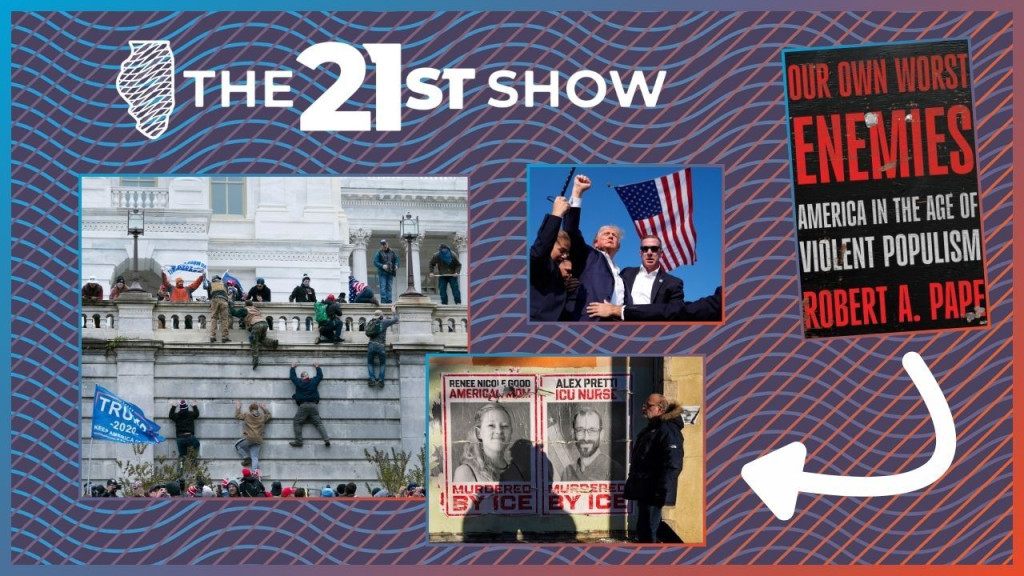
From Illinois Public Media, this is the 21st Show. I'm Brian Mackey. The last decade or so in the United States has been marked by a rise in political violence. The shooting at a congressional baseball practice, destructive protests in 2020, the storming of the U.S. Capitol, the shooting of state lawmakers in Minnesota, the assassination of United Healthcare executive Brian Thompson. Assassination attempts on OpenAI CEO Sam Altman, violent ICE raids in multiple American cities, and multiple assassination attempts on President Trump.

For decades, Robert Pape has devoted his research to international security, but in recent years, he's also directed his attention [to] what's going on here in the U.S. Pape is a professor of political science at the University of Chicago. He's also director of the Chicago Project on Security and Threats. His past books include "Cutting the Fuse: The Explosion of Global Suicide Terrorism and How to Stop It" and "Dying to Win: The Strategic Logic of Suicide Terrorism."

Pape argues that among the biggest threats to America is political violence becoming an accepted part of our society. His new book is called "Our Own Worst Enemies: America in the Age of Violent Populism." It's out this week from [the New Press]. [I] spoke [with him] yesterday afternoon. We taped this conversation in part so we could put it on video, and you can watch on our website, twentyfirstshow.org, or just search the 21st Show on YouTube. That said, no calls today, but you can always let us know what you think. Our email address [is] talk@twentyfirstshow.org. Professor Robert Pape, welcome to the 21st Show.

[00:02:55]
Robert Pape: Thanks for having me.

[00:02:57]
Brian Mackey: Let's start with Jan. 6, 2021. What do we know about the people who stormed the U.S. Capitol that day?

[00:03:04]
Robert Pape: Well, we know a lot more today than we did in those days, and as it was happening, and what we now know overturns much of what we thought we knew before. You see, as it was happening, many people remember there were thousands who were storming the Capitol, lots of pictures of that actually in real time. And then the camera started to glom on to certain individuals, especially militia group members. And that gives the impression, Brian, that they were being — the Capitol was being stormed overwhelmingly by militia group members.

Well, we have been studying at my center, the University of Chicago Project on Security and Threats, every single one of the 1,575 who stormed into the Capitol that day. They've been prosecuted. When you're prosecuted, people may not realize it, but there are reams of documents, demographic information, investigators going into your background, not just simply the journalists covering at the time. So when this gets into the court system, and this is one of the most prominent things in the court system, what you find is an enormous amount of information about each and every individual. And it's usually documented enormously.

And I was fortunate — I have research teams at the University of Chicago because this is — no one person could go through the [100,000 to] 150,000 court pages. I mean, think about that, Brian. But research teams, that is what we do. This is actually something that is within our ballpark. So we were able to go through [them]. And what we discovered, Brian, was stunning. It really did blow me away because after all, I've been studying violent perpetrators — you just read the books — for decades, and I never saw anything like this. 45% of the people who stormed the Capitol, and that includes 45% of those who beat cops, just to be clear, 45% were doctors, lawyers, CEOs, business owners, IT professionals, State Department appointees. We have pictures of some of that 45% attending the White House Christmas party the year before, and then standing with guns daring the police to shoot. This is a very different image of what we're used to thinking, and it was images like this, Brian, that really, really told me there needs to be a much bigger look at what was breaking America apart.

[00:05:56]
Brian Mackey: And let's be clear — I think because sometimes we hear the excuse being made for people who perpetrated violence and certainly trespass — well, they were tourists, the police let them in. You're not saying that even if they are lawyers and doctors, these are people —

[00:06:11]
Robert Pape: Still engaged in — so let me — yeah, Brian, thanks for bringing up the idea of the grandmas and the tourists. Because most people, they've heard this so much — Tucker Carlson — and I'd love to debate Tucker Carlson on this because the empirics just don't stand up to what he's saying. You see, those grandmas and those tourists, they represent another 400 beyond the 1,575 that were never prosecuted. So we know this — again, we've been studying this in depth. This isn't just a weekend of Google searches. This has been going on for years at the University of Chicago, [with] research teams — I think 20-30 [people on] research teams — and really doing this right with all the access to all the legal documents.

Well, what most people don't know is, oh yes, there were some 400 of the tourists who came afterwards that are just sauntering through the hallways as you've seen the video. No, they're not the 1,575 who were actually prosecuted. There are 600 who beat cops with their fists, with poles, with shields, with wooden — with wooden shields — with video and pictures of them doing it. So this is what is in the [100,000 to] 150,000 — it's between 100 and 150,000 pages of total court documents. It's not just fine print, it's pictures, it's detailed pictures of each and every person. And it's really stunning when you go through it.

And so I can understand that that sounds a bit jolting because, my goodness, I've been told they're militia — well, only 1 in 10 were militia group members. And you say, well, how can I be so sure? It's because when you go all the way through the court — our court system, Brian, there's a thing called sentencing. People have heard of that. What they don't know is that sentencing is when all the investigation on your background comes out. It's the sentencing [when] that background comes out, because that's when all the possible caveats to the sentence come into the judge. So you have both the defense and you have the prosecutors. So this is all brought out into the open.

[00:08:38]
Brian Mackey: "Gee, Officer Krupke, I was really abused." And that sort of thing.

[00:08:42]
Robert Pape: All of that is there, all of that is documented, Brian, because we live fortunately in a court system where once it's going through the court system, all of this is documented. So this is why I can speak so firmly and definitively. It's not just kind of — because again I'm making hand-wavy guesses. This is a very different look.

[00:09:10]
Brian Mackey: So what is going on in the minds of these doctors and lawyers, as you say, and engineers and government employees, that they feel this is what they have to do on that day?

[00:09:23]
Robert Pape: Yeah, they, on Jan. 6, they believe they're doing a community service, Brian. They truly believe that that election was stolen. And they believe they are patriots in the service of overturning a stolen election. Now, I'm not telling you they should have believed that, but we need to understand that what happened here in this January 6th didn't start on the day of Jan. 6. It starts on the day after the polls close in November and even a little bit before that.

You see, most people think election violence — and this is also what was so jolting — is election violence, well, that must mean violence at the polls, that you're gonna have intimidation of voters as they're going to the precinct. And some of that does happen a bit on the edges, but this is a mistake, a misunderstanding. It's not that it's completely wrong, it's actually something that — that just doesn't happen. That's not the dominant form of it, and that's true overseas and in other cases as well.

The real issue with election — uh, political violence — is the counting of votes and then the seating of the winners when the losers don't want that to happen. That's where the actual tensions really rise, because it's about power. It's about power. It's not about one vote, it's about who's taking control of power, and that's what Jan. 6 was. You need to understand that was President Trump and his supporters — trying to literally stop the transfer of power to the duly elected president, that is Joe Biden, and this is supposed to be a peaceful transfer of power. Well, on that day, that was the one and only time so far in our country it was a violent transfer of power. So we now have something that's important — a precedent has been set.

And what happened is that started literally when the voting, the count started, because on the day of the election, it was pretty clear right from the beginning that Joe Biden had won. And right from that point on, it was [that] the election was stolen, and it wasn't just a one-man show. There were numerous podcasters — Steve Bannon, just to name a few — and they didn't just say this, Brian, and the book documents all this. They grew their audiences on this. They existed before. So if you look at the shows — and the book goes through them — it's not that they literally did not exist before the November 2020 election, it's that their audiences exploded and skyrocketed over this. And that gives us a sense of how popular that idea was.

And now, a lot of people who, of course, didn't vote for Trump, or even some who did, they never bought the stolen election claim. But literally 20% of the public — 20% of the public — that's a huge portion, Brian, thought the election was stolen. And that continues, by the way, to this day, Brian. So you might think after all this time — and this is something that's very important to understand — that's not just three people. Once you have 20%, that means this extremism is in the mainstream.

See, for decades — in my life, your life — we're thinking, oh, political violence, extremism, hate is a fringe phenomenon. Yes, it is targeting African Americans, Jews, and minorities, and certainly that's not right and should never happen. But we're used to thinking that's a fringe. That's why we say it's under a rock. No, what we're describing here is a mainstream phenomenon. And this is very important to understand, and when it's in the mainstream, that changes everything. That just changes everything. It makes it so much easier for it to happen again.

And this is what we have to understand — why you just read in the intro here, you dated it perfectly, to the baseball game, the congressional baseball game in 2017. The book will give you dates of when violent populism begins. We can track it, we can identify those dates, and it's about 10 years ago, and it has been going on and on, and we need to stop being surprised about what's occurring.

The White House — we had the White House Correspondents' Dinner in April, Brian. That was the [third] Trump assassination attempt. And that shooter, Cole Allen — just wanna call attention — people saw this live. I mean, it happened live on TV, OK. So they might not — they probably don't know who Cole Allen is. Cole Allen is a 31-year-old. He lives in Torrance, California, which is like Highland Park here outside of Chicago — that is an upscale, upper-class suburb — and [he is] Caltech-educated. And he wrote a manifesto that he sent out to his family and friends just before he made that run where he shot. And he explained exactly what he was gonna do, which is he was going to stop the Trump administration. And he targeted President Trump, the vice president, everybody on that dias. He didn't want to hurt the media — he says that directly. But what he's doing is he's explaining it's political. He's going through all the issues of the politics of the Trump administration that he despises, and he says he knows many people agree, but he is going to stand up. He's going to be the one to do something. He paints himself as a Robin Hood, Brian. That is like Robin Hood was an Earl — Earl of [Loxley]. Same thing here. He's well off, he's privileged, he's gonna do what needs to be done.

And that — in sending the manifesto, and I know this from my previous work on violent extremists — you do that when you think you're gonna get applause. And people wanna know why do they make manifestos. A lot of people ask me that. They say, why are these people doing that? Doesn't that give away the store and create fingerprints? Yeah, it does, but they're doing it because they're expecting people are gonna applaud and agree. That's why they're doing it.

[00:16:17]
Brian Mackey: And based on some of the reactions to some of the other violence we've seen, that's a reasonable belief for someone.

[00:16:26]
Robert Pape: Oh my goodness. I mean, you see this with Mangione, the healthcare CEO. I'm sorry to say you saw this with the attack on Nancy Pelosi — she wasn't home, but her husband [was] almost killed. Similar to [Mangione], the assassination killing of [Brian Thompson]. Similar here with the applause on social media — [and similar with] Charlie Kirk.

Our national surveys pick all this up. And Brian, this is what we need to understand. We're in a new world. I call it violent populism. It's when extremism moves from the fringe to the mainstream.

[00:17:04]
Brian Mackey: All right, we need to take a break. When we return, more with Professor Robert Pape of the University of Chicago and author of "Our Own Worst Enemies: America in the Age of Violent Populism." This is the 21st Show. Stay with us.

It's the 21st Show. I'm Brian Mackey. We're talking today about the rise in political violence in present-day America. University of Chicago professor Robert Pape has written a book about this. It's called "Our Own Worst Enemies: America in the Age of Violent Populism." I spoke with Pape yesterday afternoon. I should say we slightly edited the conversation for time here on the radio. You can see the full uncut video version on our website, twentyfirstshow.org, or look for the 21st Show on YouTube.

Let's get into some of the definitions in your work here. Say more about what exactly you mean by violent populism and how that's different from other periods of violence that Americans may be familiar with from our history, be it the radical underground of the 1960s to the racial terror of Jim Crow.

[00:18:31]
Robert Pape: Thank you for bringing this up. So the book has — has chapters on the history here so that you can really get a better sense of this. And it is the case, we've had other punctuated periods of high political violence, historically high, and those are the 1960s in particular and the 1920s in particular. Now, of course, you could go back further, but this is a book about modern America. So I'm not literally trying to go back to the 1820s. But the point is you can see in both data, the key examples [and] histories that we remember, that those stand out — and so that's why there are chapters on those. I do cover a little bit of the periods in between to show you, yes, violence occurs, but it's not that punctuated.

And then I explain and I delve into whether these are periods of violent populism — not just political violence — where there's mass support for the violence that's occurring. And you can see right away a very common pattern to today, which is — the key fact of today and in the '60s — tens of millions of Americans support political violence. They find it acceptable. That doesn't mean you get tens of millions of perpetrators, but when you have that degree of acceptance, that's what it means to have the normalization of political violence, and that nudges the volatile individuals over the edge and makes them — in addition to everything else that's happening to them — have the expectation of social approval. And that expectation of social approval [is] enough to nudge them over the edge.

[00:20:23]
Brian Mackey: So how does political violence become increasingly normalized? You've looked at this in other countries. What are some of the patterns that you see in America as to how this is happening?

[00:20:33]
Robert Pape: Yeah, the core thing to know, Brian, is it comes from social change. And the social change that I'm gonna explain to you is happening in our country right now. We have some specifics that are not identical to the exact social changes in other countries or to the '60s or to the '20s. But what they have in common in all of that is social change. When you get rapid social change that outpaces what your political system can handle, that's a recipe for violent populism.

[00:21:08]
Brian Mackey: What do we mean by social change?

[00:21:10]
Robert Pape: Well, let me explain. There's two big ones happening to us right now. One is demographic and identity — we are transitioning from a white majority democracy to a white minority democracy for the first time in our country's 250-year history. So let me give you some data points. In 1990, we were 76% non-Hispanic white as a people. Today, we're 57% non-Hispanic white. It'll be another 10, 15, 20 years — depending on what deportations — now you see the lightning rod issue — before we'll become a white minority democracy, a true multicultural democracy.

Well, that demographic shift — and we can track this in detail in our census, Brian, this is not — these, again, [are] all hard information. That demographic shift has huge impact on our politics. It changes our parties. It changes who within parties are going to govern. And it is something that upends politics. Now, when that happens overseas, I can give you examples — say, Lebanon. Then we hear that on NPR or other [outlets], oh yes, yes, yes, well that's happening over there. If we had demographic change like that, we would never have the violence here in our country. Well, I'm sorry to say we're not immune to the impact of rapid social change.

And just to give you an example of how this fits our politics: when Donald Trump came down the escalator in 2015, he didn't just come down as a reality TV star, he came down with — what? Immigration was his lightning rod issue, and [he] immediately shot to the top. And he didn't just touch this and then go do some talk about something else. This was the issue — immigration, the wall — that he rode all the way into the White House in 2016, upending the Republican Party. And what was his issue in 2024 that he again rode into the White House on? Mass deportations.

Now this doesn't mean that everybody who voted for Trump supported [an end to] immigration, you know, [wanting to] stop immigration or mass deportations, but our surveys show a large [portion] did. And what they're effectively doing, Brian, is wanting to stop that demographic shift where America becomes a white minority democracy and reverse it. Well, that provoked a counter-reaction. That's the counter — then the left response. There's blowback because many people on the left wanna see that continue, and in fact, wanted to accelerate [it] for fear that the Trump side will stop it. So this is one of the huge issues of tension in our country right now. And again, not everybody who supports a Democratic candidate agrees with this, but in our national surveys, we find tens of millions on each side who fit that bill.

Now there's a second big change happening, Brian — so that's not bad enough, OK. There's an additional change happening that really creates this pernicious cocktail for political support for political violence in the mainstream, and that's economic. See, over these decades, we have also seen massive wealth shift to the top 1%. We all understand that now as the affordability crisis. Literally 50-year-olds can't afford a home. It's actually [the case that] the average age of first-time homeownership is 40 years old.

Well, there's a [tail] to that, Brian, which is deep anger at the establishment. Deep anger on both sides of the aisle, because the affordability crisis is party-agnostic, OK. So this is not just affecting Democrats, although many Democrats think it only affects them. It's not just affecting Republicans, although many Republicans think it's only affecting them. In our surveys and in our focus groups, Brian, this screams right out at you. And the amount of deep anger over this —

Let me tell you a little story from one of the focus groups that really got my attention and fits the bill here, which is, we did hour-long Zooms with people — 70 focus groups, lots of people, different sides of the aisle — to really try to understand what was breaking our country apart. And we just would often let them talk. Just let them talk. And as you know, [as an] interviewer, that works pretty well because after a few minutes, people just wanna tell you what's on their mind.

And what came out was — I already knew something about the student loan crisis. I've got three kids, I put them through college, but I didn't really get the depth of the anger, Brian, until you get people on who are 48 years old. They feel like they've been sold a bill of goods. They did everything they thought right. They took out the loans, they got the degree — and that's 25 years ago, and they're still paying it off. And even if they paid it off tomorrow, they're not seeing any way in their lifetimes they're affording a house. They just don't see that. That for them means the American dream is gone, they're less off — worse off than their parents. Now, they're not starving, OK? They're not out there sort of panhandling. That's true. But the deep anger — and many of them say the last thing I should have done was gone to college. I'd have a house today if I wouldn't have done that.

And both parties — you start to peel the onion on this. Who made money on student loans? Republican bankers, and I'm sorry to say this 'cause I'm a professor at a college, [and] Democratic universities. That's who made the money. And what happened is it affected both sides.

So if you look at this — you put these two together — that is the demographic shift, for the first time in our country's history, from a white majority to [a] white minority democracy, and then what I call the negative sum society, where 90% of people are worse off because [those people] have paid the price for [wealth] shifting to the top 1%. Now you have [an] actual reason why people are perfectly willing to burn down that establishment. Not everybody, of course, but now you can see how you can get 15, 20% on each side of the political spectrum today [to] support political violence. And that's the cocktail.

This is not about the old style of hate, you see. We're used to thinking of that — well, it must be coming from being a racial[ist], you know, a racist or anti-Semitic or anti-foreign. Those are still there. That hate is still there, and we can even track it in our surveys. What's different in violent populism are these big social changes added on top of that. And these are far bigger, far bigger, and that's why you're seeing a lot more political violence that's truly, truly scary.

[00:29:24]
Brian Mackey: And it tracks with some of the reporting I've done, and the work of others — social scientists and journalists — that find this — some people call it the horseshoe effect, right, where you have people who are both excited about Trump and excited about Bernie Sanders, which I think is confusing to people who are highly informed about policy and politics. But if you just want someone to smash the establishment, it begins to make more sense.

[00:29:51]
Robert Pape: That's right. So Trump and [Sanders] use somewhat different terms, OK. So Bernie Sanders will talk about the word oligarchy, and people on the right will scratch [their heads]. I don't quite understand that word. And then President Trump will talk about the carnage in America, and people on the left will scratch [their heads]. What, what do you mean by that? The truth is they're talking about the same thing. They're literally talking about the same thing, and they're using different words because as politicians, they're speaking to their specific audiences.

And that's what this book is doing. It's sort of cutting through some of that — we're used to jargon that politicians use — so that we can actually understand what's happening to our country and not keep looking through it through a Team A, Team B lens. Because that just leads to the conclusion, well, my team just wins and we're all good, right? No, we need more than that. We need more than that.

And this book has good news. It has very good news. But it also means that — this is why — we've had elections, we had Donald Trump win, that didn't stop violence. We had him lose, that didn't stop violence. We had Donald Trump win again, that didn't stop violence. So we need to look back over this period of time, and people who think, well, no, no, all we need to do is win by one vote, and everything is gonna be good — well, then we wouldn't be in the soup we're in today because we've seen that over the last eight years, and it's not good enough. And that's what the book is really trying to explain.

[00:31:29]
Brian Mackey: No, I'm 100% with you there. Electoral victories are not going to be enough. I have so many thoughts swimming right now. I wanna talk about — you've mentioned Donald Trump a number of times, and I think there are gonna be some listeners who feel like he is a unique, uh, sort of key to this increase in violence we've been seeing, right. And you talked about the demographic change, and there were times in American history — maybe not to the extent now, but the Irish were not white when they first got here, right? Southern Italians certainly were not white.

[00:32:00]
Robert Pape: [No.] How [the Irish Became White] —

[00:32:00]
Brian Mackey: — "How the Irish Became White," right? Highly recommended. If we had had a leader maybe who didn't try to weaponize this or politicize this in that way, right? George Bush — I mean, I sat in a press conference with Republicans talking about needing to increase outreach to Latino voters in 2012 after that election failure among Republicans. How much of this picture is uniquely attributable to Donald Trump and his resilience, his success despite losing the popular vote twice, and yet he's now been president twice.

[00:32:38]
Robert Pape: That's right. So Trump is a cause, Brian. He's not quite a unique cause. He's a cause and a symptom at the same time. And the fact that he's so prominent — Donald Trump is the most known person in America. We've actually done this in our surveys. Nobody comes close, just so everybody knows. Gavin Newsom — no, no. Trump is — everybody knows Trump. I mean, almost — goodness, I don't think you can find a single person here who doesn't know Donald Trump. You can't say it about any other leader, any other person, OK? So this is really quite stunning.

But that doesn't mean that once he goes away or is out, everything else is fixed. That's the mistake I want to call attention to, and it's an understandable mistake. Believe me, I understand. But here's where the rubber really hit the road for me, because I was presenting some of these early findings to the editorial boards of some of the most famous news organizations in our country — and I won't say who they were — multiple times in person. And they all went and said, no, no, no, Professor Pape, we hear you, but you know what this is — it's just Donald Trump, and we're gonna de-platform him. And then we're gonna de-platform Tucker Carlson. And some political leaders — many political leaders believe that.

And that actually happened. That was a test, Brian, because that de-platforming actually happened. And then he went — he was under four trials. OK. All right. Now I'm not saying they were coordinated, I'm not — but nonetheless, look at all the effort, and think of it as an experiment, a test of this idea that it's just Trump, and if we just could take him out, then everything would be fine. Well, we effectively did all that, and it didn't slow him down. In fact, you can even argue it put him in the White House.

[00:34:40]
Brian Mackey: All right, we need to take another break. My guest is Professor Robert Pape. He's a researcher at the University of Chicago. His new book is "Our Own Worst Enemies: America in the Age of Violent Populism." This is the 21st Show. Stay with us.

It's the 21st Show. I'm Brian Mackey. My guest is University of Chicago researcher and professor Robert Pape. He says political violence is becoming more accepted here in America, and that is one of the biggest threats to our country. All this is the subject of his new book, "Our Own Worst Enemies: America in the Age of Violent Populism." Again, I spoke with Pape yesterday afternoon. We've put a longer full version of this conversation on video and you can watch that at our website, twentyfirstshow.org, or on YouTube.

Before the break, Pape was talking about Donald Trump as both a symptom and a cause of the changing dynamics of our politics. We'll pick up right where we left off.

[00:35:51]
Robert Pape: These social changes were bubbling up under the surface. Jeb Bush — he was the leader of the other side, the opposite of Trump, embracing immigration from the Republican side of the house. And what happened was Trump just simply blew him out of the water. I mean, literally blew — he was the first one to go of the other rivals to Trump. And the reason — you can see this in opinion data — is that there was always this huge growing gap between the Republican electorate, the people [doing the] electing, and their leaders. And it's just not true that people are sheep and they'll follow their leaders off a cliff or wherever, no matter what. It's just not true.

And you saw this, by the way, on the left, with the skyrocketing rise of [Mamdani]. Skyrocketing rise. Who had heard of [Mamdani] a year before he was elected mayor? Virtually zilch, OK? And what happened is he got — he rode the right issues and he could articulate them in a powerful way that connected with average people. And Trump is like that on the right.

And I'm sorry to say that these social dynamics I just explained to you — they're likely gonna be with us for the next 10, 15, 20 years. I think we should do things to deal with this, and I have specific ideas about that. But nonetheless, we need to understand that if all we keep thinking is, oh, we're just gonna wait for that one demagogue leader to leave — that's what we said before in 2016. Exactly what we said in 2016. And the problem here is there will be others who will come, and we don't know their names today, but they are likely gonna pick on exactly the same anger that's there in the body politic. And if that anger is there, why aren't they gonna rise here? They're already doing things on social media. We're already seeing some glimmers of this.

I'm sorry to say there will be better versions of Trump in the future, and the reason is because of the social change underneath. That's the issue. And I realized this is — this means we have to understand a little bit more of our predicament. But this is why the whole strategy of de-platforming Trump was a failure. And I was arguing it would fail, and I'm glad we tried it. And now we can see there are real limits to this hope. It's just hoping to win. It's not actually changing the game.

[00:38:55]
Brian Mackey: I want to come to solutions in a few minutes. I do want to share — we ask our listeners to sometimes send in messages, and because we're not live, I can share some of them. Just by text message we got — Lloyd in Danville says America must demand change by going to the polls and changing the climate of what it means to be a political leader in our country. I'm afraid that I'm living to see the downward spiral of our country. We also heard from Roberto in Rockford who said, I believe the real source of political violence is born from a place of the people not feeling represented, the very people telling us to trust them with our votes. And then Brandy in Urbana says, where do we draw the line in the definition of political violence? Is a discriminatory justice system, which exploits prisoner labor, political violence? Are the detention centers right now political violence? Are the attacks on bodily autonomy for half of the population political violence? I think we should adjust the scope of the conversation about the possible perpetrators from left or right, and consider the implications of violence a political governing body can enact on the masses.

[00:40:01]
Robert Pape: Thank you. Yeah, so let me just talk about — and

[00:40:03]
Brian Mackey: — you do, you write about ICE quite a bit in your book.

[00:40:06]
Robert Pape: Exactly. I just want to say — so a lot of people, because you can only do so much in these interviews, Brian, as you know. And this book is 250 pages and it covers — it's gotta do the history, it's gotta cover a lot of material. And a lot of people — fortunately, you've actually looked at the book, so you know something [of] what's in it. Not every interviewer has done that. And so it's very understandable, this idea of, well, let's widen the conversation about political violence. The book does exactly that — [a] whole chapter on political violence from the states and how that looks in the era of ICE, what that means specifically. So this is exactly — she — I think it was a woman — right on point. The other comments also are on point too in another way, Brian, because what they're sensing is that there's an element of good news in this book, and it's not just general good news, it leads to avenues of untapped optimism and strength that we're just not tapping into enough.

And that is — 70% of Americans, in survey after survey over five years, [show that] at least 70% of Americans abhor political violence. And that fact never gets enough attention. And in this book, it doesn't just get a little attention — you know, check the box, feeling of optimism. I'm explaining we need to lean into that 70%. And part of that means that it is the core of our democracy. That's 70% of our people. That's the core of our democracy.

And the first element is — oh yes, as one of the listeners, or people who wrote in, [said] — vote. Absolutely. Voting is important, but it's not enough. It's not enough. And why isn't it enough? It's because it matters — not just getting somebody elected by three votes. Because if they get elected by three votes, and then they get into the legislature, it's just a logjam. And we've seen this over and over again, and nothing comes and improves the plight of the 70%. We see this over and over again.

So what that means is — and this is a call to action for the 70%. See, in many ways, the book is written for the 70%, which is — it says, hey, there's more for you to do, the 70%. Which is not just vote, but to send emails, to communicate, to send phone calls to the candidates you like, telling them to reach into the 70% even more, [to win] by a wider margin of victory. The 70% have to exert themselves more. And if not, who's gonna drive the train? Those radical 15% on each side — that's 30% of the public — they are more likely to vote, by the way, but they're also more likely to communicate with their members of Congress, to communicate. So we need to change some of this dynamic, and the 70% is just far bigger. It's just far bigger.

[00:43:24]
Brian Mackey: How do you respond to people who question — you know, the 70%, that's great, but there are so many structural impediments to true majoritarian government in America, be it the Senate or the Supreme Court, or gerrymandering or the Electoral College — that there are things that need to change more fundamentally, which — I'm sympathetic to some of those arguments, and yet I fear that that is the sort of thinking that leads down the dark path eventually to — maybe what do we really need to change?

[00:44:00]
Robert Pape: That's right. So that idea — that what we need to do is change the Constitution — the problem, Brian, is it comes from a good spot. The people making this [argument] have very good intentions. I've seen this. I've talked to [them] — this is not coming from a bad place. This is coming from, how can we have a better — and also often an enlightened place, an intellectual place. These are often people that are very thoughtful and so forth. But I study the world of political violence all around the world, [and] have for 30 years. When you start literally upending the constitutions, you have no idea where that's going. You don't — you lose control just like that. So that's the problem — no control. There's no control, and it disappears instantly. It's not like, oh yes, once I lose control, I'll stop. No, too late.

Let me give you an example that's not exactly [set] in a democracy, but I think people might enjoy hearing it. And it has to do with the revolution in Iran. Everybody now, with the Iran [situation], has heard that there was a religious revolution in Iran. Well, you know what? That didn't start as a religious revolution. That started as a liberal revolution. Michel Foucault — Foucault — the famous Foucault, who's the liberal philosopher — we teach him at the University of Chicago — he was in Tehran in the early months of the revolution, and he wrote dispatches for newspapers that are actually published as a book. And it [shows] what started out as a liberal revolution. He was all for it, Brian, because, of course, the Shah of Iran was a puppet of the United States, [and] he didn't want the oppression. Similar arguments you're hearing today from people making this [case]. And so he was all [for] breaking the government, changing the constitution of Iran, etc.

But what happened is — and you see it literally in his dispatches, [and] he was very honest about this — after three months, he completely changed his mind. And he changed his mind because that's when the religious element with all the guns came. And you know what, they shot the liberals. They literally mowed them down. And he's just tracking this, and he's saying, oh, I should have realized, we lose control. So that's the issue here, Brian, is loss of control. It's not good intention, and it's not being smart — it's that once you break these things apart, you lose control. And Iran hasn't been the same since.

[00:46:44]
Brian Mackey: Yeah, it reminds me — there's a British documentarian whose name is escaping me, but occasionally when people will say they want a revolution, he will challenge them to say, you know, that means losing your bank account, most likely. A true revolution —

[00:46:56]
Robert Pape: — to other people, to other people.

[00:46:58]
Brian Mackey: Do you just want the bankers to be nicer, or do you really want a revolution?

[00:47:03]
Robert Pape: Yeah, because of the loss of control. See, people think the grass is greener on the other side, imagining it's like just buying a better house — that, oh, I'll sell my house here, and then I'll just get a better house and everything will be better over there. It's more like a tornado. It's more like a tornado. And we just had those here, by the way, in the south part of Chicago where I live — that's a different story — and you're not standing up against a tornado, that's for sure, and that's what happened in my neighborhood. We were pummeled, and that is simply — that's what this really looks like. And that's what Foucault — and Foucault, a genius — I'm just trying to point out, this is somebody who many, many, many people, especially on the left, will know, but they won't know his book on the Iran revolution, and they should go read it. It's stunning to see what this looks like in the real world.

[00:47:57]
Brian Mackey: We're coming to the end of our time together. What would you advise people — you say in the beginning of the book, you want to sort of open people's eyes, alert them to the signs that are happening all around them that you are trying to piece together here. What should people be watching for as we're heading into this consequential election this year?

[00:48:16]
Robert Pape: Yeah, the most important thing to understand is the calm before the storm. So right now we have about six weeks before we have an election, and the actual warning period — the period of danger — doesn't start now, it starts when the polls close. Because once the polls close on [Nov. 3rd], that's when the counting starts, and the counting is when the real tension is going to come in.

Because, for example, if there's a blue wave, is Donald Trump going to allow the seating, the counts to go forward? Is he then going to allow — and I'm already hearing from many, many, many Democrats, many people who say, well, if that happens, then I'm going to get — I'll be violent then, because — and so notice how similar that is. So they're not [wanting] to support violence, they're saying in that circumstance you can't stop me. Well, the way to stop it is what I'm describing — the 70%.

Now we have six weeks, and what we can do in that six weeks is not just turn out more with the 70%, we can exert [pressure on] our favorite candidates to reach more into the 70%. And that is important because by definition, they're reaching beyond their comfort zone. They're reaching beyond their donors. Their donors are focused on getting the candidate to win by one vote, because once they win by one vote, then they get to [weather] the loss. No, we need more than that. And that's what the 70% [need], and that's a mission for the 70%, and that's the call to action now. And it's something we have six weeks [for]. Let's not burn the daylight.

[00:49:59]
Brian Mackey: Robert [A.] Pape is the author of "Our Own Worst Enemies: America in the Age of Violent Populism." Thanks again for your time.

[00:50:06]
Robert Pape: Thank you, Brian.

[00:50:08]
Brian Mackey: That is it for us today. Again, you can watch an uncut version of today's conversation on YouTube. Just search for the 21st Show, which is a production of Illinois Public Media. I'm Brian Mackey. Thanks for listening.
The last decade or so in the United States has been marked by a rise in political violence. From the January 6, 2021 riots at the U.S. Capitol to the assassination of conservative commentator Charlie Kirk to multiple assassination attempts on President Donald Trump. For decades, Robert Pape has devoted his research to international security. But in recent years, he’s also directed his attention with what’s going on domestically.
Pape argues that among the biggest threat to America is that political violence becoming an accepted part of our society in his new book called “Our Own Worst Enemies: America in the Age of Violent Populism.” He joins the program today. The extended version of the conversation can be found here.
GUEST
Robert Pape
Professor of Political Science, University of Chicago
Director of the Chicago Project on Security and Threats
Author, “Our Own Worst Enemies: America in the Age of Violent Populism”