








Illinois Governor J.B. Pritzker on prison deaths, being a billionaire, and plans for a third term
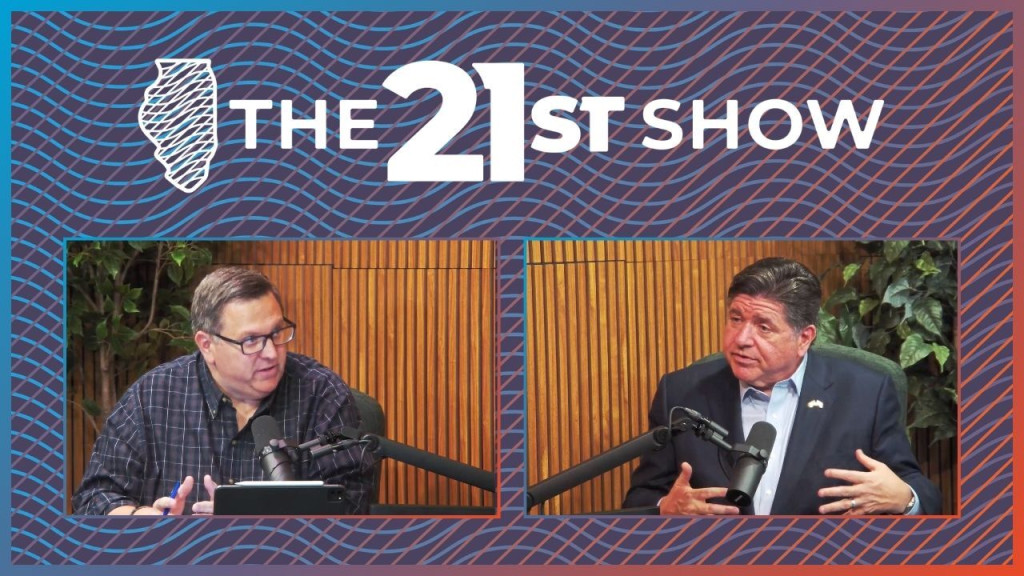
Illinois Governor JB Pritzker sat down with 21st Show host Brian Mackey last week in the podcast studio at Illinois Public Media station in Urbana. Illinois Public Media
// This is a machine generated transcript. Please report any transcription errors to will-help@illinois.edu.

[00:00:00]
Brian Mackey: From Illinois Public Media, this is The 21st Show. I'm Brian Mackey, and my guest today is Governor JB Pritzker. The Democrat is seeking a third term. If voters approve, he would join Jim Thompson as the only man to earn that privilege here in the 21st state. Pritzker's opponent is once again Darren Bailey. He's a farmer from southern Illinois, a former state senator, and a former Republican nominee for governor from just four years ago. We're scheduled to talk with him in the coming week as well. I spoke with Governor Pritzker the afternoon of Thursday, Aug. 6th in our studios in Urbana. We're putting this conversation on camera. You can find it on YouTube by searching for The 21st Show. Governor Pritzker, welcome back to The 21st Show.

[00:00:48]
Gov. Pritzker: Thanks, Brian. Great to be back with you.

[00:00:50]
Brian Mackey: So last fall when you and the First Lady visited Pope Leo, you presented him with a self-portrait by a woman named Yesenia Diaz. How did you come to choose that as sort of one of the highlight gifts?

[00:01:03]
Gov. Pritzker: Well, let me admit that my wife chose it, and as you may know, as First Lady, she's been very involved in helping incarcerated women in our state. We've had a lot of challenges with incarcerated women. They haven't been treated fairly over the many, many years in Illinois, and so she took that on as a major issue. She's made huge strides. You know, a lot of these women, as you may know, get convicted of crimes that are really about assisting someone that's their boyfriend, their husband, some other man in their life, and they sometimes spend much more time in prison than the person who actually committed the crime directly. So she's really taken that issue on, anyway.

And there's a woman who's incarcerated that my wife had gotten to know and who's really reformed in prison, and she is an artist and she made this beautiful, beautiful drawing, and my wife thought it was the perfect thing to give to Pope Leo. And he loved it, by the way. He really was touched by it. I, of course, not nearly as classy and stylish as my wife is and thoughtful, so I brought him the Pope beer. I thought he would enjoy that, and he did, by the way. He was terrific. Can I just say this Pope is really my favorite so far. I mean, of course he's from Chicago, but that's not the only reason. He's really just a great guy, and I would say somebody who genuinely has a heart for the job that he's in.

[00:02:26]
Brian Mackey: Yeah, I must admit — I was raised Catholic in the next parish over, so about six blocks from where he was 20 years later — but I do have a soft spot for him. You know, sticking with this, Ms. Diaz, a lot of people have a hard time seeing the humanity of people in prison. And I wonder — I don't know the details of her case — Diaz is more than halfway through a 33-year sentence for murder. What is it that you and MK see that others don't in people who are in prison?

[00:02:54]
Gov. Pritzker: Look, they're in prison for a reason, right? They've committed a crime and they've been sentenced. And there are many of them that don't reform in prison and don't try to better themselves, and many of them who never get out. But there are also a lot of people who go to prison who see it as an opportunity to reform themselves, to rehabilitate, and if we give them the opportunity to do that, you'll often see real transformation.

And so it's just recognizing the humanity in everybody. People make mistakes, sometimes terrible, terrible mistakes. That's not to say they shouldn't be punished for those mistakes, but it does mean that after some number of years, recognizing that they can improve themselves — and sometimes they can be examples to others in prison — we want our prison system to operate properly, you know, in a way that doesn't just have people constantly at war with the officers in the prison. So that's all it is — just a recognition that everybody's human and that wherever we can, we should recognize that humanity and reward good behavior when that's something that people exhibit.

[00:04:09]
Brian Mackey: One of the reasons I ask about that is because there is another man who was in custody of your administration. His name was Jason Stephens, who's at the Joliet Treatment Center just for people with serious mental illness. I'm not going to — it's a tough job having to work there day in and day out — presumably because of his demons, and maybe in an apparent attempt to call attention to his situation, he set his cell on fire. Guards opened the little mail slot, shot a fire extinguisher and pepper spray through the hole. Minutes went by, and then when they finally opened the cell for rescue workers and got Jason into an ambulance, they were made to wait for one minute, two minutes, 10 minutes. The guards are arguing with the firefighters. 28 minutes go by ultimately before they can even get out of the gate to the hospital. And this is not an isolated incident, right? In three years, inmates have set more than 70 fires at Joliet, which was supposed to be a model facility. Twelve of those were self-immolations. What is your reaction to what is happening in Joliet?

[00:05:07]
Gov. Pritzker: Well, I think you're well aware that where I think there is injustice — either by the agencies or by others — that I've taken action even when it's hard to do, even when it's something that should rest upon the people that are working under my administration. We did that, as you know, at the [Choate] mental health facility, a very hard situation. We've done that in other circumstances. We had to close the Stateville prison. We are going to be moving Logan as well, and some of that is for the reasons like you're describing, where there's been failures on the part of administrations past and ours — people working for our administration.

So this is another example: This shouldn't happen. And we need to make sure that we're holding people accountable who are responsible, but also that we need to make the improvements that are necessary so that people can get proper mental health [care]. And you know that mental health is often a reason why people are committing a crime, and that doesn't mean they shouldn't be held responsible — sometimes they should, absolutely, fully responsible — but they also need treatment. And so that's something we've been working very hard on. Sometimes the system doesn't work, and in this case it clearly hasn't worked, especially for the people who've been affected by these actions. And so that's something that we're doing a lot of work on now.

I will say that that's also the subject of a lawsuit, and so I probably shouldn't say any more than that. Lawyers tell me that we've got to wait sometimes for these lawsuits to play out before I can really opine about it. But I can tell you that I don't sit idle when we see that there is a problem. And I do hold people responsible where there is the situation that becomes obvious where something needs to be done and it needs to come out of either my office or above that agency.

[00:07:10]
Brian Mackey: The job is not often framed this way for the public, but you are essentially CEO of a 60,000-and-change-person company that is running with a huge geographic spread. How did you — and I know you want to listen to the lawyers and be limited in what you're saying here — how did you find out about what was happening in Joliet? Did you learn about it from the news reports? Had you known this for years that it's been happening now?

[00:07:34]
Gov. Pritzker: No, you know, when the individual reports come, I often will read about it. Sometimes I don't. Sometimes I don't know about it either because I didn't read that particular newspaper that covered it or something. But often it's either that I read the report or somebody in my administration comes to me and says, here's what's happening and gives me a description of it, or maybe they have the article and show it to me.

[00:07:58]
Brian Mackey: But I guess I'm wondering, did somebody say, hey, you know, there have been a dozen fires in Joliet, 20 fires, 70 fires?

[00:08:05]
Gov. Pritzker: Yeah, I will say that it isn't as if all along I've been made aware that there are — you know, that led up to this moment — and we've just ignored it. That's not the case. Indeed, I can say that when I find out about these things, I take action, and indeed that's something that we're engaged in right now.

You know, you talked about the state government being a 60,000-person corporation, sort of, and I know — I was in business before — I had 10,000 employees across several different divisions and companies, and I can tell you it's a hard endeavor to manage that many people. You can't do it yourself because you're not directly interacting with all those people — in my case, 10,000 people. You're indirectly, often. And so you have to rely upon people reporting up the chain. You have to rely upon good people around you to make sure they're monitoring properly. So that's a lot of what goes on. And I can say that I know how to manage, and at the same time we rely upon people to do their best, right, and be good public servants.

Sometimes people don't want to let others know that something's gone wrong in their part of the department. Or sometimes there are things that happen that really are out of the control of the people that are above those situations. Anyway, there's a wide variety of circumstances, and as you said, with roughly 60,000 employees, a whole lot can happen.

[00:09:40]
Brian Mackey: Yeah, one more question in this vein. We asked — we invited our listeners and viewers to write in. John in Chicago says please consider asking him when he last visited an Illinois prison, what did he see, what does he think needs to be improved?

[00:09:54]
Gov. Pritzker: Well, let's see. I have been to several prisons across the state. I think the last one that I visited was — I think Logan actually might have been the last one that I visited.

You know, look, this is one of the challenges — I think this is a really interesting area for us to explore if we have a minute. For so many years, it's been the case that Illinois didn't invest anything really in the facilities of the prisons of our state. The correction system is old. We have facilities that are 75 years, 100 years old.

[00:10:33]
Brian Mackey: And I'll go you one better. It was tremendously over capacity for a long time. That started to come down in your predecessor's term, but it has continued.

[00:10:40]
Gov. Pritzker: Yeah, indeed, significantly so. But the truth is that when your facilities are built 50, 75, 100 years ago, they're not built for modern circumstances, and the modern circumstances are that there are many people that we want to have rehabilitated, that we want to get an education — just as one example — who can't do that because the facilities were not made for that 50, 75, and 100 years ago. That's one problem.

A second problem is that nobody invested in the actual plant and equipment of these places. So you often have situations where the HVAC doesn't work in a whole part of a prison, and that's very trying for people who work there and of course for people who are incarcerated there.

I give you those examples because the hidden deficits in state government — in the things that state government does — were really hidden even to me and to the public until I became governor. And then you start to uncover — we all talk about the deficits of the state budget. We all talk about the deficits and the need to invest in infrastructure like roads and bridges. We all talk about the need for education funding, but very few people talk about the things that are a little bit hidden to the public because, oh, they're so difficult to deal with. And those are things that I've tried to both expose and to address with dollars, because you can't do it except that way.

And so you saw Stateville and now you're seeing Logan. And those are just two. The fact that we haven't gotten out of our state-owned developmental centers when almost every other state has gotten out of those kind of large congregate settings for people with developmental disabilities — I mean, that's something that should have happened years ago. It happened in other states years ago, and we have seven, I believe, SODCs, and we need people to be in smaller community settings [like illas]. And so we're starting to do that finally. It's not an easy thing to do. It takes years to get done, but we've been slowly but surely trying to get those things accomplished, right? Replacing or adding on or creating situations in our correction system for people to rehabilitate, making sure that we're moving people out of those congregate SODCs — and those are just the beginning. I could spend another hour with you telling you all of those challenges. But I can assure you that none of them, when I discover them, go unaddressed. We're often trying to put a plan together as we did. You saw that with the correction system and what we have to invest there.

[00:13:10]
Brian Mackey: As a manager — sticking with this idea of deficits in infrastructure — another problem that I'm sure you've encountered is the human infrastructure of government and the immovability sometimes. You have certainly better relationships with the unions that represent government workers here in Illinois than your predecessors, the last several predecessors do. But what have you learned about the difficulty of affecting widespread change when you have 60,000 people, many of whom you will never meet?

[00:13:41]
Gov. Pritzker: The challenge isn't about unions. The challenge is the number of people and making sure that everybody's moving in the same direction or in the right direction. That is the challenge, because getting 60,000 people who come to work every day and go home every day to all understand what our mission is —

[00:13:59]
Brian Mackey: You may say that — I think a lot of frontline workers in Illinois positions might say that they have their own individual struggles with locals and members — but fine, I take your point. But what have you learned about trying to get, you know, a prison guard doing the night shift in Joliet and someone cleaning up the bedpans at Choate trying to pull in this direction when, meanwhile, these stories are coming out about how terrible things are?

[00:14:27]
Gov. Pritzker: Look, our state workers carry an enormous burden. When I came into office, we were frankly a hollowed-out state government. And we didn't have enough people hired at a whole variety of agencies. I'll give you another example, which is DCFS, where the caseload was — I mean, ungodly for each caseworker. Investigators, we didn't have enough of those, and so on. And this isn't a problem you can fix overnight. It is a problem that has to be fixed, and indeed I would argue we have — that is to say, we now have fully staffed DCFS, that hasn't been done since I think Jess McDonald in the 1990s.

So I'm proud of the fact that we've been slowly, carefully and — I think within budget — rebuilding these agencies so that people get the services that they need. But the people who carry the load are people who are in agencies where we still have more work to do and people are doing the job of 1.5 or two people.

[00:15:27]
Brian Mackey: All right, at this point we need to take a break. When we come back, we'll continue with that thought and bring you the rest of our interview with Governor JB Pritzker. He's running for a third term as the state's top elected official. Again, we recorded this on Thursday in our Urbana studios. With that in mind, no calls today, but we always appreciate hearing what you think about the program. You can email us anytime. The address is talk@21stshow.org. That's talk@21stshow.org. This is The 21st Show. I'm Brian Mackey.

It's The 21st Show. I'm Brian Mackey. Let's get back to the conclusion of my interview with Governor JB Pritzker. He joined us Thursday in our Urbana studios. Before the break, we were talking about state workers and the jobs they do, and we'll pick back up right where we left off.

[00:16:52]
Gov. Pritzker: Remember, state government used to have 80,000 employees, right? Now we've got about 55,000, and then — as you — or maybe including, we've got some others at other kind of independent agencies — but we have many fewer people now. We have some technology that's helping, and so on. But we actually, interestingly, have the lowest number of state employees per capita of any state in the United States. People don't know that about Illinois. I think that people think, oh my God, look at all the people that work for the state. It's really not as many as in all the other states on a per capita basis. So we've had to rebuild some things. I'm not suggesting I want to have a lot more people, but we need enough for us to do the services that people need.

So I'm just raising the point that I think of the job as we've got to motivate people. They've got to have a mission. I try to communicate that to people — that our residents are our customers. We have to think of everything in the question — answering the question — and I'll give this example in our Department of Early Childhood, which we just created. We have to think of everything as a question about, OK, when the customer walks in the front door, so to speak — they may call, they may show up — they have a variety of problems, right? We can't say, well, we can only solve this one problem here because you showed up and asked us and we're going to send you to seven other places. We have to genuinely try to solve their problem and answer their need at that one place they show up, because many people who need government don't have time to do all of that. They need somebody to step up and help them.

So that is what we're trying to convey across all the workers of state government — that our job is to deliver for the people, and that you can't say — like sometimes you see at a restaurant — "that's not my section, sorry sir, I can't help you, that's not my section." That's what we try not to do in state government anymore.

[00:18:48]
Brian Mackey: So you're running for a third term. My father used to like to say about politicians, he never understood why they didn't want to just retire and go fishing. You could buy a fishing village. What do you want to accomplish in a third term as governor?

[00:19:02]
Gov. Pritzker: Well, you know, I came into office with a whole lot of things that needed to be accomplished, and I would say we have only accomplished some and not all of those things — and those challenges that states face. In many ways they've increased. Think about the challenge that's now upon all of us of the really transformation that's going to occur in our economy as a result of AI. The challenges that have been brought upon our children — and all of us really — by the failures of social media companies, and the fact that social media has really divided us all and caused mental health challenges for people.

These are new things that we're now trying to address. AI is very new and the solutions to it are still being explored. But I guess what I would say to you is my job as governor is to make sure that we're constantly trying to stay ahead of — or at least up with — all the things that are coming at us.

So I'll give you the example of something else new that is really, really challenging: The Trump administration has now cut drastically Medicaid coverage and food assistance for people who need it most. We as a state government have to figure out, how are we going to address the needs of people who are going to be thrown off of food assistance and healthcare for no reason other than Donald Trump wants to eliminate those programs? That really is what he's going after, but can't announce it that way. And so how are we — we can't fill the hole. We don't have enough money to do what the federal government has been doing up to now. And so we have to find new and different ways to do it.

So those are parts of my job, and then I'll just talk about the things that have been in progress and more to do —

[00:20:51]
Brian Mackey: Can we stick with the money question for a second?

[00:20:53]
Gov. Pritzker: Yes, because I just want to point out education, growing the economy — these are things that we are in the process of succeeding at. But there's so much more to do, and we've got to move Illinois forward, and those are things that motivate me to want to serve a third term.

[00:21:08]
Brian Mackey: I've been covering state government off and on for 21 years. Governor Blagojevich was fighting with the General Assembly when I started. "Where is the money going to come from?" has been the animating question. And as you pointed out, it's even harder now with the Trump administration. I would add public education as well as public food assistance and healthcare as things that are attempting to be cut. Where does the money come from? Right? It's one thing to balance the Illinois budget year to year with $30 million here, $70 million there. Where do you find the money? Because you're talking about billions if you want to backstop it.

[00:21:41]
Gov. Pritzker: We can't. I've been clear about that. There's no way to backstop the $7 billion that would have — well, you know, should have — come for Medicaid. In the coming years, the $8.5 billion, roughly, that's being cut — grants and other things that they're taking — there's no way for us to backstop that, right? Our whole budget is $55 to $56 billion. We're not going to be able to find the $15 to $20 [to] $25 billion that the federal government is taking away from us.

So the question is — when you think about the fact that we have to address the needs of people who are being ill-affected — indeed, they're being tormented by what the federal government is doing. Those are not easy things. But I will point out this: When I came into office, I think you know that we had $17 billion of unpaid bills. I mean, we'd borrowed money to pay for about $8 billion of it, but the other $9 [billion was] still there. And the $8 billion, by the way, you still have to pay the debt off — it just wasn't in the form of, you know, overdue bills. So that's $17 billion — we've paid almost all of that off.

We also have the largest — at least on a per capita basis — largest pension debt of any state in the country. We also had structural deficits. So, you know, it's not like I don't understand the challenges that we have faced and know how to overcome them. Because guess what — after 21 credit downgrades, 10 credit upgrades, balanced the budget eight years in a row, reduce that structural deficit down to less than a billion dollars, we have accomplished a lot.

Can we take all the stresses here? I don't know. But here's what I can tell you. I've had four real crises — I've been governor for eight years, and these were all things foisted upon the state of Illinois. One was from my predecessor, which was the leftover budget problem. How do you balance the budget of the state when he'd done such a terrible job and we have hollowed-out government? So that was my first crisis. Second, of course, was COVID, and that — we know all the challenges of that. The third crisis was the migrant crisis foisted upon us by a terrible governor of Texas who was trying to make some political point but of course hurting the people of Illinois and hurting the migrants themselves. And then the fourth is whatever you would call what's going on right now, where the federal government under Donald Trump is literally attacking states and the people of our state.

So all I'm saying is that we've been able to overcome, and I would say going forward, we shall overcome.

[00:24:17]
Brian Mackey: I know your aide is giving us the wrap-it-up signal here, so I want to share one last listener question. And this is in the context — there's a mood among Democrats right now. Bernie Sanders has won loyal followings by railing against the millionaires and the billionaires, and AOC's [adviser] — [AOC's] a pretty good [accent] — AOC's adviser says that, you know, every billionaire is a policy failure. We had a few more generous takes from some of our listeners. [Bethan] Champagne says speaking as someone who's very wealthy and yet still managed to have compassion for others, what is to be done about the ultra-rich? How do we meet basic human needs when the most powerful people see no value in it?

[00:24:54]
Gov. Pritzker: Well, I believe that it's a responsibility of all of us to make sure that we have a government that works for the most vulnerable, that works for the working families of our state, and that works for the middle class, and that we create an environment in which people can succeed. If they want to make an investment in themselves to build a business and create jobs, we should want that. And those small businesses that get created often become large businesses. And so when we talk about the big businesses that are in the state of Illinois, they were all small businesses once upon a time.

So look, I view — when people are criticizing me or criticizing people who are wealthy — they should ask the question, OK, but what is it that they've done to make the world a better place? What is it that their values are? What do they believe? Because I absolutely understand people's skepticism. And look at what Elon Musk did. He created an unbelievably profitable business in Tesla and other — PayPal and other things he was involved in. But he also was somebody who doesn't give a darn about working families or about the vulnerable in our country, and — you know — took out his chainsaw and went at it with DOGE and truly ruined people's lives. And I can see why someone looks at that billionaire and says, oh my God, we don't need any more of those. And that's true. I think you could name a few more.

But I do think that you can be a terrible person and have no money, and you can be a terrible person who has a lot of money. And the real question about a public servant is what are they doing to make other people's lives better? And I think I've dedicated myself — and shown myself to be — somebody who stands up for and believes in the fundamentals of what it is, the reason that I became a Democrat, which is we are all about fighting for the little guy. We're all about fighting for the most vulnerable and the working families of our state and our country. And I'm going to continue to fight like that.

It shouldn't matter how much money I have. What should matter is, am I helping to create jobs in the state? Are we making the state better for our children and our grandchildren? Are we improving healthcare? Are we providing people with enough food who otherwise wouldn't have it? These are all, you know, among the challenges that I take very seriously, and I think I've demonstrated to people — there were people who were skeptical. You may recall when I ran in the Democratic primary, lots of people on the Democratic side who are skeptical, hyper-skeptical, right? Here's some wealthy guy, and here we've got a terrible wealthy governor who's failing the state, we had a terrible wealthy president who's failing the state — why do we need some wealthy guy on the Democratic side? I remember all that. But I think I would say that people have seen that I did the things that I said I wanted to do and were the best things for the people of the state of Illinois — raising the minimum wage, investing in our roads and bridges, making sure that we're creating jobs.

And we're now the fifth-best education system in the country in the state of Illinois — fifth — and we have the highest graduation rate ever in the history of the state of Illinois for everybody, but also now for our Black residents, our Black students, and our Latino students. And I just make that point only to say, we're making a lot of progress. And I think the measure of me — certainly as people go into the voting booth in November — should be, has he done the things that he said he was going to do? Has he made life better, or at least made sure that the diminution that is being foisted upon them by Donald Trump is being ameliorated and that we're trying to address things as best we can given all the terrible circumstances that are being foisted upon us? And I think we've made a ton of progress. And so I'm proud of what I've done, and I'll — you know — whatever criticism people want to throw my way, I'd throw that back at them.

[00:28:49]
Brian Mackey: Governor JB Pritzker, thank you for your time. Thank you.

---

**Items flagged for human review:**

- [00:01:03] "hote mental health facility" — likely refers to Choate Mental Health and Developmental Center; rendered as "[Choate]" in the transcript. Please verify.
- [00:10:40] "sillas" — context suggests this may be a proper noun or acronym related to community-based settings for individuals with developmental disabilities; rendered as "[like illas]" in the transcript. Please verify the intended word or phrase.
- [00:15:27] Email address for the show: The original transcript contains "talk@2firstshow.org" and "talk at 21sTshow.org," both of which appear to be transcription errors. Rendered as talk@21stshow.org. Please verify the correct address.
- [00:24:17] "AOC's a pretty good accent" — context is unclear; may be a false start or reference to a specific comment. Rendered as "AOC's [adviser] — [AOC's] a pretty good [accent]." Please verify the intended meaning.
- [00:24:17] Listener name "Bethan Champagne" — spelling of first name uncertain; may be "Bethan," "Bethann," or another variation. Please verify.
Democrat Governor JB Pritzker is seeking a third term. If voters approve, he would join Jim Thompson as the only men ever to earn that privilege in the 21st state.
Pritzker’s opponent is once again Republican Darren Bailey. He is a farmer from Southern Illinois, a former state senator, and a former Republican nominee for governor from just four years ago. He will be joining the program in the coming week.
Pritzker sat down with 21st Show host Brian Mackey last week at the Illinois Public Media studio in Urbana to make his case for a third term. The extended version of the conversation can be found here.
GUEST
Gov. J.B. Pritzker
Governor, state of Illinois