Illinois State Rep. Kelly Cassidy on handling sexual harassment cases in statehouse
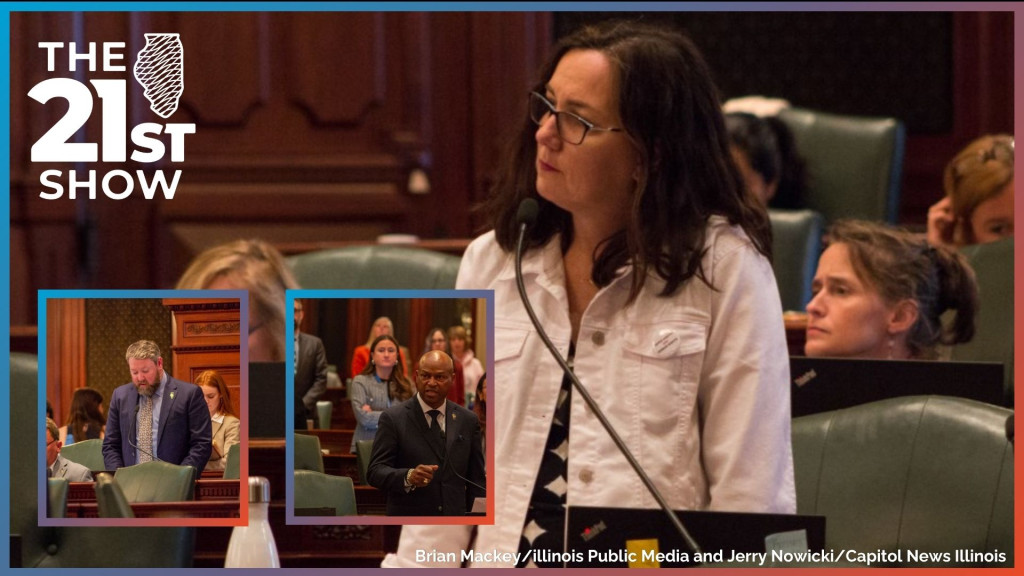
Democratic State Representative Kelly Cassidy is one of the few lawmakers who’ve gone public with criticisms of Illinois House Speaker Chris Welch regarding his handling of sexual harassment allegations involving former State Representative Harry Benton. Brian Mackey/Illinois Public Media and Jerry Nowicki/Capitol News Illinois
// This is a machine generated transcript. Please report any transcription errors to will-help@illinois.edu.

[00:00:00]
Brian Mackey: It's The 21st Show. I'm Brian Mackey. And we turn now to the ongoing fallout from revelations of sexual harassment by now-former state Representative Harry Benton. The Democrat resigned under pressure last month after it came out he'd been making unwanted advances and engaging in other harassing behavior with both a young staffer in his office and separately with a lobbyist.

For some members of the House, the episode has also called into question the leadership of Speaker Emmanuel Chris Welch, not only for how he handled the staffer's initial complaint several years ago, but also how he conducted himself after that. In one case, he responded to a text message from the woman asking for career advice by suggesting they take their chat to a disappearing messages app and meet in person in the bar of a steakhouse. And on social media, Welch reacted with the heart eyes and drooling face emoji to some of her photos. Last week he told Capitol News Illinois he meant no harm, but quote, I regret that and I'm embarrassed by it, and I apologize for it.

Welch also launched a private working group to think through what policies need to be improved in the House in order to address some of the shortcomings revealed here. Joining me now to talk more about this is state Representative Kelly Cassidy. Like Welch and Benton, she's a Democrat, but she is one of the few people who've gone public with criticisms of Welch in this case, as she did when former Speaker Mike Madigan was accused of mishandling harassment allegations against his people nearly a decade ago. I spoke with Cassidy on Friday. Because of that, no calls today, but you can share your thoughts at talk@2firstshow.org. State Representative Kelly Cassidy, welcome back to The 21st Show. Thanks for being here.

[00:01:55]
Kelly Cassidy: Thanks for having me. What was your top line reaction to this? You're on the legislative ethics commission. What was your top line reaction when [this] came into your realm of awareness?

Well, it came into my realm of awareness when we were all sort of mysteriously informed that our colleague was out of the caucus, and that set off a lot of rumor mill churning, wild speculation and, you know, gossip of the day. And what I was most aware of in that moment was the number of people that I've spoken to who have been victims of harassment in our building who were probably being triggered by everybody standing around gossiping about something they had had to endure — that in some cases they said, "I can't believe we're back here." But the truth is we never really left.

[00:02:31]
Brian Mackey: The speaker did come out — I think that was back in March, if I remember the timeline correctly. And then in April — April, yeah — well, then in April, the speaker acknowledged that there were victims involved in this. And so when did this start to become, you know, go from the realm of rumor to fact for you?

[00:02:47]
Kelly Cassidy: So I mean, as was noted in the [LIG's] report and in the media, lots of us clocked this guy pretty early on as having at least some creepy tendencies. But, you know, ultimately, I was on — I'm on the legislative ethics commission. It was clear this was going to come my way. But I was as in the dark as everybody around me because we don't know about the nature of the investigations until they're complete. So, you know, there's a very, very bright line of confidentiality within the LEC. So I was as in the dark as everyone else.

[00:03:28]
Brian Mackey: You've been in the General Assembly for what, 16 years now — have you — yeah, going on. Have you seen the culture change in terms of, you know, there are people who've always sort of treated it as like, what would you say, a hall pass from family time, party time in Springfield?

[00:03:45]
Kelly Cassidy: Have you seen that? Yeah. Oh yeah.

[00:03:46]
Brian Mackey: That's good. Well said. Have you seen that culture change?

[00:03:49]
Kelly Cassidy: Some, for sure. You know, there's definitely at least a greater awareness of not being too much of an idiot publicly. But you know, there's always people that are going to slip through that crack. And you know, so I don't necessarily think that the, you know, carousing [and] philandering has fully ended. I just think people learn to be a little more subtle about it. And, you know, ultimately, to your hall pass point, there really are people who do treat it that way. I tend to be one of these people that goes home and cooks dinner and people can come over and hang out with me if they want to, but I don't hit the bars. It's just not my scene.

[00:04:34]
Brian Mackey: Yes, to quote the character in "Lethal Weapon," I'm getting too old for this [bleep]. Uh, awkward timing. We need to take a break on the program. We're going to continue this conversation with state Representative Kelly Cassidy in a moment. This is The 21st Show. We'll be right back.

It's The 21st Show. I'm Brian Mackey. Let's get back to my conversation with state Representative Kelly Cassidy. We taped this on Friday morning. This is about the ongoing fallout from — I guess allegations, many of which have now been founded — against state, former state Representative Harry Benton about sexual harassment, and the ongoing fallout this is creating for House Speaker Chris Welch over his handling of this case and some other issues that have come to light in the wake of it. Again, I spoke with Cassidy on Friday afternoon, so we're not taking calls for the show today. But you can always let us know what you thought. Talk at 2firstshow.org.

So, Representative, one of the reasons I wanted to talk to you is you had a constituent newsletter this week that I thought really neatly laid out some of the complications of trying to get accountability for this sort of bad behavior in the Capitol. And it has to do with how many different — you know, let's take one of the, you know, a few score of session days that happen every year — how many different employer-employee relationships and rules, or lack of rules, exist. Can you lay that out for us?

[00:06:16]
Kelly Cassidy: Absolutely. I have described our workplace as [unflowchartable] because unlike in a regular workplace where you might have, you know, you have employees and then you maybe have clients or customers — right, the relationships are pretty clear — in the Capitol we've got employees of the various partisan caucuses. We have employees of state agencies in the executive branch. We have advocates who maybe are in-house counsel or in-house lobbyists to both small nonprofits that may or may not have a functioning human resources office and big corporations whose human resources department may not even know where Springfield, Illinois is. And you've got contract lobbyists who might work for law firms or might be single, you know, sole practitioners. You've got volunteer people coming into the building. You've got constituents coming into the building. It's really — and all of those folks interact, and in any place along the way you could have one of these conflicts come up.

[00:07:23]
Brian Mackey: What sort of rules are in place to try and prevent harassment? Because this is, as we talked about before the break, deja vu, right? We went through this nearly a decade ago.

[00:07:32]
Kelly Cassidy: Yeah, and like I said, you know, I think a lot of it has just gone more underground. So to folks who say I can't believe we're back here, I just keep saying we never really left. And so the rules that were put in place — and the last time we revisited this, these procedures and policies and laws was under Speaker Madigan, who famously left the legislative inspector general position vacant for years and would refer to our efforts — he would warn people who wanted a stronger inspector general that you don't want one going rogue, you know, like as if it's some sort of boogeyman.

But what we have are each caucus has their own personnel policies. You know, in the wake of these changes, the House caucus hired their first human resources person — now that's, you know, close to 10 years ago. And so each caucus has their own personnel policies that may or may not align with each other. Each agency also has — every level of government has their own inspector general — but those processes are fairly well aligned with each other.

And the reality is, you know, you can sort of ask your human resources department to handle something. There's no mandate that if you report it, it has to go to the LIG. What the mandate is, is that you have to act on it, and there's very little guideline around what that looks like. And so, you know, the speaker says he did an investigation. Well, he talked to the two parties involved and decided it was a he said, she said. That's not an investigation. That is, as I used to say about what Speaker Madigan would propose in terms of ethics reform, the least you can do. And so, you know, we don't necessarily have a really good process laid out anywhere in the building for how to truly get to the bottom of these things and what to do about it when you do. But common sense would dictate you would want to talk to more than just the perpetrator and the victim and make a decision based on that alone.

[00:09:52]
Brian Mackey: Is one of the other issues here that you, as a state representative, are not an employee of the House Democratic Caucus, right? It is not legally an employer-employee relationship, if I understand it correctly. It's quite a bit more complicated.

[00:10:06]
Kelly Cassidy: Yeah, it is. And therefore, you know, there are some open questions about where in this mythical flowchart that isn't really a flowchart, our district office employees fall, right? They are at-will employees of the members. Now, I will say the Senate personnel policies give the district office employees the same rights as the Capitol employees under their policies. So it is not impossible to provide more robust protection for them. But it is a little bit complicated, you know, but that protection can be provided without that connection between the member and their district office being interfered with, because the Senate has done that — that's just what they do. It's normal.

We are, as members, able to request the support and assistance of our human resources department. But it's sort of on an as-needed basis rather than it being a formal connection.

[00:11:13]
Brian Mackey: How well or poorly do you think the legislative inspector general functioned in this case? I was talking last week with the two Tribune reporters who've been covering this story, Jeremy Gorner and Rick Pearson. And you know, one of the things that we noticed is that the last public report made public was dated 2019. And you know, you can see that it was 19-[25 or 26], which suggests there's like dozens of cases every year. You know, maybe these are [specious] allegations. I don't know how many of them come before you on the ethics commission. I guess I could actually look that up — as a number, it is not many. Do you think — how well or poorly do you think the legislative inspector general's office is functioning and doing what it should be doing?

[00:11:59]
Kelly Cassidy: Well, to your — to the premise — like, you know, I've only been on the LEC for this year. And to this point, we had only been getting reports about closed cases, and you know they would be maybe one or two lines that suggest, you know, somebody complained that a member was using their state office for political purposes. I made a visit. They have a campaign office next door and the sign was in the next-door window. There was no violation. Case closed.

So the vast majority of what comes in comes before him and eventually us are sort of nothing burgers. And so, you know, I did see folks that — I don't remember what number this case is, it's like 5 or 6 or 7 or something like that — you know, what about all those others? What else happened? And most of them were people, you know, calling up and making a complaint that wasn't based in anything, or making a complaint about the executive branch when he's the legislative inspector general, things like that. So this is the first really big case that we've had since I've been there.

I know that there are folks who have pointed to concerns about the inconsistencies that one of the victims laid out, concerns about the LIG's rebuttal to her claims of inconsistencies. So I think that this is something that we as an LEC are going to have to look at and talk about. But you know, in this instance he took something really, really difficult and convoluted and tried to make some sense of it, having included claims from 2023 that, you know, maybe he couldn't even talk to the victim in that case. There were a lot of challenges based on how this came to be in front of him.

[00:13:58]
Brian Mackey: Where do we go from here? So House Speaker Chris Welch has said he wants to create a working group to improve how the General Assembly responds to accusations of sexual harassment. There are people who have issues — I know working groups have been used quite a bit under Welch's leadership. I know people who say, you know, it'd be nice if these things were happening more out in public in committee, so that people could have a say in some of this. What do you think of that approach to this issue? You yourself have been in the news about your reaction to this, so take us through that.

[00:14:32]
Kelly Cassidy: I think by and large working groups can be a really effective tool. It's a good way to get a lot of brains doing the research part, honestly. But one of the things that led me to deciding to withdraw from participation in this working group is that I fundamentally believe that this problem cannot be solved by legislators alone, that we have to begin with the end users that we're contemplating protecting — and that is our staff, that is the lobbyists, that is the advocates, that is our constituents who are coming into the building. And you know, my legislative philosophy has always been nothing about us without us. And what I really would like to see is some way to get reliable information from the people who aren't utilizing these systems now because they don't have faith in them.

And that is really the problem we have to start from. You know, this young woman at the beginning of her career didn't feel safe going to the LIG, and we still don't know why. What I know as someone who has gone to the LIG is that it is an incredibly daunting process. It feels huge and scary. And, you know, if you're afraid that, just as the speaker concluded, well, it's just a he said, she said, you're likely to just try to keep your head down and keep moving. And so we have built a system that doesn't work for the people that we need it to work for.

And so what I have been sort of working on myself, and wanted us to take a look at, is finding a way to get good information from people who are afraid to speak, and use that information to build the systems that they need. And so yeah, it can't be a fully closed process. I chair a different working group in the House, the Dobbs Working Group, and we have been very much about inviting others to be at the table with us. You know, when we meet, we meet with providers and advocates and partners in the Senate and partners in the governor's office and the attorney general's office, because I do believe those conversations are much more instructive that way.

[00:16:55]
Brian Mackey: I'm looking at a news headline here from 2018: "State representative says she's facing retaliation for speaking out against Madigan." And that's obviously about you. Why did you choose to speak out again this time, specifically against Speaker Welch and his handling of this case, when so many of your colleagues have not?

[00:17:15]
Kelly Cassidy: At the end of the day, you are never safer from retaliation than when you're standing in the middle of the street screaming the truth. And that's something I would like all of my colleagues to understand and all of these victims to understand — that as hard and scary as it can be, and I don't like that I have colleagues dragging me and, you know, talking about me in very unpleasant ways as they try to defend the speaker — but the bottom line is right is right. And we can't — if I hide, that's telling the victims who are hiding that they've made the right decision.

[00:18:00]
Brian Mackey: There are people who are going to say she's doing this because she wants his job. What do you say to that?

[00:18:08]
Kelly Cassidy: Sorry. I don't know why in the world anybody would want to be speaker. It's a terrible job. I have no interest in being Speaker of the House. I have a great deal of interest in having a Speaker of the House who is going to be the leader we deserve and need.

[00:18:30]
Brian Mackey: Can Welch maintain your confidence to do that?

[00:18:35]
Kelly Cassidy: That remains to be seen. The speaker's election is going to be in January. We're going to have months of this. We're going to be on the doors for ourselves or our colleagues when the mail is full of, you know, all of the news about the police reports and the sexual harassment suits and all the stuff from the past — and then this stuff, whether it's his social media activity, his mishandling of the case, all of these things. This is going to be in our faces for months. How he navigates that is going to be very telling.

[00:19:10]
Brian Mackey: State Representative Kelly Cassidy, thank you for being with us and sharing your perspective on The 21st Show.

Kelly Cassidy: Thanks for having me.

Brian Mackey: That's it for us today. Coming up on tomorrow's show, the work products of artificial intelligence are all around us, from internet searches to advertising to customer service calls. But what effect is it having on us and the way we interact with the world? We'll talk about that with people who study AI and a man whose book argues we should be doing more — as his title has it — [T]hinking like a human.

The 21st Show is produced by Christine Hatfield and Jose [Zaeda]. Our digital producer is Colson Kahan. Technical direction and engineering comes from Jason Croft and Steve Mork. Reginald Hardwick is our news director. Special thanks to our colleague DJ Roach, who's been handling the direction and editing of our video interviews, which includes today's conversation with Governor Pritzker. You can find that on our website and on our YouTube page. Just search for The 21st Show.

The 21st Show is a production of Illinois Public Media. I'm Brian Mackey. Thanks for listening. We'll talk with you again tomorrow.
State Representative Harry Benton resigned under pressure last month after it was reported that he’d been making unwanted advances and engaging in other harassing behavior with both a young staffer in his office and separately with a lobbyist.
For some members of the House, the case has also called into question the leadership of Speaker Emanual “Chris” Welch — not only for how he handled the staffer’s initial complaint several years ago, but also how he conducted himself after that.
Like Welch and Benton, State Representative Kelly Cassidy is a Democrat. But she is one of the few lawmakers who’ve gone public with criticisms of Welch in this case — as she did when former Speaker Mike Madigan was accused of mishandling harassment allegations against his people nearly a decade ago. Cassidy weighs in all of this on today's program.
State Rep. Kelly Cassidy
D-Chicago
Member, Legislative Ethics Commission