25 years later, Illinoisans remember where they were on 9/11
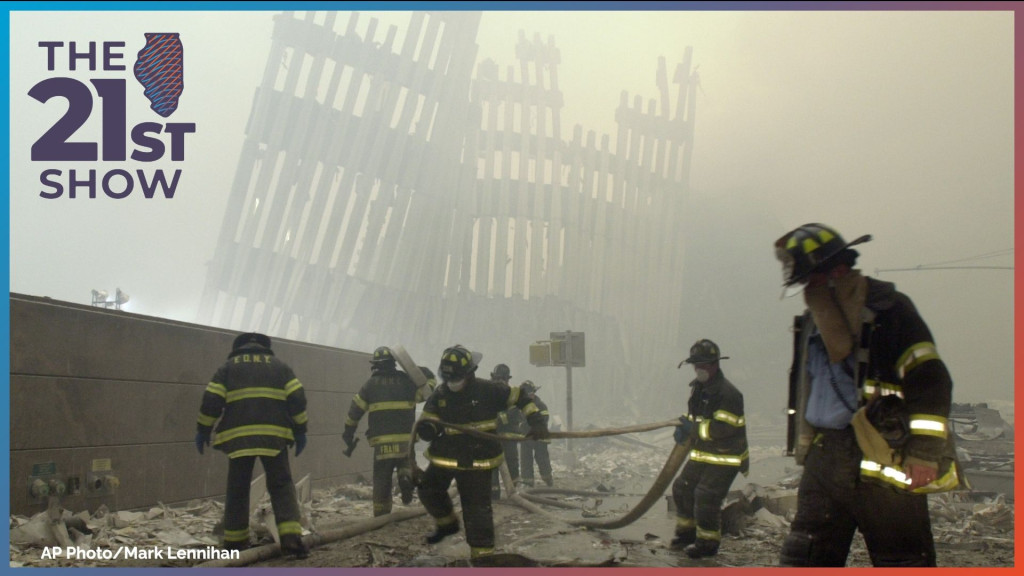
FILE - In this Sept. 11, 2001 file photo, firefighters work beneath the destroyed mullions, the vertical struts which once faced the soaring outer walls of the World Trade Center towers, after a terrorist attack on the twin towers in New York. Families of the victims of the worst terror attack on the United States in history gathered Wednesday, Sept. 11, 2013, to mark their 12th anniversary with a moment of silence and the reading of names. The Sept. 11, 2001 attacks in New York City and Washington killed almost 3,000 people and lead to a war in Afghanistan. AP Photo/Mark Lennihan
// This is a machine generated transcript. Please report any transcription errors to will-help@illinois.edu.

[00:00:00]
Brian Mackey: Today on The 21st Show, we mark 25 years since the attacks of September 11th, 2001, and we begin with two reporters who covered that day, including longtime Illinois newswoman Carol Marin, who happened to be in New York City. She rushed to Ground Zero, and as she said on CBS later that day, when one of the towers collapsed, a firefighter saved her life. He

[00:00:25]
Carol Marin: threw me into a wall, covered me with his body. Uh, I could feel his heart banging against my back. We were both so sure we were going to die.

[00:00:34]
Brian Mackey: Then later in the hour, an Illinois story of loss and remembrance. I'm Brian Mackey, and that's all coming up today on The 21st Show, which is a production of Illinois Public Media. But first, news.

From Illinois Public Media, this is The 21st Show. I'm Brian Mackey. And today we are remembering the attacks of September 11th, 2001, which took the lives of nearly 3,000 of our fellow Americans.

[00:01:22]
Speaker 2: Hello Brian, this is John from

[00:01:24]
Speaker 3: Springfield, Illinois. Hi, my name is Brenda and I'm calling from Carbondale.

[00:01:29]
Speaker 2: Yeah, my name is Taylor. I'm from Freeport, uh, up in northwest Illinois.

[00:01:34]
Speaker 4: My name is Laurel, and I am currently living in Urbana.

[00:01:39]
Speaker 2: I was at work when 9/11 happened on my computer and I immediately

[00:01:46]
Speaker 4: switched to the news.

[00:01:47]
Speaker 3: 25 years ago today, I flew from St. Louis to Toronto to meet up with my sister and her husband. The next morning while we were waiting for my partner to join us from Chicago, we saw on TV the news of the plane striking the first tower. Uh,

[00:02:07]
Speaker 2: I work as a psychotherapist and I'm, I'm, I went into the office and half the people I saw that day hadn't heard about it. Um, but we were all stunned and dazed,

[00:02:19]
Speaker 4: and I think part of it too was that we had gotten, I, I think you mentioned somewhere about how we forget and as a country we have forgotten what it was like to have someone reach in and touch us like that. It happened at Pearl Harbor. We felt complacent, we felt safe.

[00:02:42]
Brian Mackey: We felt complacent, we felt safe, but not anymore. A sampling of memories from some of our listeners. Thanks to everyone who sent a message. You can join us today at 800-222-9455.

Among the dead on September 11th were at least 10 Illinoisans, and I will read their names and we'll hear about one of their stories later this hour. But first, as terrible as it felt to live through September 11th, most Illinoisans were fortunate enough to experience it as a news event at a distance, on television or on the radio. That is not the case for one of my guests today.

Carol Marin is a name that will be familiar to many Illinoisans. She was a longtime news reporter and anchor primarily for NBC Chicago. She's also been an independent documentary filmmaker and presenter, and for more than a decade, she's been teaching the next generation of journalists at DePaul University. But on September 11th, 2001, she was reporting for 60 Minutes on CBS and that meant she was in New York City when the planes struck the Twin Towers. She joins us now to share her experiences that day. Carol Marin, thank you for being with us.

[00:03:51]
Carol Marin: Thank you, Brian, very much.

[00:03:53]
Brian Mackey: Also here is a man who is known as one of the best sourced, most thorough, and most fair reporters in Springfield, Illinois. Bernie Schoenberg was the political writer and columnist at the State Journal-Register newspaper. His byline was Bernard Schoenberg, but those of us who knew him get to call him Bernie. Thank you for being here as well.

[00:04:11]
Bernie Schoenberg: We're too kind. Nice to, nice to be here despite the solemnity of the day.

[00:04:16]
Brian Mackey: Absolutely. And again, listeners, you can join us today, at least in the first part of the show, 800-222-9455. What do you remember most about 9/11? What changed in your life after that day? And how important is it to keep these memories alive? It's now a quarter century later, 800-222-9455.

All right, Carol Marin, why were you in New York on September 11th, 2001? If, if memory serves, you were still mostly based in Chicago at that time.

[00:04:48]
Carol Marin: But I was uh no longer, uh, I was working for CBS Network News and uh was doing stories for 60 Minutes, 60 Minutes 2, Evening News with Dan Rather, uh, my producer Don Mosley and I were a team that um spent five years working for CBS and I was in New York that day. Uh, because I had a screening of a story that was getting ready to go to air on 60 Minutes, and I was in the office early and I'm, you know, I'm, I'm a Midwestern girl and so I'm in the office earlier than a lot of those New Yorkers were in the office, and everywhere around me were television monitors, and all of a sudden on those monitors, we saw a plane hit one of the trade towers and, and my instant reaction and the reaction of the people doing commentary on the morning news was must be a Cessna, must be a little plane. Uh, and then to our horror, we realized it was not a little plane, it was a jetliner, and shortly after that another one would hit the other tower. So, um, south tower hit, north tower hit.

And what I knew I was supposed to do as a reporter is what all reporters do. Get there and get there fast before police lines seal up and you can't get close to the store. You can't get close to what happened. And so I jumped in a cab on West 57th Street and started going down to the towers, uh, except thousands and thousands of people were streaming into the street away from the towers at that moment. The cab driver said, Lady, I'm not, I'm not getting any closer. So I got out and I walked along the West Side Highway down to West Street, and as I was walking, the first tower collapsed before my very eyes. Uh, from a distance, and I kept walking.

Got to West Street, where there were cinders all over the ground, firefighters everywhere, paramedics everywhere, and as I got there, a firefighter turned to me and screamed, Run, because the ground had begun to shake beneath our feet. The other tower was now coming down. He grabbed me, threw me against the wall of a granite building that had an overhang, so the overhang protected us. He covered me. I've told this story so many times, but it's always the same, always chokes me up. He covered me with his body. Uh, and I could feel his heart just banging against my backbone. Uh, and in seconds, the air went from relatively clear to utterly black, couldn't see in front of you. [Unclear] of cinders, smoke. Granules. Pieces of what was inside those towers, including the people in those towers.

And uh he handed me to a uh New York City police officer named Brendan Duke. And Brendan took my hand and we walked with our hands over our faces to try to breathe until we could find some clearing in the air. And then Brendan handed me to another NYPD officer who threw an oxygen mask on my face. And help me breathe. Uh, I've just for the first time in 25 years seen that video because someone found it and sent it to me.

Oh wow, I know a, a, a wonderful woman named [Kate Chaeffer Costello] in Arlington Heights wrote to me just a few days ago and said this looks like you. Is this you? Looks like your hair, looks like your earrings. Looks like the suit you were wearing when you got on the air with Dan Rather covered in dust and reported what you saw. It was me. Um, so

[00:09:29]
Brian Mackey: Can I ask you to just, because your instinct as, as many reporters would, not every reporter, but many reporters would was to rush to the scene. How are you thinking about gathering news versus trying to survive, just trying to get, be alive at the end of the day?

[00:09:48]
Carol Marin: Well, in the course of this. We do what we all do in, in news. Bernie, I think, would happily confirm this. We, our instinct is to go find the truth and tell someone a story that they otherwise can't know themselves. And that instinct has never changed for me. If it happened again, I'd do it again. Um, God forbid it happens again, but you know what I'm saying. So, but you're right, exactly once I realized the tower was coming down on us, I ran. In a way I have never run before. And what I realized in the aftermath of that is I shut down everything except when I needed to run. I stopped hearing. I stopped watching. I just instinctively fled. And that's what you do. You go into a kind of overdrive. And as a result, the, the firefighter who saved me, I never had the wherewithal to remember to ask for his name, but I got other people's names, including Brendan's, who I talk to Brendan every 9/11. Just to see how he's doing, he sees how I'm doing. We stayed in touch, but, but you're right, you have all of a sudden the instinct to survive overrides everything else.

[00:11:27]
Brian Mackey: Bernie Schoenberg, I, I want to bring you into the conversation now. So you and I were fortunate enough to be 1,000 miles away when this was happening. Although I think it's worth reminding people who may be too young to remember firsthand, we didn't know how narrow or widespread these attacks were gonna be at that time. And indeed that was part of the story is how much things were locking down across the rest of America that, that you covered that day.

[00:11:54]
Bernie Schoenberg: Yeah, I mean, nobody knew, uh, that day turned into one where the State Journal-Register, which had become just a morning paper, put out a special edition in the afternoon. And, uh, there was a little note that went with it. It was the first special edition since November 22 of 1963 when President Kennedy was shot and killed. So, it was a very unique situation.

I started my day like most people. I was still home. Um, our daughter, Ellie, who just had a baby in Indiana and is 34 and is soon to be 35, was 9, soon to be 10. I walked her to the corner to catch the bus. I walked home. My wife, uh, still in her medical practice at the time. She was a family practice physician. She's retired now, uh, was getting ready and was watching TV. And on TV we could see, I think the first tower smoking, and then while there. Um, I, I think I was there about the time the second plane hit. Um, and all of a sudden things got obviously real, really more serious, as Carol mentioned, you know, this became a pattern. This was not some uh little event and, uh, I got into the office. Um, everybody was being mobilized to get stories, go places. One of the stories that day was people stranded at Springfield's airport because, you know, within a very short time after this happened, uh, all, all flights were grounded in the whole country.

Uh, and, uh, I got into the office. And I think we had, I don't know, an 11 or 12 or I, I don't remember exactly the time, a, a early deadline for the special edition that was ordered up. Um, and, uh, I was able to, uh, I had a call in [to] Senator Durbin. Uh, Brian, as a colleague of mine, you wouldn't be surprised to know I'm the one that held up publication by about five minutes because the call from Senator Durbin came in right on deadline. I recorded a short conversation. I transcribed it manually, uh, uh, with, you know, my, my computer [and] typewriter and uh got something written where one of the things he said was, uh, you know, in addition, it will be another day of infamy and thousands of people will die and how terrible this is. Um, he noted that, uh, one of his roommates in Washington is Senator Schumer, Charles Schumer of New York, and his quote was, you can imagine he had his daughter in high school just a few blocks from the World Trade Center. Thank God she's safe.

So, it was, um, quite a scramble that day, but people were very unaware. And, uh, uh, an editor, probably the one, Mike Kinsler, who you know well and who is still around here, a wonderful editor. His son was at New York University at the time, and, uh, David, and uh, he, he quoted, you know, David saying what he had seen, um, you know, and it was really, uh, a difficult time there, but, uh, at least he heard from his son. Uh, this is the biggest thing I've experienced. David said at the time, I'm not sure uh it is for most people. Nobody here knows what to think or expect, and I think that says it well.

[00:15:05]
Brian Mackey: And another, another comment that stuck with me from that day, and I want to return to this later, uh, from your reporting, Dick Durbin saying, uh, we know now we have been living a charmed life. Uh, Carol, coming back to you, no, no more illusions about a charmed life were happening in New York City that day. We need to take a break in a couple of minutes, but can you talk about then, so you get this, you have the oxygen mask from the firefighter just to catch your breath amid this cloud of debris and human smoke and you start to make your way back to to CBS News headquarters,

[00:15:39]
Carol Marin: right? Right, um, and all of a sudden people are screaming again because there was a fear that gas lines were about to explode in the street, and so there was another panic. I made my way, I was, you know, I was looking for camera crews. I was looking for my people because I knew that they would be down there as close as they could get. Uh, and when we feared the gas lines were gonna blow, uh, a paramedic ambulance was going by. I by that time had caught my breath, didn't have the mask anymore. They threw me on their across their laps and drove me as far as they could drive before they had to stop. I hijacked a New York City bus that had a flat tire limping back to the bus barn. And said, can you take me to West 57th Street? And the guy took one look at me covered in debris and said, you bet, and took me to the CBS Broadcast Center, where as I walked in, um, uh, they put me on the air with Dan Rather for me to tell the story of what I saw.

[00:16:55]
Brian Mackey: Yeah, all right, let's, let's pause there. We need to take a break. We have a fixed clock on our program. If you want to join us today, 800-222-9455. We're hearing memories of September 11th with Carol Marin, who was reporting for CBS in New York City that day, and Bernie Schoenberg covering what was happening back here in Illinois, the State Journal-Register. More to come. This is The 21st Show. Please stay with us.

It's The 21st Show. I'm Brian Mackey. All during today's program, we're remembering the attacks of September 11th, 2001 from the vantage of Illinoisans here in our home state as well as in New York City.

Most of us can remember where we were on 9/11. I was still finishing my degree, taking night classes. I had a part-time administrative job in an elementary school. The students had been sent home, so I found an empty room and watched a staticky TV while hanging out on a landline phone with my good friend, Ken. And we just kept repeating our disbelief. It was more profane than I'll say here on the radio, but there was this drive to be together, and that was also the experience of the late former governor Jim Thompson, who would go on to be a member of the 9/11 Commission. At the time he was running the big time law firm, Winston & Strawn in Chicago.

[00:18:33]
Jim Thompson: The thing I remember most clearly was, as I was preparing to go home, a number of my young assistants asked if they could go home with me. They didn't want to be alone this morning. So I came home with four or five people who work for me. Uh, and for the rest of the day and into the early evening, we all sat huddled around the television set. Mrs. Thompson fed us. But we didn't move. It was such a horrifying event. And finally, as it became clear what was going on and that it was not going to be followed by anything bad in Chicago, the guys went home, but I thought that was an extraordinary thing, feeling that everybody wanted to be together in the same room. They didn't want to go home by themselves. Now these are grown men, you know. It was such an extraordinary event.

[00:19:35]
Brian Mackey: That clip is from the Oral History Collection at the Abraham Lincoln Presidential Library and Museum. An extraordinary event, the governor said, and, and one that made a lot of us angry, including one of our listeners, David in Mount Morris, who says, I had just joined the Army as an infantryman, was in Fort Polk, Louisiana, training up for Kosovo with the 10th Mountain Division when 9/11 took place. It was a mixed bag of emotions that day, anger, fear, vengeance. And excitement. Yes, I said excitement. We were young and convinced that we were going to be rerouted to fight wherever our country needed us. He says that didn't happen for my battalion and I. We watched as another battalion deployed to fight that fight. We were angry and envious. I guess that just set us up for 2003, he says.

You can join the conversation today at 800-222-9455. We're talking about this with Bernie Schoenberg, who is covering these events for the State Journal-Register newspaper in Springfield, and Carol Marin, who was with CBS News at the time and was in New York City, working on a story for 60 Minutes, rushed to Ground Zero as we heard before the break, uh, made her way back in part by commandeering, uh, an otherwise empty city bus and, uh, she was on TV within a short time of getting back. We have a short clip of that. Let's, let's listen.

[00:20:58]
Speaker 8: Carol Marin, our CBS News correspondent based in Chicago, is just back from this part of New York City, Carol.

[00:21:06]
Carol Marin: I think I was in the 2nd collapse or an explosion right after that because I was trying to make my way around Stuyvesant High School. I believe that's correct. I'm not a New Yorker, but I was coming toward the World Trade Center looking for CBS crews and asked a firefighter if he saw any. He told me to walk down the middle of the road. All of a sudden there was a roll and explosion and we could see coming at us a ball of flame stories high.

[00:21:39]
Brian Mackey: All right, Carol, our, our listeners don't know, but you are on air still covered in dust. What do you remember about getting back to the, to the newsroom, going on TV that day?

[00:21:52]
Carol Marin: You know, everything I had done until that time. In some ways, everything we do prepares us for the next thing we do. And I understood that it was my job to as faithfully as I could report it. Describe what I saw, but when in the chaos of that, when you see a huge fireball at the base of a building as it's coming down, you, you're taking mental notes, you've got trust that what you're seeing and what you're reporting is what you saw, and I was grateful and relieved that I could do it. Um, I, I mean, I worked all the rest of that day and all the rest of that week. Uh, at Ground Zero. And the reality of it was dawning on me like it was dawning on all the rest of us. What had happened, how it had happened.

We didn't know about, I didn't know about Pennsylvania at that moment. Um, I didn't know about the Pentagon at that moment. My, I couldn't get my cell phone to work. The picture of that, that police officer putting a an oxygen mask on my face, my other hand has got a phone to my ear trying to get through to the newsroom, and all the lines were jammed. So our ability to communicate um was so sort of stultified. I was touched by the Jim Thompson thing because that's what his law, uh, partners, uh, assistants were trying to do, they were trying to stay in touch with people and functionally I was trying to do the same thing.

But then I got off the air and went directly back into reporting. Um, and that was a, a mode that just, we, we cranked. We did as much as we could, uh, talk to as many people as we could. And uh and truthfully, it wasn't time for a great deal of reflection, it was a time for just gathering the pieces of this story.

[00:24:21]
Brian Mackey: And I, I will say just as a, as a, you know, somebody who is uh always studying how to do journalism better, I, I really appreciate the precision with which you spoke in that uh little bit of that clip, and it goes on from there — people can find this on YouTube — um, with Dan Rather, of, you know, I, I believe it was the second tower collapsing. I passed it, as you mentioned a certain landmark. You say, I'm not a New Yorker. You're very careful and precise about that, which I appreciate. I'm sure listeners do as well. Viewers did as well.

You know, Bernie, so one of the, I was looking back through the State Journal-Register's coverage from this extra edition you mentioned, which I think you said — I don't know if you said this — there's the first one since the Kennedy assassination and to my knowledge,

[00:25:04]
Bernie Schoenberg: the last, and I should say the editor at the time, the decision was Barry Locker, who is no longer with us, but uh said that he knew people wanted a lot of information quickly and got it done. And

[00:25:14]
Brian Mackey: I think it was, you know, he and other editors were standing literally on the street corner handing them out to people uh driving by, you know, doing the sort of newsboy thing that day. Um.

I, I was struck by one of the things I was struck by in that story was a comment from someone named Tammy Sperry. This is a sort of a roundup of local reaction. She was a clerk at a Shop and Save grocery store, which is also no longer with us. She said one of our meat guys heard about it on the radio and told everybody else, we've been watching on the television in the upstairs office. You know, Bernie, that says a lot about how people got information in 2001. There was quite a fog around.

[00:25:52]
Bernie Schoenberg: Yeah, I mean, um, I mean, news spread quickly, but in so many different ways and now people did not, uh, congregate and look at their own phones because, uh, you know, I think what the iPhone came out in what, 2006 or something. I, I, you know, so it was it was another, it was another era. The local newspaper was still really important. That's why a special edition would have made sense then. And today, everybody could have just read something online quickly, and there would be no need for an extra print job, because who reads print newspapers these days? Fewer people than before.

Um, uh, it, it did spread like wildfire, and, uh, and obviously, it, it created an unease, uh, as some of your, you know, one of the commenters on, on the telephone that you uh had on your show earlier talked about, you know, we didn't feel like we could be touched like that in America. We, uh, a vulnerability arose. I, I kind of knew things would change significantly in the future, uh, going through an airport now, going through all the security, the, the, you know, metal detectors in so many different places, um, thing, and, you know, for a while, and still some people might have to take their shoes off to get through the airport. I can't remember the latest rule. But things, it, it was one of those days where you know, life will never be quite the same. Uh, I think it led people to be suspicious of other people and other groups of people. There were calls for that not to happen, uh, but we've seen a lot of anger bubble up over the years at different groups of people, and, uh, despite the fact there were great calls for unity, you know, including uh President Bush, uh, you know, calling for that at, at Ground Zero a couple of days after, or maybe a day after this all happened. Um, it, it changed things and, um, it, it, it took away some of the innocence that, that we had about how safe we were.

[00:27:49]
Carol Marin: And it, it took, it changed things instantly. By the time I got to my, to my hotel that night. There were no cabs because there were no cabs on the street. There were no planes in the air. My hotel was locked. I needed to show three kinds of identification practically to get in. Because in an instant everything shut down, locked down. Um, and and it never, uh, or not for a very long time, got better. For days, weeks, months after that, when I would be in New York, I could still smell the burning smell at Ground Zero. Because that was a molten pit. That took forever to extinguish or felt like it. And so, you know, it, it was instantaneous and um, and we still feel the effects now. I mean, now you can carry a nail clipper onto a plane where you couldn't the next day.

I flew one of the first flights out of New York. They let me go home for a day to be at the opening of my young son's school and come back. I fle, I was on one of the first flights and in the seats around me were all the pilots who had been grounded. And when they got on that flight and the flight attendant welcomed us to American Airlines, whatever that number flight was, she collected the keys from every single pilot. These are men who fought in wars. But suddenly no one could have the key to a cockpit except the pilot who was actually flying the plane. And it was one of the most solemn things I've ever witnessed because even they could not be trusted. And that just still to this day shocks me.

[00:30:08]
Brian Mackey: We have just a few minutes left in our time together, and you know, Bernie, you mentioned having a new grandchild, [two] grandchildren actually, uh, and

[00:30:19]
Bernie Schoenberg: all in the last three months. This is pretty wild.

[00:30:21]
Brian Mackey: Mazel tov, and, uh, Carol, I know you've been, you've been, you know, you mentioned your own child, but you've, you've been teaching young people at DePaul University for, for

[00:30:30]
Carol Marin: years. I have a 5-year-old grandson.

[00:30:32]
Brian Mackey: OK, well, 9/11 will be as remote an event to them as, you know, World War II was to me and I, I don't know, World War I or the Great Depression was to, to you two. Talk about keeping this memory of this event present for future generations and, and, um, Carol, I'll start with you.

[00:30:55]
Carol Marin: So the only way my students really can experience it, I mean, they can go on YouTube and see all the work that we did in and around this time. But they can't feel it, the way my parents felt World War II, the way we have felt 9/11. Uh, and that's just the way it is. That's just life. And in some ways that's not a terrible thing. You can't carry in your heart and soul all the tragedies that are part of our existence, but you didn't live through. And yet at the same time, we talk about it. What, what you're doing uh today, Brian, is exactly what we do. We, we bring it up, we remember it. We in its way play taps for who we lost. Uh, and I think that that is appropriate. And is it enough? In, in some ways. I think it is.

[00:32:04]
Brian Mackey: Bernie, what do you think about that?

[00:32:07]
Bernie Schoenberg: I agree that you just have to try to tell the history. That doesn't mean it's going to have the same effect as being there. Um, I am really a first generation American. My mother was a, I think, you know, Brian, a, a war refugee from Austria in 1942, got to the United States with her parents after four years on the run, after being tossed out of their house with 48 hours' notice. Um, bad things happened. She got here, lived, she and her parents. All lived a wonderful life in America and kind of achieved the American dream and had that behind them.

But the whole idea of never forget, there have been people who have forgotten. There are Holocaust deniers these days. Um, 9/11 has generated conspiracy theories that some people believe that maybe as what we knew wasn't, wasn't exactly what happened or who was to blame. Um, all you can do is try to teach history, teach it accurately with good journalism and good remembrances. I agree with Carol, this is the kind of show that provides that looking back on the anniversary, and you, you just hope people can understand the seriousness of this, how it's changed us, and maybe how it makes us be more vigilant in the future, but also, hopefully, some of that reaction of unity, which has been lacking in our country in recent days, uh, can also emerge once again when we see the shared experience that we've had. Um, you know, it's terrible to have to do that by being attacked, but we know we are vulnerable, uh, and hopefully in a reasonable way we can try to avoid those things in the future.

[00:33:49]
Carol Marin: And be grateful, and be grateful, grateful.

[00:33:51]
Bernie Schoenberg: It's a wonderful, the freedom here is amazing and people know that. I appreciate it every day.

[00:33:59]
Brian Mackey: It's a wonderful life, to borrow a phrase from the movie. Bernie Schoenberg was political writer and columnist at the State Journal-Register on September 11, 2001, and many years before and after. Carol Marin, uh, you know her, uh, as a longtime Chicago journalist. She was reporting for CBS News from Ground Zero on September 11th. Thank you both for being with us and talking through some of your memories with us from that day.

[00:34:28]
Carol Marin: Thank you so much, Brian. And by the way, Bernie Schoenberg is one of the greatest political reporters we have ever had. I don't care what he says.

[00:34:36]
Bernie Schoenberg: Nobody's as cool as Carol Marin.

[00:34:37]
Carol Marin: Oh, shut up.

[00:34:41]
Brian Mackey: We'll be back after a short break. This is The 21st Show.

It's The 21st Show. I'm Brian Mackey. Tuesday, September 11th, 2001 dawned temperate and nearly cloudless in the eastern United States. That is the opening line of the 9/11 Commission report, the American government's definitive accounting of the attacks. Millions of men and women readied themselves for work, it continues. Some made their way to the Twin Towers, the signature structures of the World Trade Center complex in New York City.

Among those people was Andrea Lynn Haberman, a 25-year-old woman originally from Wisconsin but at the time living in Chicago. She was one of at least 10 Illinoisans killed that day. In the World Trade Center, the list also includes Kathy Bantis of Chicago, Chip Chan of Peoria, Suzanne [Kundranko] of Chicago, Daria [Lynn] of Chicago, Robert Arthur Rasmussen of Hinsdale, and [Susan Auer] of Chicago. Also in New York, Jeffrey Peter [Milloinnik] of Hinsdale was killed on Flight 11, and two Illinoisans, both serving in the Navy, were killed at the Pentagon: Lt. Cmdr. Patrick Jude Murphy of [Flossmore] and Cmdr. Dan Frederick [Shanauer] of [Naborville].

As I said earlier, as horrible as September 11th was for those of us who experienced it primarily through the media, it was all the more shocking and devastating for those with a personal connection to the victims. On that shorter list is Al [Kaladzi] of Naperville.

Earlier I mentioned Andrea Lynn Haberman, a 25-year-old Chicagoan killed in the North Tower of the World Trade Center.

[00:36:44]
Al Kolodzik: You know, unfortunately, um, I've come to the realization that uh time is your best friend and also your worst enemy. With uh every year that goes by, you never forget, but unfortunately, you do forget some things.

[00:37:07]
Brian Mackey: Andrea and Al had been college sweethearts. They met at Saint Norbert's in Wisconsin and were set to be married in September 2002. I spoke with Al on the program back in 2021 and began by asking him how he and Andrea got together.

[00:37:24]
Al Kolodzik: So she was the executive, one of the executive assistants, or actually the executive assistant to the president of the company for [car futures], and he had just been named president of the United States, not, you know, president of the United States, but president for his company. So they had an office at the World Trade Center in New York and also in Chicago, and so he was going to start making regular trips, I think once or twice a month to New York. And this was going to be his first one and there was going to be two girls that were going to be going with him, you know, they were going to basically take turns. The first trip was actually going to be one of her colleagues, and, but she had a scheduling conflict for this first trip that was on September 11th. So Andrea went in her place actually. And so she left on September 10th.

And in New York that night on September 10th, they had a lot of bad weather. I think her first flight was going to leave maybe 2 o'clock in the afternoon approximately. I snuck home from work to say goodbye to her, make sure she had everything. She was very nervous about going on her first trip, you know, she was a, a Wisconsin girl, so she wasn't used to the big city. She handled uh Chicago very well. She became accustomed to it and uh she did a great job of that. And so she, but she was still nervous about going to New York by herself for the first time. And so I came home to say goodbye to her. She left for the airport and the company had sent a car for her and we only lived maybe 10 minutes from O'Hare Airport.

And she gets there and her first flight was canceled because of the bad weather. So as it is, you know, from Chicago to New York, there's flights, you know, every half an hour. I've missed a couple of my days and just jumped on the next one. And so the second flight she was scheduled to go on, that was canceled too. And that was about, you know, later in the afternoon, you know, 4 o'clock, 5 o'clock, and I told her, you know what, just come home. Just go out there, you know, catch a flight in the morning. There was one leaving at 6[:00]. I said, you know, you'll get there in time. And you'll be at the office by 9 o'clock. And she goes, well, I already checked my bag. She said if the next one gets canceled, I'll come home and I'll take a flight in the morning. And unfortunately, that flight took off and she, you know, arrived in New York that night and I got a call from her, uh, probably a little bit after 10 o'clock saying that she had arrived at the hotel and was settling in.

[00:40:04]
Brian Mackey: And so that's the night of September 10th. September 11th, the morning comes. I understand she had called you that morning from the World Trade Center before the first plane hit. What, what do you remember about that phone call?

[00:40:17]
Al Kolodzik: So we have, we used to have a little contest because I worked in the road construction industry and she used to leave early, you know, because she worked for a brokerage firm and the markets opened early. So she'd get to work, you know, she'd leave almost when I did, you know, sometimes, you know, 6 o'clock in the morning, 6:30. We'd always have a contest who could be the first one to call after 7 o'clock, you know, so who was paying attention to the clock. So, she called me that morning and it was, you know, 8 o'clock, uh, a little bit after 8 o'clock New York time and a little bit after 7 o'clock here. We did talk for a little bit. Um, she said, you know, she missed me. She was up obviously very high, 92nd floor of the North Tower. And she said she, you know, had quite the view. She could see the Statue of Liberty. She could see the ferries coming across, you know, bringing people over from Jersey into, you know, to the, towards the financial district. She said it was a nice view, but uh she was a little nervous about being there, you know, first time she didn't know anybody in the office.

She had talked to plenty of people in that office, but she's never had never met anybody from that office and she was waiting for uh basically her counterpart from the New York office to come meet her in the office that morning and um she was running just a little bit late. She had brought, she, that woman had actually decided to drive that day and she had a little bit of a hard time finding a parking spot. And then she stopped for a bagel and that's when the first plane hit, so her counterpart wasn't in the building at the time. She was actually on the phone with Chicago when the plane hit with a gentleman named Henry. And, you know, obviously the phone line went dead and um that was the last time anybody had talked to her. So, but we did hang up the phone and, you know, said I love you to each other and, you know, said we'll talk a little bit later on that day.

[00:42:17]
Brian Mackey: And do you, what do you know about what happened after the plane hit the tower that morning? To her.

[00:42:25]
Al Kolodzik: So her, her family and I, you know, especially her family, the Habermans, you know, tried to investigate as much as they could and we had talked to numerous other family members that work for the same company, um, that were, you know, based in New York and, you know, talked to them because they said they had gotten phone calls from their loved ones being on the same floor. And they said, you know, they were trapped. They were unable to get out and, um, you know, I called her phone, I don't know how many times trying to get through. A lot of times it did ring and other times it was just a busy signal, you know, like a circuit busy. Uh, she did have her cell phone with her and I was trying to, you know, she gave me the number to her desk there and also she had her cell phone.

So all we know is that from talking to other family members and getting a sense of who they were, the ones that were lost for her company there on that floor, you know, that they were all excellent people. They were all caring and that they would have done their best to try to comfort her and take care of her until, you know, they were trying to get out, but obviously they didn't make it out. Nobody above 91 got out. Some, a couple of people from 91st, the 91st floor got out, but she was on the 92nd, so 92nd and above, nobody got out.

[00:43:45]
Brian Mackey: I, I wonder how long did it take you to realize, you know, that that, that was your last conversation with her that morning, you know, that, what was the process like for you in the following hours and days and weeks and months?

[00:43:59]
Al Kolodzik: Uh, it was definitely very hard, um, you know. Always, you know, every time my phone rang, I was hoping it was her. You know, two days later, we did travel to New York. We drove. I went and picked up her parents in Wisconsin and then we drove straight to New York. Um, they, you know, we couldn't get down to the site. Uh, her company had uh reserved a room for us at the Waldorf and set up a kind of a room for all the families to get together, so, you know, to be together even though we didn't know anybody. But that was nice and we met a really great family, the Meehans. And Damien was on the floor with her, who he didn't know, and his brother Mike was a New York City detective at the time and so he would come in and kind of, you know, he's still dust and, you know, all over him because he would get down to the site to see what he could find out and kind of give us a briefing.

And you know, in my back of my head, I knew she was kind of gone, but there was always hope that, you know, she had gotten out. You know, we had gone to the armory to do the missing persons so we can get our, you know, the, you know, drop off DNA, um, you know, I had brought uh clothes for her in the hope that, you know, we would be able to find her. Um, you know, checking hospitals like everybody was, you know, not knowing maybe she was, you know, they, she got pulled out with no identification on her, who would know who she was. So it uh, you know, it's always in the back of my head that she was gone but it's always in the back of my head too that um she was alive.

[00:45:43]
Brian Mackey: I understand that the cell phone you mentioned she had with her that you spoke with her on, it was one of the items that was recovered and is now part of the 9/11 Memorial Museum's collection. I wonder if you visited the memorial at all and what that might have been like.

[00:45:59]
Al Kolodzik: Many times. I've been there many times and I'm traveling there again this Friday for the 20th anniversary. So I've seen it, um, you know, I was there at her parents' house when it arrived, you know, when they sent back the items that they found, they found basically the contents of her whole purse and her wallet was intact, you know, the money was still in there. My business card was in there, you know, tickets to concerts we had just been to not too long ago that summer were still in there, you know, her driver's license, glasses, keys, you know, Blockbuster card. It's kind of like a, a, a time capsule, so to speak, that anybody who looks at it now, I'm sure young kids go, what, what's a Blockbuster card? Uh, so that stuff is on display. It actually gets uh moved. Um, it's not there permanently on display. It kind of rotates in and out with other artifacts. Um, so in the museum. So I've seen it on display. It's very nice to see. It's kind of weird to see my business card in there.

And you know, all of her stuff and it, it, it, you know, looks pretty close to the way it did the last time I saw it, which is very odd, covered in dust. You know, had been waterlogged a little bit, but the, you know, the glasses were broken. Phone was a little bit, but uh a lot of the other contents looked pretty well. Pretty good. So it's very nice that, you know, we, they waited for me to get there to open up all that stuff and then we held on to it for, for a couple of years and then we decided to donate it to the museum.

[00:47:41]
Brian Mackey: Al, last question. 20 years later, how do you want Andrea to be remembered?

[00:47:48]
Al Kolodzik: She was just a very kind person and very loving and you know she was, you know, a tad bit shy, but once you relaxed and you, you know, you got to know her a little bit, she was just a, a great, great person to be around and just had a lot of fun. And you know, I think because of her, she made me a better person and I think she made a lot of people better. Um, the people we've met because of her has been fantastic, you know, to the point where, you know, one of their old customers at the restaurant they used to own was a Milwaukee Journal reporter, a writer, and he decided to write a book about not only her a little bit and a little bit about us, but about all the people we've met because of her. That helped us along the way. And you know, all the proceeds go to charity. Or a portion of the proceeds. I should, I don't want to misspeak, but I'm pretty sure a portion of them or all the, all of them go to charity actually. It's a book that we've had around for about 10 years now and it's, uh, it's fantastic, and I try to hand out as many as I can over the years. And

[00:49:01]
Brian Mackey: what's the book called?

[00:49:02]
Al Kolodzik: It's called Just a Few Sleeps Away. Just a Few Sleeps Away. And I would try to order a bunch on Amazon every year and try to kind of hand them out to people that I tell the story to.

[00:49:16]
Brian Mackey: Well, Al Kolodzik, I want to thank you so much for sharing your story with us. Uh, I'm sorry for your loss, uh, but I do appreciate you taking the time to speak with us about it.

[00:49:25]
Al Kolodzik: No problem at all. I appreciate it.

[00:49:35]
Brian Mackey: Al Kolodzik speaking with me in 2021. Al and Andrea were engaged to be married. She was 25 years old on September 11th, and she was among at least 10 Illinoisans killed in the attacks that day. The 21st Show is a production of Illinois Public Media. I'm Brian Mackey. Never forget, we'll talk again next week.

---

**Flags for Human Review:**

- **[00:04:48]** — "Don Mosley" is the name given for Carol Marin's producer. Please verify spelling.
- **[00:04:48]** — "You can't get close to the store" appears to be a transcription error for "scene" or similar word. Flagged but not corrected per editing rules: [store].
- **[00:07:08]** — "[Kate Chaeffer Costello]" — name is phonetically rendered and spelling is uncertain. Please verify.
- **[00:09:48]** — "I talk to Brendan every 9/11" — original transcript reads "I talked to Brendan every 9/11." Possible tense inconsistency in original audio; flagged for review.
- **[00:12:54]** — "computer [and] typewriter" — original reads "computer typewriter," which is ambiguous. Inference added; please verify.
- **[00:30:08]** — Brian Mackey says Bernie has "22 grandchildren" but Bernie responds as though the number is two ("all in the last three months"). The number "22" appears to be a transcription error. Flagged but not corrected: [22].
- **[00:35:48]** — Multiple names in the list of Illinoisans killed may contain transcription errors: "[Kundranko]," "[Daria Lynn]," "[Susan Auer]," "[Milloinnik]," "[Flossmore]," "[Shanauer]," "[Naborville]," "[Kaladzi]." Please verify all spellings against official records.
- **[00:37:24]** — "[car futures]" — the company name is unclear from context. Please verify.
- **[00:49:16]** — Brian Mackey is referred to as "Al Kaladzi" earlier in the transcript but is consistently identified as "Al Kolodzik" elsewhere. The earlier instance has been flagged as [Kaladzi] and the speaker label has been applied as "Al Kolodzik" throughout, consistent with the name used at the end of the segment. Please verify.
Nearly 3,000 Americans were killed on the September 11, 2001 attacks on the World Trade Center in New York City. At least ten Illinoisans were among the deceased.
A Chicago-based journalist was in New York City that day working on a different story. She shares her experience being in the midst of the chaos and reporting on it. A former Springfield-based political writer also remembers reporting on the horrific events of the day.
Discussed
- The 9/11 Memorial & Museum: Remembering Andrea Haberman
- Carol Marin on CBS news shortly after escaping Ground Zero
- The State Journal-Register's coverage and photos from September 11, 2021
- Past 21st Show segments on 9/11:
- Aurora firefighter who assisted in rescue efforts on 9/11 reflects on attacks 23 years later
- High school students interview locals on what happened on 9/11
- Teaching 9/11 To Generations Born After 9/11
GUESTS
Carol Marin
Journalism faculty, DePaul University
Retired reporter and anchor, NBC Chicago and CBS Chicago/CBS News
Bernard Schoenburg
Retired political reporter and columnist, The State Journal-Register