








From Peoria to potential sainthood: The life and legacy of Fulton Sheen
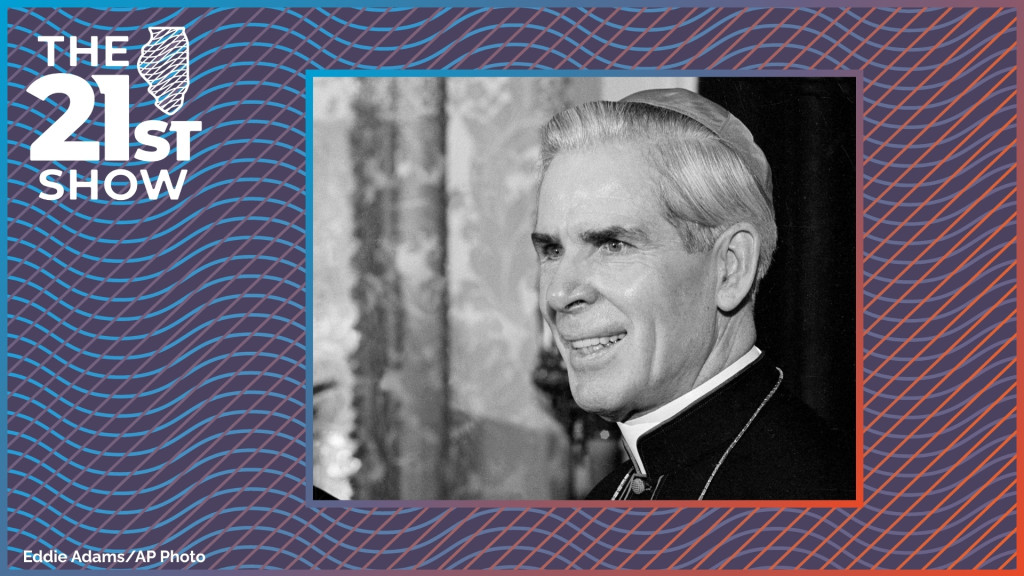
This Oct. 26, 1966 file photo shows Bishop Fulton J. Sheen at his office at the Propagation of Faith in New York. Eddie Adams/AP Photo
// This is a machine generated transcript. Please report any transcription errors to will-help@illinois.edu.

[00:00:00]
Brian Mackey: It's the 21st show. I'm Brian Mackey. By the mid-1950s, roughly half of American households had a television set. If you were sitting down to watch TV, let's say 7 o'clock Illinois time, Tuesday evening, you might have had three choices of what to watch: one of two comedy variety shows or an auxiliary Catholic bishop in New York City.

[00:00:45]
Speaker 1: It's the Buick [Berle] show coming to you live from New York.

[00:00:52]
Speaker 2: The Red Skelton show.

[00:00:57]
Speaker 3: Friends. I heard of a, of an Irish woman who went to Moscow and she met a, uh, met a communist over there who helped her onto a tram. She was rather surprised. And she turned to him and she said, may the good Lord find a nice cool spot in hell for you.

[00:01:17]
Brian Mackey: Milton Berle on NBC, Red Skelton on CBS, and Life Is Worth Living with Bishop Fulton Sheen on the DuMont Network. At his peak, Sheen, later Archbishop Sheen, would reach millions and millions of Catholics through his radio and TV shows. He was born Peter John Sheen, 1895 in El Paso, Illinois, and he grew up in Peoria. Now he's a candidate for sainthood in the Catholic Church. And this week marks a major milestone in that process, his beatification.

Joining me to talk more about Sheen's life and work and the process and meaning of sainthood is Dr. Dennis Kremen, director of the History Center and chair of the history department at Lewis University, which is a Catholic university in Romeoville, Illinois. Dennis, if I may, welcome back to the 21st show.

[00:02:09]
Dr. Dennis Kremen: Thank you so much, Brian. It's so great to be back on the show.

[00:02:12]
Brian Mackey: And listeners, you can join us — 800-222-9455 — if you have memories, especially of maybe watching, or being made to watch, as we'll hear from a listener text message we got a little later. Uh, Fulton Sheen, we'd love to hear your impressions of it or just your questions about Catholic sainthood in general.

All right, Dennis, let's start with Sheen's sort of background, his upbringing in Peoria. What can you tell us about his early life and how he got from, you know, a boy in El Paso to one of the best-known Catholic broadcasters in history?

[00:02:50]
Dr. Dennis Kremen: Yeah, he's a, he's an amazing story, a true Illinois story. Um, as you pointed out, small El Paso, but quickly moved to Peoria and called Peoria home. The, the Fulton, he was originally Peter, as you pointed out, but, um, it was his mother's maiden name. So he's the oldest of four boys, and, um, so he took this name rather than Peter as Fulton. Um, just as a side note, my middle name is Howard after my, um, grandmother's maiden name. So I guess this is fairly common.

Um, he was very active. Um, he went to, uh, Saint Viator High School and was active in debate, and it turns out that he wasn't very good at it at the start. And in fact, his debate teacher told him to go over and practice a speech in the corner over and over. And you know, oftentimes when you have a reversal and you overcome something — he's later credited with leading the team over the vaunted Notre Dame team. Um, and so he kind of comes back strong, and I can't help but think that this led him on the way that he went with the rest of his life.

[00:04:04]
Brian Mackey: And so he becomes a priest. What do we know about his decision to sort of enter religious life, which I guess was fairly common back then, especially in a family of four.

[00:04:14]
Dr. Dennis Kremen: Correct. And, um, again, religious family, um, he, um, shows great promise. He becomes a diocesan priest, so he's not affiliated with a particular religious order like the Jesuits or, um, the Franciscans. Um, and he ends up going away and this shows you something — he goes and studies in Louvain, um, Belgium. This is really one of the top schools where he's studying theology and, um, uh, philosophy. And again, he's very bright. Um, and I think this also plays into his ability, uh, to go on and teach at, uh, Catholic University in Washington, D.C. Um, he teaches there for 23 years. Uh, think about that for a second. I'm in my 23rd year. Uh, that's a good bit of time, um, and he is extremely popular. Uh, people are signing up for his classes because he's a lively speaker and he has a great humanity about him. In fact, um, the classroom where he taught is still dedicated, uh, to him there at Catholic University.

[00:05:25]
Brian Mackey: Well, I was just going to say, so how does he begin to move into broadcast ministry, right? I mean, radio — our station dates itself back to 1922. Uh, this is, this medium is just coming online and becoming a mainstream thing in the [1920s] and, and especially into the 1930s in America. How does he become a part of that?

[00:05:49]
Dr. Dennis Kremen: So, you know, he's going down, he's being invited to go down to New York City. And he's, um, on the early radio station — the first time he's on the airwaves is in 1926, so very early — and he does a number of Lenten sermons. And then from 1930 through 1950, he's on the Catholic Hour. Um, and the Catholic Hour, again, turns into this, uh, 20-year experience. Um, and he is very popular, as you pointed out in the introduction there. He's going against Uncle Milton, Milty, uh, Milton [Berle]. Um, and in this period, he's also — this is the period when, um, FDR is doing the fireside chats, you have to think about this. This is the period of the Great Depression. And people are inviting the radio into their homes. I can think of these small sets that look like a, uh, uh, a Gothic cathedral, and singly, but also in groups gathered around the radio and getting tales of, of, of hope and that, you know, America's gonna be coming back in the depths of the Depression from FDR. And he continues to do this. He does 30 chats from [19]33 to 1944. And um Sheen's doing the same thing. He, he is a great humanist. He, he values, uh, the individual and he's giving people hope through their radio.

[00:07:25]
Brian Mackey: And it's interesting — and maybe we should, you know, let me take a pause on that. We'll come back and talk more on the other side of the break. I don't want to get into something too deep here and then we have to cut away. And let me invite listeners, if you want to join us, 800-222-9455.

We already heard from some of you by text. Uh, Randy in rural Peoria County says, with so many crazy and unconventional rules being broken today, it's actually refreshing to have a system that seems rigorous, quite well documented, and enduring. He's talking about the path to sainthood. I'm not a big fan of broadcast religion, but the memories of him, Sheen, raise all such efforts. He had such a wide reach, everyone wanted to hear him no matter the place one attended. He says that alone is a miracle.

On the other hand, Lex in Champaign says, when I attended a Catholic grade school in the 1950s and high school in the 1960s, some nuns required us to watch his TV show and write a short summary or essay of its content the next day. I found it even then to be rigid and didactic. He was a stern teacher and way too conservative. I do not believe he should be sainted. He was too much a man of his time and not a visionary, Lex says.

All right, what do you think? 800-222-9455 is the number. We're gonna talk more with Dennis Kremen, director of the History Center at Lewis University. This is the 21st show. Stay with us.

It's the 21st show. I'm Brian Mackey. We're talking today about Archbishop Fulton Sheen — the venerable Fulton Sheen, soon to be the blessed Fulton Sheen. He's being beatified later this week, which is a major milestone on the path to sainthood in the Catholic Church. Sheen is best known for his radio and then television program in the mid-20th century, when he reached millions, perhaps tens of millions, of Catholics every week. Let's listen to another excerpt.

[00:09:40]
Speaker 3: A poor widow who was visited by the insurance company after the death of her husband, and he gave her a check for $50,000 and the insurance agent said, I'm sure you're very sad after having lost your husband, and she said, well, I would give $5,000 to have him back.

[00:10:01]
Brian Mackey: Some polite, polite humor there. And obviously, we've chosen a couple of the more humorous comments, but these were parables on the way to much more serious conversations about uh spirituality, religion, uh, subjects of the time like birth control, uh, contraception were a couple of the episodes, uh, that you can still find on YouTube if you want to watch them.

We're talking about Sheen's life and work and sainthood with Dennis Kremen, who is director of the History Center and chair of the history department at Lewis University, the Catholic university in Romeoville, Illinois. If you want to join us, 800-222-9455.

So, Fulton Sheen, as we said, born in El Paso, Illinois, raised in Peoria. He's a professor in Washington. He gets this radio show, moves into television. What can you say about the TV landscape back then? I mean, we found these clips that we played — obviously Milton Berle, Red Skelton — uh, a lot of shows we found that don't exist in clip format anymore from that era because nobody thought they were worth preserving perhaps. Maybe you can find them in some museum somewhere. But just talk about his place in the sort of broadcast landscape of America, if you can.

[00:11:24]
Dr. Dennis Kremen: Well, it's interesting, um, he, he moves into television and, um, you know, in some ways, in the [1920s], there's a lot of anti-Catholic feeling in America and he's part of bringing Catholicism into the mainstream. The other towering figure that does this is Bing Crosby. Um, he, he wins the Academy Award for Best Actor as Father Chuck O'Malley in 1944, uh, Going My Way. He's nonchalant, he's not anxious, he's very human. Um, he has the older traditional priest, Barry Fitzgerald, um, who doesn't approve of this kid who plays ball with the boys and the window gets broken and all of this. Um, so that's one of the figures I would actually put out there. He had also made the bounce from the [Kraft] Music Hour, um, a very popular show coming into the 1940s, top show for its time, and then he goes into film.

Um, the other figures in this period on, on television are kind of Jackie Gleason, right? The Honeymooners is a, is a big, big show. And again, kind of a working-class show. They live in an apartment in New York, but, um, uh, Reverend [Archbishop] Fulton Sheen, um, dresses in his vestments, one of his vestments, his religious, uh, clothes. He, he wears a cape. Um, he is a handsome man, he's theatrical, um, and, and like a good professor of the time period, he writes on the chalkboard to make his point. Um, but he's got, as you point out, he has a great sense of humor. Um, one of my favorite lines that he has is he gets an award from the Emmys, um, for his show. And he says, um, I, I owe some of this, um, uh, success to my writers. I have some of the greatest writers of all time: Matthew, Mark, Luke, and John, who are the gospel writers, uh, from the New Testament. So clever joke.

[00:13:29]
Brian Mackey: Indeed. So how does he react? He is still on air as Vatican II marks a significant change in the way Catholic people interact with their church. How does he fit into that picture?

[00:13:44]
Dr. Dennis Kremen: Well, you know, it's amazing. He attends Vatican II. He is a really top, um, theologian and thinker. He's really a, a moral philosopher in many ways, so he's attending those long meetings in Rome and is very active, so he's completely aware of this — the ability of the word that comes out of that, the Italian word aggiornamento, that Catholicism needs an updating. And this is where we have a move away from the Latin mass into vernacular languages, everyday languages: English in, in, in areas where you speak English, Spanish in areas where you speak Spanish, so on. Um, and he's, he's very aware of it and he tends to be somebody who is able to make, uh, changes with the time. He's, um, also quite the cold warrior. He, he, um, uh, believes in the choices that you have in America to especially, um, worship, um, in, in, in any way that you would choose, right?

[00:14:49]
Brian Mackey: Indeed, and yes, and there were some um episodes I was listening to where he talked a lot about capitalism. And you know, I was trying to find excerpts, but the man did not talk in soundbites, I will say, and I, I don't think we have time to listen to like 8 minutes of him, but you know, he, he does talk about, you know, the idea that, uh, capitalism as restrained by the power of labor unions in the United States is, uh, you know, different from some of the systems of communism that, that he was opposing at the time.

All right, in the time we have remaining, let's talk about sainthood. What, what does that mean for people, especially who are not from the Catholic tradition? I think, you know, to some people it almost appears like it's polytheistic in a way. Can you say what saints represent in the Catholic tradition and uh in the church?

[00:15:39]
Dr. Dennis Kremen: Yeah, so, you know, it's very interesting. One of the things that sets Christianity apart in general is the belief that God has become human — that the incarnation, the fancy word for it, is that God becomes human and therefore humanity has a very special place in the world. And some of us — we could talk about the Book of Genesis and the role, but I think what's really important is that there is a great humanity and that we have the ability to be saints ourselves. Um, and, and so part of this is that we can look to each other and look for people who show a great ability to have a devotion to God and live their life accordingly. Um, I was impressed in, in preparing for today that he reserved a, a time to be and pray with the Eucharist — the, the, the bread, um, uh, that is part of the, the celebration of the mass for Catholics — um, but he would reserve an hour, um, and it's again this mystical idea that Christ is truly present in the bread and the wine, and, um, and particularly in the bread. And so we have this figure who represents holiness and is elevated.

Um, another part of this is that you, you kind of move on a, um, a, a pathway. So they opened a file on him with the [Dicastery], um, in Rome in, um, 2002, and I remember I knew, um, the, the procurator, uh, for the [De La Salle] Christian Brothers, uh, Brother Rodolfo, Rodolfo [Maoli]. And this is really a big research project. So you find out everything about the individual, you're doing exhaustive research to put forth this document to start on this way.

But then Catholicism's interesting because it also believes in a life everlasting and that people who have died can continue to have influence. Um, and in the case of, uh, um, Fulton Sheen, he moved from Venerable — maybe you've heard this term from the Middle Ages, venerable [Bede], kind of the first level. And on Thursday the 24th in, um, Saint Louis, um, he will be named blessed, um, the, the beato. Um, uh, we have the Beatitude, so blessed are they who. So he's, um, they've actually, uh, assigned a, uh, miracle to him, um, uh, which is what is needed to be moved up — one miracle to be a blessed and actually two verified and accepted to be a saint.

[00:18:32]
Brian Mackey: And that'll be then this next one has to come. I think this is also another thing worth pausing on, a couple of points. One, I heard a priest — I think it's Father James Martin, who's a well-known public speaker and intellectual — uh, saying, you know, just to clarify, Catholics don't pray to saints, they ask the saints to pray for them. And so the idea of this miracle is it's not like, sort of, you might picture in the old televangelist style of he lays his hands on someone and they get up from a wheelchair or something like that. This has to be after this mass or this service you mentioned on Thursday, and it's praying to him and then, you know, some miraculous turnaround in a medical condition or something along those lines. Do I have that largely right?

[00:19:16]
Dr. Dennis Kremen: Correct, um, the, the formal word is veneration, so we venerate saints, we, we pray through them, um, to God, um, and, uh, we ask for their advocacy. Um, and, um, in, in the case of the miracle, uh, this happened with the birth of James, um, uh, Engstrom, who was rushed to the hospital — his mother, Bonnie, was rushed to the hospital — and with a medical crisis, the baby was born. His name will be James Fulton [Engstrom], and they were looking for a pulse and they were working on him for 61 minutes. And ultimately, um, the family, uh, I've [heard], uh, prayed for a, a miracle. And uh we have one. He survives, he's alive, and I saw his mother Bonnie says, we're just everyday people, we were just praying. We're praying in that moment, they're from Peoria, um, and prayed for this miraculous event and the survival of their son. And so it's believed then, uh, Pope Francis accepted the miracle that among the many, I'm sure, that they prayed for, but in particular, uh, the Reverend Fulton Sheen.

[00:20:40]
Brian Mackey: So, just a few minutes left in our time together. You mentioned Pope Francis. Obviously, there's a new Pope, uh, Leo the 14th. Fulton Sheen is in the news this week. Leo has been in the news for a year and a half now. Um, talk about this moment that American Catholics, Illinois Catholics in particular, are experiencing right now.

[00:21:00]
Dr. Dennis Kremen: It's an incredible moment. Illinois is in the center of the Catholic world right now, as you point out. Um, uh, uh, the former Cardinal Robert Prevost, um, from Chicago, Illinois — the, the, outside of Chicago — um, elected on May 8th in 2025, becoming Leo the 14th. Um, his beloved White Sox had a Pope hat night on August 11th, and not that I'm ascribing anything miraculous here, but this is a team that had [300-loss] seasons, and with 6 games remaining in the regular season, they look to be heading to the wild card, um, coincidence, you decide. And then ultimately in Saint Louis, because they needed to use the domed stadium there, um, uh, Reverend Fulton Sheen, Illinois's own, um, elevated to, uh, blessed. Um, it is quite the moment in Illinois.

[00:21:58]
Brian Mackey: What, uh, yeah, and I, I would note at that White Sox game you mentioned, the, uh, the Pope hat giveaway. I think it's the term miter. I'm trying to think of what the official term is for the, um, bishop's —

[00:22:08]
Dr. Dennis Kremen: Miter. I'm not quite sure.

[00:22:09]
Brian Mackey: Yeah, all right, well, fair enough, but the, uh, we'll call it a pope hat, uh. Even Darren Bailey, the Republican, famously, I believe an evangelical Christian, uh, was, you know, proud to post pictures on social media of himself at Pope hat night at, at the [Guaranteed Rate Field] or whatever the heck they're calling it these days.

Uh, Dennis Kremen is director of the History Center and chair of the history department at Lewis University in Romeoville. Thanks so much for being with us today to talk about Fulton Sheen's, uh, life and legacy and candidacy for sainthood.

[00:22:47]
Dr. Dennis Kremen: [Brian], thank you so much.

[00:23:08]
Brian Mackey: That is all we have for today. Coming up tomorrow on the program, we will be talking with Central Illinois Congressman Darin LaHood. He's from the Peoria area like Fulton Sheen and represents a large swath of mostly rural north-central Illinois. We're talking with him tomorrow.

Also, Pokémon Go. The video game that takes people out into the real world, into parks, sometimes over fences they're not supposed to cross — at least in the early days. That is still a thing. People still get together to play this game. It's turning 10 years old. We'll reflect on some people who are still fans of Pokémon Go here in Illinois. That's all coming up tomorrow on the 21st show.

Before we go, I wanna ask you to join our texting group. You heard a couple of comments we shared today. We are always asking listeners what they think about what we're talking about, if they have questions for our guests. You can do that by texting the word talk — T-A-L-K — to 217-803-0730. Again, text the word talk, 217-803-0730. You can also find that on our website, twentyfirstshow.org. The 21st show is a production of Illinois Public Media. I'm Brian Mackey. Thanks for listening.
By the mid-1950's, roughly half of American households had a television set. If people were sitting down to watch TV on a Tuesday evening, they might have three choices of what to watch: one of two comedy-variety shows … or an auxiliary catholic bishop in New York City.
At his peak, Archbishop Sheen would reach millions and millions of Catholics through his radio and TV shows. He was born Peter John Sheen in El Paso, Illinois in 1895 and grew up in Peoria. Now, he’s a candidate for sainthood in the Catholic Church. This week marks a major milestone in that process — his beatification.
An expert in Catholic history discusses Sheen’s life and work — and the process and meaning of sainthood.
GUEST
Dennis Cremin, Ph.D.
Director of the History Center & Chair of the History Department, Lewis University