








A new women’s pro baseball league is playing in Springfield. But Illinois has always been part of the women’s baseball scene
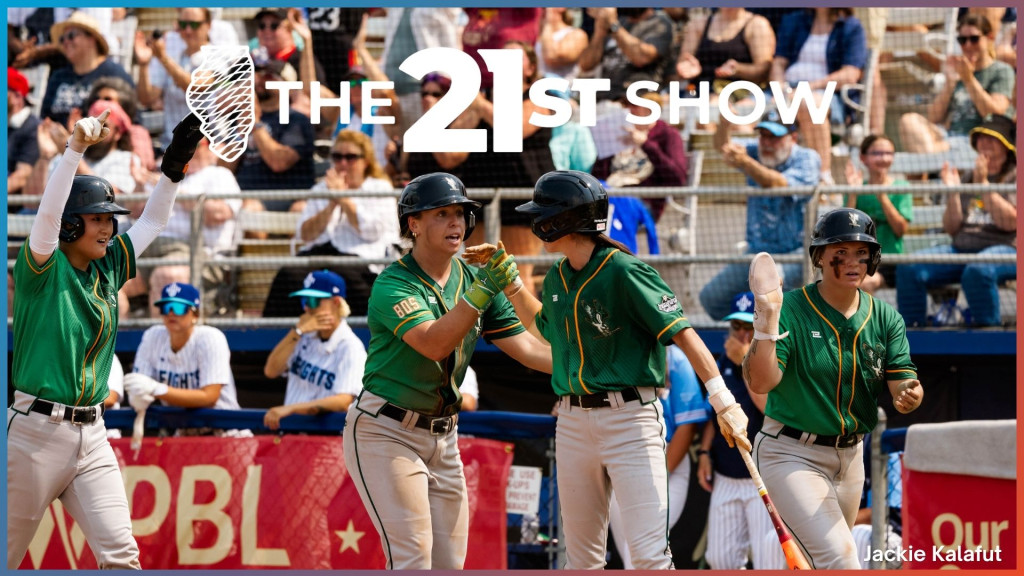
Alli Schroder, Captain of the Boston Hunters, with teammates at Springfield's Robin Roberts Stadium during the inaugural season of the Women's Pro Baseball Leaugue Jackie Kalafut
// This is a machine generated transcript. Please report any transcription errors to will-help@illinois.edu.

[00:00:00]
Brian Mackey: It's the 21st show. I'm Brian Mackey, and right now, sports history is being made in Springfield, Illinois. It's happening five nights a week at Robin Roberts Stadium, named for the local boy who became a Hall of Fame pitcher. Roberts made his Major League debut in 1948, but this summer in Springfield, every player on the field is making a debut of sorts. That's because this is the inaugural season of the Women's Professional Baseball League. Created in 2024, the league aims to create a new professional career pathway for women ballplayers.

[00:01:05]
Speaker 1: We're back in Springfield, Illinois, the one-time home of Abraham Lincoln, and now it's time for some Sunday Night Baseball. Sandra's just 18 years old, an Illinois native drafted in the 4th round in the WPBL. Waits on that

[00:01:21]
Speaker 2: pitch down the line on the right side. [Hondres] in the 2 spot, she's looking for two bases. Headfirst into 2, the tag in time. What a relay from right. [Hunters] get the victory 9 to 7 over the Heights. They've taken 3 of the 4 matchups from New York.

[00:01:43]
Brian Mackey: Highlights from some of the latest games this week. Now this is not the first time women have played baseball professionally. Arguably the most notable of several previous attempts started in World War II with the All-American Girls Professional Baseball League that was based right here in Illinois. For the rest of the hour today, we're going to talk about women's professional baseball then and now. Joining us from the new league is Allie Schroeder, captain of the Boston Hunters. Allie, welcome to the 21st show. Thanks for being here. Thank you for having me. Also here is Laura Furman, curator of collections and education at the Midway Village Museum in Rockford. They have an exhibit on the Rockford Peaches, which competed in the All-American Girls Professional Baseball League. Laura, welcome to you as well. Thank you. Listeners, you can join us 800-222-9455. Have you been to one of these women's pro baseball league games? Please let us know about your experience. Uh, maybe you have memories, the All-American Girls Professional Baseball League or one of the other women's professional baseball leagues that has been developed over the years. 800-222-9455 is the number. Ellie, I'm gonna start with you. Tell me about your baseball journey. How did you get into this sport?

[00:02:56]
Allie Schroeder: Yeah, I grew up playing baseball in rural British Columbia, Canada. Um, the thing to do is play a whole bunch of sports and activities when you're a kid up there, so I was in a whole bunch of sports and kind of fell in love with the game by the time I was 8 years old. Kind of played all through high school with the boys on different travel ball teams and then decided I wanted to play college baseball, so I pursued that, became the first girl to sign and play Canadian collegiate baseball. And uh here we are, got drafted last November and playing in the WPBL now.

[00:03:29]
Brian Mackey: So has, how much of your career has been, you know, you're the only girl or one of the, one of the few girls on the boys' team kind of thing.

[00:03:37]
Allie Schroeder: Yeah, I would say, I mean, the majority of my career, um, I made Team Canada women's national team when I was 15 years old, so I had a bit of a crossover where I was playing women's baseball and boys' baseball, but certainly right up until until I graduated university, I was playing with the boys.

[00:03:56]
Brian Mackey: How was it, how was it for you? Or did you find it easy to, to integrate or, or were there bumps along the way?

[00:04:03]
Allie Schroeder: Um, bumps along the way for sure, definitely had my fair share of, you know, discrimination on the field, mostly from other teams. Um, super, super grateful to grow up in a small town where, you know, all the boys I was playing baseball with were my best friends as well. We were going to school, we were neighbors, um, so I had a really good supportive environment from a young age from that perspective.

[00:04:25]
Brian Mackey: Laura Furman with the Midway Village Museum. Hearing that, so how does, how does Ellie's experience compare to the women who played in the All-American Girls Professional Baseball League, which, as I mentioned, is the subject of an exhibit, the Rockford Peaches were part of that, uh, at the museum now.

[00:04:40]
Laura Furman: I think there are a lot of commonalities, you know, the women who were joining the league in the 1940s very often didn't have the opportunity to play women's sports in their schools and their communities. Very often, a lot of their experience was playing around the neighborhood with, with the boys in the, in their area. Um, interested, Ali, to, to hear your connection to, uh, to being to Canada because when the All-American Girls Professional Baseball League got its start and they started recruiting players, they did, uh, tryouts not just in the US but also, uh, throughout Canada as well. And a number of the Rockford Peaches who really made a big name for themselves were Canadian players as well.

[00:05:26]
Brian Mackey: Oh, that's interesting. Ali, are you tied in at all? I mean, do you, or read in on the history of women's baseball in Canada?

[00:05:33]
Allie Schroeder: Yeah, I sure have, yeah, I know, like Laura mentioned, quite a few players on the Rockford Peaches were from Saskatchewan, um, which is, it's mind blowing to hear of the Canadians that were part of that time in history in women's baseball, but I'm definitely aware that, you know, the Canadian female baseball players played a large part in the original All-American Girls Baseball League. Mhm.

[00:05:53]
Brian Mackey: So, uh, how did Laura, Laura, how did the All-American Girls Professional Baseball League come about? It's an Illinois story.

[00:06:00]
Laura Furman: It is thanks to Philip Wrigley, who was the owner of the Chicago Cubs as World War II started to make an impact on the United States, the draft was put in place. We start sending young men off to war and suddenly men's professional baseball was not looking so good. They were losing more than 500 of their best players who were going off to serve in the military. The minors were having um, their own similar problems to the extent that some of the minor league teams ceased operation because they didn't have enough players. And so Philip Wrigley and some of his fellow businessmen sat down and said, how are we going to save our investment here? We need to make sure that people are still watching baseball. We need to still put people in seats and keep the enthusiasm up. And so they landed on establishing the All-American Girls Professional Baseball League and started in the first year in 1943 with with four teams, kept it mainly Midwestern. They had a team in uh Rockford, Illinois

[00:07:10]
Brian Mackey: and Peoria and others, yeah, I mean, I'm sorry to interrupt you. We're on a, we're on a fixed clock on the show and we have to take a break here. So we are gonna continue this conversation about the past and the very live present happening this week in Springfield of women's professional baseball. We're talking with Laura Furman of the Midway Village Museum, Allie Schroeder, captain of the Boston Hunters, one of the four teams competing in Springfield. We'll be back after a short break.

This is the 21st show. I'm Brian Mackey. We are talking about women's professional baseball. History is being made this month and next in Springfield, Illinois. Uh, as the Women's Pro Baseball League is launching its inaugural season there, 4 teams from, uh, New York, Boston, and 2 from California are competing, uh, 5 nights a week, a few doubleheaders on Saturdays, uh, and, uh, again, making history here. We're speaking with Ellie Schroeder, captain of the Boston Hunters, about her experience. We're also joined by Laura Furman, who's a curator of collections and education at the Midway Village Museum in Rockford. Which has an exhibit on the Rockford Peaches, which competed in the All-American Girls Professional Baseball League in the 1940s and 1950s, 800-222-9455. That's 800-222-9455.

And Laura, the, we were talking about how the league developed. It did have sort of a limit on it though, and it, and it eventually wrapped up and ended its life. I don't know if you can take us to the end of the story of the Rockford Peaches and the other teams.

[00:08:56]
Laura Furman: Sure, the league continued until 1954 but found that by the late 1940s, men's baseball was back in action with the war having ended, gas rationing was no longer a thing. People were back on the road seeking out entertainment in all kinds of places and increasingly TV was becoming part of people's homes and their entertainment, and all of those things meant that the attendance for the All-American [P]rofessional [W]omen's [P]rofessional [B]aseball [L]eague dropped pretty precipitously to the point that the league ended in 1954.

[00:09:34]
Brian Mackey: So Ali, tell me about the Boston Hunters. I mean, you mentioned when you were drafted to, you know, taking the field in Springfield this month. What has that process been like?

[00:09:44]
Allie Schroeder: Yeah, I mean, a little bit different for me. Like, I work full time as a firefighter back home, so I, I kind of do a dual career, but um definitely a lot of personal preparation, getting, getting hyped and excited to finally arrive in Springfield to meet my team. Um, I think Boston and and all the other teams are in really interesting boats where we can build a franchise from the ground up. I mean, this is the first time any of these teams have ever been a thing, so now that we're all here in [Springfield]. [I'm] just trusting the preparation that we've all done individually to get to this point where we're able to call ourselves professional baseball players for the first time ever and now taking that personal preparation and putting it towards a team goal of winning a championship for Boston.

[00:10:26]
Brian Mackey: You know, uh, when I first heard about this happening in Springfield, I, I've, I've lived in Springfield 21 years now, and it's not like, I think, you know, the first city people would think of for professional baseball. Uh, there's, there's like a [collegiate wood bat] team that plays there in the summer. No disrespect to the Springfield Lucky Horseshoes. Uh, but like, what did you, what was your reaction? I mean, did you have to look it up on a map when you first heard about this?

[00:10:50]
Allie Schroeder: I mean, I did have to look it up on a map. I personally was pretty excited, and I mean, coming from rural Canada, Springfield is kind of like home to me, the cornfields and everything. So, and I think that, you know, having having something of this magnitude in a smaller city town, I mean, it pulls the town together, everybody really rallies behind it, so I definitely see the vision that the league was going with, and I think we're seeing great success from that perspective.

[00:11:16]
Brian Mackey: What have the games been like for you?

[00:11:19]
Allie Schroeder: I mean, incredible. We've we've had great, great, uh, like amounts of people come out. Our, our opening day sold out, and, and since then, I mean, you know, the midweek games are obviously a little bit different, um, people working and whatnot during the but weekend certainly gets people out to the ballpark. The atmosphere is great. The, the league is doing a great job of creating an exciting atmosphere for women's baseball in the stands and in the announcer's booth as well. So I think that it's been, it's been a lot of fun, not just for the players but for the fans as well.

[00:11:49]
Brian Mackey: I will say you're also competing with the state fair uh this week, so that could be some some stiff competition. Have, how, you know, I don't know if you've made it to the state fair. How have you found, uh, life in Springfield for the, for the time you've been there? And, and you can be honest, the good, the bad, the, the indifferent.

[00:12:05]
Allie Schroeder: Yeah, my honest opinion is I've actually really enjoyed it. Like I said, it's kind of similar to home for me. Um, we've got out to the rodeo, the state fair. There's definitely things going on. I think that, you know, living in the Midwest in the summertime is a different experience for a lot of people that especially aren't from the United States, and I think, you know, depending on what mindset you go into it with, it can be, it can be a cool experience as well.

[00:12:29]
Brian Mackey: So Laura, can you talk a little bit more about the All-American Girls Professional Baseball League and its sort of evolution season by season and, you know, the support they, they had initially and, and, you know, how that compares to what we've been seeing happening in Springfield this month.

[00:12:45]
Laura Furman: Sure, well, the teams that that got their start with the league were placed in communities that stepped up and raised a little money upfront that could be matched by Wrigley. So there was a lot of buy-in, particularly in Rockford from the beginning. There was a fan club with member units being sold. Some of my favorite artifacts in our Peaches collection are wonderful scrapbooks kept by kids in Rockford who were taking pictures and pens and balls to every game they could to get every last autograph they could from, from Peaches players. Um, so there was definitely a lot of community support, uh, rallying behind, behind the Peaches.

[00:13:33]
Brian Mackey: You know, nowadays, uh, Laura, we think of like women's sports as being an inspiration to, to, especially to little girls. Um, uh, you know, you see girls lining up for autographs and stuff like that. Sometimes though, when we apply modern thinking to the past, you know, that's not quite the way the story was. Do you have evidence in your collection of like, you know, little, little girls being inspired by this? Because, I mean, obviously what happened to that professional baseball league was not ultimately an inspiring story, at least how it, how it ended.

[00:14:04]
Laura Furman: Despite it having ended after 12 seasons, these women went on to some pretty tremendous things. Most of these women started playing with the league as teenagers, sometimes not even out of out of high school, often had never been away from home before, and many of them went on to take the lessons of what they were able to achieve as athletes and say, well, why should I let things stop me? Um, we had Peaches players who were went on to be physical therapists, went on to be professors at Midwestern universities, um, working in banks, um, all kinds of careers that, uh, at that time probably would have been discouraged and even if their baseball career was only 12 years for the league, I think they, they didn't let anything slow them down. They were also compensated better in some cases than their parents were, and that I think too, set them up for success in life and chasing dreams.

[00:15:11]
Brian Mackey: Maybe this is a good time to shout out Maybelle Blair, uh, 99 years young. I think she recently threw out a ceremonial first pitch at a game in Rockford. If I, if I remember bringing the news story correctly, she did have a 37-year career at the Northrop Corporation, one of only 3 women managers at that company at the time.

Um, Ali, let me come back to you. Uh, you're, I believe you're 24 years old. You've come of age in, in a world in which, you know, women's sports are much more of a thing than they were in the past. The WNBA is older than you are. Uh, you know, women's soccer is obviously a big, big deal every, every 4 years, at least in context of the World Cup. But, you know, women's baseball is where some of these other sports were. Uh, you know, years ago, at least at this attempt at starting a professional league. I wonder how you've experienced that, you know, that progress or lack of progress. How do you think about that? Or, or maybe you don't think about it, you're just concentrating on the, the game day to day.

[00:16:06]
Allie Schroeder: Yeah, I mean, I think it's hard as as any female athlete at any level to not think about it right now. I think now is such an exciting time for women in sports, and I think about this across all sports as focused as I am on women's baseball. I mean, in Canada, I watch hockey a lot, um, so talking about the Women's Hockey League and seeing the trajectory that that has taken, I, I only hope for the exact same thing to happen with the Women's Professional Baseball League. I don't think there is any better time for these startup leagues to be happening, and I think it's, it's just all around a really exciting time to see the love and support that, you know, communities have to give to women's sports that we haven't had in so long.

[00:16:47]
Brian Mackey: Allie, I know you have a practice coming up at noon, so I'm gonna let you go a little before the end of the show, but I do, you mentioned you're a firefighter in Canada, a wildland firefighter, if, if I have that right. And you know, Canadian wildfires, you may not know this, but that is a phrase we have heard a lot in the news in Illinois, uh, and, and across the Midwest because a lot of smoke has drifted down. Have you been called up for service recently? What, what is that, what is that like for you?

[00:17:13]
Allie Schroeder: Yeah, so I am entering my 7th year of service with the BC Wildfire Service at home. Um, I, yeah, we are seeing the exact same climate change that that everybody in the states is seeing. Obviously you get our smoke quite a bit, um, but, uh, yeah, I'm super grateful that they've given me this time off to be here and pursue this dream with the understanding that I'll be back soon to do my part, helping our communities at home.

[00:17:40]
Brian Mackey: Where do you see the women's pro baseball league going from here?

[00:17:44]
Allie Schroeder: I see some expanding in our near future. I think that it would be really cool to see, you know, an expansion of teams like I talk about the PWHL, the WNBA, um, exact same thing, and I think the biggest thing on my mind right now is I want to go live in Boston and be able to represent Boston's team while living, training, and playing in the city.

[00:18:05]
Brian Mackey: Yeah, absolutely. Although I get probably saves a lot on the travel budget for this first season to play it all in one spot. All right, Allie, I know you need to go. Thank you so much for being with us and sharing your experience with us today on the 21st show.

[00:18:18]
Allie Schroeder: Thank you for having me.

[00:18:19]
Brian Mackey: I'm gonna, Laura, I'm gonna keep you around until the end of the program. Uh, we're speaking now with Laura Furman, curator of collections and education at Midway Village Museum in Rockford, which has an exhibit on the Rockford Peaches. Maybe we can just talk about that exhibit for a moment. What, what can people see? What are some of the highlights of some of the uh artifacts you've curated there?

[00:18:40]
Laura Furman: Um, some of the, the things that people will see are stories on the experiences of, of specific players. Um, some of the, the best, uh, players that we had like, uh, Dottie Kamenchek. Um, we have some fun things from Bobby Thompson, who played for the Peaches a couple of years in the, towards the end. Um, she's given us her, her cleats and her glove and uh had shared her story of, of growing up as a kid and, and throwing the ball around in her backyard. My favorite thing with, with her case is that we have an essay that she wrote for what I, what I'm planning to do on my summer vacation, um, which was all about how excited she was to be playing baseball for the summer with a, with a team that was affiliated with a local business.

[00:19:31]
Brian Mackey: Are there any lessons for, you know, I should say from the Rockford Peaches or the All-American Girls Professional Baseball League more broadly that can, that can work today, that people like Laura who, or I should say Allie, who is of course is no longer with us, uh, Laura, uh, can, you know, can take from them today?

[00:19:51]
Laura Furman: Well, these women really were fabulous athletes, and they stepped up to the challenge, you know, they started out playing a game that was more like softball rules, shorter distances between bases, bigger balls, things like that. And by the end of the league's history they were playing a game that really was what the men were playing. I think that's a, that's a very relevant story today as it was then. They really rose to the challenge and showed their their prowess and their their skill.

[00:20:25]
Brian Mackey: Laura Furman is curator of collections and education at Midway Village Museum in Rockford, which has an exhibit on the Rockford Peaches. We also spoke a little earlier with Allie Schroeder, captain of the Boston [Hunters], which is competing in the Women's Pro Baseball League. They are playing the New York Heights tomorrow, Thursday, 6:30 p.m. at Robin Roberts Stadium in beautiful Springfield, Illinois, if you want to check that out. Uh, Laura, thank you so much for being with us today on the 21st show. Thank you.

That is it for us today. Coming up on tomorrow's program, as I teased earlier, the pesticides that farmers use can drift miles beyond where they are originally deployed, harming plants, trees. And people will talk about how it happens as well as what could change with a little more regulation. Plus, we'll talk with a Springfield woman who in collaboration with her sister is going to Burning Man and installing a large sculpture that will also eventually make its way back from the California desert to here in Illinois. That's all coming up tomorrow on the 21st show.

We love hearing from you about what you think about what we've been talking about or future suggestions for topics. You can email us, [talk@21stshow.org] is the address. You can also find that and every other way to contact us on our website and find links to our podcast while you're there, or just look us up. The [21st] show on Apple, Spotify, YouTube, or wherever you listen.

The 21st show is produced by Christine Hatfield and Jose [Zaeda]. Our digital producer is Colson [Kahahn]. Technical direction and engineering comes from Jason Croft and Steve Mork. Reginald Hardwick is our news director. The 21st show is a production of Illinois Public Media. I'm Brian Mackey. Thanks for listening. We'll talk with you again tomorrow.
Two years after the launch of the Women’s Pro Baseball League, the inaugural season is taking place right now in Springfield, Illinois.
A captain of a women's baseball team and a curator from a museum that has an exhibit showcasing a Rockford-based girls baseball league discuss the significance of Women’s Pro Baseball League and the history of women playing baseball in America and in Illinois.
GUESTS
Alli Schroder
Captain, Boston Hunters
Laura Furman
Curator of Collections and Education, Midway Village Museum