








For the Love of Music Teachers
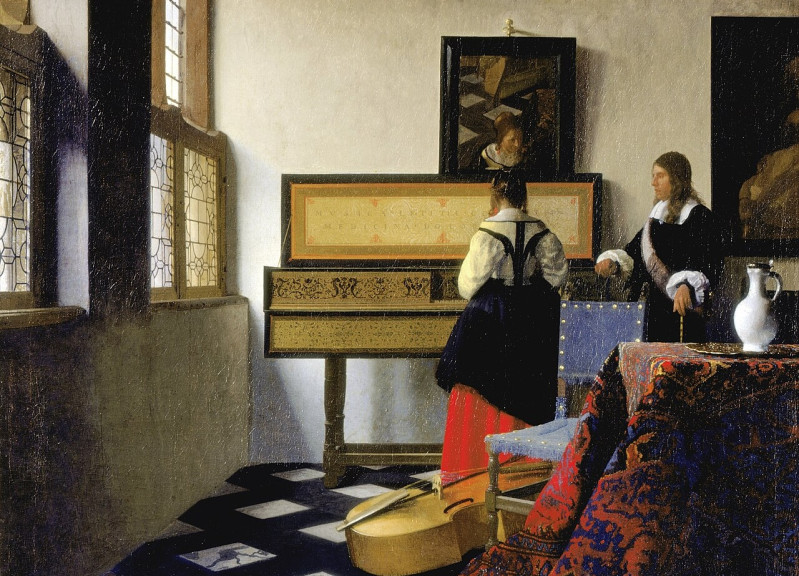
"The Music Lesson" by Johannes Vermeer c. 1662–1665
“What have teachers got to do with music?” Leonard Bernstein asks in the New York Philharmonic Young Person’s Concert broadcast on CBS on November 19, 1963. “The answer is: everything,” he continues. “It is almost impossible to imagine a professional musician who doesn’t owe something to one teacher or another. The trouble is that we don’t always realize how important teachers are, in music or in anything else. Teaching is probably the noblest profession in the world—the most unselfish, difficult, and honorable profession. It is also the most unappreciated, underrated, underpaid, and underpraised profession in the world.”
To right this wrong, we’re highlighting several pieces composers dedicated to important music teachers in their lives in anticipation of the upcoming school year.
Josquin des Prez – Nymphes des bois
Although there is no definitive evidence that Josquin des Prez (c. 1450/5–1521) was a pupil of composer Johannes Ockeghem (c. 1410–1497), he certainly had extensive knowledge of Ockeghem’s music and learned from it by example. When Ockeghem died in 1497, Josquin paid tribute to the Franco-Flemish master with one of his most famous and moving pieces, Nymphes des bois. He sets a poem by Jean Molinet, which calls for the “nymphs of the woods” to join in lamenting Ockeghem’s death. The poem names composers who are indebted to Ockeghem, such as Antoine Brumel, Loyset Compère, and Josquin himself. While four of the five voice parts sing this poem, the Tenor intones the “Requiem aeternam” chant from the Catholic Mass for the Dead.
The choice of text pays explicit homage to Ockeghem, but Josquin also subtly nods to his predecessor's musical style through both stylistic imitation and direct quotation. Josquin reverted to Ockeghem’s older style, characterized by long, melismatic lines on one syllable, whereas Josquin’s style had developed to favor shorter motivic cells imitated across voices. Josquin also quotes several of Ockeghem’s works, including his Requiem Mass, the earliest surviving polyphonic setting of that text. In this way, Nymphes des bois both serves as a personal memorial to a mentor and meditates on artistic lineage across generations.
Ludwig van Beethoven – Piano Sonatas Op. 2, Nos. 1–3
Although Beethoven later claimed he had learned “absolutely nothing” from Franz Joseph Haydn, his Op. 2 piano sonatas tell a different story.
In 1792, Beethoven, then 21 years old, decided to move from his hometown of Bonn to the musical capital of the world: Vienna. The goal was to study under Haydn—the so-called father of the symphony and perhaps the most famous composer in Europe at the time. A friend wrote to Beethoven shortly before his departure, “You are going to Vienna in fulfillment of your long-frustrated wishes . . . With the help of assiduous labor you shall receive Mozart’s spirit from Haydn’s hands.”
Beethoven studied counterpoint with Haydn from November 1792 until Haydn’s departure for England in January 1794. Their student–teacher relationship was cordial, but their personalities did not gel. “Papa Haydn,” as he was fondly referred to, was affable and sought the affection of his students. Beethoven was too mistrustful to reciprocate, however, even when Haydn lent him money to cover his living expenses. One of his misgivings was that Haydn was not thorough enough in his instruction. He also composed relatively few new works under Haydn’s direct supervision, choosing instead to revise several older works he had composed in Bonn. Nonetheless, Haydn remained proud of his brilliant pupil, correctly predicting that Beethoven would “in time fill the position of one of Europe’s greatest composers.” Haydn’s seal of approval also helped to establish Beethoven as a composer of consequence.
After Haydn set sail for England, Beethoven composed three piano sonatas, his first piano sonatas to which he gave an opus number (Op. 2). While he refrained from writing “pupil of Haydn” on the title page, as was custom and what Haydn wished, he decided to dedicate them to his most famous mentor instead. Even if he felt he didn’t get much out of his lessons with Haydn, these sonatas bear Haydn’s fingerprint, particularly in how larger musical structures are built out of small cells. Yet, they also demonstrate a composer coming into his own and anticipate Beethoven’s later innovations in the genre.
Aaron Copland – Symphony for Organ and Orchestra
When Aaron Copland was a young man, American composers were expected to go to Europe for “finishing.” So, in 1921, having learned all he could from his first composition teacher, Rubin Goldmark, the 21-year-old Copland packed up and headed to Paris. A friend there convinced him to take a harmony class with a young female teacher named Nadia Boulanger at the newly established American School at Fontainebleau. Boulanger, then only in her mid-30s, would go on to teach many of the greatest American composers and musicians of the 20th century, including Phillip Glass, Walter Piston, Virgil Thomson, and Quincy Jones.
Boulanger was a strict taskmaster but unwaveringly supportive of her star pupil. In addition to giving Copland a firm technical foundation, she also introduced him to influential figures that would further his career. One such connection was conductor Serge Koussevitzky, who had contracted Boulanger to appear as organ soloist during his first season leading the Boston Symphony Orchestra in 1924–25. She asked Copland to compose an organ symphony for the occasion. Koussevitzky was highly impressed with the outcome and went on to become one of Copland’s greatest champions.
Boulanger and Copland would remain lifelong friends after Copland returned to the United States in 1924. Copland wrote to Boulanger in 1950, “I shall count our meeting the most important of my musical life. Whatever I have accomplished is intimately associated in my mind with those early years, and with what you have since been as inspiration and example.” He dedicated more works to “Mademoiselle Boulanger” than any other person. In addition to the Organ Symphony, these include Passacaglia (1922), a theme and variations for piano written in response to Boulanger’s insistence that her students master traditional forms; Dirge in Woods (1954), a song for voice and piano written to celebrate her 50th year of teaching; and Nonet for Strings (1960), dedicated to Boulanger “after forty years of friendship.”
Franz Liszt – Transcendental Études
If Beethoven received Mozart’s spirit through Haydn’s hands, Franz Liszt received Beethoven’s through the hands of his teacher, Carl Czerny. Czerny was introduced to Beethoven at age 10 and took lessons with him several times a week for about two years. Czerny became so intimately acquainted with Beethoven’s piano music that as a teenager he could perform any opus number from memory on command. When Beethoven had to stop teaching to focus on composition, they remained good friends and colleagues, with Czerny premiering several of Beethoven’s works, including the “Emperor” piano concerto (No. 5).
While most of Czerny’s compositions have fallen into obscurity, his legacy as a teacher lives on, both through his technical exercises, which are mainstays of piano pedagogy to this day, and through his most famous pupil, Franz Liszt. In 1822, Liszt’s family moved to Vienna so their nine-year-old son’s musical talent could be properly nurtured. There, he studied piano with Czerny and composition with Antonio Salieri. His lessons with Czerny—the prodigy’s only professional piano teacher—lasted about 10 months before he embarked on an international concert career. Czerny wrote in his memoir, “never before had I had so eager, talented, or industrious a student.” When Liszt came to him, he was brimming with raw talent but lacked polish and proper technique. For the first few months, Czerny gave Liszt a strict diet of scales and dry, mechanical exercises to instill rhythmic exactness, tone, and fingering before moving onto repertoire.
In 1826, Liszt composed a set of 12 piano études, which are relatively straightforward and reminiscent of Czerny’s own pedagogical exercises. He revised them in 1837–39, significantly increasing their technical demands and appending titles to all but two of the études. True to form, Liszt reworked his études yet again in 1851, renaming them Études d'exécution transcendante, or Transcendental Études. The set was published the following year and dedicated to Czerny, proving that a teacher’s influence can extend long after the lessons are over.