








MIOpera and BACH Join Forces for Handel’s “Semele”
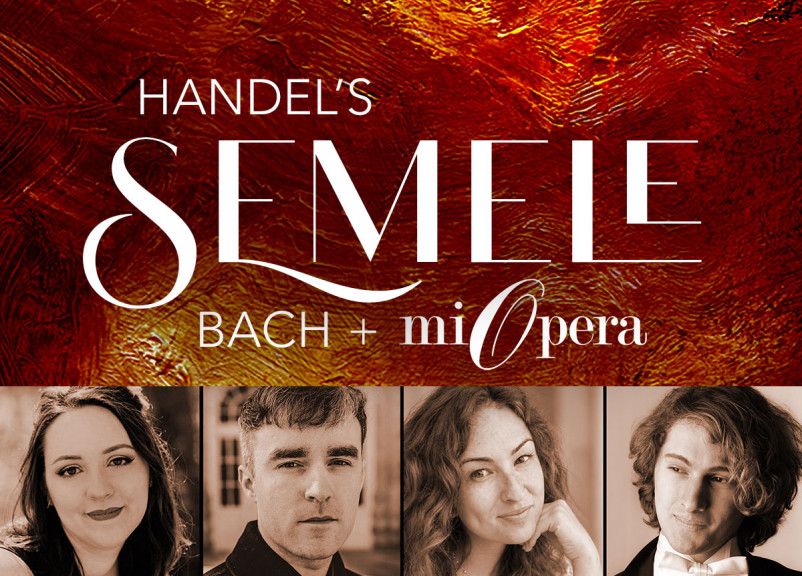
On November 7 and 8, MIOpera joins forces with the Baroque Artists of Champaign-Urbana (BACH) to present George Frideric Handel’s Semele. This production marks the first collaboration between the Bloomington-Normal-based professional opera company and the Baroque ensemble. BACH will provide the chorus, orchestra, and continuo, while MIOpera will provide the soloists, set pieces, and costumes. To learn more about the show, we spoke with Tracy Koch, MIOpera’s artistic director and stage director, and BACH Music Director Sarah Riskind, who will conduct the production.
Although it is often billed as an opera, Semele is technically a secular music drama presented “after the manner of an oratorio.” However, it is far from the sacred oratorios audiences may be more familiar with, such as Handel’s Messiah or Saul. Because opera was banned during the solemn season of Lent, unstaged English oratorios became a popular replacement. Oratorio texts drawn from Biblical subject matter were the norm, though secular music dramas based on stories from mythology or history eventually emerged as well.
When Semele premiered in 1744, audiences looking for the spiritual uplift of Handel’s sacred oratorios were shocked by its scandalous plot and immoral characters. Drawn from Ovid’s Metamorphoses, the story concerns the mortal Princess Semele, who is engaged in a passionate love affair with Jupiter, king of the gods, despite being already betrothed to Prince Athamas. Juno, Jupiter’s jealous wife, schemes to destroy Semele by playing into her vanity and ambition. She convinces Semele that she can achieve immortality by demanding that Jupiter reveal himself to her in his full godlike form. When he does, his brilliance consumes her and turns her to ash.
While Semele was first performed in a concert setting, today it is often performed as a fully staged opera. MIOPera’s coproduction with BACH will likewise be staged, using the two church venues—First United Methodist Church in Normal and Wesley United Methodist Church in Urbana—to the fullest extent.
“Churches are a great place to do performances,” Koch said. “Not only are the acoustics amazing, but you have different levels and can adjust the lighting.” With added spotlights, set pieces, costumes, and props, Koch assures us, “You’ll feel like you’re in the theater.”
The BACH chorus will play a large role in the production. Dressed in black and positioned upstage, the singers will act as a quasi-Greek chorus. A few chorus members will also interact with the leads on stage and help move set pieces throughout the show.
This is not the first time the BACH chorus has been involved in a dramatic production, although it has been over a decade. Riskind recounted that BACH performed Henry Purcell’s Dido and Aeneas under founding director Chet Alwes in 2014 and sang in Handel’s Acis and Galatea with the Mark Morris Dance Group at the Krannert Center for the Performing Arts in 2015. Returning to secular dramatic repertoire will be a fun challenge for the group and a special way to inaugurate the organization’s 30th anniversary season.
“It’s a really unique opportunity for us,” Riskind said. “It allows us to perform repertoire we wouldn’t have been able to do effectively otherwise. We’ve done a lot of sacred music and occasionally some secular music, but it’s fun to find all these musical differences that are inherent in this secular piece that we wouldn’t have in a sacred work.”
Koch had the initial idea to collaborate. She had wanted to stage a Baroque opera or oratorio with MIOpera and reached out to Riskind to see if BACH would like to be involved. Koch believed it would be a great way to bring two local musical organizations together and share something new with their respective audiences in Bloomington-Normal and Champaign-Urbana. Riskind agreed, and the two collectively decided on Handel’s Semele as a piece that would show off both organizations to their best advantage.
The complexity and variety of the choral writing in Semele was a major deciding factor. “It can be hard to find operas that have a really substantial, complex, meaty choral component,” Riskind explained. While not as intricate as Handel’s Dixit Dominus, which BACH performed in 2024, the choral writing in Semele still contains some polyphony and counterpoint, alongside moments of declamatory drama (e.g., “Oh, Terror and Astonishment”) and Baroque dance (e.g., “Now Love that Everlasting Boy” and “Lucky Omens Bless Our Rites”).
The score is full of crowd-pleasing arias as well. Semele herself has several showstoppers, including the cheeky “Myself I Shall Adore" (above), the sensuous “Endless Pleasure, Endless Love,” and the defiant “No, No, I'll Take No Less." Jupiter offers the opera's most famous tune in “Where'er You Walk,” while Juno unleashes her jealous fury in “Iris, Hence Away!”
Dramatically, Koch was drawn to the story of Semele because it is accessible and features a strong female character who knows what she wants and goes out and gets it, even if it ultimately leads to her downfall. “Semele refuses to marry the man her father has chosen for her,” Koch said in a press release. “Instead, she follows her heart, no matter the cost.” Despite Semele’s tragic fate, Koch says the story is ultimately lighthearted and contains themes that will resonate with contemporary audiences. “The opera is witty and funny, but it also has serious themes like materialism and extreme narcissism that feel modern today,” she continued.
Many of the roles will be sung by returning MIOpera artists. In the title role is soprano Madison King, who was last heard as Dido in MIOpera’s production of Dido and Aeneas in 2024. Tenor Macauley Allen, a native of Monticello, sings the role of Jupiter. Mezzo-soprano Sidney Megeff of Champaign takes on the dual roles of Juno and Semele’s sister, Ino. Additional cast members are bass O. Neal Medina as Somnus, soprano Paige Calvert as Juno’s servant, and Alesia Wall as Cupid.
Countertenor Byrce Zimmerman makes his MIOpera debut as Semele’s rejected fiancé, Athamas, a role he has sung before elsewhere. Although he is currently studying for a master’s in vocal performance at Indiana University, Zimmerman has ties to the Champaign-Urbana community, having sung with the BACH choir last summer in their performance with the Five Cities Baroque Festival. He will also serve as alto soloist in BACH’s annual Messiah Sing-Along on November 29.
Don’t miss Handel’s Semele, a coproduction of MIOpera and BACH, Saturday, November 7 at 7 pm at First United Methodist Church in Normal, and Sunday, November 8 at 4 pm at Wesley United Methodist Church in Urbana.