







Music for Your Thanksgiving Playlist (That Isn’t “Simple Gifts”)
When you think of classical music appropriate for the Thanksgiving holiday, the first thing that probably comes to mind is the Shaker song “Simple Gifts,” made famous by Aaron Copland’s ballet Appalachian Spring. We thought we’d dive into some lesser-known pieces that will make great additions to your Thanksgiving playlist, whether you play it in the background during your festive meal or listen to it while cooking—that is, of course, if you’re not already tuned into Illinois Classical!
Aaron Copland – The Tender Land: “The Promise of Living”
Okay, okay, this one isn’t exactly “unknown,” but it’s a Copland piece that takes inspiration from another Shaker hymn. “The Promise of Living” is the Act 1 finale of Aaron Copland’s 1954 opera, The Tender Land. Laurie, an impressionable teenage girl on the cusp of adulthood, lives on her family’s farm in the American heartland during the Great Depression. Her life is turned upside down when her grandfather hires two itinerant workers, Martin and Top, to help bring in the harvest. In this scene, the men join Laurie and her grandmother, Ma Moss, in this anthem extolling the virtues of hard work, loving one’s neighbor, and sharing one’s gifts with the community. The chorus grows out of the early American revivalist hymn “Zion’s Walls,” building from single voices to a duet, trio, then quintet. “The Promise of Living” gained popularity as a standalone work and is often heard in various choral and band arrangements.
Leonard Bernstein – Divertimento for Orchestra: V. “Turkey Trot”
Leonard Bernstein composed his Divertimento for Orchestra in 1980 for the Boston Symphony’s 100th anniversary season, calling it a “love letter” to the orchestra. “Turkey Trot” is the fifth movement in the eight-movement work. In typical Bernstein fashion, it is a tongue-in-cheek dance characterized by jaunty syncopated rhythms and dotted with colorful percussion. We don’t recommend listening to it while running the Turkey Trot, though, or you might just trip over your own two feet!
Amy Beach – “A Thanksgiving Fable”
Keeping with the lighthearted mood, we have Amy Beach’s “A Thanksgiving Fable,” part of her set of Four Songs, Op. 75, published in 1914. The poem by Oliver Herford is about a hungry cat who spots a mouse eating an ear of corn on Thanksgiving morning. The cat believes the mouse will feel thankful when the cat eats it for having provided her with a meal, which, in turn, makes the cat even more “thank-full.” Of course, while the cat ponders her good fortune, the mouse slips away, leaving the cat hungry.
John Corigliano – A Black November Turkey
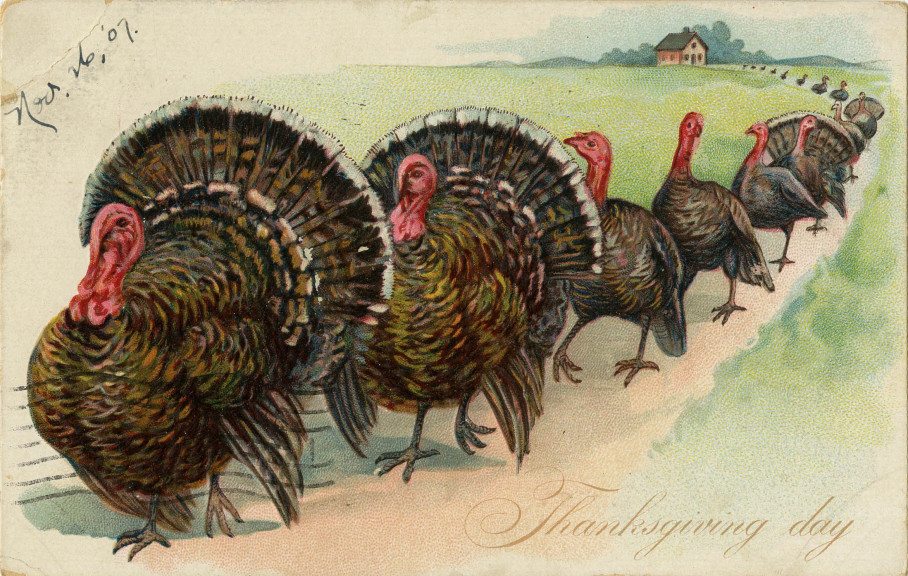
In 1972, John Corigliano composed A Black November Turkey for chorus and piano, then reworked it for string quartet in 2003. The title comes from a poem by Richard Wilbur published in The New Yorker in 1953. It tells the tale of a proud turkey who squires around a group of white hens shortly before Thanksgiving, unaware of his impending fate. Corigliano writes, “This savage barnyard allegory is set against an inane patter of clucking chickens (marked ‘with bitter sarcasm’ in the score), and portrays a sad and endless futility, a celebrated and unnoticed death.”
Anonymous – “Nutmegs and Ginger”
“Nutmegs and Ginger” was a popular drinking song in Elizabethan England. The anonymous tune first appeared in print c. 1595 in the Cambridge Consort Books. As was the practice at the time, the tune was set to multiple texts and used and referenced in various plays in the early 17th century, perhaps even in those by Shakespeare. The original title likely refers to the practice of adding spices to wine and ale for special occasions. The chorus of one version goes, “Nutmegs and Ginger, Cinnamon and Cloves, they gave me this jolly red nose.” So, whether you use nutmeg and ginger in your pumpkin pie or add them to a festive quaff this Thanksgiving, enjoy this lovely spiced ballad.
William Bolcom – “Lime Jell-O Marshmallow Cottage Cheese Surprise”
Pulitzer Prize-winning composer William Bolcom wrote “Lime Jell-O Marshmallow Cottage Cheese Surprise” in 1980 as a satirical encore for the cabaret recitals he performed with his wife, mezzo-soprano Joan Morris. The song parodies his experience as a young man playing piano in women’s clubs. It pokes fun at the unappetizing concoctions they’d often serve—think Jell-O salads with seemingly disparate ingredients molded into strange shapes. Thankfully, such dishes are falling out of favor at many Thanksgiving tables, except perhaps in the most staunchly upper-Midwestern households.