








New Music Festival Brings Renowned Composers to UIUC
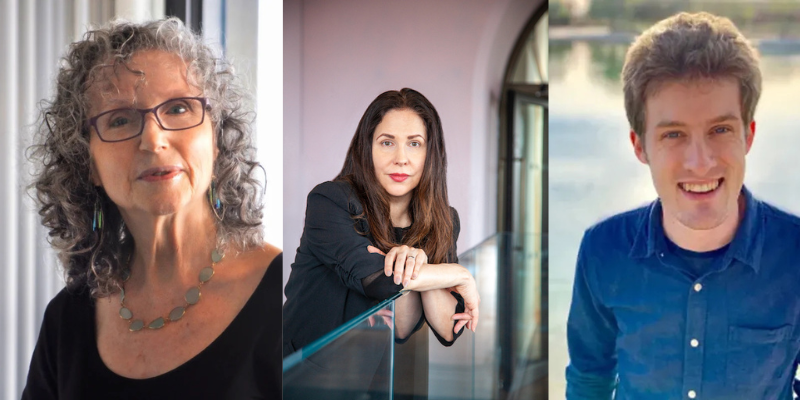
Shulamit Ran (left / pc: Valarie Booth); Arlene Sierra (center / pc: Ian Phillips-McLaren); Joshua Graham (left)
The University of Illinois School of Music will mount its second annual New Music Festival this fall. Running October 18–20, the festival welcomes composers Shulamit Ran and Arlene Sierra for a series of concerts at Smith Memorial Hall and the Krannert Center for the Performing Arts. We spoke with Dr. Joshua Graham, the festival’s acting director and assistant professor and coordinator of the percussion program, to learn more about the festival and what he hopes students and the community will gain from it.
Graham came to teach at the University of Illinois in August 2024 after a stint at the University of Northern Iowa. Before that, he worked as a freelance percussionist in Chicago, where he frequently commissioned new music as a soloist and with his trio, F-PLUS. Coming to the University of Illinois, he knew he wanted to build upon the school’s legacy of fostering burgeoning composers by starting an annual contemporary music festival—something he was surprised to find did not exist yet.
Although the School of Music has other activities devoted to contemporary music, there was no standing new music festival. “For a university of our size and a School of Music that has the history that ours does with composition, I thought it was odd,” Graham said. “I thought we should have something where we’re bringing in a renowned guest composer to work with our students and faculty every year.”
For the inaugural festival, Graham brought Irish composer and University of Illinois alum Donnacha Dennehy (MM '94, DMA '14) to campus to work with the students. Graham had commissioned a piece from Dennehy for his trio using a grant from the Koussevitzky Foundation at the Library of Congress and thought it would be special to premiere it at Dennehy’s alma mater. (You can watch F-PLUS’s premiere performance of Moire from last year’s festival below.)
Dennehy, currently on faculty at Princeton University, came to campus for a three-day residency, during which time he gave a lecture about his music and his career, worked with composition students in lessons and classes, and coached students and faculty on the pieces they were going to perform in a portrait concert of his music.
In addition to Dennehy’s residence, Graham’s trio colleagues led various classes during the festival, including one on musical entrepreneurship. “We had a lot of different offerings about what can a career look like outside of these walls, which is something I think that we want to be promoting to our students as much as possible,” Graham explained. “You don’t have to play in an orchestra or teach at a university to be successful. There are a lot of ways to make a life in music, and we want to be advocating those as much as possible.”
A week after the inaugural New Music Festival, Dennehy was nominated for two Grammy Awards, winning “Best Chamber Music/Small Ensemble Performance” for his composition Land of Winter. To Graham, this win was a great endorsement for the School of Music and the burgeoning New Music Festival. “I think it was a great way for us to put our foot forward by bringing in an alum of our program and saying, this is what our alumni do.”
Graham hopes to continue engaging composers for the festival who have a connection either with the University of Illinois or the state of Illinois more broadly. This year, the festival is bringing two guest composers to campus: Shulamit Ran and Arlene Sierra. Ran, the second woman to win a Pulitzer Prize in Music, was formerly composer-in-residence with both the Chicago Symphony Orchestra and Lyric Opera of Chicago. She is now professor emerita at the University of Chicago, where she taught from 1973 to 2015. Sierra is a London-based American composer who teaches composition at Cardiff University, an institution with which the University of Illinois has a strategic partnership.
Graham got to know Ran a few years ago when she attended several performances of his featuring works by her University of Chicago colleague Marta Ptaszyńska. He then reached out to her about the idea of composing a work for solo marimba. Although she is a highly accomplished composer with a diverse catalogue, Ran was initially hesitant, as she had never composed for solo percussion before. However, Graham persisted in convincing her and secured a grant from the Illinois Arts Council to commission and record the work.
The composition process was highly collaborative, with Graham sending Ran examples from the marimba repertoire to acquaint her with the mechanics of writing for the instrument. Graham premiered the resulting four-movement piece, titled Quadrophony, at the Masterworks Festival in Virginia this past June.
“I'm just so over the moon that we have a piece by a composer of Shulamit’s caliber added to our repertoire,” Graham said. He will be performing Quadrophony during one of the concerts as part of the New Music Festival.
Two concerts will be held in Smith Memorial Hall's Recital Hall on Sunday, October 18 and Monday, October 19. Music by both Ran and Sierra will be performed by faculty and students, who will have received coaching from the composers during the festival. Both concerts will begin at 7:30 pm and will be free and open to the public.
The Jupiter String Quartet will headline the festival with a concert on Tuesday, October 20 at the Krannert Center for the Performing Arts. The concert will feature Ran’s third string quartet, titled Glitter, Doom, Shards, Memory, which was commissioned by Music Accord for the Pacifica Quartet in 2013. The program will also feature the US premiere of Sierra’s quintet for bassoon and string quartet titled A Young Mind in Old Bees, featuring University of Illinois Professor of Bassoon Ben Roidl-Ward, who premiered the piece in Wales in April. After the concert, Graham will facilitate a panel discussion between the performers and composers to help “bring the audiences inside those pieces,” he said.
“We’re really hoping that the New Music Festival can be a chance for the community to engage with incredible artists from across the state and across the world,” Graham explained, as well as give students and faculty the chance to “work in-depth with composers on their music who they don’t normally rub shoulders with.”
“I do hope that it becomes something really valuable to the community as a whole—to Champaign-Urbana and Central Illinois—as something where people can feel like they’re part of new works being premiered,” he continued. He also hopes that hearing the music of living composers and listening to them speak about it will “demystify” contemporary music for audiences and make it less intimidating to those who might think it’s not for them.
“We have such a vibrant community of people who attend concerts here, which is amazing, especially for a community our size,” he said. “I want people to feel like they’re inside the process, and it’s for them. So, if we can be doing that through the New Music Festival, I’ll be thrilled.”
Graham hopes to expand the festival in future years, involving more University ensembles in the festival’s offerings. This year, the Men’s Varsity Glee Club and Illinois Modern Ensemble will perform Ran's compositions, but he hopes to get the University’s bands and orchestras involved too, and even branch out to venues off campus. “The bigger footprint we can have both here and in the community, I think, the better.”
For more details about the New Music Festival, visit the School of Music's website.