








“The Odyssey” as Told through Music
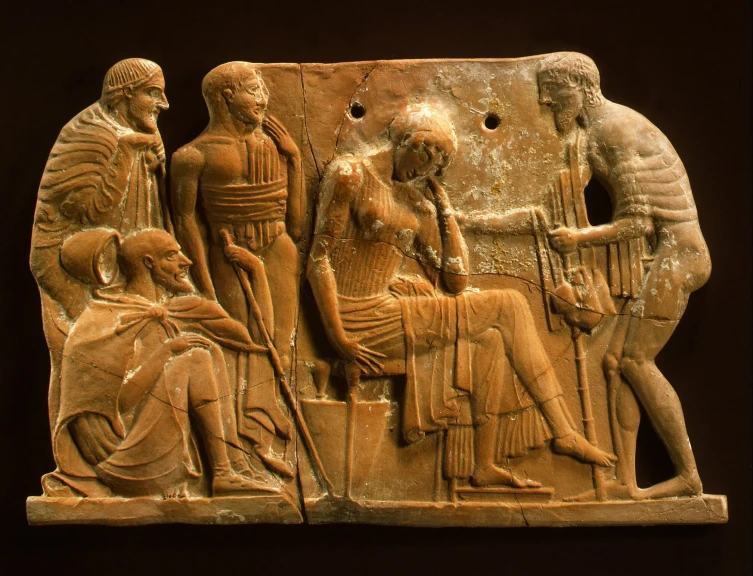
Terracotta plaque (ca. 460–450 BCE, Greek) depicting Odysseus disguised as a beggar comforting his grieving wife, Penelope. The Metropolitan Museum of Art, New York
One of the oldest surviving works of literature and a bedrock of Western culture, The Odyssey continues to move and enthrall audiences nearly 2,700 years after its supposed composition by the blind poet, Homer. Christopher Nolan’s recent film is just the latest take on a text that has inspired countless adaptations and works of art. Since The Odyssey seems to be the only thing anyone can talk about this summer, let’s look at musical adaptations of the Homeric epic, from operas and oratorios to intimate art songs.
Greco-Roman mythology and ancient classical literature have served as fodder for opera plots since opera’s inception. In fact, what scholars consider the very first opera—Jacopo Peri’s Dafne (1598)— tells of Apollo’s pursuit of the nymph Daphne. Greek mythology and the Homeric epics are particularly well-suited to the opera stage, with gods, mortals, and fantastical beasts entangled in dramatic stories that reveal truths about human nature.
Perhaps these stories are so well-suited to opera because they were always meant to be sung. The Odyssey was originally transmitted orally through song by “rhapsodes,” a person who recited epic poetry from memory. “Rhapsodes” translates to “stitcher of songs” and gives us the modern word “rhapsody,” a free-flowing, quasi-improvisatory piece of music that stitches together different moods and themes.
Claudio Monteverdi: Il ritorno d’Ulisse in patria
Monteverdi turned to Greek myth for his first opera, L’Orfeo. Based on the story of Orpheus and Euridice, the opera is considered the first “great” opera that is regularly performed today. Monteverdi composed L’Orfeo and his second opera, L’Arianna (also based on Greek myth; now lost), for the court of the Duke of Mantua between 1606 and 1608. In 1613, Monteverdi left his court position and relocated to Venice, where he served as the Music Director at St. Mark’s Basilica. Given his high-profile position within a sacred institution, he was reluctant to compose for the burgeoning commercial opera industry in Venice—that is, until 1639, when the poet Giacomo Badoaro presented the 70-year-old composer with a libretto based on the second half of The Odyssey.
Monteverdi’s Il ritorno d’Ulisse in patria (“The return of Ulysses/Odysseus to his homeland”) premiered during the 1639–40 Venetian Carnival season at the Teatro Santi Giovanni e Paolo. It was an immediate success, garnering ten performances in Venice that season, a production in Bologna later that year, and a revival the following season.
The opera begins with a prologue wherein “Human Frailty” is mocked by the allegorical figures of Time, Fortune, and Love—three forces that control man’s fate. The opera then proceeds from Book XIII of The Odyssey, recounting Odysseus’s return to Ithaca after 20 years following his triumph in the Trojan War. With Odysseus’s many trials at sea now behind him, the opera focuses less on the monsters, nymphs, and sirens and more on the human element of the story: the love and constancy between Odysseus and his wife, Penelope, and the political intrigue and power struggle as Odysseus reclaims his kingdom from the suitors. Monteverdi’s music brings out the characters’ humanity, intensifying the expressive power of the sweeping epic that still captures our imaginations today.
Max Bruch: Odysseus, op. 41
After his Violin Concerto, Max Bruch’s most popular work in his lifetime was Odysseus, a secular oratorio for chorus, vocal soloists, and orchestra. The work was an immediate success when it premiered in 1873 and received over 42 performances in the first two years after its composition. Johannes Brahms, who was never one to praise his contemporaries lightly, even chose to conduct the work to close out his tenure as music director of the Society of Music in Vienna in 1875.
Rather than depicting the story sequentially and continuously, as an opera might, the oratorio presents a tableau of twelve scenes from Homer’s epic. The chorus plays a major role throughout the work, either narrating the story like a Greek chorus or acting as participants, such as Odysseus's companions, spirits of Hades, or the people of Ithaca. Given the nonstaged nature of an oratorio, the work is not super dramatic but rather leaves the heart of the drama to the audience’s imagination.
Part of the reason the work was so popular in Bruch’s time was that it capitalized on a period of nationalistic fervor following the unification of Germany. In direct counterpoint to Wagner’s use of Norse mythology as a means of developing a national mysticism, Bruch proposed a more accessible cultural ideal drawn from ancient Greece. As conductor Leon Botstein puts it, “The underlying conceit was the idea that the new Germany might become the new neoclassical force, a new Athens as a world historical cultural and political power. Bruch’s music was designed to inspire both sentimental pride and optimism regarding the formation of a homeland. Germany became the ideal of a community restored, evoked through the image of Odysseus’s triumphant return and his defeat of the rival suitors.”
Bruch’s Odysseus fell out of favor at the end of his life, partially due to anti-German sentiment after World War I, as well as the work’s perceived sentimentality and old-fashionedness amid the modernist movement of the early 20th century. Plus, the genre of secular oratorio as a whole experienced waning popularity as the number of amateur choral societies capable of performing the work decreased in the 20th century.
Nikolai Rimsky-Korsakov: From Homer, op. 60
In the 1890s, Rimsky-Korsakov had the idea to set text by Homer while walking on the beach in Odessa. As a young man, he had spent three years aboard a ship on the Atlantic Ocean as a sea cadet. Given the harrowing experiences he recounts in his memoirs, he probably sympathized with Odysseus’s plight in turbulent waters. In 1901, Rimsky-Korsakov approached librettist Vladimir Bel’sky to write an opera based on Nausicaa, the princess of the island of Phaeacia. In Book VI of The Odyssey, Nausicaa falls in love with Odysseus when he washes up naked on her shores after leaving Calypso’s island on a raft. She clothes him, feeds him, and tells him how best to plead his case to her parents. After Odysseus recounts his adventures to her father, King Alcinous, he is given ships so he can finally return home to Ithaca.
While Nausicaa does not appear in Nolan’s film, Rimsky-Korsakov thought she was important enough for a whole opera. Sadly, Bel’sky was too busy writing librettos for other works, so the Nausicaa opera never materialized. However, Rimsky-Korsakov had already written a curtain-raiser for the opera, which premiered as a concert piece in 1903 called A Page from Homer, or simply From Homer. The prelude–cantata is scored for women’s choir, orchestra, and three female soloists. The prelude opens with a dramatic sea storm. After Poseidon’s vengeful tempest, the curtain opens to reveal a peaceful scene as Nausicaa’s maidens welcome the dawn, Eos.
William Byrd: “Constant Penelope”
William Byrd’s consort song “Constant Penelope” appears in his first published book of songs, Psalms, Sonnets and Songs of Sadness and Piety (1588). The song is scored for solo voice and four-part viol consort. Byrd’s choice of text capitalizes on the Elizabethans’ preoccupation with classical themes after the “rediscovery” of ancient Greek and Roman art, literature, and philosophy during the Italian Renaissance.
The text comes not directly from Homer, but from Ovid’s Heroides, a collection of 15 epistolary poems, each told from the perspective of a heroine of Greek and Roman mythology addressing lovers who have abandoned or mistreated them. In the first Epistula, Penelope writes to her husband, Odysseus—the great hero of the Trojan War who has long been absent. She sings, "Constant Penelope sends to thee, careless Ulysses, / Write not again, but come sweet mate thyself to revive me."
Mason Bates – Sirens
Sirens is a six-movement unaccompanied choral work by Mason Bates about the mythological creatures whose songs are so beautiful they lead sailors to crash into the rocks and die. They appear in Book XII of The Odyssey. Having been warned by Circe about the dangers of the sirens’ song, Odysseus instructs his crew to plug their ears with wax. However, he is so curious about the sirens’ song that he orders his crew to tie him to the mast of the ship so he can hear them without endangering himself or his men.
The opening and closing movements of Sirens take their text from Book XII of The Odyssey, the “shattered Greek words” woven together like “an intricate, bewitching mosaic,” Bates describes in his program note. Sirens don’t just appear in Greek mythology, however. “This cycle casts a wide net in exploring seduction music,” Bates explains. The second movement sets a poem by 19th-century poet Heinrich Heine called “Die Lorelei,” a German version of the siren myth set on the Rhine River. Sirens aren’t always dangerous. In Pietro Aretino’s 16th-century love sonnet “Stelle, vostra mercè l’eccelse sfere,” used in the third movement, the sirens are portrayed as heavenly beings that sit atop the stars. Bates then turns to South America with an earthy Quechua poem about sirens, while the fifth movement uses text from the Gospel of Matthew, where Jesus calls Peter and Andrew to be his disciples, saying, “Come, follow me, and I will teach you to be fishers of men.”
Bonus: Clara Schumann: Die Loreley
Check out Clara Schumann’s setting of Heine’s famous poem.