Educator Gilo Kwesi Logan’s book pays homage to his father while trying to improve community-youth relations
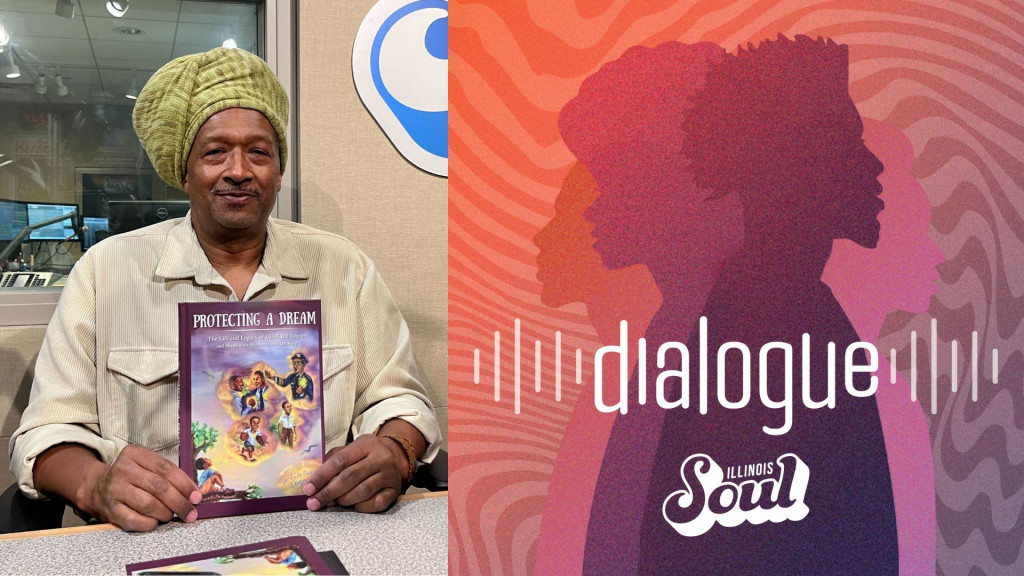
Gilo Kwesi Logan holds his book "Protecting A Dream" which is about his father, the first Black police chief in Evanston, Illinois. Reginald Hardwick/IPM News
Reginald Hardwick  00:06 (transcribed by Otter.ai)
From Illinois soul, this is Dialogue. I'm Reginald Hardwick, News and Public Affairs Director at Illinois Public Media. Dialogue is an exchange about culture straight from the soul.

Reginald Hardwick  00:26
When Dr Gilo Kwesi Logan walks in the room, he makes quite an impression. His long locks are wrapped in a colorful turban, and on this day, he is carrying a purple book called protecting a dream. The book is about an historic legacy in his hometown of Evanston. His father was the city's first black police chief and served as a personal bodyguard to civil rights icon Martin Luther King, Jr, during two trips to the home of Northwestern University in late February. The founder of soul creations, an arts and education organization, spoke to schools in Champaign Urbana, and Dr Logan had time to have a dialog with me about his family's legacy.

Reginald Hardwick  01:14
Dr Logan Tell me about your childhood in Evanston. Oh, wow.

Dr Gilo Kwesi Logan 01:21
My childhood in Evanston. You know, I consider Evanston to be my village. So, when I look back, I had a very deep village experience, meaning the community was strong, it was rich. Relationships were plentiful. You know, people knew one another, looked out for each other. I With Evanston being the northern suburb. You know, there's lots of resources there, and all these things are things that I took for granted growing up. I was oblivious to the privileges that I held. So, I would say I grew up very privileged. And you know, Evanston is known for its diversity, and I would say many people in our community call it drive by diversity, meaning you can see it when you're driving by. But it's not necessarily rooted in the reality, because as diverse as Evanston is, it's definitely grounded in racial segregation, which is socio economic segregation, and that's a big part of the experience of me growing up in Evanston. So, I grew up in broader Evanston, but I had a very kind of, you know, African American experience. The preschool I went to was all black. I always had the black teachers when I went to elementary school, middle school, and I socialized with a variety of different types of people, but there was definitely a groundedness in the black community. Growing up in Evanston,

Reginald Hardwick  02:47
you're a fifth generation Evanstonian. What can you tell me about your family's legacy there?

Dr Gilo Kwesi Logan  02:53
Well, my mom's side. We came to Evanston in around 1895 from Windsor, from St Catherine, Canada to Windsor in Canada, to Evanston, Illinois. Apparently, my family went north on the Underground Railroad, and after slavery ended, they came down back into the states. So on that line and lineage, I come from a long tradition of community servants, community activists, all the way from my great grandmother down to my grandparents, my mom, my father's side, we migrated to Evanston in about 1905 escaping the lynchings and the brutality in South Carolina from Greenwood, South Carolina, and my grandfather was the one to come up as a Child to Evanston, so they came with a strong tradition of social activism. On both sides of my family, there's a lot of entrepreneurship, some entrepreneurs in both sides of my family. That's part of the legacy. So, my family has contributed to a number of businesses, nonprofit organizations, and programs in Evanston, developing them, in addition to serving in them.

Reginald Hardwick  04:06
How did you get your arts and education organization, Soul creation started?

Dr Gilo Kwesi Logan  04:13
So, I've always had a penchant for music. It was never formally captured or trained when I was traveling overseas, that really exposed me to myself as an artist, and I got into that part, I got into touch with that part of myself as an artist. And I'm also an educator by trade, and I have a background in business. So, after traveling from overseas, while traveling, I saw the value and the power and the impact of culture and how central that is to the development of an identity, from an individual to a group to a whole race of people, and I felt. Felt that that was important to try to bring that forth to my own community, in terms of bringing some cultural programming that helps to develop a healthy identity in our young people. So, with that, I saw what was missing and developed soul creations as an arts and education agency. So soul is an acronym for spirit of universal love, essentially encapsulating the idea that, from my experience, at least as I traveled, I saw that there's something that connects us all in this spirit. It's deeper than religion, deeper than nationality, ethnicity. No one group owns it, and with that spirit, we have the power to create. We have the power to manifest, to bring goodness into the world. And it's all based on love. And I was with so many indigenous people who embodied that Spirit, who had that culture, who were caretakers of that love, and I was the recipient of that as I traveled throughout their communities. So soul is a spirit is an acronym for spirit of universal love. Then when I returned to the States, I combined. I triangulated my business with my travels, with my background in education, and founded soul creations in 1998.

Reginald Hardwick  06:22
so, tell me about your father. Who is Chief William Bill Logan.

Dr Gilo Kwesi Logan  06:27
That's my dad. That's my dad. You know, growing up, he was just dad. He was a very regular, nice, decent, kind human being. He was a nice, nice person. It's only as I grew older and interacted with the community that I began to see who he was in the eyes of other people. So, my father was the one, you know, and I'll get to his accomplishments in a moment. But despite all of his accomplishments, you know, he was there. He taught me to tie my shoes. He taught me how to, you know, cut the grass by showing me, you know, taught me how to do my chores and clean the bathroom, how to walk the dogs, how to feed the dogs, how to tie a tie, shoot a basketball, catch a baseball, you know, drive. I mean, he was there. He was present. So that, to me, that's who he is, that's who he was. He was just dad. He was my father, my greatest role model, my first, greatest role model of what it means to just be a decent human being and a kind person and a man to the world and to the community. My father is, and was the first African American lieutenant, Captain, Deputy Chief, and chief of police in Evanston, I would really say the first nonwhite, because there were no other people of color as well. He had the honor of serving as Dr King's bodyguard on two occasions when he came to Evanston. So, he so that's part of his accomplishments if you will. He's the co-founder of one of the founding members of noble, the National Organization of Black Law Enforcement Executives. This year marks the 50th year anniversary, so he's part of that group. A year and a half ago, he passed away at the age of 92 so right now, it's really you know about preserving his legacy and passing it on.

Reginald Hardwick  08:30
Did he share some of his experiences as a black police chief in what I assume is a mostly white and, in some parts, affluent area?

Dr Gilo Kwesi Logan  08:41
Yeah, you know, it's interesting. You know, one hand with what I was saying about my father, he never really brought that stuff home. You know, we didn't hear all those kinds of stories and things. He was just a regular. He was just dad. You know, when he came home, as he got older, he got more and more into storytelling as aspect of things. However, as I became an adult, yes, we've had lots of conversations about what it meant to navigate this dichotomy of being both black and a police officer. I found an article that he wrote back in the early 70s, and it really embodies the essence of WEB Du Bois concept, the dilemma of double consciousness. He didn't use those terms, but that's exactly what he was talking about, not from the standpoint of Dubois, who said, you know, we're both Africa, black and American, and kind of navigating that dichotomy. It was the dichotomy of being a police officer and being black. So being a black cop is what he said. So being, you know, in the community, you're black, so you're part of the community, but yet you're a cop, so people are looking at you a certain way, and then in the police department, you're a cop, so you're part of the fraternity, but yet you're black. So there. Looking at you in a certain way, and he talked about the challenges that that brought about, but the fact that he felt, and he did, he felt that he could navigate that, and you didn't have to succumb to the either or aspect of that, and you can be both black and be a cop and still maintain your identity and be true to who you see yourself to be.

Reginald Hardwick  10:31
You're listening to dialog from Illinois soul. I'm Reginald Hartwick. We're speaking with Dr Gilo Kwesi Logan, founder of soul creations, an arts and education organization based in Evanston. In February, he shared a book about his father, the first black police chief in his hometown. This was sound from Dr Martin Luther King, Jr, talking with reporters in 1966 after marching through Cicero, where he met lots of resistance.

Martin Luther King, Jr.  11:03
Oh, I've been hit so many times. I'm immune to it. How do you feel about this reception? Well, this is a terrible thing. I've been in many demonstrations all across the south, but I can say that I have never seen even in Mississippi and Alabama, mob as hostile and as hate filled as I've seen in Chicago, the March will go on anyway. Oh, very definitely. We can't stop tomorrow. Few minutes, you feel you're in a closed society. Dr King, here in the southwest side, oh yes, it's definitely a closed society, and we're going to make it an open society, and we feel that we have to do it this way in order to bring the evil out into the open.

Reginald Hardwick  11:48
What did he tell you about protecting Dr King?

Dr Gilo Kwesi Logan  11:51
So, his time protecting Dr King, he always stressed that it wasn't a big deal, really, because at that time, Dr King was not who we know him to be. Today. He's not held he wasn't held in the same regard. At that time, Dr King was one of the most hated men in the country, so his life was under threat, but he wasn't revered and honored and regarded in the way that we do today. So, from that standpoint, he was a regular guy, as my father would say, he was very nice. He had a good sense of humor. And my father and his partner, Hank white, they were friends, but they were also police officers. They shadowed him around everywhere he went, and they got him where he needed to go, when he needed to get there. They did so safely, but also, they were part of plugging him into the local black community in Evanston. So, it was a tremendous honor, though, for my father, he always spoke about it as a true honor and something that forever changed his life because of the second visit he had with Dr King. In this conversation they had, which the book is kind of centered around this conversation they had, in the advice that he gave my father that transformed his life at a very difficult time in his life, and he for the rest of his life, he always spoke about that. So, it was very impactful. He was very much honored. And he always also, in addition to talking about how nice of a gentleman Dr King was, he always remembered King telling him that, you know, in most places in the south, law enforcement are trying to arrest him, he said, but yet he comes north and comes to Evanston, and here law enforcement is protecting him and taking care of him and just how much he really, really appreciated that.

Reginald Hardwick  13:52
Why was Dr King there? I've always heard of the stories, of course, about Cicero and the problems he faced there. But why did he come to Evanston twice.

Dr Gilo Kwesi Logan  14:03
Both occasions, the focus was on discrimination in housing. So, King came because he spoke in Evanston, he spoke in other surrounding suburbs, but he was really focused on, at that time, on the racial discrimination in housing.

Reginald Hardwick  14:22
Why did you write protecting the dream?

Dr Gilo Kwesi Logan  14:26
You know, I wrote protecting a dream. I didn't know this is what it was going to become. So, I thought it was going to be an adult's book and many other things, but this is what it turned out to be. But I wrote it, and I wrote it now because and I wrote it for young people, because many of our young people are faced with just despondency, you know, despair, the disconnect. It is depressed, isolated, lonely, you know, lacking role models. And I wanted to capture my father's life and legacy as an example, as an example, as in a story form, not a history book, but in as a story, to try to inspire and move our young people in a positive direction. So, I was really inspired to write, plus I have a child. My youngest son is the age that this book is targeting, fourth through eighth grade. So that was another inspiration. It was also part of capturing and preserving his life and his legacy. But it was really about bringing this message home to our young people, who I feel are in such need for it right now, and especially given the times that we're living in, to have that type of positive inspiration, I think is invaluable. And in capturing this story, it's also speaks to it's a form of resistance against some of the forces that be who are trying to silence our stories and silence our voices and trying to rewrite history. This book is a form of resistance against that.

Reginald Hardwick  16:15
you're listening to dialog from Illinois soul. I'm Reginald Hartwick, and we're speaking with Dr Gilo Kwesi Logan, founder of soul creations, an arts and education organization based in Evanston, in February, he shared a book about his father, the first black police chief in his hometown with local schools. I asked Dr Logan to read a passage from the book.

Dr Gilo Kwesi Logan  16:38
This is Chapter nine in his own words. So, these are the words from my father towards the end of the book. You know, the kids and the readers have heard me paraphrasing. They've heard quotes and testimonies, but these are my father's own words. He said. Dr King asked a question that stayed with me, what are you doing for others? He taught me that when we believe in ourselves and take action to help others, we can make our world better. Dr King also said faith is taking the first step even when you don't see the whole staircase. That means you don't have to know every step ahead. You just have to be brave enough to start. It's not enough to hold on to your dream. You must live it out. Dreams grow when you work hard to make them real, and when you take a step toward your dream, you inspire others to do the same when you help someone else with decency and courage. You're not just protecting your dream. You're protecting you're helping make their dreams come true too. Protecting your dreams takes resilience when life gets hard and takes decency when you deal with others. I have dedicated my life to helping people and making my community strong. Now it's your turn to protect your dream by believing in yourself and working hard to make it real and remember dreams aren't just for you. They're meant to be shared. When you lift someone else, you become part of their dream too. That's how we build a better world together. Don't forget, don't forget what Dr King once told me, you must be prepared, and no matter what happens, like the elders in the black community often say, Keep on. Keeping on. That means don't quit. Keep moving forward, even when things get tough.

Reginald Hardwick  19:02
I know you're in Champaign Urbana this week that we're taping this, and you've spoken to a few local schools. What is the reaction from young people,

Dr Gilo Kwesi Logan  19:12
by young people? It's been very favorable, very positive. Lots of excitement, lots of awe. You know, I wrote it as an intergenerational children's book. So, it's geared for children, but it's meant to be read and engaged with adults, so that we can have the conversations with our young people that typically we're not having, and then we can pass because everyone has a story. We all come from a legacy. So, this isn't just about my father's life and his legacy. It's about how we can use this as a tool and a vehicle for other people, kind of really telling their stories and preserving their legacy. So, with that, the adults are super excited about the book. Also, it's an easy read for adults. So, it's something that they can grasp in relatively short time. But I've been really moved and encouraged by the excitement of our young people, over the story, over the book, the illustrations in the book, the quest, the discussion questions that are in the book, the fact that you can kind of feel the print on the pages like kids notice that kind of stuff. And as we've gone to Leo elementary school this morning, we were at Kenwood elementary school this afternoon, to me, they're a typical example, you know, of just the excitement that kids have over meeting an author being able to hold a living history, living history in their hands, because the book is told as a story, as opposed to telling history. And I think children, young people, are really resonating with that, and they love how colorful it is and it's a multi-sensory, multi-dimensional type of book. And I find that the excitement that that triggers in kids has been very motivating for me as well.

Reginald Hardwick  21:06
You know, in some places, some black and brown communities, law enforcement can be triggering because they've been disempowered, or maybe their parents felt disempowered by law enforcement. Has this helped, you know, kind of bridge the gap, or give a new perspective. Or how do you deal with that? If, or do we ever people, or do ever people push back and say, why this book? Or, you know, yes,

Dr Gilo Kwesi Logan  21:35
so, one of the other purposes of the book is to try to humanize law enforcement. You know, I've straddled that fence myself. I'm African Americans. I've had certain experiences with law enforcement from that standpoint, but yet, I come from a family of law enforcement, so I can understand both worlds. And through this book, part of what I try to do is to humanize law enforcement. So, at Kenwood elementary school, we had chief Tyler there, so he and I, both kind of CO presented this morning at Leo. We had one of the sergeants there. So, in Evanston, this Saturday, we have a books and badges program with the police chief there. So, part of it is also partnering with law enforcement to try to humanize law enforcement to kids, because before they put on their uniforms, they're people. And I think from the assemblies and the programs that we had today, kids are able to see that. So, the book is also designed to try to bridge, help bridge this gap between law enforcement and the community, particularly black and brown communities. And there's discussion so I'm also as a consultant. I've done a lot of work with law enforcement and dealing with the concepts of community policing, and helping law enforcement understand the communities, the identity that communities hold, and how to better serve those communities, and vice versa, how the communities need to better understand law enforcement and the identity of law enforcement officers and how to kind of navigate this gap in this chasm. So, I do a lot of restorative work trying to restore some of the harm and the damage that's been done to repair that. And I see that this book is also a tool that's not the purpose for it, but it's also a tool for facilitating some of those kinds of conversations, to disarm, if you will. No pun intended on it, but to just disarm everyone of the fear of the other, the community, the fear they have of law enforcement, law enforcement, the fear they have of the community. And I'm inspired. I'm very appreciative to see how this is helping to bridge that gap.

Reginald Hardwick  23:46
So many people in this moment, and you mentioned it earlier, feel disempowered when they have leaders literally trying to dismiss or dismantle our history. What lesson from your father. Do you think would meet this moment?

Dr Gilo Kwesi Logan  24:06
Wow. You know, I think, okay, I'll say it, there's a lot, so I'll say, I'll tell a short story to illustrate one. So, when I was in sixth grade, it was like December 23 It was cold outside, like six o'clock in the evening, so it was dark out, and I'm in the driveway shoveling snow and chipping ice away so I can practice my layups going to the basketball room. My father pulls in the garage with his car. Stand to the side and wait for him to finish. Like, come on, Pops, hurry up. You interfere with my practice. He parks the car, gets out, walks past me. I'm like, Hey, pops says, hey. Takes a few more steps. He stops. He turns around. He looks at me, and he said, Son, if you put. Half as much energy into your sports, if you put half as much energy into your academics as you do your sports, you would be a genius. And I heard that. I just kind of brushed it off. And you know, what does he know? So, I go back to shoot my layups and practice in my baskets, and lo and behold, decades later, that moment was like a flashback, and I recalled that, and I recalled that advice, and it helped me get through college. So I say that to say that I feel that concept of transforming energy is something that's needed today because we are inundated with so much negativity the political climate in which we're operating in, there's a lot of issues that we're faced with, and a lot of people are just overwhelmed by the chaos, the confusion, the negativity that they're faced with in their life. And to me, that story speaks to how can we take that and transform that into something that's positive? I believe soul has the ability to do that. So, when we talk about soul brother and soul sister and soul food or but it's really about there's an essence. I believe there's a spirit that allows us to transform ugliness and pain into something that that's beautiful. And right now, there's a lot of ugliness. A lot of people are in pain, and I think it's really having that faith that we have the capability to transform that into something that's powerful. Now we can't transform and change everything that we would like to, but it's all about playing our part, you know, and playing our role. And the other part, I would say, is keep on, keeping on, you know, we got to. We need to remember that as hard as it is right now, we're not the first, you know. We have to remember our ancestors. We need to remember our elders, what they've been through, what they've survived, what they have sacrificed for to give us that strength within us to be able to endure a lot of the challenges that we're faced with today. So, I think to keep on, keeping on, I think transforming energy is very relevant. And lastly, I'll say that, you know, my father's life is, you know, we say protecting a dream as a title of the book, but really, his life was living out the dream. And by that, I mean what he believed in. He lived it out. And it's not just hoping, praying, and waiting, it's we have to do the work. And I see that he did that, and a lot of what inspired him was one of the pieces of advice Dr King gave my father, was, you have to be prepared. You have to be prepared. We have to do the work. And I think a lot of us want things that we're not necessarily doing the work to acquire them. I think we want a better society to live in. We want more righteousness, justice, peace, love, and harmony. But what are we doing to protect that? What are we doing to preserve that? What are we doing to perpetuate that? And I feel that that notion of being prepared, always doing the work, and preparing ourselves, even though we don't know what we might be faced with and what the outcomes might be, but having faith that we can do that with and with positive outcomes. But we must be prepared, so we have to

Reginald Hardwick  28:42
do the work. Thank you for coming to Illinois, soul to speak with us today.

Dr Gilo Kwesi Logan 28:47
Thank you. It's been an honor. Thank you so much.

Reginald Hardwick  28:59
That was author, Dr Gilo Kwesi Logan, founder of soul creations, an arts and education organization, he shared his book, protecting a dream with local students in Champaign in February. If you'd like to learn more, go to protecting a dream.com there are links to the book as well as services like workshops and restorative peace circles and trainings.

Reginald Hardwick  29:30
Next on Dialogue, we'll hear from the front runners of the Democratic US Senate race in Illinois, candidates Kelly, Krishnamoorthi and Stratton speak at an NAACP forum in Champaign, you'll hear from a discussion that I moderated next on Dialogue.
When Dr. Gilo Kwesi Logan walks in the room, he makes quite a presence. His long locks are wrapped in a colorful turban. And on this day, he is carrying a purple book called Protecting A Dream. It's about an historic legacy in his hometown of Evanston. His father was the city's first Black police chief and a personal bodyguard to civil rights icon Martin Luther King, Jr.
In February 2026, Dr. Logan, the founder of SOUL Creations, an arts-in-education organization spoke to schools in Champaign-Urbana and then, he came to Illinois Public Media to speak his family's legacy.