He traveled for justice and found tragedy: unpacking the death of Antonio Mays in Seattle’s CHOP
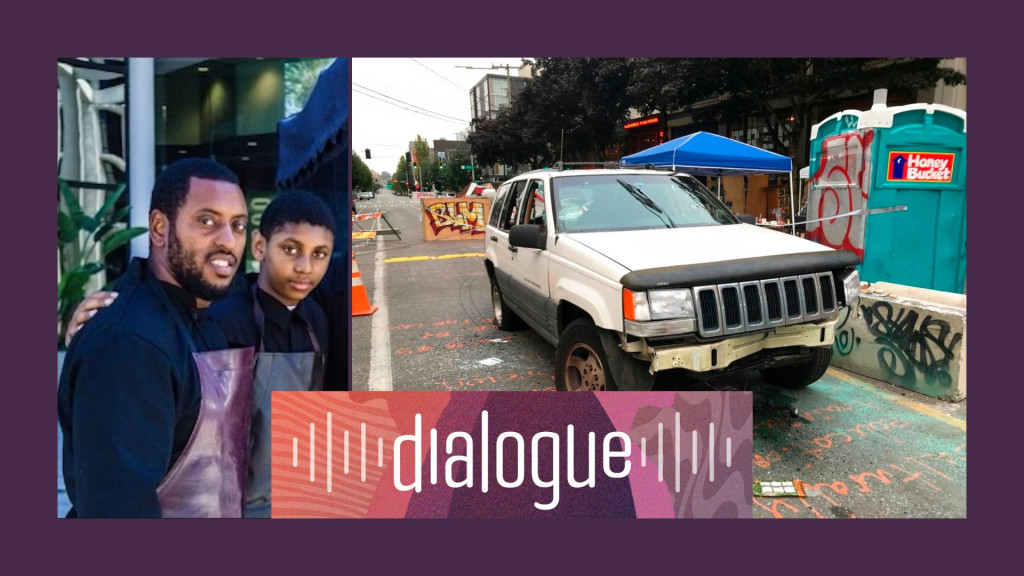
Left: Antonio Mays Sr., Antonio Mays, Jr. Right: a car sits in the Capitol Hill Organized Protest zone following a shooting in Seattle early Monday, June 29, 2020. At least one man was killed and another was wounded early Monday morning when they were shot in the protest area known as CHOP, after driving the vehicle into the area. Illinois Public Media, AP Photo/Aron Ranen
// This is a machine generated transcript. Please report any transcription errors to will-help@illinois.edu.

[00:00:00]
Illinois Public Media: From your first cup of coffee to the arrival of the storm, Illinois Public Media keeps you ahead of the weather. Start your morning with meteorologist Andrew Pritchard preparing you for the day in East Central Illinois. And when severe weather breaks, stay with the team honored by the Illinois News Broadcasters Association for best breaking news. For forecast and award-winning storm coverage, tune into Illinois Soul FM 101.1 or IPMnewsroom.org. This is Illinois Public Media.

From Illinois Soul, this is Dialogue. Dialogue is an exchange about culture straight from the soul. I'm Reginald Hardwick.

Six years ago, the country was in the midst of a racial reckoning after Minneapolis police murdered George Floyd.

[00:01:06]
Speaker 1: Protesters of all races carry signs that read Black Lives Matter and I can't breathe while calling out the names of Black men and women who lost their lives due to police brutality. 16-year-old Nykila Henderson says she used social media to put the march together and she wants demonstrators to remain consistent.

[00:01:24]
Speaker 2: I hope this don't just not no one week thing. We stay mad for a week and forget about this. Let's keep going. Let's keep, let's keep the battle going. They want to keep killing us, we're gonna keep going. That's — that's our problem. We got to be consistent. Black folks

[00:01:36]
Speaker 3: are mad. We're mad. We're mad. And it's a contained — right now, even though this is peaceful, this is a contained anger, but there's always anger under the surface for this. We have had enough. It's 400 years enough. Finally, when is it enough?

[00:01:50]
Reginald Hardwick: In California, a Black teenager named Antonio May Jr. decided to join the protest. He left for Seattle in the summer of 2020. Within a week of arriving there, he was dead. What happened to him is the focus of a new podcast series from NPR's Embedded team called We Keep Us Safe. Joining us is co-host Will James of NPR member station KUOW. Welcome to Dialogue, Will.

[00:02:15]
Will James: Thanks so much for having me, Reginald. I, I appreciate it.

[00:02:19]
Reginald Hardwick: What can you tell us about Antonio May Junior and his family life in California?

[00:02:25]
Will James: He was 16 years old. He was — he grew up kind of steeped in the story of Black history and the struggle for Black liberation. His father made a point to, you know, impart on his son this history and what it meant to be Black in America. And so when the racial justice movement of 2020 broke out, Antonio was immediately sort of invested in it. He and his dad would discuss the news, discuss the the protests that were going on in their, in their, you know, home community in Southern California, but also all over the country.

And he, you know, this is a big factor in why he ended up, you know, leaving home without his dad's permission and traveling 1,000 miles to Seattle, a city where by all accounts he had never been before, to join a very unique and unusual protest that was unfolding here.

[00:03:35]
Reginald Hardwick: Right, there were protests all over the country, including there in Southern California. Do you, do you know why, what prompted him to specifically go to Seattle?

[00:03:46]
Will James: We don't know. He, he never said in, in the note he left for his dad when he left home, but we can surmise that Seattle — the the protests unfolding in Seattle looked very different from the protests happening almost everywhere else in the country. Here in Seattle, there were, there were lots of marches, just like there were in many cities. But here, protesters actually came to occupy several square blocks of the city. They set up tents, they started to create a kind of static community here, and this happened after a really intense standoff with police that led police to end up retreating and and sort of vacating one of their precincts.

So Seattle was getting a lot of attention for this occupied protest known as CHOP. And we know that Antonio and his dad discussed what was happening in Seattle, so it's, it's, you know, it's reasonable to assume that Antonio was drawn here by the unique form that the protest took here.

[00:04:56]
Reginald Hardwick: Yeah, tell me a little bit more about the neighborhood where he went.

[00:05:01]
Will James: Capitol Hill in Seattle is a predominantly white, young — it's like the LGBTQ community in Seattle, the LGBTQ neighborhood, a lot of young activist energy here, a lot of creative people and artists. And so it it sort of makes sense that the the energy of the movement that summer would would converge in that neighborhood.

[00:05:32]
Reginald Hardwick: I listened to episode one last night and you all have gathered sound from the moments when it's believed that Antonio was shot. Can you tell me a little bit about that?

[00:05:44]
Will James: Yeah, so on the night Antonio was killed, we know that he was inside a stolen Jeep that was driving around Chop, and protesters interpreted this as an attack, some kind of mass shooting or car attack on Chop. The occupation at that point had formed its own volunteer security force because they were worried about attacks, political attacks from the outside. And so a chain of events unfolded that led to the Jeep crashing, and people within [Chop] opening fire on the Jeep. And Antonio Mays Junior was killed in that gunfire.

What's unusual about this case is that so many people were live streaming at CHOP that even in the early hours of the morning when Antonio was killed, there are multiple videos of the events leading up to that shooting, the aftermath of the shooting, and even the shooting itself. And so that is that is one of the factors that led us to believe that even 6 years later, we might be able to shake loose some new information in this case and even maybe get some answers for Antonio's dad.

[00:07:08]
Reginald Hardwick: And live streaming — and you normally think, OK, well there's the evidence right there in front of you, but I was also listening — immediately, people also began to do what police normally — you know, ask people not to do — is disturb the scene. Tell us about that.

[00:07:26]
Will James: Yes. Immediately after Antonio was killed, people, volunteers on the ground tried to save his life. They, they tried to deliver medical care to him, they tried to rush him to, to an ambulance. But they also started to rifle through the Jeep, and at least one person on the ground started to pick up evidence. There, there's someone caught on camera saying, pick up my shells, or I'm gonna pick up my shells.

And so one of the reasons we can, we can guess that this case remains unsolved all these years later is that people at the scene cleaned up, you know, they — there was an effort to maintain silence around this shooting. And that was one of the challenges in investigating this case, is that some of that silence, that impulse towards silence — silence remains, you know, all these years later.

[00:08:28]
Reginald Hardwick: What does law enforcement have to say about this case?

[00:08:32]
Will James: Seattle police say that they have been investigating this case for the past 6 years, that the case remains open, active, ongoing. However, Antonio's dad says that he hasn't gotten an update from Seattle police since 2020, since shortly after his son was killed.

[00:08:53]
Antonio May Sr.: The sheriff came to my house, knocked on my door. Told me the bad news. I talked to the detective, the chief of police at that time called me once or twice. I said, I need some arrests made. I need justice for my son. We're working on that. We got some leads we're gonna follow up on. You know, this could take a while. But we're working on it.

[00:09:22]
Will James: The, the Seattle Police Department has been almost entirely silent on, you know, how far their investigation has gotten, to what extent they're still actively investigating it and why it remains unsolved when, you know, there's evidence like these videos just sitting out there.

[00:09:43]
Reginald Hardwick: How many people did you talk to and were they all very forthcoming?

[00:09:48]
Will James: We talked to nearly 100 people for this podcast. And we had a hunch that all these years later, enough time had passed that that some people might be more willing to talk or to reflect on what happened at CHOP, and that was true, some people were. But it was also interesting to find that all these years later, there are still a lot of people who participated in CHOP, who participated in that particular protest, who are very invested in, you know, protecting themselves, protecting the reputation of that protest. In in some cases telling stories that that sort of blame Antonio for his own death.

So there was a lot to cut through in in in in our attempt to get to the truth of this case. There was a lot of sort of protective impulses that people had to be able to look back on on what they did that summer and feel good about it, if that makes sense.

[00:11:01]
Reginald Hardwick: We talked a little bit about what was in episode one. What's forthcoming in the concurrent episodes?

[00:11:09]
Will James: In episodes 2 and 3, we kind of look back on CHOP itself and some of the factors that led that occupation to take the form that it did, and kind of culminate in this this dangerous environment that Antonio ultimately arrived in. Episode 4, we take a close look at Antonio himself and what we've learned about this this teenager. And then for the rest of the series, we kind of unload, you know, we, we, we unpack what we've learned about this shooting and and the findings that we've had.

And, you know, we've managed to get some significant answers about what happened to Antonio that night. It turns out that a lot of the narratives that protesters have been telling for six years have not been true. And I'm really, really excited for for listeners to to hear this because I think I think there is something worth understanding about how this very idealistic movement turned into something else, something that turned out to be very dangerous for a 16-year-old Black kid, one of the very people who presumably this movement was intended to protect.

[00:12:36]
Reginald Hardwick: We've been speaking with Will James of NPR member station KUOW. He's the co-host of a new podcast from NPR's Embedded team called We Keep Us Safe. Will, thanks for joining us.
In the summer of 2020, 16-year-old Antonio Mays Jr. left his California home to participate in the racial justice movement at the Capitol Hill Occupied Protest (CHOP) in Seattle. Within a week of arriving in the police-free neighborhood, the teenager was tragically killed when volunteer security forces opened fire on a crashed Jeep he was inside. The new podcast We Keep Us Safe, co-hosted by Will James, investigates the chaotic events of that night, revealing how bystanders tampered with the scene and maintained a protective silence in the aftermath. Six years later, the series aims to cut through the false narratives built by activists to expose the facts of this unsolved murder and provide overdue answers for Antonio's grieving father.