Illinois Public Media is helping launch a new teen video podcast. Here’s how to sign up.
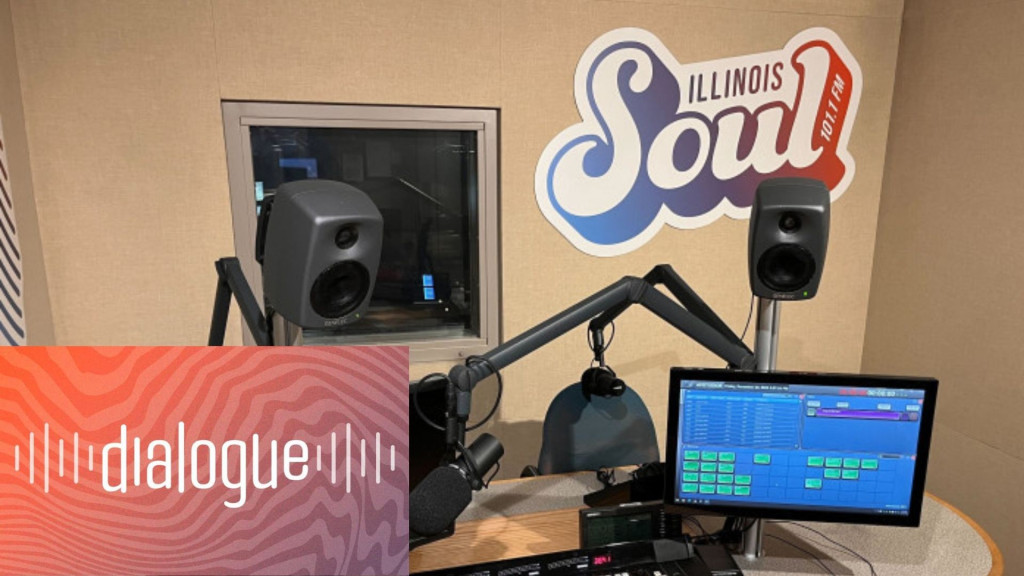
Illinois Soul studio at Illinois Public Media Reginald Hardwick/IPM News
Reginald Hardwick
You're listening to Dialogue from Illinois. Soul. Dialogue is an exchange about culture straight from the soul. I'm Reginald Hardwick, news and public affairs director at Illinois public media.

Kimberly Schofield
And I'm Kimberly Schofield, Morning Edition host at Illinois public media reg. Do you remember the 1990s talk show era?

Reginald Hardwick
Do I? Yes. I fondly remember Oprah, Phil Donahue, Montel Williams and more.

Clips from Oprah Winfrey, Donahue, Montel Williams, Jerry Springer, and Rolanda Watts talk shows in the 1990’s.

Reginald Hardwick
A few of those talk shows for a while were taped about two hours up the road in Chicago. Donahue was taped at WGN until he moved to New York City. Jenny Jones and Jerry Springer were taped at the NBC Tower, and most notably, Oprah Winfrey went from a local talk show host at ABC 7 to a national phenomenon, and in the 1990s she was unstoppable.

Kimberly Schofield
Yes, she was and in the same decade, Black Entertainment Television was hitting its prime, founded by University of Illinois alums Robert and Sheila Johnson, the national cable network may have been best known for bringing Black music videos into homes across the country. Music videos at the predominant cable network of the day, MTV refused to play.

Reginald Hardwick
BET was later sold to Viacom, which is now Paramount sky dance, the parent company of CBS. The sale of BET was worth more than $2 billion and helped make the Johnsons, now divorced both billionaires, Sheila Johnson has turned her share of the profit to become a business mogul. She founded salamander Hotels and Resorts. Johnson holds a majority stake in the sports holding company that owns the Washington Capitals NHL team, Washington Wizards, NBA team and Washington mystics, WNBA team. She is also a film executive producer.

Kimberly Schofield
Sheila is also a philanthropist and ambassador for care, a humanitarian agency fighting poverty around the world, and she loves children in her book, Walk Through Fire, A Memoir of Love, Loss, and Triumph. She talks about being a classic violinist who created school programs to help children embrace music, and she created BET's Teen Summit program. As she writes in her book, my ideas for Teen Summit was a one-hour show that would feature real students, not actors, talking about the issues affecting their lives. I wanted to find smart kids who were curious about the world and unafraid to express their opinions on serious subjects.

Reginald Hardwick
The program was groundbreaking. Black teens talking about teen pregnancy, family relationships, and drug use in a dignified way. They interviewed then First Lady Hillary Rodham Clinton,

BET Teen Summit 1990’s clip
Welcome back to Teen Summit. We're honored to have First Lady Hillary Rodham Clinton with us. We've come here to speak to the posse. Now, I know you guys got some questions. Have you ever thought about becoming president or maybe running? No, I haven't, but I'd encourage you to think so.

Reginald Hardwick
Teen Summit was at the front seat of the explosive growth of hip hop in the 1990s musical acts such as the late Tupac Shakur, the late Notorious BIG as well as artists who are still with us, like Jay Z and Arrested Development stopped by to share their rhymes and their perspectives on the music industry.

BET Teen Summit 1990’s clip

Reginald Hardwick
Kimberly, there's not a week that goes by that I see an Instagram video with people nostalgic for teen Summit, with people sharing some of the clips online.

BET Teen Summit 1990’s clip

Kimberly Schofield
Nearly 30 years later, Teen Summit is coming back Illinois Public Media, along with the University of Illinois Urbana-Champaign has created Teen Summit 2.0 The Remix. And thanks to generous gifts from Sheila Johnson and the Illinois General Assembly, we are creating a new generation of the beloved show. Joining us now to talk about it is Dr Malaika McKee, professor at the University of Illinois, Urbana-Champaign, College of Education and Reginald is going to offer some perspectives from the Illinois public media side. Dr McKee, why is it important to bring back Teen Summit now?

Malaika McKee
Wow, great question. You know, in the 80s, we had the benefit of television being a Shibboleth for everybody. I don't know if you remember, but when I came home after school, and this is high school, 330 it was Yo MTV Raps, all of us kind of coalesced around a television screen. We were doing the Roger Rabbit [dance], we were doing the Cabbage Patch [dance] we were looking for Fab Freddy to tell us what was cool and where to go, BET that was on the MTV side. On the BET side was Teen Summit. And what was distinctive about teen summit was not only was it was the cool music, it was also the cool ideas, the things that really mattered to us as political actors, as teens. Now, of course, we didn't call ourselves that, but we were like, Yeah, we're hip. We know what's going on in the world. And you go to Teen Summit, you see salt and pepper, and then you get an issue, right? Kind of all works that Shibboleth is missing now, and I know that teens are looking for it because they're atomized all over these mean internet streets.

Kimberly Schofield
And what will the show consist of Teen Summit, 2.0 The Remix?

Malaika McKee
So, The Remix is really honoring three important themes that I think we want the audience to know. That one, we're not going away from our history. Etymologically, this is all based on the black Afrofuturist ideas of Tony Regusters and Ms. Sheila Johnson. These were two people who decided that it was not enough to entertain. We also had to edutain, and we had to edutain in a way that honored the culture and meaning, the music, the esthetics, but also honor the things that plague us and challenge us to do good democratic work as African American citizens. So, we're not getting away from that in terms of its etymology, but we're doing the remix. So, The Remix is that in this arena where debate now can get you killed because we have not taught those important civic skills of how do you disagree, and how do you disagree well, with facts, and how do you keep your affective emotions in check? We want to be that place where teens hone that critical thinking skill to do the debate, but then to honor that metacognitive arc, to say we still want the culture, which is the musicology. So that's still there. The hip hop will, as we say, we don't stop. We won't stop. And then also integrating social media, AI and podcast, how do you feel affectively? And let's be able to talk about that in ways that move us towards pro-social behavior.

Kimberly Schofield
Reginald, is this just a TV program?

Reginald Hardwick
It is the next generation of media. So, we will tape it in TV and our podcast studios here at Illinois Public Media, but we will distribute it, you know, on television, maybe later this summer. But also take the audio strip that put it on Illinois Seoul, and then, of course, offer it on video via YouTube, and then we have a social media component. We have an excellent producer who's in town, Walt B, of The Safe Haven, and he's working with all of the summiteers, the young people who will be participating to take the videos that we shoot in the studio and. In addition, some other ones, and make them vertical videos. So, for folks that want to see, you know, the short videos on Instagram or TikTok or Twitch, or wherever. He can meet them where they're at. And then for other people that just want to watch on YouTube, other people want to watch of a certain generation on television, good old television, or listen here on Illinois Soul, it will be on various platforms.

Kimberly Schofield
How did Dr Sheila Johnson become a part of this effort?

Malaika McKee
Then we asked her… I mean, here, okay, so here's the funny story. So, Reginald and I thought initially we were just gonna do a very modest podcast where we asked Urbana High school students to come on and, like, talk about their feelings, and we would help them with media. Reginald always been schooling me on just the illustrious history of PBS. So, he's been like my PBS docent. And he's like, girl, you do know, this is the oldest station in the country you have to recognize, yeah.’ So, we, we had small dreams, and then, in the words of Sheila E, we got big dreams and a big brown Mercedes sedan.’

And we, she, he said, guess who's coming?’ And I'm like, as in the Sheila Johnson. He was like,‘yeah, she's coming. She's an alumni.’ I'm like, ‘I didn't know.’ And so, as we were talking and thinking about, what would it mean to honor her legacy and her presence and just her entrepreneurship, I mean, the woman is the proverbial badass, as we like to say, she's done everything. And I mean, you have to recognize and salute that. So, we read her book, we did our homework, and we were like, What? What is the thing that would just seem to resonate with her body of ideas and where she might go? Where's Teen Summit? What if we just asked

Kimberly Schofield
Dr McKee, if parents or teens listening want to take part, how do they do that?

Malaika McKee
Go online to TeenSummit2.net and they fill out an application, and it's free. We're asking for just a snapshot of you so we can see your best self. We're asking for you to answer some simple questions about who you are, what's your voice. We're also paying you. We're paying teens $20 an hour. Minimum wage is 15.17, so we're saying hey for your time, because we know a lot of our teens in our community have to work, so we want to honor them, giving us their time to do this really important civic work. And we're really hoping that in this inaugural class that it stimulates a lot of teen interest to really go forward and multiply.

Kimberly Schofield
Yeah, after entering, what is the process like?

Malaika McKee
So, do you mean like, what will they experience in our world?

Kimberly Schofield
Yes, once they enter, I assume they'll hear back if they are chosen, yes.

Malaika McKee
So, we want them to feel first special. We think that no matter what your academic ability, we're not asking for a transcript. We know that for a lot of teens, high school is not fun, and we want this to be the place where you feel authentically yourself and you can meet other teens who have the same concerns as you and that you are in a community of folks who honor going through this metacognitive journey of developing your civic voice and also honoring the culture. We don't want to deny that music is so important, and visual art and fashion and social media are an important part of being a teen. I don't know about you, but when I was a teen on my wall, I was convinced that Prince was my man, and that all of life would be just so fabulous once I connected with that magical person past Purple Rain. By the way, for all you real prince fans out there, but I know that that teenage sensibility is still there, and it's there for a really important reason. Neurocognitively, teen brains are still developing, and that ideation around the culture and art is something that we have to respect. And so, it's an integral part of the show.

Kimberly Schofield
Reginald, who are the kids who you're looking for?

Reginald Hardwick
We're looking for students 15 to 19 years old from across the Champaign County region. And we're looking for students who have things to say. You know, as we talked about in the lead up to this from Sheila Johnson's book, she wanted really inquisitive, intelligent teens who have an opinion on today's issues, and they are going to between Dr. McKee and the other team members kind of lead them in talking about researching and how to really correspond and talk with each other, even debate a little bit about some of the issues of today. Also, it's important to note, while the original teen summit was on Black Entertainment Television and featured predominantly Black teens, this will be open to all. Young people in Champaign County. So regardless of culture, we do want to have a real sampling of the community that's doing here. So, we're, you know, we're hoping to hear from and from rural folks. We're hoping to hear from folks on the north side of Champaign. We're hoping to hear from Rantoul, from Urbana, folks who may be tied to the University of Illinois, but folks who are in the community and have no ties to the University of Illinois, all economic backgrounds, athletes, you know, any kind of you know, nerds like myself, who are in journalism and speech class in high school. You know, we want to hear from artists. We want to hear from everyone. So go to TeenSummit2.net and sign up today. Make sure you have your parents with you, because there are some parental type things and waivers and that sort of thing. So, because we are putting this out into the world. And, you know, there are a lot of safety guidelines to look through.

Malaika McKee
One of the things that Ms. Johnson wanted us to really do was to have the show look like America. She and I thought that that was kind of a really interesting kind of evolution from BET to what does it mean to look like America, right? And she said, ‘I want the farmer's daughter from Danville. I want the dishwasher’s kid from Champaign. I want the professor's kid from Urbana. I want all of those people to know if we're going to have something called Teen Summit. It better look like what America is going to look like.’ And I was, was really, really inspired by that. So, I'm really glad that you brought that up. We really, this is not this is the America that I think we celebrate. You know, when we look at that dollar bill and it says, E Pluribus in the Unum, all for one and one for all, in terms of who we are as a, as a, as a very fragile experiment in democracy, it takes a lot of work to do good governance and good democracy, and it means that everybody's got a voice at the table. And I think Sheila's vision around what that looks like on the youth education side, is, is, is what inspires us and is motivating.

Kimberly Schofield
Yeah, teens in and around Champaign County who have something to say, yeah, which I'm sure a lot of them do. When will this air and what are the long term hopes for its distribution?

Reginald Hardwick
Good question. Kimberly, we will tape this program Saturdays in March and April. There will be some postproduction involved, and that means adding video elements, graphics, etc., and polishing up the production for television. So, it's likely we won't see it air on WILL-TV until late spring or summer. Since you don't have to deal with polishing up video for audio versions, we will probably air that on Illinois Soul FM 101.1 in place of dialog in a few weeks after the production finishes. And we know this is an on-demand society, so we are preparing Teen Summit 2.0 The Remix to be released on YouTube and the PBS app. Now we also know teenagers cannot wait to share, especially on social media, so our digital producer Walt B and the summit tears, the young participants will work together to edit vertical videos and release them when they're ready. That will give people some insight into what we're doing, and build buzz around Teen Summit 2.0 The Remix, so people will watch the longer program when it is ready to air. Now, Kimberly, the long-term goal for us here at Illinois public media and the University of Illinois Urbana-Champaign is creating a model that other public media organizations and communities may want to replicate and make a dent in the algorithmic videos that constantly display angertainment and bad behavior. Ms. Johnson and the University of Illinois Alumni Association, as well as the Black delegation of the Illinois General Assembly contributed gifts totaling more than a half million dollars so that we could create this pilot program. That money partially goes to capital for studio upgrades, and it goes to people power, the educators who will coach the teens, paying the young people for their time and for production teams here at IPM to make all of this happen. They invested in hopes of seeing this replicated in communities across the state and later across the country. We're also talking about Sheila Johnson's legacy and what she began at BET nearly 40 years ago, now applying to all of America's teens and giving them a voice on local public media.

Malaika McKee
I'm really glad though, that you brought up the algorithms of anger, because that's what's out there. There's a lot of rage bait, and it sells, and it's not helping us. It's got a lot of people on these internet streets being mad and kind of as in the words of Barack Obama popping off. You know, they are losing it on social media and not able to find any pro social examples of, how do we do this? And what I like about the PBS tradition is. And again, Reginald has been my best teacher on this. He's like, look, we did something innovative back in the 70s. We decided that TV could become America's classroom, and I think it's time to catch that title again. I think it's time to really operationalize that in some new ways that honors the new AI transformations that we've got going on, which is a part of the show, but I'll leave that as a cliffhanger, and also just to the asking people to model. How do we do good dialog? And that's real, not, you know, taking the positions that we tend to see on TV, where people just get rooted in what we call an epistemic bubble, where I'm not moving from my position. I'm stuck in my thing and like I shall not to be moved right? But what we're saying here through this unique pedagogy of what we're calling it's actually, it's nothing new. It's very much rooted in hip hop pedagogy, which is flipping the script. We all know that term, right? But we're asking these teens, through the discursive technique of debate, to be able to flip the script in their technique, so that they can burst those epistemic bubbles and actually learn how to do perspective taking that we think is so critical to reclaiming America's classroom, and that's the innovation that PBS does, and that's what we need to fund. So hey, any money out there, please give us some we're still building as we're climbing.

Kimberly Schofield
Is there a deadline for the application for the teens and their parents to complete?

Malaika McKee
February 2.

Kimberly Schofield
Thank you, Reginald and Dr Malaika McKee, professor at the University of Illinois, Urbana Champaign, College of Education. If you want to know more about Teen Summit, go to TeenSummit2.net. That's TeenSummit2.net.
Teen Summit 2.0, The Remix
Illinois Public Media and the University of Illinois Urbana-Champaign are looking for teenagers between the ages of 15 and 19 residing in East Central Illinois. Students chosen for the position will be paid $20 per hour. If interested, click here to apply with a brief questionnaire and parental documents.
Thirty years ago, Black Entertainment Television launched a groundbreaking program called Teen Summit. It was the brainchild of University of Illinois alum Sheila Johnson. The weekly hour-long program featured teens talking about youth pregnancy, family relationships, and other challenges in a dignified way. The program also featured interviews from athletes, artists, and former First Lady Hillary Rodham Clinton. After selling BET to Viacom, Johnson became the first Black woman billionaire in the U.S. She owns resorts and several pro-sports teams.
Decades after the original Teen Summit, Johnson is giving her blessing and generosity for Illinois Public Media and the University of Illinois Urbana-Champaign to launch Teen Summit 2.0 The Remix.
IPM’s Kimberly Schofield spoke with Dr. Malaika McKee, a professor at the University of Illinois College of Education, and Reginald Hardwick, News Director at Illinois Public Media, about this new video podcast. Both serve as executive producers for the program.