








Behind The Mic: Agriculture/Environmental reporter Abigail Bottar views her work as public service
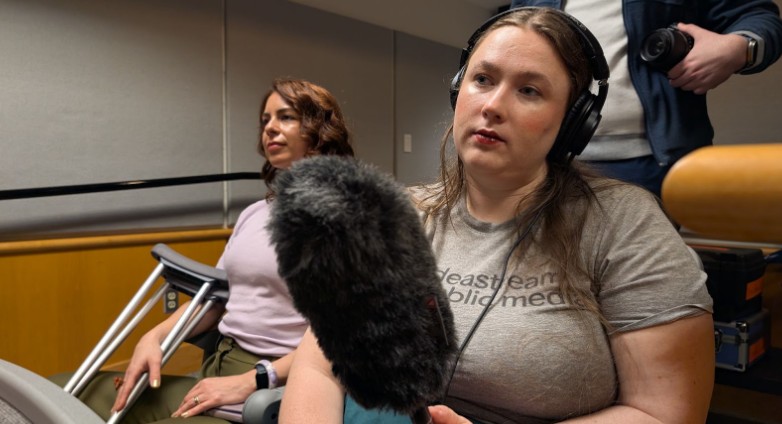
Abigail Bottar specializes in local agriculture and environmental news, where she recently reported on coal communities transitions post-industrial. Giuliana Means/IPM News
Abigail Bottar has been a published journalist for six years. In March 2026, Abigail joined Illinois Public Media as our Agriculture/Environmental reporter after serving as a reporter for Ideastream Public Media (formerly WKSU) in Ohio. As part of her role, she contributes to Harvest Public Media, a partnership of NPR member stations which report on food, agriculture, and Midwest communities.
Since coming to Central Illinois, she has reported on local data centers, farmland trusts, agricultural technologies and nature centers.
This interview has been edited for clarity and brevity.
IPM: What got you into journalism?
ABIGAIL: “I got into journalism through public radio. I just really loved NPR, and I grew up listening to WKSU in Ohio. It was really a touch point for me in 2016, when the news was really hectic, and everything felt like it was on fire all the time. And I found public radio to be a place where I could get that information in a factual way, and it wasn't like the sky was burning all the time.
In college, I applied for an internship at that radio station and did that for two years, and loved it. So, I decided that was what I wanted to do. I have been working in public media ever since.”
IPM: Why agricultural journalism?
ABIGAIL: “For my first full-time job, I got to bop around from environment to local politics to police to agriculture. I grew up in a pretty rural part of Ohio, so I always really valued doing those stories and lifting those voices.
When this job popped up, I thought it would be a really good fit because I really enjoyed working with those communities, and the Midwest is just so ripe with great agriculture stories, great environmental stories. So that was it was really exciting.”
IPM: What draws you to being a journalist in the Midwest?
ABIGAIL: “I really love the Midwest, I think the people and communities here are very special, kind and open-hearted. So, I was excited that I got to stay at a station in the Midwest, and I was really interested in digging into a specific topic, which is why I was really excited about being able to focus on agriculture and the environment.”
IPM: Since you started working at IPM this March, how has the adjustment been?
ABIGAIL: “I've been having a great time. Everyone is great. There are so many great stories and” interesting topics and so many cool things going on in ag and environmental stuff right now. It's been very, very fun, and I've been learning a lot. I love how walkable it is. I love the farmers market, so that was kind of a selling point for me."
IPM: Why journalism?
ABIGAIL: “I think of journalism as a public service because I have a very community-oriented mindset. I think of this as an act of service that I'm providing my community by finding interesting stories to tell, educating people, and breaking down complicated issues so people aren't overwhelmed.
Also covering hard topics and holding truth to power, but also finding stories that bring levity, that bring joy. Because I know that our listeners really like that and need that, especially in times where the world feels like it's on fire.”
IPM: Why is journalism important?
ABIGAIL: “Without journalism, we would not have any third-party accountability to government structures, nonprofits, or businesses. We are watchdogs in a lot of ways, even without being a very serious investigative reporter; we're all watchdogs of the various organizations and communities that we cover.
With the rapid decline of newspapers across the US—especially in rural communities— journalism becomes a lifeline. We offer so much information about weather and agriculture that you can't get that in a lot of places in the state anymore. I also hope it builds community and brings people together.”
IPM: Why do you think public media matters?
ABIGAIL: “The most important thing about public media is that we never have a paywall. The information is always open and free to everyone. You don't even need a radio. You can play it on your phone or computer. No one else provides that.
Being members supported, that makes it so that we're truly accountable to our community. Which makes me feel so much more connected with the people I'm reporting on and working with, because I know at the end of the day, they're kind of my boss.
This is a very important public service that I love working in and supporting; it's very exciting to be new here and to see people's connection with this station and to be a part of that."
IPM: Favorite story you have ever written?
ABIGAIL: "I lived really close to Cuyahoga Valley National Park in Ohio, and they had this great opportunity to purchase this old golf course and transition it into park land. I got to go on a hike in the new land with a tour guide who showed me why it was so special and important to conserve.
My favorite part was up this ridge, where all of the noise from the nearby road disappears, and it's just very quiet. You can hear the trees rustling and the birds chirping, the wind blowing, and nothing else. You just feel very serene and peaceful."
IPM: Favorite public media story?
ABIGAIL: “I think something NPR does really well is international politics. They have really great coverage of the war in Gaza and what's going on in Iran. The fact that they are so committed to bringing us what's happening on the frontlines of these conflicts is so important.
Through all of the murkiness of governments and groups and everything, journalism is so important for democracy.”
IPM: Is there a specific story that changed the trajectory of your career?
ABIGAIL: “The East Palestine [train] derailment story did that for me, because that became my full beat for a year. And I continued to cover it up until I left the area. It was less than six months since I started as a full-time reporter, and all of a sudden I was covering visits from the president, Senate visits, and executive branch meetings on why this happened and policy about railroads because a lot of us live really close to train tracks."
IPM: What does a day in the life look like for you?
ABIGAIL: “When I start work, I go through my email and newsletters that help me see what people are talking about and what is going on. We have news meetings twice a week. So we talk about what we're covering, what we should be covering.
And then I'm putting out calls to sources to put together my stories. Right now, I'm working on a longer-term story. So I'm setting up interviews and going out to the field to do those.
Once we have our sound, then I listen back to it and pull the quotes that I want to use and start making the audio story. But our audio listeners aren't necessarily the same as our web listeners. So we need to make sure we're communicating in a way that makes sense for the medium.”
IPM: When you aren't at the station, where can listeners likely find you?
ABIGAIL: “I've been going to Common Ground, the grocery store. I'm there because their prepared food is really good. And I've been eating that a lot, so I'm most likely there.”
IPM: If you could pick one album that you could bring with you on a desert album or Desert Island, what would it be?
ABIGAIL: “‘The Stranger’ by Billy Joel. That's his best album. Vienna's my favorite song of all time, so I don't think I could give that up. And that is his best album, so it works out.”
IPM: What's your favorite hobby?
ABIGAIL: “I'm a really big reader, so I've been I do a lot of reading. I need to get a library card here because I'm going to run out of reading material soon. I also just really like spending time outside. So I love to go on walks, hikes, and check out new parks. If I'm not at the grocery store, I'm probably outside somewhere.”
IPM: Is there a public radio show that you've been really into lately?
ABIGAIL: “I've been listening to The 21st Show because I did not know about that before I worked here. I'm often driving somewhere to an interview or back to the station at 11 AM, so I get to listen to them. They have such a great balance of fun conversations about culture and great conversations about policy and other important things today.”
IPM: Who would you say is your greatest inspiration?
ABIGAIL: “NPR was founded by a lot of women who were very forward-thinking. I have always looked up to Nina Totenberg so much because she essentially created the way that you cover the Supreme Court. And she's still doing it so many years later. I feel very grateful to work in a field where women like Nina Totenberg paved the way for me to be able to have this career."