








Behind The Mic: Newsroom editor Arjun Thakkar thinks public media is integral in combatting information overload
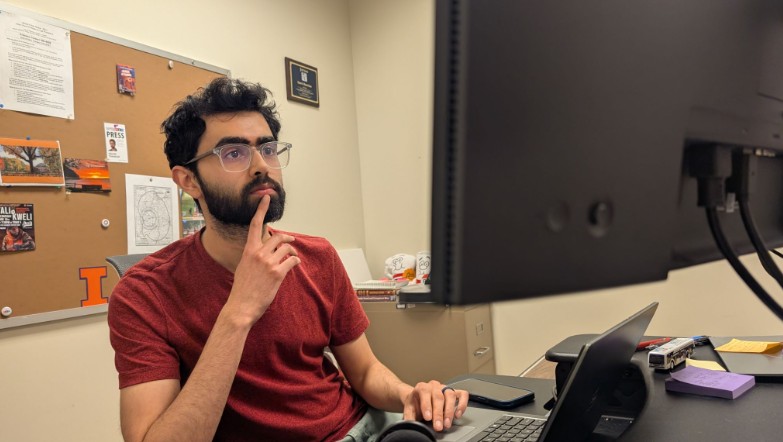
Arjun Thakkar is the senior editor for Illinois Public Media, where he can be found going over, pitching, and creating content schedules for stories. Giuliana Means/IPM News
Senior Editor Arjun Thakkar has been with Illinois Public Media since the Fall of 2024. He came from WKAR, the NPR/PBS station at Michigan State University, where he primarily reported on campus politics and civics for two years.
The Illinois native currently helps reporters with story pitches, sources, and final editing. And sometimes picks up stories himself. He enjoys reporting on local transportation.
Not only does he edit and report, but Arjun can sometimes be heard hosting All Things Considered and Morning Edition, making him one of the most flexible staff members on the IPM team.
IPM: What got you interested in journalism?
ARJUN: “As I was growing up, I liked the idea of telling stories. I did a couple of journalism classes in high school, where I started to realize that what I liked the most about it was finding ways to make complicated issues accessible.
At [the University of] Michigan, I did a lot of stories about things that could be pretty complex. But I really enjoyed the process of making this complex legal thing that people might not be as interested in as accessible as possible so that they could understand why they might want to learn more about it.”
IPM: What draws you to continue journalism?
ARJUN: “There's a quote by an Argentine writer, Jorge Luis Borges, who said, ‘Don’t talk unless you can improve the silence.’ If I'm going to contribute something, I want it to be meaningful and have the greatest impact.
If other outlets are covering a story, I don't take that as a motivation that I need to do that story too. I think about what the most pressing thing is that a person in my audience, in my community, should know or might benefit from knowing.”
IPM: Why do you think journalism is important?
ARJUN: “People need access to information, although we live in a time with a lot of unique information challenges. There's information overload. It's easy to come across information that is not well-informed or accurate.
The one thing that journalism does advocate for is the truth and free access to that truth. You can go on Instagram or TikTok and find lots of influencers making content, but I think journalism will always be important because of that.”
IPM: What makes you passionate about being an editor?
ARJUN: “I really enjoy working with our reporters and seeing the interesting stories they come up with. They're really good at finding human voices, like people who have passionate thoughts or emotions that they want to express about a given news event.
I'm working on a few long feature stories with different reporters right now, and I love that process of seeing what we have right now, but how can we reorder things so that the listener can go from beginning to end and cohesively process the whole thing.”
IPM: Why do you think journalism is important in Central Illinois?
ARJUN: “Illinois, in particular, has a lot of news deserts and areas that would benefit from having more robust news coverage.
During the pandemic, a newspaper that provided coverage for the northern suburbs shut down within a month. You're talking about probably 5 to 10 towns that overnight lost all of their local news coverage, which to me was the first time that I realized the impact of what happens when local news deteriorates; people just lose access to information. So I think about how we can best support our area and find those opportunities to look in our region and see what's going on in this area."
IPM: Why does public media matter?
ARJUN: “Public media's mission is to serve everyone and do it in a way that's free and accessible.
We recently reported on the Champaign-Urbana Mass Transit District because they were annexing a piece of land. You can look at that and report on it in a very legal, bureaucratic way, or you can report on it in a practical, here's what it means, here's how it works perspective.
That's the approach that I had us take. That matters because people very easily tune out of bureaucratic things. That's why a lot of people, I think, don't look at federal news because they read about the processes in Congress that can be slow-moving and hard for people to understand."
That's why public media is interesting because you get the coverage that is targeted to what the audience needs.”
IPM: What is your favorite public media story that you've ever reported on?
ARJUN: “I'm pretty interested in biking and transportation stories, so last fall I went on a moonlight bike ride that Prairie Cycle Club does. It was a pretty scenic ride. You start at sundown, so the sun's behind you and the moon is rising above the horizon, and heading up in the sky.
It's scenic in that regard. You've got cornfields and soybean fields around you. You're biking to get ice cream with friends. I enjoyed the whimsy of it.”
IPM: Is there a story that changed the trajectory of your career?
ARJUN: “When I was at [the University of] Michigan, I often covered carbon neutrality policy. Once, I was just curious, when you walk around campus at night, there are lots of buildings with lights on. One could say that they're wasting electricity to leave the lights on, so that was the route of my being interested in answering the questions that people might have, and trying to meet their needs.”
IPM: What does a day in the life look like?
ARJUN: “A perfect day for me would be coming into work, ideally on my bike, talking with a couple of reporters, maybe working with them on a feature story, getting a couple of short stories for the newscast ready.
They always have cool anecdotes from being in the field. I've really enjoyed how much we're able to innovate here. I really enjoyed being able to kind of jump in and help our team try out new formats and learn from that.”
IPM: If you're not at the station, where can listeners typically find you?
ARJUN: “I'm often at coffee shops in the area. I like going there with friends and family or to read a book and get some personal work and hobbies taken care of. Sometimes I bike around town, go for runs, and play Frisbee.”
IPM: If you could bring one album to a desert island, what would it be?
ARJUN: “Spanish music is what I listen to the most. I just enjoy learning and practicing Spanish while listening to music. So, if I could bring only one album to a desert island, I would say Bad Bunny's most recent album, DeBÍ TiRAR MáS FOToS. I like that one a good amount; there are some good beats in there.”
IPM: What's your favorite hobby?
ARJUN: “Probably biking.”
IPM: Favorite public media show?
ARJUN: “Post-college, I was really into Throughline. They would take an ongoing current event and look at it in a historical perspective. Like, what were the moments, key figures, and ideas that influenced that idea in a given time. They have an episode about the idea of nostalgia, and how in the Civil War, they characterized nostalgia as a medical condition because it would cause people not to want to go to war.”
IPM: Who is your greatest inspiration?"
ARJUN: “I look to my parents and grandparents. They taught me the value of putting in hard work, and it paying off in some fashion. That doesn't mean you always succeed, but it means something to you, and that is meaningful.
I believed in that a lot. Putting forth my best effort, do the best I can, even if I don't do everything perfectly. You can't say that I didn't try. So I learned that a lot from my family. I would say I also admire the people I've worked with here, in Michigan, and in the Chicago area.”