







Sousa’s Illinois Legacy
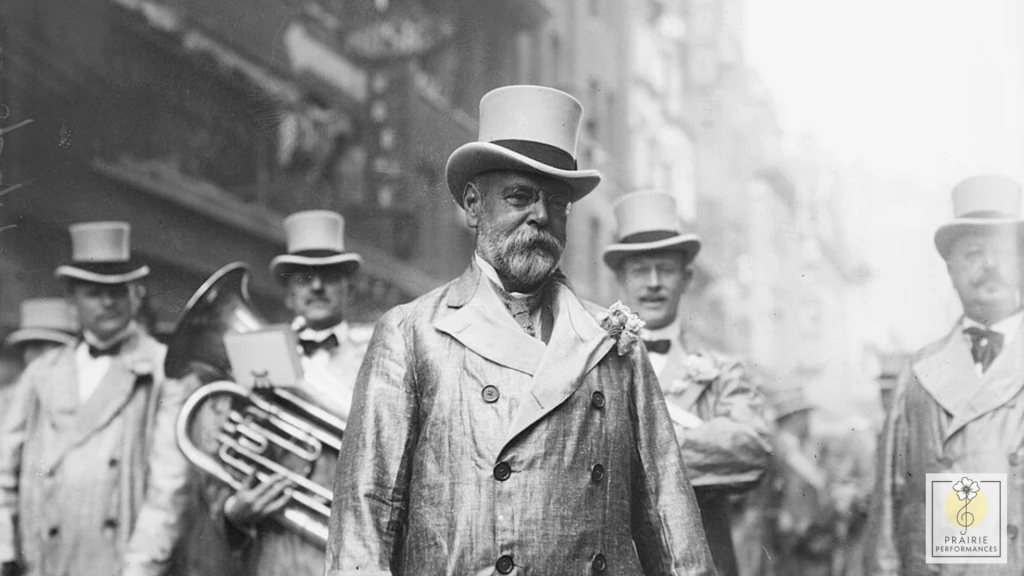
Sousa with a marching band Wikimedia Commons
// This is a machine generated transcript. Please report any transcription errors to will-help@illinois.edu.

[00:00:00]
Jason Croft: Good evening from Urbana and the University of Illinois. It's Prairie Performances, WILL's weekly show presenting classical and jazz from the heart of the prairie in central Illinois. Prairie Performances is made possible in part by funding from the John Frayne Graduate Student Classical Music Work Experience Endowment.

[00:00:28]
Mel Miller: Good evening and welcome to Prairie Performances. I'm your host, Mel Miller. Tonight, in honor of the birthday of John Philip Sousa, we're taking a look at the composer's musical impact on our home state of Illinois. This is Sousa's Illinois Legacy.

That was John Phillip Sousa’s “The Belle of Chicago.” Before that, you heard the President's Own United States Marine Band performing A Century of Progress, a piece commissioned from Sousa for the 1933 Chicago World's Fair. We're exploring Sousa's Illinois legacy on this Prairie Performances. I'm your host, Mel Miller. We've already heard two marches Sousa composed for or about the city of Chicago, but tonight we'll be focusing on a connection even closer to home by taking a look at Sousa's ties to the University of Illinois and his longstanding relationship with band director A. Austin Harding. Who was A. Austin Harding? Well, he was a student at the U of I who went on to become a pioneer of collegiate bands. Scott Schwartz, archivist and director of the Sousa archives, can tell you more.

[00:06:41]
Scott Schwartz: For those who don't know Austin Harding, um, he's a musician, cornetist principally, although he plays most instruments. He comes to the University of Illinois as an older student and wants to get a degree in civil engineering. He also has an interest in football. Um, the one thing that Harding lacked was size and speed. And it wasn't gonna be what Huff would have described as a successful football player, and so it's Huff who tells him about the military band and the fact that he's a musician, that's where he gets his hook, and it doesn't take long before this student becomes sort of the unofficial director and eventually director of this military band. And the reality is he never finishes his degree in civil engineering. Um, the School of Music hires him away. They essentially then, um, start telling people he's a faculty member of the School of Music, taking care of the band program and everything. Then they suddenly realized that this faculty member has no degree. And they quickly discover we need to correct this. He's done everything that a music student should do, and so they grant him a degree in music, um, coming from the results of his work as the first director of bands.

[00:08:03]
Mel Miller: The Huff that Scott Schwartz refers to is George Huff, who served as athletic director of the University of Illinois from 1901 to 1935. Harding would have developed a close professional relationship with Huff during his time as band director, and both have campus buildings named after them. Huff Hall, now home to the Fighting Illini volleyball, wrestling, and men's and women's gymnastics teams, and the Harding Band Building, home to the Marching Illini. Here's an excerpt of A. Austin Harding conducting the University of Illinois band in 1906. The piece is called Illinois Loyalty, and while the audio quality isn't the best, this recording is 120 years old, you can still hear how tight the band sounded under Harding's tutelage.

Pretty cool, right? Again, this recording is 120 years old, really neat stuff.

Now you're probably wondering how Harding and Sousa managed to cross paths. You'll hear more on that from Scott Schwartz later in the episode. But first, here's the Illinois Wind Symphony performing Marching Along, a parade of Sousa marches compiled and edited by Colonel John R. Bourgeois, a former director of the United States Marine Band. On this Prairie Performances.


Marching Along, a parade of Sousa marches compiled and edited by Colonel John R. Bourgeois and performed here by the Illinois Wind Symphony. In honor of his birthday, we're taking a look at John Philip Sousa's Illinois legacy on this week's Prairie Performances. I'm your host, Mel Miller. Earlier we learned about the University of Illinois's very first director of bands, Austin Harding, but how did Harding and Sousa cross paths? Here's Scott Schwartz from the Sousa archives to tell you more.

[00:19:10]
Scott Schwartz: Foellinger Auditorium is finished 1907, 1908, dedicated in 1908. And Harding is able to convince the university to bring the Sousa band here as one of the ensembles that would unveil the stage, and their approach was not just one major concert, but many concerts by many people. But Harding gets the Sousa band to come here and they do two concerts. That's quite remarkable because up to this point, Urbana-Champaign is still a cow town. They have a college, yes, yes, but you know, uh, the Sousa band has played once or twice here, it's a passing gig. Now he's brought here to become a helper of unveiling the new auditorium. Um, after the first concert, the president of the university invites Sousa to dinner. Um, Harding also attends, and it's at that point that Sousa and Harding have a conversation about Harding's view of bands in America and the role of colleges. And at that point, Harding essentially tells Sousa that his vision for the Illinois band would be what we now recognize as a collegiate band model — to train musicians to play in professional bands, to be music educators — and prior to this, you went to conservatories, you know, if you wanted to be a professional musician, you didn't go to college. And then Harding tells Sousa that he's modeling the Illinois program on the Sousa band. The two men kind of hit it off. This was an intriguing concept that no other university was doing, and so they stayed in contact with each other, often corresponding about how are you arranging this symphonic piece for wind band, because you can't go to the store and buy the music, you have to arrange it. And so they're — they're not providing each other trade secrets, but they're really having a conversation. How are we approaching bands?

Um, the other thing is that, um, Sousa stays with a fairly standard instrumentation because that's what's required. You, you play regularly throughout the community, they have an expectation for what the ensemble is made up with. Um, Harding, on the other hand, was quite flexible, experimenting with different instruments, um, often instruments that Sousa knew about but didn't have available to him. And so now you've got this collegiate band that essentially has grown exponentially in the first three to four years from something that consists of 30 to 40 musicians to several hundred musicians. He has three ensembles and a drum and bugle corps. So the two really stay connected based on that. I'm often asked, did Sousa come to the university to be a student? No, he had no college degree, although he did have an honorary doctorate or two. But the bottom line is essentially we have this new model and, um, you know, Harding essentially becomes the model maker for universities' collegiate band programs, and I think that's important. The Illinois band becomes a standard for collegiate bands, and by 1920, Harding, Sousa, and [Joseph Maddie] in Michigan established what is today the American school band movement. We are the only country like it anywhere that allows students to get school credit for being in a music ensemble, whether it be orchestra, choir, or bands. Um, so we often think of Harding as the dean of the American school band movement, but he's also the progenitor of the collegiate band model, which is modeled on Sousa. So there's the connection between Harding and Sousa — a civil engineering student and musician who becomes the director of bands and takes the country's band programs in directions that had not been imagined at that time.

[00:23:23]
Mel Miller: In other words, Sousa and Harding's relationship had a significant impact on what university bands look like today. Honoring that legacy, here's a trio of Sousa marches performed by the Illinois Wind Symphony for Sousa's sesquicentennial celebration. The U.S. Field Artillery march followed by Easter Monday on the White House Lawn and By the Light of the Polar Star from the Looking Upward Suite, here on Prairie Performances.


John Philip Sousa's By the Light of the Polar Star from the Looking Upward Suite as performed by the University of Illinois Wind Symphony with James Keene conducting. Before that, you heard the Wind Symphony performing Sousa's Easter Monday on the White House Lawn and U.S. Field Artillery march. All part of this Prairie Performances exploring Sousa's Illinois legacy. I'm your host, Mel Miller. Perhaps Sousa's most audible connection to the UI campus is the University of Illinois march composed in 1929 for the university bands. Here's Scott Schwartz, director and archivist for the Sousa archives, to tell you more.

[00:35:55]
Scott Schwartz: Illinois was looking for a special march, and Harding had requested, um, that Sousa might consider it. The general understanding was that if he wrote something for a college or an organization, you were required to commit to purchasing music for that march. Every march Sousa writes, he publishes it first for band, then orchestra, then arranges or has somebody else arrange it for, um, guitar quartet, banjo trio. I mean, each of those is a different arrangement, a piece of which you have to buy the music, of which royalties go back to Sousa. So for the University of Illinois march, um, Harding asked and he knew that he'd be required, um, to purchase a number of copies of the published music — this is usually sheet music, um. And you know, he was fine with that. But then the two men begin to talk about what melodies does the band typically play that might be suitable as part of the march — not so much a medley, but something that Sousa could quote. And so they're beginning to have a conversation about what should be included in this, what do you want to focus on. And, um, that's how it starts.

Um, and the ironic thing is, unlike the other marches written to colleges, it's finished in '29 and then the band plays it on several radio broadcasts — in itself quite extraordinary because quite frankly, Sousa, you know, didn't really see a whole lot of value for audio recording technology or for that matter, radio broadcasts. And, um, so the Illinois march is actually broadcast, played by the Sousa band before Harding and the Illinois band even get the music, which is great. Band members get to hear their march played by what they consider the greatest band in the country, and they're intrigued. In some respects, I do think this march was written as much for the student population in the band of Illinois as it was for Harding, in terms of the close collegial relationship they had over the years. I consider it — dare I say this, um — I always put El Capitan first because it's the one piece that the saxophones get to play a melody as opposed to the ends of beats. But in terms of other marches, University of Illinois is — I consider that probably the most unique and distinct march.

[00:38:36]
Mel Miller: Up next, the University of Illinois march as performed by the Illinois Wind Symphony conducted by James Keene. After that, you'll hear El Capitan and The Federal on this Prairie Performances.

John Philip Sousa's The Federal as performed by the Illinois Wind Symphony. Before that, you heard El Capitan and the University of Illinois march. All part of this Prairie Performances celebrating Sousa's Illinois legacy. I'm your host, Mel Miller. Throughout this episode, you've been hearing from Scott Schwartz, director of the Sousa archives at the University of Illinois. Now you're probably wondering what sort of materials do we have on Sousa in that archive. Here's Scott Schwartz to tell you more.

[00:48:06]
Scott Schwartz: Sousa dies March 6, 1932, and then 39 trunks and two boxes of music come to the University of Illinois because Sousa recognized that — the original plan was to have his entire music library go to the Library of Congress. This is the early 1920s, and Sousa suddenly recognizes it goes to the Library of Congress, the music sits on a shelf and dies a silent death. That — that's not what he's looking for. He's looking for an ensemble equal to his own, which he has stated numerous times to Harding. All right, it's not artificial flattery. It was true, sincere belief in the Illinois program and essentially a conductor who knew how to conduct Sousa's music, and those were essential. So when Sousa passed away, there was discussion where should the music go, but it had already been discussed with the family that the music needed to come to Illinois, and it has stayed here.

The um building that we have currently, which was dedicated in '59, you know, was a state-of-the-art band building. No other university had it, and part of that design was to have a museum and library for Sousa's music — not to sit quietly in boxes or file cabinets, but to be used by the bands for active performance of Sousa's music. And it continues to do that today. Um, we try to do at least one Sousa piece every concert. Although then we did Carl King and Henry Fillmore, you know, we got lots of greats to play, but we, we try to regularly play at least one Sousa piece, and I think that's important. How do you keep the legacy alive? How do you play the music in a way that essentially follows the path that Sousa had charted for his music.

[00:50:14]
Mel Miller: It's quite the legacy that Sousa left here at the University of Illinois — from band programs to original works to the Sousa archives themselves. I find it all really fascinating and I hope you have as well. We're reaching the end of this week's episode. Thank you so much for joining me. I'll leave you tonight with two final Sousa marches. First up, Glory of the Yankee Navy as performed by the Illinois Symphonic Band with Harry Begian conducting. After that, the Illinois Wind Symphony playing Stars and Stripes Forever with James Keene conducting. Thank you so much for listening with me this evening here on Prairie Performances.

Prairie Performances is a production of Illinois Public Media. I'm your host, Mel Miller. I hope you'll join me next time.
In honor of the birthday of John Philip Sousa, this week’s Prairie Performances takes a look at Sousa’s musical legacy right here on the University of Illinois campus. You can hear the University Bands play some of Sousa’s greatest hits, along with interview audio with Archivist and Director of the Sousa Archives, Scott Schwartz.
Tune in Thursday, November 5 at 7pm CST on Illinois Classical 90.9 or stream now!
Playlist
| Title | Artist | Album |
|---|---|---|
| John Philip Sousa's "A Century of Progress" | John Philip Sousa | The American March Tradition |
| John Philip Sousa's "The Belle of Chicago" | The President's Own United States Marine Band | Sousa: Deep Cuts, Vol. 2 |
| Thatcher Howland Guild's "Illinois Loyalty" | The University of Illinois Band, conducted by A. Austin Harding | The Illinois Legacy |
| "Marching Along, a 'Parade' of Sousa Marches" comp. and ed. by Col. John R. Bourgeois | Illinois Wind Symphony, conducted by James F. Keene | John Philip Sousa and His Band |
| John Philip Sousa's "U.S. Field Artillery March" | Illinois Wind Symphony, conducted by James F. Keene | John Philip Sousa and His Band |
| John Philip Sousa's "Easter Monday on the White House Lawn" | University of Illinois Symphonic Band, conducted by James F. Keene | Live! In Concert with the University of Illinois Symphonic Band, Recording #126 |
| John Philip Sousa's "By the Light of the Polar Star from "Looking Upward" Suite | Illinois Wind Symphony, conducted by James F. Keene | John Philip Sousa and His Band |
| John Philip Sousa's "University of Illinois March" | Illinois Wind Symphony, conducted by James F. Keene | University of Illinois Wind Symphony at Carnegie Hall 2006 |
| John Philip Sousa's "El Capitan March" | Illinois Wind Symphony, conducted by James F. Keene | John Philip Sousa and His Band |
| John Philip Sousa's "The Federal" | University of Illinois Symphonic Band, conducted by James F. Keene | Live! In Concert with the University of Illinois Symphonic Band, Recording #125 |
| John Philip Sousa's "Glory of the Yankee Navy" | University of Illinois Symphonic Band, conducted by Harry Begian | In Concert with the University of Illinois Symphonic Band: Great Marches of the World, The Begian Years Vol. IV |
| John Philip Sousa's "Stars and Stripes Forever" | Illinois Wind Symphony, conducted by James F. Keene | John Philip Sousa and His Band |