








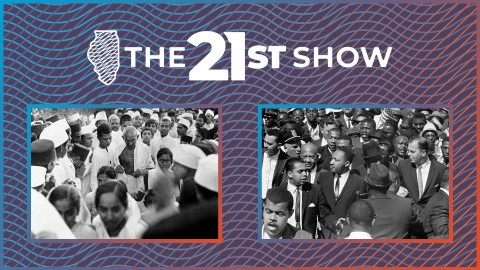
Gandhi, King and non-violence today
For Martin Luther King, nonviolence was an essential element of his prosecution of the Black freedom struggle. In an interview from 1957 — this after the Little Rock school crisis — King talked about why he was committed to the philosophy:
“It seems to me that there are three ways that oppressed people can deal with their oppression,” he said. “One is to rise up in open violence, in physical violence. And some persons have used that method, persons who have been oppressed. But I think the danger of that method is its futility. I feel that violence creates many more social problems than it's solved.”
But just as King thought violence was wrong, he also rejected passive acceptance of oppression: ”I think that is just as bad as violence because non-cooperation with evil is as much a moral obligation as is cooperation with good.”
Today we’re going to talk about what Martin Luther King called his “Pilgrimage to Nonviolence,” how it relates to the foundations of that philosophy as articulated by Gandhi, and how in both King’s time and today there were those who question the effectiveness of nonviolence as a tool of politics.
Last year, Brian Mackey talked about this with Columbia University political science professor Karuna Mantena. She is a scholar of Gandhi and King, and wrote a chapter in a book that came out a few years ago called To Shape a New World: Essays on the Political Philosophy of Martin Luther King Jr. The chapter was called “Showdown for Nonviolence: the Theory and Practice of Nonviolent Politics.”