Transcript: New book gives ‘literary tour of the Midwest’, highlighting writers from America’s Heartland
Transcript: New book gives ‘literary tour of the Midwest’, highlighting writers from America’s Heartland
The 21st Show
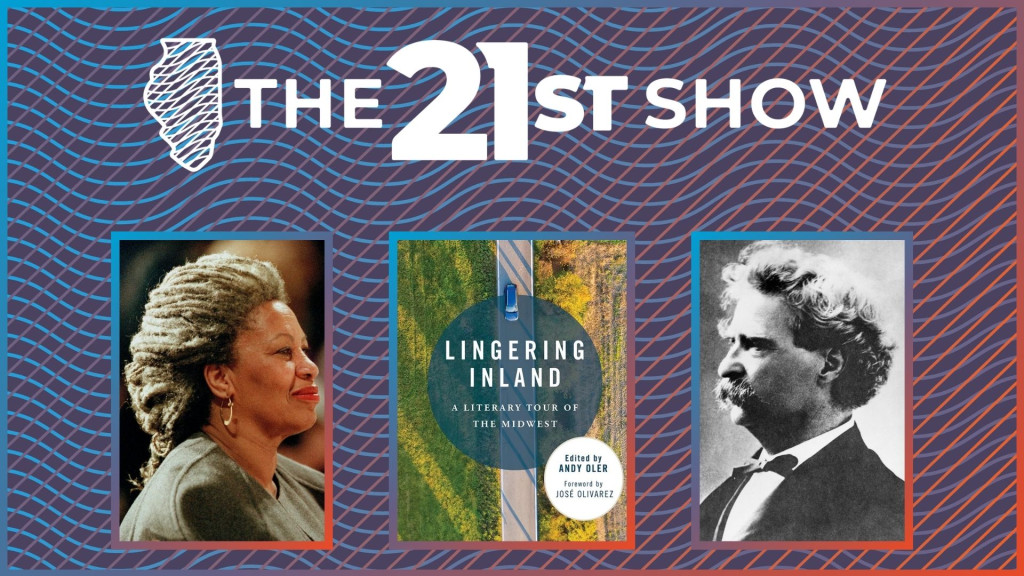
New book gives ‘literary tour of the Midwest’, highlighting writers from America’s Heartland
Read the full story at https://will.illinois.edu/21stShow/book-gives-literary-tour-of-the-midwest-highlighting-writers-from-americas-heartland.
Transcript
// This is a machine generated transcript. Please report any transcription errors to will-help@illinois.edu.

[00:00:00]
Brian Mackey: It's The 21st Show. I'm Brian Mackey, and we're going to spend the rest of the hour today on a literary tour of the Midwest. That in fact is the subtitle of a book called "Lingering Inland." It's a collection of short essays by contemporary writers exploring their literary peers and ancestors, and what it means to be a writer of the Midwest. It's from Three Fields Books, which is part of the University of Illinois Press.

In the foreword, the young poet José Olivares from Calumet City in the south suburbs of Chicago explains what it meant for him to begin recognizing Chicago as a literary landscape. There was art to be made from the steel mills and the concrete and the mall and hours spent on the expressway. There was song in the suburbs. There was literature in the flash fried foods. There was sculpture to be made from our distinctive drawl.

The collection is edited by Andy Ohler, a professor in humanities and communication at Embry-Riddle Aeronautical University in Daytona Beach, Florida. We originally spoke with him in late 2025. We're revisiting that conversation for the rest of the program today.

I should note, Andy will be hosting an event of reading and conversation with some of the book's contributors later this week. That'll be at Chicago's Bookseller, Thursday, 7 p.m. We'll have details on our website, twentyfirstshow.org.

Because this conversation's on tape, we're not taking calls live, but you can share your thoughts. Our email address is talk@twentyfirstshow.org.

Alright, Andy, let's talk about the book. How did "Lingering Inland" come to be?

[00:01:49]
Andy Ohler: Well, "Lingering Inland" came about as a development of a series that I edit for the New Territory magazine. The New Territory calls itself the Autobiography of the Lower Midwest, and at its heart, it's a print magazine that includes journalism and short stories and creative nonfiction essays and poetry and photography. It's a lovely magazine. I encourage everybody to check it out.

And I pitched to them this series called Literary Landscapes, in which contributors to the series — who end up being part of this book — visit a place that is associated somehow with Midwestern literature. And so that sometimes is an author's house that's become a museum. Sometimes it's a grave site. Sometimes it is, you know, just a gravel road that's a scene from some poem. And it could be a lot of different things, and we have places that still exist and the remains of places that are represented in this book. And they go and they think about and they write about what about that place is interesting, how it connects to the literature, and how their experience is meaningful in some way.

So this was a project that got started right before COVID, in early 2020, and we started publishing in June, I believe, just after everything was locked down. So in a lot of ways this project was like a COVID lifeline, because all of these essays are short — they're about 900 to 1,000 words. So, like a lot of people at that time, I did not have the stamina or the brainpower to really think deeply or carefully about anything in the world. It was just all overwhelming. But when I would get these essays come into my inbox, and it was something that people were enthusiastic about that was meaningful to them, I could help them shape those essays into something that was publishable, and it was an amazing experience. It continues to be an amazing experience. So we worked on this. Yeah, go —

[00:04:02]
Brian Mackey: Go ahead, go ahead. I say this is perhaps a digression, but I suspect some significant share of art produced in the next generation will have its roots in the — would you say the house plants of the pandemic, right?

[00:04:14]
Andy Ohler: I think you're absolutely right, and some of the essays in this book are very clearly related to the pandemic. Kella Thornton from St. Louis has a really terrific essay where she, during the pandemic, went and sat on Kate Chopin's final — sorry, she sat on the stoop of Kate Chopin's final home in St. Louis and kind of reflected on Chopin's writing, her experience along with Kella's at that time. And it was this amazing thing to read because you could see someone working through that in real time. So I think that, exactly that — those kinds of struggles, those kinds of ways of thinking about the world are going to reverberate for years to come. You're absolutely right about that.

[00:04:54]
Brian Mackey: I'm curious how you defined the Midwest, and this is a — you know, this can be a contentious topic in the academy. I've heard it, you know, stretching all the way from West Virginia to Colorado in some cases. What were you looking at here?

[00:05:10]
Andy Ohler: Well, I am at heart an expansive Midwest kind of a guy, and the reason for that is because there are no clear sort of geographical boundaries to the Midwest. I mean, you can probably put the Ohio River as one. You might be able to say the Great Lakes, but that's a limited boundary. The Great Plains is sort of a, you know, a boundary, but it's not exactly. So I was trying to think about the Midwest as places that share certain cultural streams.

So one of the developments of the Midwest, of the idea of the Midwest, came about when you had sort of these northern Yankees moving west at the same time as the Southerners sort of came west and northwest, and so the mingling of those cultures — this was in the 1800s primarily — but that kind of cultural history sort of lingers in this region. And so I always wanted to make sure that there was some of that represented in the region where I was looking. But geographically, I would generally say what the Census describes as the Midwest, so from Ohio to the Great Plains states and then from Minnesota. I do have one essay from Arkansas, and some parts of Arkansas share some of those cultural characteristics, but generally we would go from kind of Minnesota to Missouri.

[00:06:48]
Brian Mackey: We'll come back to it later, but — London, and not London in Illinois or Ohio or anything like that — comes in. We'll come back to that.

[Another] other definition, sort of as we lay the groundwork — what do you consider literary? Because there's an expansive view of that as well here.

[00:07:07]
Andy Ohler: Yeah, so one of the challenges that I had as I was creating the series and thinking about the book project was that we started to be very limited to say the 20th century and later — 20th and 21st century. And that didn't sit right with me because I think there's a lot of literature produced in previous times. So I kind of expanded the idea to think about the kinds of writing that circulates maybe in and around, say, an English class, whether that's in a college or a high school, but something that you might bring in as context for that.

So one example that a lot of people might not say is literary is legal writing. So we have one essay on a woman named Rachel, who was a formerly enslaved woman, and this essay was by [Kristy Clark Buhara — spelling unverified], who's a historian. And Rachel wrote a petition for her freedom. And I thought, OK, this is one of the only sort of publicly available pieces of writing from Black women in the Midwest at this time. And this is an important context, and there's a way to think about the kind of writing that she was doing — not just limit ourselves to poetry or short stories or something like that.

[00:08:30]
Brian Mackey: Yeah, the things we recognize from English class.

Well, let me ask you — let me remind listeners first, actually, that this is The 21st Show. We're speaking with Andy Ohler, who is a department chair and professor in humanities and communication at Embry-Riddle Aeronautical University in Daytona Beach, Florida. And more to the point for our conversation, he's the editor of a collection from Three Fields Books, part of the University of Illinois Press. It's called "Lingering Inland: A Literary Tour of the Midwest."

You opened the book describing your own experience visiting a poet's house in Indiana when you were quite, quite young — elementary school age, if I remember correctly. Talk about what you get out of visiting places associated with writers or their work.

[00:09:15]
Andy Ohler: Well, my experience in particular — I don't think I probably got as much out of it at the moment as maybe somebody who does when they're really actually thinking about it.

So my experience that I recount in the introduction: I did a [media fair] project. It was a little video on James Whitcomb Riley and his poetry. He's the Hoosier poet. And I talked about his poems, I talked about his life, and I gave a little background. And part of this I filmed right in front of the James Whitcomb Riley home in Greenfield, Indiana, and I have fond memories of doing this. Unfortunately, the video is lost.

But I think it shows — when you go to a literary place of some kind or you recognize that there's a literary place on your commute, I have one of those here where I live in Daytona Beach — it helps you think about the way that your place matters, the fact that people are willing to tell stories about it and that it sticks around long after that author wrote it, and probably long after you live there. And so I think that acknowledging and understanding that there are important stories being told about the place where you live, or the places where you visit, can help you really connect to that place and that culture and the people who are there all around you.

[00:10:44]
Brian Mackey: This is a digression again, but I'm curious — what is the literary place on your commute in Daytona Beach?

[00:10:49]
Andy Ohler: So I live in Ormond Beach, Florida, and I drive down to my campus in Daytona Beach, and I drive along the Intracoastal Waterway. And along there, Zora Neale Hurston — famous Florida writer — lived in a houseboat, I think for a couple of years. And so I go right past — I mean, the marina has changed — but I go right past the marina where she lived on this houseboat. And it's crazy for me to think about Hurston being this just like titan of literature now, like someone we think of as a massive figure in the 20th century, kind of in this like forgotten little houseboat. And just like — it makes me really realize the way that stories live on.

[00:11:32]
Brian Mackey: Fascinating. So how do you decide what people and places to include in the book?

[00:11:39]
Andy Ohler: You know, the contributors decided a lot of that. I put out an idea for this series, and when I made the idea, I really wanted to think about how to show how the stories we tell about our places — how they are relevant in our lives. And I realized that it couldn't just be me. Like, my voice wasn't enough, so I really relied on the contributors.

So I put out a list. I said, hey, here's a bunch of authors and places that might work, but if you've got something that you're excited about, email me, we'll talk about it, we'll see if we can make it work. So most of the essays that I published came to me because someone said, oh, I worked in the library where James Emanuel spent — like, in the town where he grew up, and he wrote this poem about the library, so I wanna write about that. Or, I went to this park that Langston Hughes mentions in a poem. I mean, there's all these kinds of stories, so most of the places really come from the contributors' personal experiences.

And honestly, that's what sets this book apart from other books or websites that are focused on literary places. A lot of those will give you a lot of great information about that place. It's kind of encyclopedic and they're terrific resources. They're fun to read. They have good pictures. But what this one does is it provides that real personal angle. And so mostly I let them flow in. I did start to reach out to certain people, maybe that I knew, perhaps that they had written about some of those authors. But the key thing for me was always just making sure that there was that personal connection — not just to the literature but also to the place.

[00:13:28]
Brian Mackey: I guess, and you're not going for an encyclopedia here, right? Because as I'm looking at it, I'm like, oh, where's Saul Bellow? I'm looking for Nelson Algren and Hemingway and Luis Alberto Urrea and [Vachel] Lindsay — but, as you say, it's what the contributors pitch in, I guess.

[00:13:42]
Andy Ohler: Yeah, and you know, I've got an ongoing list of people that I want to have contributors write about for Literary Landscapes, and hopefully we'll do another volume of this kind of a book in the future.

But yeah, I couldn't possibly cover everything. I mean, if I tried to do that, it would be such a big fat heavy book, no one could ever pick it up. So I say this in the intro: I don't think that any one person or any one experience can really capture everything. And I don't think that this book is going to try to capture everything. But when you put all of these perspectives together — both the original authors that they're writing about and then also the contemporary folks who are writing about these places and experiences — when you put that all together, I think you do start to get a good mosaic understanding of the region. But there are absolutely gaps, and there are things that I would love to include, have included in the past, or to include in the future.

[00:14:46]
Brian Mackey: All right, we need to take a break in a couple of minutes. But before we do — and we'll get into some of the individual essays and some of the authors when we return — maybe we can just talk briefly about what in your view defines Midwestern identity. Right? In the introduction, you have a line that the Midwest is a region that, like all regions, lays bare the desire for collectivity across vast landscapes. What does that mean?

[00:15:13]
Andy Ohler: Well, this goes back to what I was saying earlier in terms of the Midwest not having firm geographical boundaries. And it's not true of every place in the Midwest. I mean, you have river towns, you have Chicago on the lake, and everything kind of radiates out from sort of the lakeshore there. And those places have firm, careful identities that are pretty established and enduring.

But when you look at the whole region — because you were not particularly bounded as a region — that tells me that to think of the Midwest as the Midwest as a collective, people have to imagine that they have some connection to someone who is, you know, four or five states away, hundreds of miles from them, whose climate may be very different, but still we tell these stories about ourselves. And so I don't think that I can pin down what is Midwestern identity. I don't think that that's necessarily possible in many respects. But I do see that willingness to make a connection and that interest in the place, but also an understanding that the place is not as fixed as some people would have it. I think those are some of the things that can become really important here.

[00:16:47]
Brian Mackey: All right, let me reintroduce our conversation. My guest is Andy Ohler, professor in humanities and communication at Embry-Riddle Aeronautical University, Daytona Beach, Florida. He's also the editor of the collection "Lingering Inland: A Literary Tour of the Midwest." It's from Three Fields Books, which is part of the University of Illinois Press. We spoke with Ohler in 2025.

Again, he'll be in conversation with some of the book's contributors this week, Thursday at the Bookseller in Chicago. We'll have details on our website, twentyfirstshow.org. More to come after a short break.

This is the [21st] Show. It's The 21st Show. I'm Brian Mackey. We're listening back to my conversation with Andy Ohler, editor of a book called "Lingering Inland: A Literary Tour of the Midwest." It's a collection of short essays by contemporary writers exploring their literary peers and forebears, and this place we call home. As Bob Dylan said, the country I come from is called the Midwest.

We originally spoke with him back in 2025, and he's going to be hosting readings from the book and conversations with contributors at the Bookseller in Chicago this Thursday evening. We'll have the details on our website, twentyfirstshow.org. No calls for this part of the program, but let us know what you thought. Talk at twentyfirstshow.org.

All right, so there are a broad range of writers covered here, but a few of them — a select few — were selected by multiple contributors to this collection and get sort of little standout groupings. And among them is Willa Cather. Now, I might be revealing myself as a philistine here, but I haven't thought too much about Willa Cather since freshman year of high school, when I was forced to read "My Ántonia." So can you just remind us who was Willa Cather? Why is she important in literature?

[00:18:54]
Andy Ohler: Well, Willa Cather was a Nebraska author of the early 20th century, and she is, to my mind, one of the most important authors in Midwestern literature. She wrote a lot about sort of pioneer life, I guess you would say, in the Nebraska plains. And actually, "My Ántonia" for a long time was my go-to book recommendation. I mean, maybe you didn't love it as a freshman in high school — I would understand that.

[00:19:29]
Brian Mackey: I think I wasn't ready for it. Yeah, it's probably more —

[00:19:32]
Andy Ohler: It's a lovely book. Yeah. I was TAing for a class in which our students read that book, and I remember the professor standing on stage and he read something aloud. He said, "Willa Cather sure can write a sentence." And I hold on to that. I think that's true.

But I wanted to think about — well, in this book, I wanted to represent a wide range of authors, but it's also important to notice and to recognize that some really important authors came out of this region as well. And so I chose Cather, Mark Twain and Toni Morrison for this book, and we could have chosen any number of others to have a real focus on. Louise Erdrich is one who came to mind. There are lots of possibilities. Ernest Hemingway, like you mentioned. And you know, maybe in the next version we'll get some of those together.

But with those canonical authors, I wanted to think about how their influence extends beyond their specific place. And so for Cather specifically, her essays — or the essays about her — go from Taos, New Mexico, all the way to Jaffrey, New Hampshire. She visited New Mexico at one point, she was out on the mesa, she wrote some letters about it, and the contributors had read those, they had visited the same places, and they wanted to think about their experience in relation to hers.

And so one of the things I really see with Cather is she's got a really wonderful way of describing nature and the landscape and of just helping you imagine it just like that. And so I thought that she was a terrific person to not only represent the plains, but also to show how there's this really valuable connection to the land that goes through Midwestern literature.

[00:21:33]
Brian Mackey: I was intrigued by the section — in Willa — or, I should say, the short essay in Willa Cather's section on the Fine Arts Building in Chicago, which gets at this idea of Chicago as a hub for the Midwest with its railroad kingdom. And it's depicted as this great circulator of ideas, right? Well, at that time, others saw it as kind of a magnet, attracting the strongest talent out of the hinterlands. Talk me through that.

[00:22:02]
Andy Ohler: Well, let's see — that was [Jesse Raber] who wrote that piece, and he lives in Chicago. And I think he has, you know, gone to the Fine Arts Building a number of times, and he wrote about one of Cather's novels called "Song of the Lark." And that's one of those stories — and there are a lot of them in the early 20th century — where somebody from the country, whether that is, you know, a small town in Kansas or the Nebraska plains or wherever, they go to the Midwest metropolis and they move to Chicago and there's going to be opportunity there. And then they get there and it's dirty and it's upsetting and it's scary, but then they find something and it becomes the city of excitement that they imagined it to be.

And there's — I can't remember the language of the passage specifically, but it kind of likens people to rivers in a way, like there's a way that people will come together and it might feel random. You watch a stream go and you can't necessarily predict it, but it's all going to sort of join up this large stream of humanity. And I love the way that [Jesse] talked about that, and I think it really shows some of the excitement of the connection between these different places.

[00:23:25]
Brian Mackey: Maybe we can also talk then about Mark Twain, who has a similarly expansive geography of Midwestern places here.

[00:23:36]
Andy Ohler: Yeah, the Twain — that one developed in a really interesting way, because we've got two that are focused in Hannibal, Missouri, and then two that are focused in London, England. And those sandwich Elmira, New York, and Hartford, Connecticut.

So Twain is, you know, what a lot of people think of as almost this Midwestern river figure — in that kind of Huck Finn, so I guess the reputation of "Huck Finn" lasting so long and being so powerful. And he is that, and that's where he came from, but he also spent a lot of time out west and he traveled the world and he lived for certain periods of time in London, in different parts of London, and most of his adult life he spent living in Connecticut.

And so I wanted to think about Twain's origins, and so we've got his boyhood home represented here in an essay by Cindy Lovell in Hannibal. The other thing we've got is the Mark Twain Cave, and so it's this place that there was a story told about, right, in "Tom Sawyer," but it also became a tourist attraction. And so you think about how the lives of these authors change and develop and what they mean to people over time.

And I actually reached out to some of the folks in this. Susan [Gillman] Harris wrote a really good book about Twain's travels all over the world, and she had gone along that route, and I thought, oh, she's going to pick somewhere in East Asia to write about or something, but no — she picked one of the homes that he lived in in London. And I also had someone else who wanted to write about London. I thought, you know what, these are two different times of his life, they have different stories to tell about it. And these people, these contributors, have their own personal perspectives. It's a really fun collection of essays because it goes from everything from this boyhood home to this sort of late-life mansion, and people have really cool stories to tell about each of them.

[00:25:46]
Brian Mackey: You know, it's interesting considering some of the writers here. And there's a line in some film or musical or something, and I can't — I've been scratching my head trying to place it and I haven't been able to do so. But it's like, you ever notice how many people say they're from the Midwest, but they're no longer in the Midwest? And I think, I mean, you yourself are living proof of that. Talk about what role that plays in the literature in some of these essays here.

[00:26:15]
Andy Ohler: That's an interesting question. When I try to think about the whole group of essays, I would say most of the people who wrote these essays are still living in the Midwest, but then there is a large group — and I myself included — that are thinking back on the time that they spent in the Midwest, whether that was growing up or, you know, when they were in college or when they lived in, you know, St. Louis for a period, their grandparents or whatever.

But there's an important thread, I think, that runs through this book — of people who have this daily experience of the Midwest, and another of people who are looking back on their experience and drawing meaning from things that happened in the past. And so there's a way that a line of nostalgia runs through this book. I think that a lot of the contributors cut through that, because this is not a book that is simply boosting the reputation of the Midwest. I mean, lots of individuals, lots of stories — people deal with hard things, both in real life here and in the essays in this book. But there is that kind of fondness and consideration over time that can come from people who have left, whether that's permanently or temporarily.

[00:27:45]
Brian Mackey: And another through line is sort of — and maybe this gets at, you know, the expansive view of the people were approaching this work with — is injustice then, injustice now, right? Sojourner Truth in particular, in Michigan, who, you know, is, I think, not best known for her writing, although that is an important part of her story. But it connects to some of the injustice people are fighting against today.

[00:28:13]
Andy Ohler: Yeah, absolutely. One good example of that is one of the Indianapolis essays on Booth Tarkington. It's written by Wes Bishop, who's a historian, and he wrote it during COVID. He edited a little bit for the book version, so it wasn't quite as focused on that particular time, but he was watching some of the way that the streets kind of emptied out and he was watching some of the unrest that happened at the same time, and he was thinking about how that in some ways was similar to the world that Tarkington tells us about in Indianapolis. So his is just about a street in Indianapolis, and he brings in all of this history, including his own personal experience of the place. So yeah, absolutely.

[00:29:01]
Brian Mackey: One of the other characters that struck me here was Elijah Lovejoy, who is a man who's probably more famous for his murder — and how he was murdered and what happened in relation to that — than he was for anything he actually wrote on the page. And I guess this gets back to that earlier idea we talked about, of a sort of broad view of what constitutes literature and literary life. But can you talk about his story briefly?

[00:29:29]
Andy Ohler: Well, Lovejoy was a newspaper publisher and he was an abolitionist. And he — let's see, I remember the details — I think he kind of got run out of St. Louis by pro-slavery forces. And then he started up his newspaper again in Alton, Illinois, and then was murdered there for that.

And so Evan Allen Wood writes about actually the memorial to Lovejoy that is in Alton — I think it's at his gravesite, if I remember correctly. And he's trying to think about, you know, this person who was pushed aside, who was chased out, but who now has this memorial for them — and what does it mean to remember something, and how do we decide what grabs our attention now or what's important to us now, versus what that will be a few decades into the future.

And certainly those are some of the questions that went through a lot of essays here. I mean, especially when you get essays about, say, author houses that have been demolished. Like, they may go to a street and there's an empty lot there and say, OK, here's what used to be here, and here's why that's still significant, even though we can't see it as it was.

[00:30:48]
Brian Mackey: That was my conversation with Andy Ohler, editor of the collection "Lingering Inland: A Literary Tour of the Midwest." It's from Three Fields Books, which is part of the University of Illinois Press. We originally spoke with Ohler back in December 2025.

This week, he's hosting an event about the book featuring readings and talking with some of the contributors. It's going to be Thursday, May 21st, at a place called the Bookseller in Chicago. More information about that on our website, twentyfirstshow.org.

While you're there, you can find information about how to contact us. It's got our email address, our voicemail line, our texting group. It's all on our website, twentyfirstshow.org. That's twentyfirstshow.org. You can also find links to our podcasts, or look us up on Apple, Spotify, YouTube, or wherever you listen.

That's it for us today. The 21st Show is produced by Christine Hatfield and Jose Zepeda. Our digital producer is Kulsoom Khan. Technical direction and engineering comes from Jason Croft and Steve Morck. Reginald Hardwick is our news director. Thanks to the band Public Access for our theme music. The 21st Show is a production of Illinois Public Media. I'm Brian Mackey. Thanks for listening. We'll talk with you again tomorrow.
Transcript Assistance
Illinois Public Media may use AI assistance for transcript generation and/or formatting. Transcripts that have not yet been reviewed for accuracy will be labeled.
To report a transcription error, or to request transcription of archival material, please contact will-help@illinois.edu.