Transcript: How the Iran war is impacting Illinoisans at the gas pump
Transcript: How the Iran war is impacting Illinoisans at the gas pump
The 21st Show
How the Iran war is impacting Illinoisans at the gas pump
Read the full story at https://will.illinois.edu/21stShow/how-the-iran-war-is-impacting-gas-prices.
Transcript
// This is a machine generated transcript. Please report any transcription errors to will-help@illinois.edu.

[00:00:00]
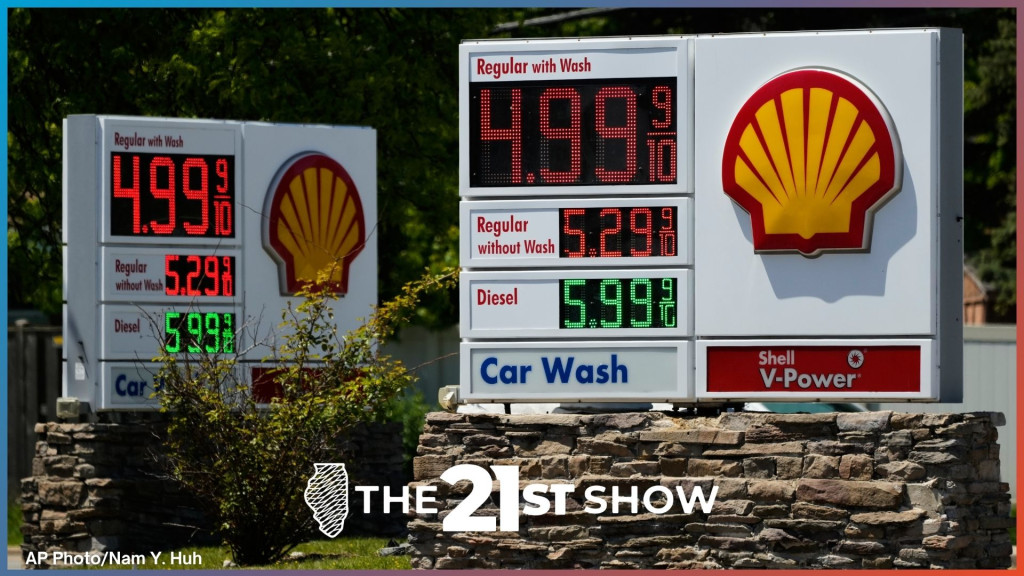
Brian Mackey: From Illinois Public Media, this is The 21st Show. I'm Brian Mackey. Illinois drivers are paying more than $5 a gallon for gas this week, among the highest prices in the country. The immediate cause is war in the Middle East, a U.S.-Israeli military campaign against Iran that began in early March. Iran, although militarily degraded, has effectively shut down shipping through the Strait of Hormuz, which is a critical choke point for global energy supplies. But the story goes well beyond gas prices. The military campaign is already reshaping the region's politics in ways that will outlast the conflict itself.

We heard from a range of listeners this morning on how you are feeling the effects of this conflict in your wallet, so to speak. Jay in Elburn owns a small bakery in Batavia and says sales dropped noticeably once gas prices spiked. He's not sure what small businesses operating on thin margins can do. Brandy in Urbana lives in a rural area, says she and her husband have no real alternatives. Their commute costs have nearly doubled. And Kevin in Elburn has been driving an all-electric car exclusively for the past year. He says while higher gas prices validate his transportation choices, he still feels the squeeze at the grocery store.

We're moving fast today, I should say. If you have a question or comment, you can join us at 800-222-9455. That's 800-222-9455.

To help us understand these connections, how what is happening in the Gulf is affecting us here in the 21st state, we're joined this morning by Rachel Bronson. She's a scholar at the Chicago Council on Global Affairs, also a senior advisor at the Bulletin of the Atomic Scientists, which is an organization she led for a decade. Dr. Bronson, welcome to The 21st Show. Thank you for being with us.

[00:01:55]
Rachel Bronson: Thank you so much for having me. I'm delighted to be here with you today.

[00:01:59]
Brian Mackey: So when the Trump administration launched this war, you immediately wrote a piece raising questions about the timeline, which was one week, and the strategic objectives, which included regime change, military destruction, and the degradation of Iran's proxy groups like Hamas, Hezbollah. That's how it started. How do you think it's going?

[00:02:20]
Rachel Bronson: Well, I think the fact that we're still talking about it, and there's an active conflict going on right now, even if it's not a hot conflict with the exchange of missiles and drones, but that we've got a blockade and the Strait of Hormuz is effectively closed — it's not going well. The president was very clear when this began about timelines, and that's the piece that I wrote that you're referring to, which he started by saying this would be over in days. He very quickly pivoted, smartly so, to say, well, not days, but four to six weeks. But even that change was instructive. And we can talk about why the four to six weeks was so important, but he did lay that out and we remember the secretary of defense was very clear about that, secretary of state as well, four to six weeks. We're now well past that. And so, given that, I would say it is not going well. It is not going as planned.

[00:03:26]
Brian Mackey: Have you been surprised by Iran's seizure of the Strait of Hormuz, which I just want to remind listeners was free and open to shipping, to global shipping, a couple of months ago.

[00:03:39]
Rachel Bronson: Surprised and not surprised. So the surprise — I think anybody who would say that was something that we expected them to do, that wouldn't be quite right. It is an extraordinary move for them to close the Strait of Hormuz. It is the biggest card that they have when they were going to be really backed into a corner. But to back up, the U.S. military and political leaders have been war gaming and planning and concerned about and recognize the vulnerability of the Strait of Hormuz. This was one of the worst things that could happen, and this is a card that American planners, European planners, Asian planners all knew that they could play. So it's not surprising, and yet to see it happen conveys how significant this conflict is for the Iranians and everyone in the region.

[00:05:00]
Brian Mackey: What's the cliche? You're shocked but not surprised. Maybe that's —

[00:05:03]
Rachel Bronson: Exactly it. Thank you for that. I'm shocked but not surprised. Thank you. And so I think if you go back to the piece that I wrote back in the first few days of this conflict — when the president put regime change onto the strategic objectives of what the United States was seeking to achieve, he facilitated the Iranians making this decision. That to me was — of the many, you know, always in conflict there's mistakes made and unexpected consequences — but to put regime change on the table as a war end, which the president did, and effectively by taking out 40 of its top leaders we had underway, but the moment he said that, it made it an existential war for the Iranian regime. He talked about, you know, going after — later, he talked about going after civilian infrastructure, all of that — but focusing on the regime made it existential. And once it became an existential fight or a fight to the death for this regime, that made the closure of the Strait of Hormuz much, much, much more likely, and we saw the Iranians respond almost immediately.

[00:06:27]
Brian Mackey: So the IEA has warned that energy markets could remain undersupplied through October, even if the conflict were to end soon. Can you talk about what goes into a forecast like that and how you're thinking about what the new timelines for this could be?

[00:06:45]
Rachel Bronson: Sure. The reason the International Energy Agency puts out forecasts like that — and in some ways it's conservative, quite frankly — is they're assessing damage to facilities. They're assessing what kind of storage and stockpiles countries have, and also importantly, how long it takes for the energy supplies in the Gulf to reach ports to deliver their supply. So even assuming that this conflict ended tomorrow, there was some sort of deal and the U.S. relaxed its blockade, the Iranians said it's now open for transit, everybody was safe, the insurance companies believed them, and everything was operating — we still have several factors that are guarding against a return to normal.

And the most obvious one is just how long it takes to move and transit this cargo. It takes weeks to get from the Persian Gulf to ports in China, where a considerable amount of energy [supplies] go. For Iran, China is their largest export market. And it can take up to — it takes about six weeks when things are going well. So one of the things that has been cushioning markets — if you can believe it or not, that they're cushioned — but one of the things that's been cushioning it is that when the conflict began, there was a lot of storage on the open seas. It was called a loose market. There was a lot of excess capacity. There was a lot of full tankers floating around. There was a lot of offshore storage being held. Countries were kind of flush. It was a loose market. And so that meant it would take up to about six weeks to really deplete those reserves that were already out there and available.

And that's why the president's timeline of four to six weeks was so important. And that's why you see the ceasefire come into effect about six weeks, almost to the day of the conflict — the idea was that for those six weeks, all the surplus oil and gas that was on the seas, everything that was moving, could kind of make up the difference. But once you get past that, we start depleting those resources. And now there's nothing coming behind it, or very little coming behind it. And so that's why we've seen countries led by the United States put out — to release the strategic [petroleum] reserve, we can talk about that — but that's why the IEA would say, you know, this is going to be at least to October.

Now, very quickly, that doesn't account for the destruction of facilities that we've seen. And so Qatar is the best example. Qatar, which provides a significant portion of global LNG — liquefied natural gas — their key plant was hit by Iranian missiles, and their estimations [are it's] going to take three to five years to get that back up and going. So we've got a long kind of wait for this to really push through the system. And I've described it as like a snake that's eaten a mouse that it has to work itself through the whole supply chain. And right now it's going to take a long time to get back up and running.

[00:10:54]
Brian Mackey: Just about five minutes left in our time together. I'm old enough — I can remember when I first started driving, which is in the 1990s, you know, gas was less than a dollar. I can still remember the shock I felt the first time I saw a 2 as the first digit on a gas station sign. It was a Shell station in Bolingbrook. I don't know why it's stuck in my head all these years. Now that seems quaint. Are we going to just have to get used to 4s and 5s, and I don't — where is it, 6s, 7s — as the first digit on the gas station sign?

[00:11:25]
Rachel Bronson: Right. So I think for where we are now, those 5s are so shocking. 4s are disappointing and 5s are shocking. So there's — I would say good news, but there's some ways that we can begin to think our way out of it. First of all, the U.S. has been buffered by some of this, by this extraordinary change in our own energy positioning globally — the shale revolution that happened and the innovations around fracking and the horizontal drilling and all of these changes. That have contributed to this kind of shale revolution has moved the United States from an important energy actor and a net importer to a net exporter. That means that we are not immune because pricing is set globally, but we are certainly buffered. And so we feel it in terms of inflationary pressures, in terms of what we're seeing at the pump, but not as significantly as the rest of the world. And that will continue for the foreseeable future.

The extent to which we can reduce our dependence on fossil fuel, that will also help us. So you had the reference to one of your callers who is using an electric car — that was a perfect example. He is benefiting from the fact that there's an energy transition underway that he is part of, but he's still feeling those global prices, especially at the supermarket. So to the extent to which we can continue to diversify our energy mix and pursue all forms of energy inputs, we will benefit from that.

[00:13:27]
Brian Mackey: Do you think — just a few minutes left — but do you think, you know, in the '70s there was this move to smaller cars, or at least that's what I understand the history to be of that time because of the oil crisis. And yet, you know, and then we had high prices during the Second Gulf War in the early 2000s. And yet people were still buying Hummers and they're still buying, you know, Ford F-250 jacked-up sort of pickup truck gas-guzzling things. How long do you think prices have to stay up to really create like a secular change in American vehicle culture and fuel consumption and that sort of thing?

[00:14:08]
Rachel Bronson: You know, it's a great question. And when we compare to the '70s, the American economy is significantly more energy efficient than we have been in the past. And that's a real tribute to individual decisions, corporate decisions, government decisions, policies made to reduce the amount of energy required to do anything.

So there's a pause there — to the extent to which the trend continues. What concerns me a little bit right now in terms of American energy policy is this real focus on doubling down on carbon, on gas and oil. We have it in considerable amounts and that's beneficial to us. But I would like us to be aggressively pursuing an all-of-the-above strategy, which includes renewables and federal policies advancing renewables as well as nuclear. That's a big issue here in Illinois. We are a nuclear superpower. 55% of our energy comes from nuclear power. The governor has made some important changes to regulations to support a nuclear base. Anything that we can do to diversify rather than doubling down on gas and oil would be beneficial to the United States. And if we can keep doing that and keep working towards meeting new and more aggressive efficiency standards, we will be protected and those swings will hit us less hard. We're seeing some of that if you compare to the rest of the world, but we still have a long way to go. And what concerns me is current policy, which is just focused — it seems to me — on oil and gas as our path out.

[00:16:01]
Brian Mackey: Yeah, we've left behind all of the above. Rachel Bronson is the Lester Crown non-resident senior fellow for energy and geopolitics at the Chicago Council on Global Affairs. That would be a great tease for a future conversation. I hope we can have you back. Thank you so much for being with us today here on The 21st Show.

[00:16:18]
Rachel Bronson: Thank you. It's a pleasure to be with you today.

[00:16:21]
Brian Mackey: More to come after a break. This is The 21st Show. Stay with us.
Transcript Assistance
Illinois Public Media may use AI assistance for transcript generation and/or formatting. Transcripts that have not yet been reviewed for accuracy will be labeled.
To report a transcription error, or to request transcription of archival material, please contact will-help@illinois.edu.