








Transcript: ‘Los Yarderos’ explores lives of Mexican yard workers in the Midwest
Transcript: ‘Los Yarderos’ explores lives of Mexican yard workers in the Midwest
The 21st Show
‘Los Yarderos’ explores lives of Mexican yard workers in the Midwest
Read the full story at https://will.illinois.edu/21stshow/Book-explores-lives-of-mexican-yard-workers-in-the-midwest.
Transcript
// This is a machine generated transcript. Please report any transcription errors to will-help@illinois.edu.

[00:00:00]
Brian Mackey: It's the 21st Show. I'm Brian Mackey. Summer and fall are big seasons for landscapers and lawn workers across Illinois, the people that so many rely on for everything from gardening to keeping grass mowed. Many of those workers are immigrants who came from Mexico in search of a better life for themselves and their families. They face many challenges from being able to make enough money to survive each month to facing the threat of immigration enforcement. And the work itself is grueling. Still, these workers carry out their tasks in search of the American dream.

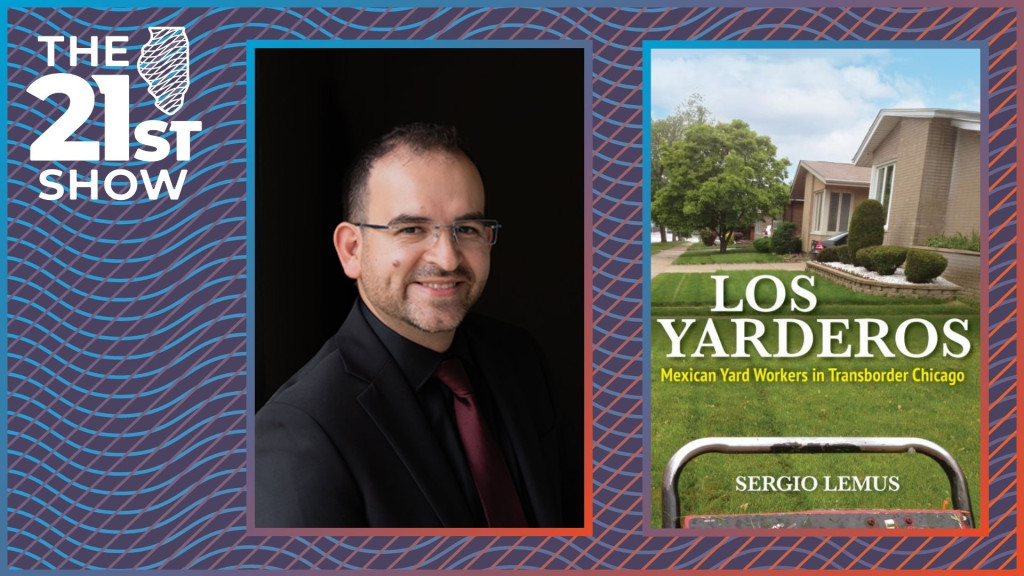
Sergio Lemus is currently an assistant professor in the Department of Anthropology at Texas A&M University. His family migrated from Mexico to Chicago when he was 11 years old, and now Sergio's written about the experiences of many Mexican immigrants who call Chicago, Illinois, and the Midwest home, trying to make a life for themselves. His book is "Los Yarderos, Mexican Yard Workers in Transborder Chicago." It's out now from the University of Illinois Press. Joining me now to talk about this is Sergio Lemus. Professor Lemus, Sergio, if I may, welcome to the 21st show.

[00:01:12]
Sergio Lemus: Oh, thank you very much for having me in. It's a wonderful opportunity to tell your listeners about the work that I have done in the last decade or so with the yarderos in Chicago.

[00:01:26]
Brian Mackey: And I should say to our listeners, in order to make our schedules meet, we spoke last week because — we're not taking calls live today, but you can let us know what you thought. Our email address is talk@21stshow.org. I want to begin by asking you, I was so struck by a passage from the book, some of your field notes talking about your own experience with this work back in 2013.

[00:01:50]
Sergio Lemus: On a hot, humid, and exhausting June afternoon, drops of sweat slowly slide down my brown face as I mow lawns — yardas — for residential clients while the heat approaches unbearable temperatures in the triple digits. I have thick, dark eyebrows. Sometimes the sweat settles there until I wipe my hand across my brow. My green button-down shirt is wet from the saline elements the body expels. Sticky grass clippings and dirt texture my pants. We're in the middle of June and as we approach the Fourth of July celebration, we're putting in extra hours so the lawns of our clients will look pretty for that day. I am wearing brown work boots and my left foot has started to hurt from eight hours of walking and mowing with only noticeable short breaks. Just like any other landscaper in Chicago, we usually work for 10 hours during the summer. On the way home, I regularly see lawn care workers or maintenance workers — called yarderos — still mowing grass around 7 or 8 into the late evening.

[00:03:15]
Brian Mackey: Thank you for reading that. So it's not just a yard worker, it's a yardero. Talk about what that term represents.

[00:03:22]
Sergio Lemus: Yes, so the term yardero, it is a term that many of these lawn service workers or landscapers identify as such culturally speaking. Usually, a yardero or a landscaper perceive himself or herself as a yardero once they typically have worked for a number of years mowing the grass of residential homes in the city of Chicago. In other parts of the United States, for instance, in Los Angeles, they often call [themselves] jardineros or in places like Texas, the Dallas area, they often call themselves yarderos or jardineros, but particularly the case in Chicago, this is where I found them talking about yarderos.

Now, one of the interesting sort of cultural and historical elements that I found is if you recall the early history of meatpacking and cattle ranching in Chicago, I mean, Chicago right now is mostly urban, but back in the early 1900s or late 1800s, early 1900s, there were still cattle in Chicago.

[00:04:42]
Brian Mackey: That's where the Back of the Yards neighborhood gets its name from.

[00:04:45]
Sergio Lemus: Correct. And also, of course, the yard itself, the Back of the Yards being an area where there's warehouses that are often called the — the space where the warehouse is not — is in the open, it's called the yard. So linguistically it links between these different spaces, the yard and now of course the backyard of our homes in Chicago — we usually call them the yard or the backyard, the front yard — but once you translate that into Spanish, it is people understand it to be la yarda, la yarda de atrás or la yarda de frente, and if you're constantly in that space mowing the grass of the yard, then you acquired the sort of the identity of the environment that is la yarda. So if you are mowing the grass then typically in the context of Chicago you are a yardero yourself.

[00:05:42]
Brian Mackey: What brings people specifically to Chicago and the Midwest?

[00:05:46]
Sergio Lemus: According to the work that I did and the people that I interview and hang out with covering all this research, some of them came in the late 1970s, others in the mid 1980s and the great majority began to arrive to Chicago — at least [to] work in this area — in the mid 1980s, mid 1990s I should say. And of course it has to do with the economic cycles back in Mexico, the need to find a better life in the North, the need to put money on the table for their families back in Mexico, so it's that process of migration that has been going on since Chicago — which was, the early Mexicans came in the 1900s as a consequence of the Mexican Revolution. And slowly grow — the Spanish-speaking community is slowly growing in this area of South Chicago where by the 1970s it was around 50-60,000 Mexicans and by the end of the 1990s, you're looking at a substantial amount of Mexican population that [was] in the city — and of course the main reasons are basically seeking a better life in the north, looking for jobs so they can also take care of the families back at home.

But another process that happened in the early 2000s is that many of these migrants after a couple of years working in la yarda began to bring their families back over in the early 2000s, in the early 2010s. Yeah, so, so that's some of the kind of the — if you kind of focus on the economic reasons, which are usually the case in this wave of migrants and working class that I looked at.

[00:07:37]
Brian Mackey: All right, we are going to take a break. If you're just joining us, it's the 21st Show. We're talking with Sergio Lemus who worked and talked on the ground with Mexican yard workers in Chicago to learn more about their experiences of immigration, work, and life in the Midwest. And he talks about that work in his new book which is called "Los Yarderos, Mexican Yard Workers in Transborder Chicago." Sergio is also an assistant professor in the Department of Anthropology at Texas A&M University. Our program's on tape today, but you can let us know what you thought by emailing talk@21stshow.org. We're going to continue after a short break. This is the 21st Show. Stay with us.

It's the 21st Show. I'm Brian Mackey. We are talking for the rest of the program today about Mexican migrants who come to Illinois and the United States in search of opportunity, many of whom have taken on jobs as yard workers, mowing lawns, gardening, handling other landscaping work. Sergio Lemus, assistant professor in the Department of Anthropology at Texas A&M University — he himself migrated with his family to Chicago at the age of 11 — he writes about the experiences of these yard workers in his book "Los Yarderos, Mexican Yard Workers in Transborder Chicago." It's out now from the University of Illinois Press. Our program is on tape today, so no calls, but let us know what you thought. Our voicemail line: 217-300-2121.

All right, Sergio, there's often this perception of academics is detached from the people they are talking about. They're sometimes said to be talking about them, not with them. You talk in the book about the experience of working as a yardero yourself. Talk to me about the importance of that to you.

[00:09:28]
Sergio Lemus: Yes, I mean, it's very critical, and you're right, it is this perception that academia is somewhat detached from the everyday workings of populations and for various reasons that we can get into, but basically, I did carry out [a] different approach. I was trained at the University of Illinois, the Department of Anthropology by now a retired faculty from that department, Dr. Alejandro Lugo. He carried out research with maquiladora workers in Ciudad Juarez and he carried out this very close — what I would call it follow the subject or close to the subject research — where you basically carry out the same activities as the people that you study. In his case, he did work alongside with maquiladoras, going and being hired and working the work day — and in my case to bring back to Chicago, I decided to do the same. The actual fieldwork experience was for about 16 months and out of those 16 months, seven of those months were working alongside with the landscapers, the yarderos.

So I [would] work with two crews and the main crew that I work with, they would pick me [up] at 7:45 a.m. from my home in South Chicago and then we basically drove to the neighboring areas of middle-class African Americans and upper-class white residents in the area and basically start mowing, [mow] for 10 hours with a half an hour break in between and be dropped home. Mostly for five days of the week and then Saturday was kind of a lower pace but still very intensive work. So I decided to carry out this research in that way so I could get a better understanding of basically what working-class folks experience rather than assume or in a very objectivist way assume what they experience.

[00:11:47]
Brian Mackey: Were people suspicious of you, this college guy coming in with a notepad or, or maybe you didn't appear that way to them? I don't know.

[00:11:53]
Sergio Lemus: To some degree, there's always this perception of — they know that I'm doing some kind of a work at the university and I'm hanging out with them so they're suspicious at the beginning of course. I have done already some kind of pilot research in 2009 and by the time that I got to do this research in 2012 and 2013 they knew me to some degree or they knew folks that knew me. So it was not at all, um, at least my perception was that it was not at all like strange that I was hanging out with them and oftentimes they would ask me, well, what are you doing working here with us and I would say, well, I'm trying to understand issues of migration and what it's like to be a working class [person].

Of course from the perspective of them they might say well there's nothing to it, we basically work all day, but from my perspective of course I got to explore issues of race, issues of class differences, of class within the working-class population and tackle issues on immigration towards the end of the book that I eventually wrote during that time.

[00:13:12]
Brian Mackey: Yeah, let me, let me ask you [about] — cause one of the interesting things you write about is how perceptions of skin color in Mexico follow these workers to America and also evolve in the process. How does that happen?

[00:13:25]
Sergio Lemus: Correct, so without getting into much of the historical academic arguments and all of that, we have this understanding for a long time that the U.S.-Mexico border, once a person crosses the U.S.-Mexico border that there's this process of acculturation into mainstream society. A lot of the research that we have done — if I include myself in fields such as Chicano studies, Latino studies, border studies, and of course critical studies of anthropology — we find out that no, that many migrants don't necessarily want to acculturate as we perceive that other European migrations did such as Italian, Polish, or other Eastern [European] groups — and that is even a question mark to sort of not to complicate the argument, but in this case, going back to my research, I, the color hierarchies that [have] been in Mexico for since the colonial period do not disappear or the argument that some of us are carrying is that these color hierarchies do not disappear in 1910 with the emergence of the Mexican nation state or even in 1910 when there was a big push by the Mexican government to blanquiar la raza or whitening the Mexican race, that this continue and just because folks cross an international border that doesn't mean that they leave behind either the previous color hierarchies and what I document is sort of the — not only that they don't leave them behind but they also incorporate other hierarchies more intensely such as as they interact with African American folks in the context of South Chicago.

So I add that sort of that layer of understanding to — while we might perceive race relations through color hierarchies which are often difficult to distinguish even analytically or we might be speaking about race, but we're actually referring to culture. We often talk about culture, but we're referring to race or class or other markers.

[00:15:44]
Brian Mackey: Lots of overlap in those. Yeah.

[00:15:47]
Sergio Lemus: Yeah.

[00:15:48]
Brian Mackey: You know, you mentioned that you did a lot of this fieldwork 2009, 2012. The world has changed. America has changed a lot in that time. And I wonder how the politics of immigration and immigration enforcement affected the workers you write about then and I don't know to what extent you can speak about it now with what we've been seeing in the past year.

[00:16:10]
Sergio Lemus: Well, that's the second book that it is on the contract with Rutgers University Press, where I deal with more closely with this question. But for instance, during 2012, 2013, it was during the Obama administration, kind of the second administration of Obama, well in that transitional period, but by 20 — when I was actually settling to write this book, here we're talking in 2016, 2017 — it was when the, of course, our current 47th president, at that point his 45th presidency, was becoming into the federal government, so, it was certainly —

[00:16:55]
Brian Mackey: I can remember after 2012, the Republican Party nationally had what they called the autopsy and felt like they needed to soften their position on a lot of the immigration issues and things like that. I attended myself a press conference with some of the top Republicans in Illinois when they passed the driver's license, temporary visitor driver's license here. So I mean things really took a turn though when Trump came up.

[00:17:20]
Sergio Lemus: Definitely. So, so yeah, so you're referring to that period when there was a softening, definitely that's how — I think that's a good metaphor to use. It was softening towards undocumented immigration and not only that, I mean in higher education you saw for instance states allowing students to register and pay for in-state tuition, to give another quick example — but definitely they took a turn in 2016, with the increasing xenophobic rhetoric and increasing exceptionalism. Which has been in the United States since the beginning since 1776 — exceptionalism of the United States — but of course in 2016 took a more intense turns where it was about again of defending the borders but in this case the borders of the territorial borders but also the borders within and that's the second aspect that has become more extensive that I mean as I see it there has been an intensification of border surveillance, border policing, but also not only externally outside of the U.S.-Mexico border but internally towards the population of the United States itself and how you see it, of course.

Right now you have ICE in the neighborhood that I published — that I write about this — in the same streets that I mow on. You have ICE officers openly stopping anyone that looks suspiciously to be undocumented and being arrested and sent to a detention center in Chicago so definitely a lot has changed as far as enforcement and surveillance in the last decade, yeah. But during my time it was not necessarily [as] — I don't know, we often have a short memory of not remembering the past, but hopefully this book reminds folks a bit of what can possibly [be] other type of spaces where things were not as bad as they are right now. Although I addressed that at the end of the book with the last chapter on that moment when surveillance increasingly was being mobilized by different small towns throughout the U.S.

[00:19:52]
Brian Mackey: We have just a couple of minutes left in our time together. I guess, as I often ask authors, what do you hope people will take away from the experience of reading your book?

[00:20:01]
Sergio Lemus: Wonderful question. I mean, I — I hope that one of the main reasons why I wanted to write this book is because I wanted to show people that being a working-class person it is hard work, it is very hard work and people do it diligently and in this case the yarderos, many of them have done it for — some of the people that are [in the book] they have done it for 30 years, more than 30 years, some of them 20, some of them 10 — and they wake up early every day at 6 a.m. Get their stuff ready, go out and work very hard jobs and they sweat as I write in the book to make a living in the U.S. and they still believe in the American dream. They still believe in that dream of making it but not only for them but also for their families and I hope they take away that the humanizing aspect of not making quick — hopefully my hope is that they don't make quick judgments as far as policy. When a political figure says, well, let's get rid of everyone, especially if they're undocumented or if they are from a specific ethnic background and hopefully they think twice when making that decision or [appealing] to a certain political agenda whether it be at the state level, local level or federal level. Of course, that is my hope that they sort of basically see the worth of these populations and how they're contributing to the well-being of the United States, economically, culturally, and politically.

[00:21:48]
Brian Mackey: Sergio Lemus is the author of "Los Yarderos, Mexican Yard Workers in Transborder Chicago." He's also an assistant professor in the Department of Anthropology at Texas A&M University. Thank you so much for sharing your work with us today on the 21st Show.

[00:22:04]
Sergio Lemus: Thank you. I appreciate your time.

[00:22:06]
Brian Mackey: That's it for us today. Coming up tomorrow on the program, for generations, gays and lesbians often found community in bars. That has changed in recent years, but political events and the corporate pullback from pride have left LGBT Americans thinking more about separate places they can be themselves. We'll talk about that tomorrow on the 21st show.

Before we go, I want to mention our texting group. We often send messages out about shows we are working on and solicit questions and comments for our guests. You can join that by sending the word talk, T-A-L-K to 217-803-0730. Again, send the word talk, T-A-L-K to 217-803-0730. We appreciate hearing from you about our programs and your suggestions for future guests or stories. Our email address: talk@21stshow.org. You can find that address, the text messaging group, and every other way to contact us on our website, 21stshow.org. We've got our past conversations there, and you can find links to subscribe to our podcasts or just look us up on Apple, Spotify, YouTube, or wherever you listen.

The 21st Show is produced by Christine Hatfield, Harrison Malkin, and Jose Zepeda. Technical direction and engineering come from Jason Croft and Steve Morck. Reginald Hardwick is our news director. The 21st Show is a production of Illinois Public Media. I'm Brian Mackey. Thanks for listening. We'll talk with you again tomorrow.
Transcript Assistance
Illinois Public Media may use AI assistance for transcript generation and/or formatting. Transcripts that have not yet been reviewed for accuracy will be labeled.
To report a transcription error, or to request transcription of archival material, please contact will-help@illinois.edu.