








Transcript: A deep look into the past and future of Native American mascots
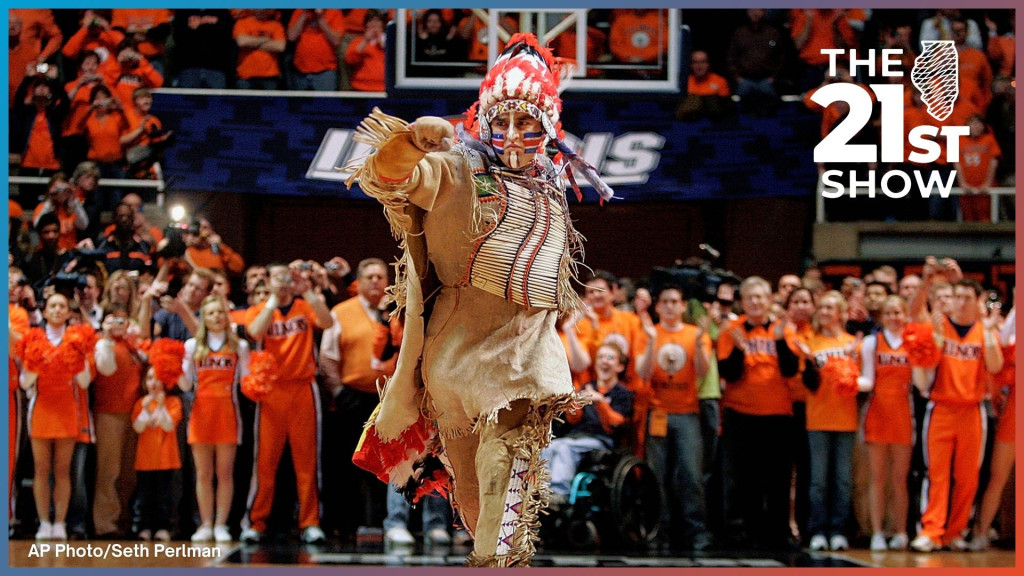
Transcript: A deep look into the past and future of Native American mascots
The 21st Show
A deep look into the past and future of Native American mascots
Read the full story at https://will.illinois.edu/21stshow/a-deep-look-into-history-of-native-american-mascots.
Transcript
// This is a machine generated transcript. Please report any transcription errors to will-help@illinois.edu.

[00:00:00]
Speaker 0: Today on the 21st show, from Chief Illiniwek to high school gymnasiums, Native American mascots remain a flashpoint in American sports. But what does the research say about their effects? We'll talk with Harvard psychologist Joseph Gone. He's a University of Illinois alum and a member of a Montana tribal nation. I'm Brian Mackey. The science and stakes of Native American mascots coming up today on the 21st show, which is a production of Illinois Public Media, airing on WILL in Urbana, WUIS in Springfield, WNIJ in Rockford-DeKalb, WVIK in the Quad Cities and WSIU in Carbondale. But first, news. From Illinois Public Media, this is the 21st show. I'm Brian Mackey. President Trump has threatened to block a new football stadium for the Washington Commanders unless the team changes its name back to what it used to be. Here in Illinois, an Illini basketball player wore Chief Illiniwek sneakers during a game last fall, sparking reaction, pro and con. And a group called the Native American Guardians Association claims that 90% of Native Americans actually support Indian mascots. Our guest today has spent decades studying these questions as a psychologist, as a member of the Aaniiih Gros Ventre Tribal Nation, and as a University of Illinois graduate student who campaigned against Chief Illiniwek in the 1990s. Joseph Gone is a Ph.D. psychologist. He's also a professor of anthropology and of global health and social medicine at Harvard University. He's the faculty director there as well of the Harvard University Native American Program. And finally, he's giving a talk later this month at the University of Illinois. We'll have more information on that later in the program and on our website twentyfirstshow.org. For now, Joe Gone, welcome to the 21st show. Thanks for being with us today.

[00:02:19]
Joseph Gone: Thank you, Brian. It's a delight to join you.

[00:02:22]
Speaker 0: I want to start with your background. Can you tell me about where and how you grew up?

[00:02:29]
Joseph Gone: Sure. I was born in Helena, Montana, and I've been reared in lots of different cities in Montana, five or six of them throughout my developmental years. I went to junior high and high school in Kalispell, Montana, which is northwestern Montana, kind of near the entrance of Glacier National Park, and left when I was 18 years old for a Bible college in Oklahoma, where I spent a year before joining the army and going to school other places eventually.

[00:02:55]
Speaker 0: Yeah. So what did you understand about your heritage, your sort of Native American heritage when you were growing up?

[00:03:03]
Joseph Gone: Well, it was something that was very important to me since I was very young, and yet also something I hadn't plugged into as much until I went home to the reservation during my college years. After I got out of the army and transferred to a new university, I spent summers on the reservation and got to know a large extended family and my tribal community in ways that have been really important for shaping my life ever since.

[00:03:30]
Speaker 0: Yeah. And I don't mean, I hope it's not too personal, and if I do ask something that is, feel free to tell me we should move on and we will. But I am curious because, you know, part of what your research looks at is some of the stereotypes of Native Americans and, you know, the warriors is one of those. And I'm curious what drew you to the military and eventually to study for a time at West Point.

[00:03:52]
Joseph Gone: The United States Army provided an opportunity for me after my first year of Bible college where I got disillusioned and wanted some time to sort out what was what and needed money for college. And so at that time, the GI Bill offered [enlistees] an opportunity to earn money for future college. So that's what drew me. A number of my buddies from high school had done that sort of option as well. And so that's why I enlisted for a three-year period, although I only served two years of that because I got inspired by some army officers during my time in the military who had West Point in common. And by talking with them, I was encouraged to try to get a congressional nomination to go to West Point and with their help and support, I was able to get an appointment and went to West Point to study to be an Army officer. During my time at West Point, two years, three summers, I determined that I wanted to be a psychologist and to help people around mental health concerns. And there's not a quick easy way to do that in the military. So [I] decided to transfer from West Point. You're allowed to do that all the way up until the first hour of your first class during your third year. And that's when I left and transferred to Harvard University to finish up my undergraduate studies in psychology.

[00:04:57]
Speaker 0: What was Harvard like?

[00:05:00]
Joseph Gone: It was intoxicating. It was the antithesis intellectually, I would say, of West Point. West Point, of course, is a fantastic education. It's a very science and engineering based education. It's pre-professionalism honed to perfection. It's all about training you to become an army officer. Harvard was an opportunity to really think intellectually less about the professional concerns and more about what are ideas and understandings that really matter and in a field that I cared about, psychology. So it was fantastic. I was there, you know, not quite two years before graduating. And it was in some ways almost overly rich in terms of all that was offered there. I was happy when I graduated to return to the reservation and start work and life there.

[00:05:41]
Speaker 0: From people I've known, you do get an excellent education at the military academies, but you also spend a lot of time learning how to, you know, properly iron a shirt and shine shoes and things like that as well. So you mentioned sort of, it was during college when you sort of reconnected with your tribal community, and correct me if I'm saying that wrong. What can you tell me about the Aaniiih Gros Ventre tribal nation?

[00:06:05]
Joseph Gone: We're a people, Northern Plains people very closely related to our Arapaho kin, who currently have a reservation in Montana, central Montana, the Fort Belknap Indian Reservation. We reside there with our former allies, the Nakoda Assiniboines, and I have Assiniboine ancestry as well as Nez Perce ancestry, some Crow ancestry, but most of my ancestors are Aaniiih. And we as the northern Plains people were the mounted buffalo hunters for, you know, that celebrated portion of U.S. history where horses and guns transformed life on the northern plains because of the nature of horses and guns and trade with Europeans during the historical era. The northern plains was really a cauldron of violence, lots of peoples competing to control the fur trade and access to guns, access to horses. So the warrior ethos very much predominated in our consciousness throughout the past couple of centuries to the reservation era. And so that warrior aspect is something that persists. I think people don't necessarily go into the military only for that. A lot of it's economic, of course, but there is a longstanding celebration of martial values and it is something that persists to this day.

[00:07:16]
Speaker 0: So you eventually end up at the University of Illinois in Urbana-Champaign in psychology. How did that come about?

[00:07:24]
Joseph Gone: As I said, I got excited about psychology and that was my ambition. And so when it came time to apply to doctoral study to become a psychologist, you couldn't in those days especially do much as a psychologist without a doctoral degree. I looked around and found that at the University of Illinois in Champaign there was an emphasis and commitment to a mix of clinical psychology and community psychology. Clinical psychology is about the assessment and treatment of mental health problems. Community psychology broke away from clinical psychology in protest back in the 1960s to sort of say, look, we don't need to harness a medical approach to people's well-being. We can actually collaborate directly with citizens in their own communities to facilitate their solving their own problems on their own terms. And so University of Illinois had a hybrid clinical community doctoral training experience that was just fantastic. I had a fantastic time in graduate school and loved it in terms of all the intellectual stimulation and the preparation for the career I wanted to do. But of course, the downside was that Chief Illiniwek then was dancing at halftime for sporting events.

[00:08:30]
Speaker 0: Did you know that? I mean, how much was that part of your thinking when applying to graduate school?

[00:08:35]
Joseph Gone: I did not know that at all when I applied to graduate school there. In fact, when I came for my first visit, I asked to meet with native students who were there and I was able to meet during that visit with [Olle Perkins], who was getting his fine arts degree there, and [Jabari Groves], who was an undergraduate there, both native students. And I remember we went out to one of the local bars just to socialize and I could ask questions. And you know, they outright told me, don't come here. It's not good for native students. And I remember being very surprised to hear that and they told me all about the mascot and they told me about what happens to native students who complain about the mascot or make public statements against university sponsorship of the mascot. And I remember walking out of there thinking, wow, that's really bizarre. I've never encountered anything like it. It was hard for me to grasp how the mascot could color the consciousness of native students so much. And at that time, it did not feel like it was significant enough to deter me from coming and so, again, I accepted the offer, came to Illinois, had a great experience in the department of psychology there, but did find that in fact, as a native student, you were more or less obligated to sort of stand up and talk to university folks about the fact that they were promoting a harmful racial stereotype, but they shouldn't be doing that.

[00:09:50]
Speaker 0: Well, tell me about that. So, and maybe this is a way to bridge into some of your research. You do end up campaigning against the chief or for the chief's retirement, if you want to phrase it positively. How did you come to be involved in that organization or activity, I guess?

[00:10:07]
Joseph Gone: Native students at most universities are a little bit rare. That was certainly true in Illinois and so when I first got there, it coincided with the arrival of a new assistant dean named Dennis Tibbetts. He also happened to be a psychologist and was serving in that role and a native person. And there were some other students who were already there, of course, but we gathered together as a student community to talk about how we might be more socially engaged as a native community on campus. Again, not very large, so there were probably 10 of us at that first meeting. And the discussion sort of started to split around how much of a focus there should be on mascot activities and asking the university to retire the mascot. About half of the students felt like that was a super important thing to be doing. The other half felt like they just came for their studies and didn't want to be involved in so-called political activity. And so our solution at that time was [to] say, OK, some who want to should do the mascot stuff, but there also should be a community social kinds of activities that could apply to everybody. So that's what we agreed to do. I ended up also spending time with the half a dozen or so folks who were committed to letting the university know this was not acceptable. They needed to change their sponsorship of the mascot. And so during especially those first two years, we spent a good deal of activity and energy figuring out, OK, how do you ask an institution like this university to, you know, listen to reason and to stop its sponsorship of a harmful racial stereotype. No other university in the country would, in the abstract at least, argue that such a thing is acceptable. It gets federal dollars, that's not allowed to sort of discriminate. Why on earth is this institution sponsoring a harmful racial stereotype? And we thought it would be straightforward, but it was far from straightforward.

[00:11:52]
Speaker 0: What form does this take, right? Cause I, and this is what, mid-90s, late 90s? We're talking marches, showing up at trustees meetings? What form does this take?

[00:12:04]
Joseph Gone: Yeah. I arrived in August of 1993 and I was on campus for the 3.5 years through 1997 and during the first years in particular, the group of native students who were interested along with Dennis Tibbetts, the assistant dean psychologist, met and strategized, and there were a lot of marches. There were protests by non-native people on campus who recognized that the chief was a harmful stereotype and also wanted to see the university retire it. The board of trustees had in 1990 officially determined that the symbol would stay the mascot. And so when I arrived in '93, it was some years past official endorsement. And a big part of our strategy efforts were around what I called connecting the dots. Like what is it that you can imagine happening if you take this particular action that could lead to the retirement of Chief Illiniwek as the official university mascot? And we tested each other and prodded each other to say, look, if you're suggesting X, you've got to be able to tell me as you connect the dots how that results in retirement of the mascot. And marching on the streets or, you know, various kinds of antics for us didn't seem like it was going to necessarily accomplish that. We talked, you know, over several meetings, but we really arrived on two different strategies that we thought might connect those dots and might result in retirement of the mascot during those years in the mid-90s. The two strategies were, first, to go to the NCAA and to let them know that this was a [harmful] stereotype and that they shouldn't allow teams and universities to compete who were sponsoring it. The second strategy we hit on was to go ahead and file complaints with the Office for Civil Rights in the U.S. Department of Education, alleging that the mascot created a [standard different treatment] of Native students on campus [in a hostile environment]. And of those two strategies, we [tried] to decide which to undertake in whatever sequence. And we did a gesture to both of them, but we ended up focusing on the OCR complaints as a way to move forward. We filed those complaints in March and April of 1994.

[00:14:15]
Speaker 0: So I want to drill deep and let me remind listeners, this is the 21st show. We're speaking with Joseph Gone. He is a professor at Harvard University where he directs the Harvard University Native American program. He's gonna be giving a talk in Urbana, Champaign, Urbana later this month. We'll have more information on that on our website twentyfirstshow.org. But he has done a lot of research into Native American stereotypes and athletic mascots and how those things relate. I want to drill down on what you said about harmful Native American stereotypes and, and I should say as a preliminary matter, I'm sure you've been having these conversations for decades. It might seem basic to you and perhaps some of our listeners, why are we going into such detail about this? But it occurs to me that there's an entire generation of students now, starting university who have, for whom this is not, you know, there has not been the dancing person at halftime, anytime in their lifetimes or certainly their sort of consciousness. And so they may not be aware of some of all these, you know, some of this research, these things that we're talking about. So I do think it's worth drilling into this. Maybe we can start — you know, and I'm looking at the clock. We have a break coming up. So you know what, let me just say, we're gonna take a break. I wanna hear from our listeners today though. 800-222-9455 is the number if you wanna join us. Maybe you have a perspective on Chief Illiniwek. I know there are a lot of supporters still out there. There are Facebook groups. You can find Chief Merchandise at stores in town. There was a [line] basketball player who wore a set of shoes on court during a game last fall with the chief logo on it. What do you think of this? What do you think of the university's decision to retire the Chief? But also this persistence of the Chief as a symbol, both in sort of sanctioned ways in some sort of surreptitiously sanctioned ways it seems, and in other ways that maybe are just people doing things on their own. But let us know 800-222-9455 is the number if you want to join our conversation on the program today. 800-222-9455. We're gonna continue with Joe Gone after a short break. This is the 21st show. Stay with us.

[00:16:59]
Speaker 2: Support for the 21st show comes from the Des Moines Art Center located in Iowa's capital city featuring works by regional, national, and international artists of the 20th and 21st centuries. Details are at desmoinesartcenter.org.

[00:17:37]
Speaker 0: It's the 21st show. I'm Brian Mackey and we are talking for the hour today with Joseph Gone, a Ph.D. psychologist, professor of anthropology and global health and social medicine at Harvard, faculty director of the Harvard University Native American Program. [In] his work, he's published dozens of papers on mental health and Native Americans. A subset of that work has involved sports, mascots and symbols, and a couple of the titles of his papers include "The Psychosocial Effects of Native American Mascots," "Native Appropriation in Sports," "White American Historical Memory and Support for Native Appropriation," and so on. And we're talking about some of the contemporary issues that still persist with potentially thousands of American schools, mostly schools, having Native American symbols or mascots for their sports teams. He's gonna be giving a talk, January 22nd at the University of Illinois. We'll have more information on that on our website, twentyfirstshow.org. All right, thank you for your patience with our show clock there. So I wanna come back to sort of this idea you mentioned about harmful stereotypes. You co-authored a comprehensive review of, you know, much of the published research on Native American mascots. What does that body of evidence show?

[00:19:01]
Joseph Gone: Yes, the review we published is in the journal Race, Ethnicity and Education, and I collaborated with my colleagues, Laurel Davis Delano and Stephanie Fryberg to publish this review of 19 studies that have explored the psychological effects of native mascots and representations. And the literature that we reviewed includes lots of different methods and approaches, lots of different samples and different effects like the effects directly on native students or the effects on non-native people who are exposed to these mascots. And I think the consistent set of findings is that exposure to native mascots is not good for native people and for other people's perceptions of native people. Let me just give you an example of what this research can look like. The best experimental research has been done by the social psychologist Stephanie Fryberg, who teaches at Northwestern University. And Stephanie did research early on in her dissertation work, which really takes native high school students and systematically exposes them to native mascot and other stereotypical representations. In one of her studies, she actually used Chief Illiniwek as the representation. And then [she] asked native students to, you know, write about their future plans, what they expected for themselves down the road in life. And what was interesting is that exposure to the mascot versus a condition which did not expose them to that mascot led them to have shortened ideas, less ambitious ideas about what they might do in the future. So that's the kind of example of an experimental study. So the only difference between the outcomes was whether they were exposed to the mascot or not. [It] shows that native young people can have foreshortened futures relative to their expectations and ambitions in life just by simple exposure to a mascot. Like I said, there are 19 studies. Most of them are not about native students and those direct effects. A lot of them are about what happens to non-native people who are exposed to these mascot representations, and those also show that people end up, surprise, surprise, endorsing stereotypical portrayals, not being as supportive of native rights and modern native people in all kinds of ways. So it's an important review and I refer people to it because it does provide the set of evidence that helps to help lead us to understand that native mascots are not good for native people or our society if we care about inclusivity and appropriate respect and regard for all peoples. The only thing to underscore that I'll add is, you know, not one study found positive effects of these mascots and their representational power over people. There's not one good thing that comes of it. So of course the studies were designed to explore certain psychological impacts. Obviously they're popular because they do serve a psychological function for lots of non-native people like former Illinois students and the community as well as the large group of alums today who probably many of whom would love to see the chief come back.

[00:22:03]
Speaker 0: Well, maybe this is a good time to go to the phones at 800-222-9455. Because on that idea of is there something positive to come out of these symbols, we have Eric calling from Princeton, Illinois. Eric, thank you for calling in.

[00:22:17]
Eric: Thanks for answering. I appreciate that. I've got, I'm, and I preface my everything with, I, first of all, I'm educated. I can't empathize with you because I'm not American Indian and I can't sympathize for you because that sounds too wimpy, but I have spent a lot of time trying to understand and study and not just see the symbols in an Indian coloring book that represents the Indian. So I have two questions for you. One, why instead of, and I'm not disagreeing with you, I just wanna, I just wanna continue to learn. Instead of trying to ban the mascot, why didn't you embrace it and say this is an American Indian, this is a brave, this is a chief, this is where we came from, this is what we were. Sort of like the negroes are doing now saying, hey, you know, [that] was us with the slavery. Instead they're saying we, we survived slavery and we're a strong people. Why didn't American Indian take that aspect [with] the mascot? And the second question is the moderator stated that there's a whole couple of generations of people coming in and understanding that. And I lived in Naperville when they changed Redskins and I remember the, you know, all that. It was a big issue and it still is and it still should be. But my second question is, since there is not more mascots, but the one Chief Illiniwek was out there and drew attention to the American Indian by the thousands if not hundreds of thousands. Now that he's taken away, do you not regret, but can you see that not everybody now knows about the plight or understanding about it when if you still have that mascot, you could direct that attention towards more education? Do you not regret that, but can, could, should that have happened?

[00:24:10]
Speaker 0: All right, Eric, thank you. Thank you so much for calling in, Eric. I appreciate it. Joe Gone, I'll let you take that.

[00:24:17]
Joseph Gone: You know, what was really clear from our efforts at the University of Illinois during the mid-nineties is that everyone we talked to about the harmful effects of the mascot, some of whom were sympathetic, basically were not interested in doing what we asked. And what became very clear is that the mascot and the entire chief performance and complex, if you will, was not about Indian people at all. If the University of Illinois leadership at that time had cared about Indian people, they would have hearkened to what we had to say. They would have found ways to support and be more inclusive of the native community there, etc. and that's not what happened. So the problem with these mascots is that they're not about native people at all. They're about, you know, white people fantasies about native people, which have to do with a bunch of complicated psychological dynamics again that have nothing to do with the Indians. What they tend to be about are what my colleague here at Harvard, the historian Philip Deloria, refers to as playing Indian. And he has a whole analysis of how throughout American history, playing Indian has served white American goals and projects. And those include things like [a] partaking of a kind of indigeneity or aboriginality to the U.S. nation state and the continent of North America. Because people arrived from Europe and they had to come up with a new identity that was no longer European. And so when the Boston Tea Party involved people dressing up as Indians to throw tea against, throw tea in the sea against English taxes and so on. And the Boy Scouts of America and on and on through all kinds of instances that Deloria documents, playing Indian is about white America, partaking of an American identity kind of on the backs or at the expense of native people, because it all presumes that the Indians that matter are long dead and practice cultural traditions that which don't make sense in the modern world and which eclipse and erase what modern native people need and are up to and care about.

[00:26:22]
Speaker 0: At this point, maybe it's a good time. I feel like I want to share a piece of information about myself. And that is in the late 1990s, I was an undergrad at the U of I and like many students, I had the chief on hats and t-shirts. But I also had a more direct and personal stake, which is that I was part of the staff of the Marching Illini. And one of our duties was escorting the chief to the field. You know, one of the assistant chiefs was a good friend of mine. I know he took it quite seriously. He studied history. He tried to imbue the role with what he considered to be maximum dignity. I mention that to say, OK, for me, that was then. Today, and for many years now, I have a different perspective on this, shaped, I now understand by your work and that of others. And I mention all that, not only for disclosure purposes, but to set up your writing about the chief. At least in the past couple of decades ago, you published a piece that acknowledged the symbol means different things to different people. I think we heard some of that with the caller there. How do you think about that divide today?

[00:27:22]
Joseph Gone: I think that divide persists in lots of ways. You know, in university campuses there has been a move to retire some of these symbols and mascots, but American Indian representations are plentiful, especially [at] the high school level. I mean, there's thousands and thousands and thousands of schools in the United States that continue to support native mascots. And so it's an ongoing issue and of course a mascot is important to fans or for school and institutional identity in all kinds of ways. And my experience during the mid-nineties at Illinois was that many people, you know, celebrated the mascot with good intent and for good feelings and for connection to the university, etc. And my question to them in response to that recognition was, well, how come we can't pick a mascot where all of us can feel that connection and this ability to celebrate this great institution? How come it has to be on the backs of a harmful racial stereotype against a certain group of people, including some of us who study at the University of Illinois? And so I recognize that there were sometimes noble intent, but that we have to separate out the difference between intent and effect. Intent and effect. And if your good intent involves promoting a harmful racial stereotype, and if native people who are bearing the brunt of that harm come to you and say, hey, look, this isn't really working for us. It's a problem we need to change it, and you turn a deaf ear and turn your back and say no, well then we have a problem. It's not about dignity anymore. It's about discrimination.

[00:28:59]
Speaker 0: Let me remind listeners, you can join us at 800-222-9455. We're speaking with Joseph Gone. He's on the faculty at Harvard University, heads the Harvard University Native American program there. He's gonna be giving a talk in Urbana later this month. Let's go back to the phones. Mark is calling from Urbana on line two. Mark, thank you for calling in.

[00:29:23]
Mark: Hi, thank you for taking my call. I'm calling because I have some awareness that there's still a great presence of the mascot among the fans at the basketball games [a lot of], or at the tailgating parties that there's a lot of flags and trucks decorated with it. [So on.] And I'm wondering why it is that the leadership at the university has not taken more hold of this by providing [uh what uh] Professor Gone has just stated, which is something we can all rally around. Why is there not a new mascot? And I'm wondering if there's anybody out there among the listenership or there at the, if anybody has any pull with, let's say the chancellor or the athletic directors, at least to get them to listen to this show and to and to attend Professor Gone's talk when he comes to campus. Thank you.

[00:30:28]
Speaker 0: All right, thanks for that, Mark. I appreciate it. And in fact, students have voted a couple of times in favor of, I understand adopting the belted kingfisher, which is this orange and blue bird. I don't think that would run the risk of being considered a harmful racist stereotype. So, I don't know what you think of that or [what] if you want to respond to the caller in any other way, professor.

[00:30:53]
Joseph Gone: Yeah, I do look to the day when there could be an adoption of a mascot that we could all get behind and that would change my attitude to the institution, of course, as an alum who had a great experience and obtained a fantastic doctoral education, but had this as kind of a blight on my time there. I do think it's important to recognize as we did back in the 1990s that, you know, we started with a lot of internal strategy around assuming that reasonable people will hear reasonable arguments in an academic setting and recognize that university sponsorship of a harmful racial stereotype is completely inappropriate and unacceptable. And we went through committee after committee, leader by leader, all the way up to the president and the chancellor and the head of the you know, affirmative action, all the folks, we made the rounds and made our case, and those people never exactly disagreed with us. They just simply said the board of trustees has made a decision and that's that. And so the internal options for leveraging change were really tapped out at that point. And that's why we decided strategically to think about external coercions of the university, whether it was the NCAA or whether it was the Office for Civil Rights in the U.S. Department of Education, you know, that was what was necessary. And of course, in the end, it was the NCAA that was effective in getting the university to retire the mascot. And so I think it's easy to ask how come people aren't being commonsensical about this stuff. But in reality, you know, you've got a huge alumni base. The chief has been dancing at Illinois since the 1920s. It just means so much to folks who are not open and interested in hearing what people like me have to say about it, that I think that, you know, in the end, we can't count on the leadership to do the right thing.

[00:32:40]
Speaker 0: Does it surprise you that we're still having this conversation 30 years after your time at the university?

[00:32:48]
Joseph Gone: I don't think I'm surprised because it's going to take a generation. It makes sense because of the deep alumni base and the meaning of the chief to a university, you know, fraternity. But I also think that, you know, a really important change is that the university no longer officially sponsors. It's one thing what fans do, students, and, you know, individuals do, you know, that's a discussion and dialogue to have with those folks, you know, at whatever time. It really is a problem when a university, an institution of higher education that's committed to the pursuit of truth and of knowledge and is responsible for representing knowledge in faithful and accurate ways to promote a harmful racial stereotype in an official way. That was the main problem. And so that thankfully is no longer the case. That change has happened and I think the rest will take care of itself, although it might take another decade or two.

[00:33:42]
Speaker 0: Let me share another listener reaction. This is an email we got from [Alita] in Normal, Illinois. [Says] it occurs to me that it's pretty ironic when people argue to keep stereotype mascots, claiming that they honor quote unquote, native people, and they are saying so in the context of an institution of higher education. Instead, universities and schools at all levels should be teaching about native peoples, if they really are about education. If you want to join us 800-222-9455. We're speaking with Joseph Gone, who is a professor of anthropology and [of] global health and social medicine at Harvard. He's faculty director of the Harvard University Native American Program. He is also a member of the Aaniiih Gros Ventre Tribal Nation and is an alum of the University of Illinois. [He] earned his graduate degrees here in the 1990s. Again, 800-222-9455. We're going to continue this conversation after a short break. This is the 21st show. Stay with us. It's the 21st show. I'm Brian Mackey. We're talking with Joseph Gone, a psychologist, has a Ph.D. from the University of Illinois, Urbana-Champaign. Today, he's professor of anthropology and global health and social medicine at Harvard and is faculty director of the Native American Program there. 800-222-9455 if you want to join us. Today 800-222-9455. I should also mention he's going to be giving a talk at the University of Illinois called "The Trouble with American Indian Sports Mascots." That's 5:30 p.m. January 22nd, Thursday, upcoming Thursday, not this Thursday, but the following Thursday. At the Knight Auditorium at the Spurlock Museum in Urbana. If you're in town and you want to attend, we'll have more information about that on our website, twentyfirstshow.org. I'd like to also talk about the Washington Commanders football team. President Trump has threatened to block a deal for a new stadium unless they go back to their former name. Just as a preliminary matter, how do you handle that former name in polite conversation?

[00:36:14]
Joseph Gone: Well, I often just say the word, although I'm aware that there are native people who find the word so offensive that they prefer shorthand for it. So I'm not particularly squeamish about the word because in part it doesn't just doesn't have the power of [the n-word] does for black Americans, for example. But some people think that we should really reframe it in that way.

[00:36:38]
Speaker 0: Yeah, yeah. I just, I try to be respectful of listeners and guests. So, OK, so there was a survey. I want to ask about this because the, there's a group that calls itself the Native American Guardians Association, NAGA, which I don't know that that's a coincidence that it kind of rhymes with NAGA. But they point to, they sort of argue on behalf of some of these Native American mascots. And they point to a survey the Washington Post conducted now 10 years ago that purported to find 90% of Native Americans surveyed are not bothered by the Washington quote unquote Redskins name. I wonder what you make of that.

[00:37:21]
Joseph Gone: The problem with surveys of Native Americans in any kind of national context is it's actually a methodological challenge to figure out who to survey, that is who represents Native American perspectives and points of view. Many, many Americans will tell you they have native ancestry, sometimes quite distant, sometimes even imagined. We have a problem with pretendianismism in the United States, which is a whole bunch of people who say that they're native when they're not, for various reasons, some psychological, some exploitative. So who is and who is not American Indian, Alaska Native, Native Hawaiian in the United States is a complicated question. And a casual survey that just asks people who identify as Native American to tell you anything depending on how it goes can be really misleading. And that's the case with the Native American Guardian Association findings. Again, Stephanie Fryberg, my social psychologist colleague at Northwestern University, has a much better sample for people who are truly Native American, that is citizens of tribal nations or descendants of citizens of tribal nations, and in her survey [of research], she's found the opposite, that actually it's a very small number of these folks who would support mascots. So a lot of it depends on the kind of approach you take in your study and unless, you know, these are sophisticated scientists who know about methodology and really take care to figure out who their samples are, these findings are just not compelling.

[00:38:51]
Speaker 0: This is, I mean, the president's move here seems to be part of a broader trend to sort of, what would you say, make a disparaging language acceptable again. I wonder what went through your mind when you heard him making this specific demand.

[00:39:09]
Joseph Gone: Seems like it's par for the course, you know, my take on Make America Great Again is [to] a national move to roll back the progress of civil rights and to centralize and privilege white people and white experiences as the true American experience, which of course is deeply ironic to native and indigenous people whose ancestors have been in this continent for thousands, tens of thousands of years. So we know who the true Americans really are, but you know, in the kind of colonial dynamics of nation states like the U.S., you know, we are, are systematically excluded, marginalized, and erased from public life in any kind of modern form, and our views and perspectives are, you know, not solicited, not encouraged, not listened to, and not heeded. And so that's the challenge that we face as a beleaguered contemporary indigenous polity is to try to figure out how best to make our voices heard and our perspectives known, and it's a big challenge with you know, harmful racial stereotypes being promoted at the highest level of university and sports.

[00:40:21]
Speaker 0: Let's go back to the phones, 800-222-9455. We have Melvin calling from Carbondale. Melvin, thank you for calling in. Thank you. Go ahead. I understand you wanted to respond to one of the previous callers.

[00:40:37]
Melvin: Yes. [No.] In reference to names and identification of people, there's no Negroland, so how [people referred to as] Negro, African, African American, Black, the, the blend of native people with African people was once, [um], a big thing in the Seminole Nation and Florida and so forth so to identify persons of color, especially, how do we come to getting a clear depiction of who people are, because there was a time, I believe [you were one-fourth] Indian, you were entitled to some provisions that were for Indian population.

[00:41:38]
Speaker 0: All right, Melvin, thank you for the call. Appreciate that. Joseph, do you have a perspective on that?

[00:41:46]
Joseph Gone: In the U.S. we tend to default to racial identification as being something that an individual determines for him or herself. And so whether you identify as black American, Latin American, Native American is sort of up to you and on the U.S. census we'll ask questions about your racial background and you check the boxes. But when it comes to American Indian Alaska Native status, as I said, these are complex identity categories, but there is a difference in the sense that we do have over 570 plus American and Alaska Native tribal nations in the United States. These are semi-sovereign polities that because of a history of treaty making and U.S. federal trust responsibility and so on, these are tribal nations that are nations within a nation. And our nations within a nation actually set our own citizenship requirements. It's often referred to as tribal enrollment. And you either are or you are not a citizen of a federally recognized tribal nation in the United States and that in some ways is the core of who should be considered American, Indian or Alaska Native. Now there's people who, you know, are descendants of those folks and who are not citizens themselves. There's a lot of areas around the edges to fold in more people as legitimate claiming American Indian Alaska Native identity. But at least in our instance, because of the history of treaties, because of the federal trust obligation, because of the nation to nation relationships that exist between tribal nations in the United States, there is a sort of basic foundation of tribal members to draw on for purposes of identifying who is American Indian and Alaska Native and who's not.

[00:43:24]
Speaker 0: We had another person who wrote in asking about place names. And if that is, you know, how that relates to what we've been talking about today, right? So many states and cities and rivers and land features and other things have Native American stories behind their names. Is that a different story in your view?

[00:43:47]
Joseph Gone: It is different because place names themselves are not necessarily stereotypical in the way that mascots usually are, but it does index a particular phenomenon in the modern U.S. which is important to call out because mascots are a part of it, which is that American Indian and Alaska Native indigenous people in the United States are both simultaneously everywhere and nowhere. We're everywhere in the sense that our, our names, our languages, our designations of places, our representation of portrayals in cartoons, in commercial merchandise, in sports teams mascots is sort of everywhere and Americans are exposed to those in really regular ways. At the same time, actual modern living native people are almost nowhere in the sense that almost no one in America knows living, breathing modern native people and has been exposed to the interests and perspectives of our communities. And so we're always battling the representations that lock us in the past, that too often stereotype us and that undermine our ability to engage in modern lives with a view to a future that's good for generations to come. And so I think the place names are just an index of the American heritage. It's back to the psychological dynamics of playing Indian. It's about America becoming American and not European junior. Um, and so, [Europe Junior,] and so there's just all these dynamics that are at play, but the main point is this: native peoples exist today. We occupy some 570 plus tribal nations. We are engaged in ongoing struggles for securing our sovereignty, for imagining great futures for our descendants, and that too often is [eclipsed by] all this other stuff, whether it's mascots, which are harmful racial stereotypes, or whether it's just dead Indians or dead Indian cultures that America has a steady diet of, but therefore imagines or thinks that we don't matter or that we in fact vanished as people imagined in the beginning of the 20th century.

[00:45:51]
Speaker 0: And until recently, there were no tribal, at least recognized tribal lands in Illinois, but of course, Chicago has one of the largest urban Native American populations in the U.S. worth noting that. Let's see if we can get one more caller in. Lee is calling from Princeton. Lee, thanks for calling in.

[00:46:07]
Lee: Well you're welcome. I was also a graduate student at the U of I during the 1990s. I [was] off campus and I worked off campus as an employee of the U of I. I, on the rare occasion when we had a class and it was brought up about Chief Illiniwek and the movement toward, uh, retiring him, the response from any of the, the one teacher and any of the classmates, um, was negative to retiring the chief and maintaining the status quo. I found that a little bit offensive, but not, not, I didn't, I understood it. I, when I was younger, I also took my turn playing Indian. I was fortunate enough when I got older [to through] personal interaction with the actual people of uh Indian-American heritage to find out that they, they go to school, they speak English, they live in houses, they interact in the society like the rest of us do. They're not running around. Um Um, with, uh, war bonnets on [and that] except when they are performing. Yeah, Lee,

[00:47:51]
Speaker 0: Lee, I'm sorry to cut you off. We're so short on time. I appreciate you calling in and sharing that. And maybe we can wrap this into a final question, Joe, with our time running out. I mean, Lee evolved. I talked about my own journey on this topic. What gives you sort of hope or or is it dispirited at the fact that you're still having this debate 30 years after you began?

[00:48:15]
Joseph Gone: It's not so surprising that the debate goes on because there are so few native people, as I said, maybe no one knows for sure, but about 5 million tribal members, tribal citizens in the country probably. And that means that we're just such a small group that it's hard to have the personal relationships with non-native folks that really make the difference in these matters. But what Lee just talked about is the importance of a personal interaction and a personal relationship that mattered. And so to me, that's what's really important. You can't say you honor Indian people through promotion of a mascot. Honoring Indian people would mean seeking out and honoring personal relationships with living, breathing modern native peoples. And so until you do that, I think that your rhetoric about honoring us just isn't compelling or persuasive, and we need more personal interactions, personal relationships. That's the solution to racial difference and racial animosity in our country more generally.

[00:49:08]
Speaker 0: Joseph Gone is an alum of the University of Illinois Urbana-Champaign. He is also a professor at Harvard University. He's gonna be on campus in Urbana at the Spurlock Museum giving a talk late afternoon, January 22nd. We'll have a link with more information about that on our website, twentyfirstshow.org. Joe Gone, thanks for taking the time to speak with us today here on the 21st show. Safe travels to Illinois.

[00:49:33]
Joseph Gone: Thanks so much. Look forward to coming.

[00:49:37]
Speaker 0: And that is all the time we have for our program today. Coming up tomorrow, we're going to continue our series of conversations with candidates for the United States Senate. We'll be talking with Democrat Kevin Ryan. He's a teacher and Marine Corps veteran. We want to know what questions you have for him and other candidates. You can do that by leaving a voicemail at 217-300-2121. Once again, our voicemail number 217-300-2121. Any questions for Mr. Ryan or anyone else running for Senate, we're gonna be interviewing many more candidates in the weeks ahead. That is it for us today. The twenty-first show is a production of Illinois Public Media. I'm Brian Mackey. Thanks for listening. We'll talk with you again tomorrow.
Transcript Assistance
Illinois Public Media may use AI assistance for transcript generation and/or formatting. Transcripts that have not yet been reviewed for accuracy will be labeled.
To report a transcription error, or to request transcription of archival material, please contact will-help@illinois.edu.