







Transcript: A look into the debate surrounding Data Centers in Illinois
Transcript: A look into the debate surrounding Data Centers in Illinois
The 21st Show
A look into the debate surrounding Data Centers in Illinois
Read the full story at https://will.illinois.edu/21stshow/a-look-into-the-debate-surrounding-data-centers-in-illinois.
Transcript
// This is a machine generated transcript. Please report any transcription errors to will-help@illinois.edu.

[00:00:00]
Brian Mackey: It's The 21st Show. I'm Brian Mackey. There's been a lot of talk about data centers and how local governments in Illinois should approach them, approve them in their area, encourage them even, or say, no thank you. Those against say they're a nuisance to the neighborhood in which they'd be located. They're an environmental concern because of the water and energy they consume. Those who support them say, hey, this could mean more jobs, a significant increase in tax revenue that could benefit the community in other ways. Either way, municipalities across Illinois have taken different approaches to this. And for the rest of the program today, we're going to focus on three in particular: City of Joliet, Champaign County and Sangamon County. Bob Okon covers the Joliet area for the Herald News. Bob, welcome to The 21st Show. Thanks for being with us. Also with us, Abigail Bottar, agriculture and environmental reporter for our home station, Illinois Public Media. Thanks for being here. Thanks for having me. And Dilpreet Raju, staff writer at Illinois Times, is back again. Dilpreet, welcome back to the show.

[00:01:11]
Dilpreet Raju: Thanks for having me.

[00:01:12]
Brian Mackey: You can join us. It's going to be tight on time, 15 minutes, 800-222-9455 though, if you have a question or comment on potential data centers in your area. Dilpreet, I'll start with you. What did Sangamon County decide to do and, and give us a brief overview of how it got there?

[00:01:28]
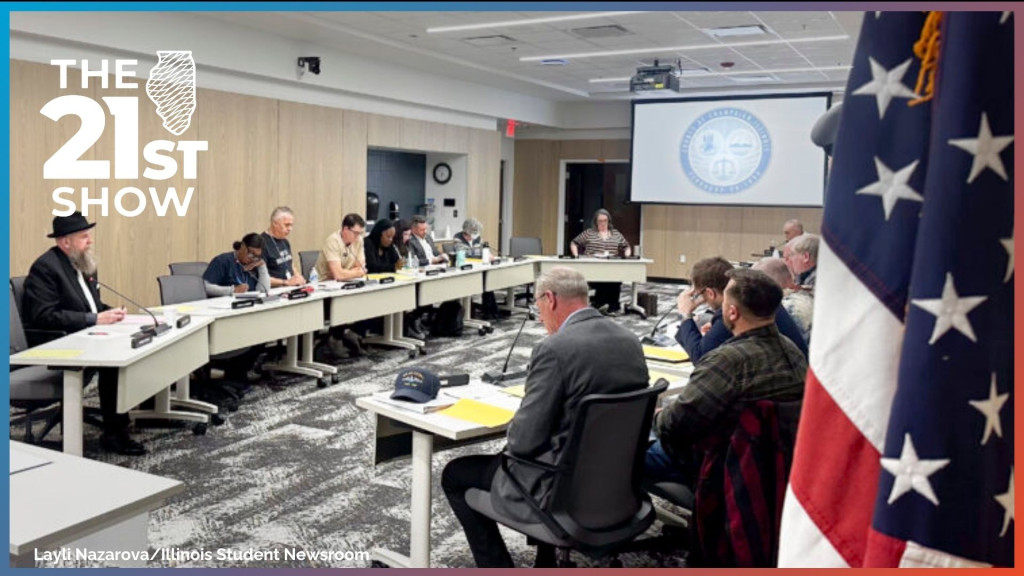
Dilpreet Raju: Yeah, I'll give you as brief of an overview as I can. Yeah, so basically, there was a data center proposal that was being run through in Sangamon County, and the Sangamon County Board was considering over the past few months whether to approve the zoning for this project, the conditional use that is. And that was approved on April 7th, following two weeks of the project being tabled, which happened after a bunch of outcry from residents. However, that last meeting at April 7th kind of also had some strife and issues associated with it. But ultimately county board members voted 17 to 10 to approve the project.

[00:02:18]
Brian Mackey: All right, we'll get back to that meeting in a minute. Bob Okon, let me come to you with the Herald News in Joliet. What, what is the story there? How did it play out?

[00:02:27]
Bob Okon: Well, Joliet approved a 795 acre data center called the Joliet Technology Center, which, first, which has been described as the largest in the state, but I don't think that's correct. There's one in Yorkville, which is more acreage and the same potential gigawatt use, 1.8 gigawatts, which is a lot. And, it's, as I said, larger acreage. So they're about, so, but it's among the largest. It was first put on a plan commission agenda in October, was put on hold because of, you know, the need to look into it more and public outcry, etc. and then got approved in a couple of weeks in March by both the plan commission and the city of Joliet.

[00:03:10]
Brian Mackey: Whenever I hear someone saying 1.8 gigawatts, I can't help but think of the 1.21 gigawatts in Back to the Future. Abigail, let me come to you. Compared with Joliet in Sangamon County, Champaign County is going in a different direction. What's happening here?

[00:03:24]
Abigail Bottar: Yes, and they're using both of those examples as they're moving forward. So they created a data center task force to look at how they are using what the zoning code is for unused land in the county. And at the same time they are looking at putting a moratorium on large scale facilities that will be up for the board, the county board to vote on on Thursday. It was a 12 month moratorium. Now it's a 9 month because some people want it want a full year. Some people are saying 6 months. So the county board will vote on that moratorium, and yeah, they're watching both of these examples, listening to what, you know, the residents in Champaign County have to say and also how people are reacting across the state in areas where these big data centers are being approved and they want to take that and and kind of set some guardrails up before a super large data center comes to Champaign County.

[00:04:17]
Brian Mackey: All right, Dilpreet Raju, let me come back to you. Tell me, I think people hear data centers and they think of like Meta, the Facebook parent company, or maybe OpenAI or something. What is this company Cyrus One? What are they about?

[00:04:29]
Dilpreet Raju: They have been in the data center space for some time. I think this new wave of hyperscaling is something that they are also kind of getting into. Their website currently doesn't list any hyperscale data centers. So this is something that they're starting to do as many other companies like you listed are.

[00:04:51]
Brian Mackey: What is a hypercenter, what does that, what does that mean, a hyper data center?

[00:04:55]
Dilpreet Raju: That means, that means that it's basically just a very large center. I think it's a couple 100 megawatts, but and you know, 1000 megawatts equals 1 gigawatt. So that's why when you're talking about the one up in Joliet, that's considerably bigger than what's being proposed down here. But hyperscalers are essentially these massive complexes, the ones that you'll often see photographs of, that are just these, you know, gigantic warehouse looking things that are, I guess housing a bunch of servers and computer racks that are essentially processing artificial intelligence tasks and things like that. Yeah.

[00:05:35]
Brian Mackey: Bob, what, what about Hillwood? What, what is that company about?

[00:05:39]
Bob Okon: Well, Hillwood is a Ross [Perot], the late Ross [Perot] Company, which, generally develops, warehouses. They're developing the Joliet data center with in a partnership with Powerhouse Data Centers out of McLean, Virginia. They've attempted to build more warehouses in Joliet in the past and, then they've, latched on to this, data center project.

[00:06:03]
Brian Mackey: So, Abigail, let's come back to Champaign County. What, what do they hope to learn from this task force, right? I hear task force and I hear putting off a decision oftentimes, right?

[00:06:13]
Abigail Bottar: Well, I went to their first meeting and I will say I was really impressed with the, like variety of people they had on this task force. They had people concerned about environment, farmers. They had union reps. They had people that are are pro relatively pro data centers on this task force. And really what they started that first meeting with was we need more information. We need to know more about what data centers are. We need people to come in and explain how they use electricity, what kind of power they need, how much water they use. Could we support that? And what are the pros and cons. So they, they've [had] two meetings so far and both have been really just setting ground rules. Last meeting they had someone come in and talk about the environmental impact. So they are learning about what that would actually look like in Champaign County and then they'll be tasked with setting new zoning regulation for this unused land that could potentially be used by data centers in the future.

[00:07:13]
Brian Mackey: All right, let me remind listeners this is The 21st Show. I'm Brian Mackey. We're talking about how different units of local government across Illinois are dealing with requests to put data centers in their areas, notably Sangamon County and the city of Joliet have approved projects where while, at the same time, Champaign County has a moratorium and is studying the matter further. We're talking about this with three reporters from those areas. Abigail Bottar is ag and environmental reporter with our home station, Illinois Public Media in Urbana. Dilpreet Raju, staff writer. Illinois Times in Springfield and Bob Okon is with the Herald News in Joliet. Bob, how did, how did, how did local officials, how did they think about the water and energy demands that this massive data center we've been talking about could impose on, on that area there?

[00:08:05]
Bob Okon: Well, the water, is, according to the, according to the developers and according to Joliet is not really an issue. They, they use a closed loop water system to so described, which, according to the city and the, and Hillwood would use less water than a if it was developed for a residential subdivision and less than if it was developed for warehouses. So with the energy demands they kind of, I, I, I, I. I think the city kind of punts on that one, but, the, they, they kind of leave that up to the energy providers. I mean, [ComEd] is saying that they are developing programs and to separate the, the demand of data center users from the demands of consumers so they're not imposing costs. On, consumers, I don't know how well that works. I think you know we know electricity costs are going up quite a bit, that is being blamed on data centers, but [ComEd] says they've developed a program to separate those two. There is going to be a, substation, built on the site. To supply the data center, but I mean it basically goes on the same grid that we all use, and I think the city of Joliet's view was, well, if not here, it'll be built elsewhere. The grid goes far beyond Joliet, far beyond Illinois. We, will, take the advantage of the jobs and the, taxes that it generates, and, we'll leave it up to the, larger elec electric people to decide whether it can provide the, power that's needed for this project.

[00:09:42]
Brian Mackey: Abigail, I mean, Illinois lawmakers are looking at this electricity issue as well, right? I mean, there was a hearing last week. Can you talk, and there's some legislation that's been proposed.

[00:09:51]
Abigail Bottar: Yeah, there's a big piece of legislation called the Power Act, and I've been kind of researching how the Midwest, Midwest communities and [Illinois] are reacting to data centers, and this seems like the biggest statewide legislation that's been introduced so far. And this kind of, in my mind, solves a lot of the problems that people have concerns about. It would require data centers to pay for their own energy. It would require them to report their water usage, and it would even require them to like create energy sources from renewable energy. And prohibit costs from being shifted to residents. That's a big concern is people are worried and their energy bills are going to go up. They're worried about that and it is happening with or without a moratorium in Champaign County that will happen. So this is something that is in the state house right now. I've been speaking with advocates and they say that there's like a lot more political willpower to support this bill than there might have been a year ago. So yeah, they, they've had some hearings about energy and kind of explaining how does the state even have enough energy to support this many data centers. Wednesday they'll have another hearing which will be about water and water use.

[00:10:56]
Brian Mackey: Fascinating. Dilpreet, let me, let me come back to you because I know that energy and, and some of these other environmental concerns were some things raised by Spring, not just Springfield, but Sangamon County residents, with the consideration of the data center there. How were those heard or not heard? What, what did people have to say about the way the, the board approached this?

[00:11:17]
Dilpreet Raju: Yeah, I think in terms of just energy use and water concerns, there was kind of a lot of what you guys were talking about. There, there was mention of closed loop water systems and how that will not be a concern, and the location was actually, they said it's an advantageous location because no substation will need to be built. There will be a couple, there will be 420 backup generators for the for the site, but no additional electricity besides transmission lines and whatnot to the center itself from a local Ameren project that was actually just upgraded a few years ago. So there there's little concern in terms of the data center being able to get up to power and get up to power quick, which is what I'm hearing that a lot of these data center companies are hoping to get. They want to get connected fast. And yeah, that was a that was an issue that not a lot of people were able to really bring up at the most recent meeting. There was a limitation on the public comment period. They limited it to one hour, which was not the case at the March meeting where the proposal was tabled. That meeting they had public comment fully where everyone who signed up had the opportunity and they ultimately decided to table the proposal, but in April they limited comments to an hour, and there was a motion to extend it actually to an, another 30 minutes to allow more people to sign up. However, that was struck down by board chair Andy Van Meter, and I think that has caused a lot of strife with opponents who felt like they weren't even allowed to be heard by the county board, but I mean this is obviously an ongoing issue and I think this is the first that a lot of Sangamon County residents have heard about it, but you know, I think going forward it'll it'll certainly be an issue that opponents will be looking at.

[00:13:30]
Brian Mackey: Yeah, and I think we're only going to hear more about this. Abigail, just briefly to end here, what, what sort of timeline are you looking at for what's happening in in Champaign County to potentially, you know, move forward or move to a more permanent moratorium?

[00:13:46]
Abigail Bottar: Right? Yeah, so this will come before the full county board on Thursday. They'll vote on this now 9 month moratorium. And during that 9 months, the goal is for this, this task force to kind of come up with the guidelines. I think generally the feeling here is that I haven't heard a lot of people talk about point blank not wanting any data centers. They just want better guidelines to shape how this will impact their community. And so they're hoping that this task force will come up with those guidelines. They'll have the 9 months to do that without anyone hammering on their door with giant data center requests that need to move fast, they'll have the time to breathe and do that. And then 9 months from now they'll have new guidelines, and then we'll see if data centers are still interested in Champaign County and what kind of proposals they'll get.

[00:14:29]
Brian Mackey: All right, Abigail Bottar covers agriculture and the environment for Illinois Public Media. Dilpreet Raju is a staff writer at Illinois Times in Springfield, and Bob Okon is with the Herald News in Joliet. Thank you all for sharing your time and reporting with us here on The 21st Show. Thank you. That is it for us today. Coming up tomorrow on the program, increasingly more young people say they prefer socialism to capitalism, or at least they have a more positive view. More, more young people have a positive view of socialism than capitalism. We've seen a rise in political candidates identifying with the Democratic Socialists of America. We're going to talk with a DSA alderwoman from Chicago about that, two downstate DSA organizers and a historian to put this in broader context. That's all coming up tomorrow on The 21st Show, which is a production of Illinois Public Media. I'm Brian Mackey. Thanks for listening.
Transcript Assistance
Illinois Public Media may use AI assistance for transcript generation and/or formatting. Transcripts that have not yet been reviewed for accuracy will be labeled.
To report a transcription error, or to request transcription of archival material, please contact will-help@illinois.edu.